
Introduction
International private jet travel can make the airport experience faster, quieter, and more personalized. However, flying privately does not allow passengers or crew members to avoid customs, immigration, passport, visa, security, health, or agricultural requirements.
Every international private flight must comply with the entry and exit rules of the countries involved. Flight operators may also need to provide passenger and crew information to border authorities before departure.
The exact process depends on the route, airport, nationality of each passenger, purpose of travel, aircraft registration, visa rules, goods being carried, and availability of border officers.
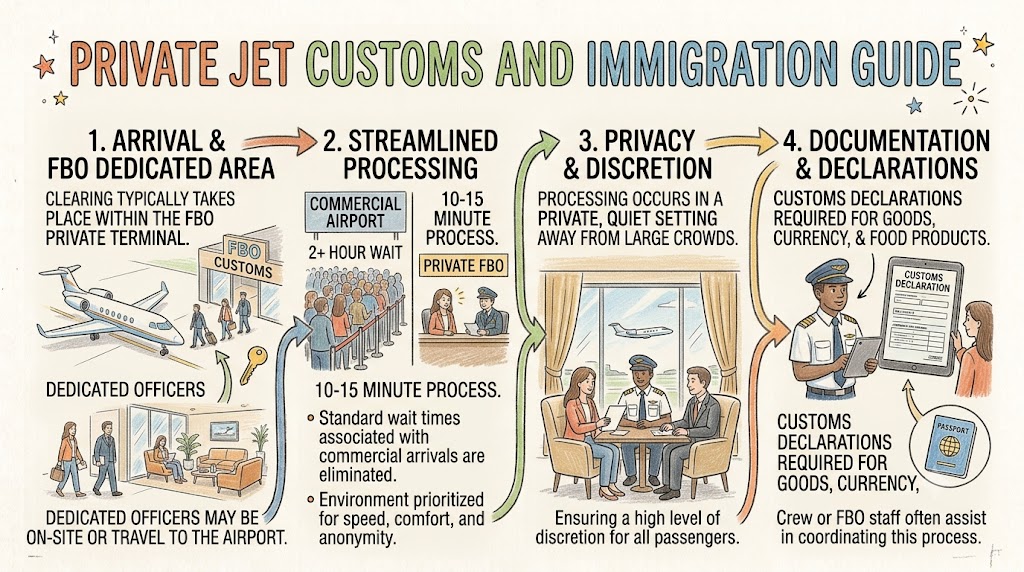
Customs and immigration may take place inside a Fixed-Base Operator, commonly known as an FBO, in a dedicated private aviation facility or at a government inspection area. At smaller airports, clearance may need to be arranged in advance.
International Civil Aviation Organization facilitation standards cover the clearance of aircraft, passengers, crew, baggage and cargo through customs, immigration, public health and agricultural authorities. Individual countries apply these responsibilities through their own laws and procedures.
This guide explains what private jet passengers should expect and how to prepare for a smooth international journey.
Do Private Jet Passengers Go Through Customs and Immigration?
Yes. Private jet passengers and crew members must complete all applicable border procedures when entering or leaving a country.
The experience may be faster and more discreet than clearance inside a commercial terminal, but the legal requirements remain.
Passengers may be required to:
- Present passports
- Show visas or travel authorizations
- Confirm their purpose of travel
- Declare goods
- Declare cash or financial instruments
- Provide health documents
- Present pet certificates
- Complete agricultural declarations
- Answer questions from border officers
- Allow baggage or aircraft inspection
Authorities may inspect passengers, crew, baggage, goods, cargo or the aircraft when permitted under national law.
Difference Between Customs and Immigration
Customs and immigration are related, but they perform different functions.
Immigration
Immigration controls the movement of people across national borders.
Immigration officers may check:
- Passport validity
- Visa status
- Travel authorization
- Nationality
- Entry eligibility
- Length of intended stay
- Purpose of travel
- Previous travel history
- Supporting documents
The officer may approve entry, limit the permitted stay, request additional information or refuse entry under applicable law.
Customs
Customs controls goods entering or leaving a country.
Customs officers may examine:
- Passenger baggage
- Commercial goods
- High-value items
- Currency
- Gifts
- Alcohol and tobacco
- Food and agricultural products
- Medicines
- Weapons
- Aircraft supplies
- Cargo
Passengers must follow the same declaration rules that apply to other international travellers.
Who Coordinates Private Jet Border Clearance?
Private jet customs and immigration involve several parties.
Aircraft Operator
The operator manages the flight and ensures that required operational and passenger information is submitted.
Its responsibilities may include:
- Collecting passport details
- Preparing passenger manifests
- Filing advance passenger information
- Confirming visa requirements
- Selecting a suitable airport
- Coordinating border clearance
- Updating passenger changes
- Retaining required records
Flight Crew
Pilots confirm that required flight documents and passenger information are available.
The crew may also:
- Communicate with the ground handler
- Confirm arrival permission
- Carry general declarations
- Present aircraft documents
- Follow border officer instructions
- Prevent passengers from leaving before clearance
FBO or Ground Handler
The FBO or local ground handler helps coordinate the arrival and departure process.
Services may include:
- Contacting customs and immigration
- Reserving an inspection time
- Providing passenger information
- Arranging a clearance room
- Escorting officers to the aircraft
- Handling documents
- Coordinating baggage inspection
- Organizing onward transportation
Passenger
Every passenger remains responsible for carrying valid and accurate travel documents.
Using a private jet does not transfer personal passport, visa or declaration responsibility entirely to the operator.
Advance Passenger Information
Many governments require private aircraft operators to submit information about the flight, passengers and crew before an international departure or arrival.
This information may be called:
- Advance Passenger Information
- API
- APIS
- Electronic passenger manifest
- General Aviation Report
- General Declaration
- Border notification
- Passenger information submission
The required data may include:
- Full legal name
- Date of birth
- Gender
- Nationality
- Passport number
- Passport expiry date
- Passport-issuing country
- Aircraft registration
- Departure airport
- Destination airport
- Estimated arrival time
- Crew details
ICAO describes advance passenger information systems as tools that allow governments to receive and assess traveller information and, in some systems, communicate a response concerning entry documentation.
Passengers should provide passport information accurately. A spelling error, expired passport number or last-minute unreported passenger can delay clearance.
Selecting an Approved Airport of Entry
Not every airport can process international private flights.
An international arrival may need to use an airport that has:
- Customs facilities
- Immigration officers
- Agricultural inspection
- Public health support
- Approved operating hours
- Suitable aircraft parking
- Advance-arrangement services
- Permission to accept international flights
Some airports provide border clearance throughout the day. Others offer service only during limited hours or by prior appointment.
A smaller airport may be convenient but unable to process an international arrival. In that situation, the private jet may first land at an approved airport of entry, complete clearance and then continue domestically to the final destination.
The operator should verify border availability before confirming the itinerary.
Documents Required from Private Jet Passengers
Document requirements vary, but passengers should generally prepare the following.
Passport
The passport should be:
- Valid
- Undamaged
- Issued in the passenger’s correct legal name
- Acceptable for the destination
- Valid for the required period beyond travel
Some destinations require several months of remaining passport validity.
Visa or Travel Authorization
Depending on nationality and destination, a passenger may need:
- Tourist visa
- Business visa
- Transit visa
- Electronic travel authorization
- Residence permit
- Work authorization
- Diplomatic documentation
A visa exemption for one nationality does not automatically apply to other passengers travelling on the same aircraft.
Supporting Travel Documents
Border officers may request:
- Hotel reservation
- Host address
- Business invitation
- Return travel plan
- Proof of sufficient funds
- Employment information
- Medical appointment confirmation
- Conference registration
- Travel insurance
- Parental consent for children
Health Documents
Where applicable, passengers may require:
- Vaccination certificates
- Medical clearance
- Health declarations
- Prescription documentation
- Public health forms
Health requirements can change, so they should be checked close to departure.
Documents Required for Children
Children require appropriate travel documents even when flying privately.
These may include:
- Individual passport
- Visa
- Birth certificate
- Parental consent letter
- Custody documents
- Adoption documents
- Contact information for guardians
Additional documents may be required when:
- A child travels with one parent
- A child travels without either parent
- The child and parent have different surnames
- A guardian accompanies the child
- There is a custody arrangement
Parents should verify child-travel rules with the relevant authorities before departure.
Documents Required from the Crew and Aircraft
Border authorities may also request aircraft and crew documentation.
Common examples include:
- Aircraft registration certificate
- Airworthiness certificate
- Insurance certificate
- Flight plan
- Crew licences
- Crew passports
- Medical certificates
- General declaration
- Passenger manifest
- Operator certificate where applicable
- Aircraft radio licence
- Landing permission
- Customs forms
The exact requirements depend on the aircraft category, flight type, country and operator.
Private Jet Departure Process
Customs and immigration procedures may begin before passengers reach the airport.
Passenger Information Collection
The charter company or operator collects passport and travel details from every passenger.
Information should be submitted early enough for:
- Border filing
- Security checks
- Visa verification
- Airport approval
- Manifest preparation
Advance Filing
The operator submits the required flight and passenger information through the relevant government system.
Deadlines vary. A late filing may result in:
- Departure delay
- Clearance refusal
- Additional inspection
- Administrative penalties
- Requirement to use another airport
Arrival at the FBO
Passengers arrive at the private terminal and provide original travel documents.
Staff may compare the passports with the previously filed manifest.
Exit Immigration
Some countries conduct formal exit immigration checks. Officers may inspect passports, visas and length of stay before authorizing departure.
Customs Declaration
Passengers may need to declare goods, cash, valuable items or restricted articles being taken out of the country.
Boarding Authorization
Passengers board after the required departure checks and operational approvals are complete.
Private Jet Arrival Process
The arrival procedure usually begins before the aircraft lands.
Pre-Arrival Notification
The operator or handler confirms:
- Estimated arrival time
- Aircraft registration
- Passenger manifest
- Crew manifest
- Departure location
- Required inspection
- Parking position
- Officer availability
Aircraft Parking
After landing, the aircraft normally taxis to a designated private aviation or inspection area.
Passengers must remain onboard or within a controlled area until officers or ground staff authorize movement.
Immigration Inspection
Immigration officers may board the aircraft or process passengers inside the FBO.
Passengers present their passports and other supporting documents.
Officers may ask questions such as:
- Why are you visiting?
- How long will you stay?
- Where will you stay?
- When will you leave?
- Are you travelling for business?
- Who arranged the flight?
Answers should be truthful and consistent with the travel documents.
Customs Inspection
Customs officers may ask passengers to declare goods or open baggage.
They may also inspect:
- Aircraft cabin
- Baggage compartments
- Catering supplies
- Cargo
- Crew items
- Pets
- Food products
Clearance Completion
After customs and immigration approval, passengers may collect their baggage and leave through the private terminal.
Ground transportation can then meet them at the terminal or, where permitted, near the aircraft.
Customs and Immigration Inside an FBO
Many business aviation airports provide a dedicated border-clearance room inside the FBO.
A typical arrangement may include:
- Private waiting area
- Passport-inspection desk
- Baggage examination space
- Restricted access
- Direct ramp connection
- Separate passenger exit
This can reduce queues and improve privacy.
However, the FBO does not replace government authorities. It provides the facility and coordination, while authorized officers make border and customs decisions.
Clearance Directly at the Aircraft
At certain airports, customs and immigration officers may meet the aircraft on the ramp.
The process may involve:
- Aircraft door remaining closed until officers arrive
- Passenger documents being collected
- Individual passport inspection
- Baggage examination
- Aircraft inspection
- Verbal declarations
- Clearance confirmation
Passengers should not walk away from the aircraft until authorized.
United States Private Aircraft Clearance Example
The United States requires international general aviation arrivals to coordinate directly with the responsible Customs and Border Protection port and obtain permission to land. CBP also requires private aircraft travelling to or from a foreign location to submit passenger and crew manifest information through its advance passenger system.
An operator planning a US arrival may need to coordinate:
- Advance electronic manifest
- Permission to land
- Approved airport of entry
- Estimated arrival time
- Inspection location
- Passport and visa details
- Crew information
Local port procedures and operating hours should always be confirmed for the specific airport.
United Kingdom Private Aircraft Clearance Example
Operators and pilots conducting international general aviation flights to or from the United Kingdom may be required to submit a General Aviation Report containing flight, passenger and crew information.
The UK government provides an online reporting service, and current official guidance explains reporting obligations for customs, immigration and policing purposes. The guidance was updated in June 2026, demonstrating why operators should check current requirements before every international journey.
These examples should not be treated as universal rules. Every destination has its own border procedures.
Flights Between Countries with Regional Travel Arrangements
Some groups of countries have regional arrangements that may reduce routine immigration checks on certain routes.
However, passengers should not assume that:
- Immigration procedures are completely removed
- Customs rules are identical
- Private aircraft reporting is unnecessary
- All airports can accept the flight
- Temporary border checks cannot occur
Customs territory, immigration territory and aviation reporting areas may not always be the same.
The operator should verify the specific route with the relevant authorities and handler.
Customs Declarations for Private Jet Passengers
Private jet travellers must follow national declaration rules.
Items that may need to be declared include:
- Large amounts of cash
- Jewellery
- Watches
- Commercial samples
- Business equipment
- Artwork
- Gifts
- Alcohol
- Tobacco
- Food
- Plants
- Medicines
- Weapons
- Goods intended for sale
Declaration thresholds and allowances vary by country.
Failing to declare an item can lead to:
- Confiscation
- Tax or duty assessment
- Financial penalties
- Investigation
- Travel delay
- Prosecution in serious cases
Passengers should ask before travelling when they are uncertain about an item.
Travelling with Large Amounts of Cash
Many countries require travellers to declare cash or equivalent financial instruments above a specified threshold.
The rules may cover:
- Banknotes
- Coins
- Bearer instruments
- Travellers’ cheques
- Negotiable instruments
- Certain prepaid instruments
Private travel does not make cash movements exempt from reporting.
Passengers should check:
- Departure-country requirements
- Arrival-country requirements
- Transit-country requirements
- Required declaration form
- Supporting evidence for the funds
High-Value Personal Items
Passengers carrying expensive watches, jewellery, cameras, computers, professional equipment or artwork may benefit from keeping evidence that the items were legally owned before the journey.
Useful records may include:
- Purchase receipt
- Insurance schedule
- Serial number
- Photograph
- Export declaration
- Temporary admission document
This can help distinguish personal property from newly imported goods.
Business Equipment and Commercial Samples
Executives travelling with business goods should confirm whether the items require temporary import or export documentation.
Examples include:
- Exhibition equipment
- Demonstration products
- Professional cameras
- Technical instruments
- Samples
- Luxury goods
- Musical equipment
- Racing equipment
Carrying goods on a private jet does not automatically classify them as personal baggage.
Food, Plants and Agricultural Products
Many countries restrict the import of food, plants, seeds, soil and animal products to protect agriculture and public health.
Restricted items may include:
- Fresh fruit
- Vegetables
- Meat
- Dairy products
- Seeds
- Flowers
- Plant cuttings
- Soil
- Homemade food
- Animal products
Passengers should declare agricultural goods when required, even when the items were supplied as private jet catering.
The FBO or caterer should understand whether unused international catering must remain onboard, be sealed or be destroyed.
Travelling with Medicines
Passengers carrying medicine should prepare carefully.
Recommended documentation may include:
- Original packaging
- Prescription
- Doctor’s letter
- Generic medicine name
- Medical condition explanation
- Quantity required for the trip
- Import authorization where necessary
A medicine that is legal in one country may be restricted in another.
Controlled drugs, injectable medicines, medical oxygen and large quantities may require advance approval.
Travelling with Pets
International private jet travel with pets can be convenient, but customs, veterinary and agricultural rules still apply.
Documents may include:
- Veterinary health certificate
- Vaccination record
- Rabies certificate
- Microchip record
- Import permit
- Export permit
- Parasite-treatment record
- Pet passport where recognized
- Quarantine approval
Passengers should also confirm:
- Approved arrival airport
- Inspection appointment
- Airline or operator policy
- Crate requirements
- Breed restrictions
- Quarantine rules
Incorrect pet documents can result in quarantine, return transport or refusal of entry.
Firearms and Weapons
Firearms, ammunition and other weapons require specialized legal and operational planning.
Potential requirements include:
- Export licence
- Import permit
- Transit permit
- Police authorization
- Customs declaration
- Operator approval
- Secure storage
- Approved packaging
- Advance airport coordination
Passengers should never arrive with a firearm or restricted weapon without written authorization and confirmed handling arrangements.
Customs Rules for Aircraft Catering
International catering may be subject to customs and agricultural controls.
Unused food from an international flight may need to be:
- Retained onboard
- Placed in sealed waste
- Removed by an approved provider
- Destroyed under controlled procedures
- Declared to authorities
Crew members and passengers should not remove restricted catering items from the aircraft without approval.
Crew Customs and Immigration
Pilots and cabin crew also complete border procedures.
Crew members may need:
- Passport
- Crew identification card
- Visa
- General declaration
- Crew manifest
- Medical documentation
- Work authorization
- Layover information
Crew immigration treatment may differ from passenger treatment, depending on national rules and length of stay.
Technical Stops and Fuel Stops
A private jet making a short international fuel stop may still require border coordination.
Requirements depend on whether:
- Passengers leave the aircraft
- Baggage is unloaded
- Crew members change
- The aircraft arrives from another country
- Goods enter the country
- The stop is treated as transit
- Local authorities require inspection
A technical stop should never be assumed to be free from customs and immigration formalities.
Connecting to Another Private Jet
Passengers transferring between private aircraft may still need to complete entry, transit or departure procedures.
The process depends on:
- Whether the transfer country requires entry clearance
- Whether passengers remain in a controlled zone
- Whether baggage is moved
- Whether aircraft operators are different
- Whether the onward flight is domestic or international
- Whether visas are required
The complete itinerary should be reviewed rather than treating each flight separately.
Repositioning and Empty-Leg Flights
Even when an aircraft has no paying passengers, international crew and aircraft reporting requirements may still apply.
An empty aircraft may still need:
- Crew manifest
- Advance notification
- Landing permission
- Customs coordination
- Aircraft documentation
- General declaration
“Empty leg” does not mean “exempt from border control.”
Private Jet Customs and Immigration Costs
Border-clearance expenses vary by location.
Possible charges include:
- Customs service fee
- Immigration service fee
- After-hours fee
- Officer call-out fee
- Airport-of-entry fee
- FBO handling fee
- Agricultural inspection fee
- Pet inspection fee
- Overtime charge
- Ground transport for officers
- Parking fee during inspection
Charges may be higher when:
- Clearance is requested outside normal hours
- Officers must travel from another airport
- Passengers arrive late
- The flight schedule changes repeatedly
- Special cargo or pets require inspection
The operator should request a detailed quotation before confirming the flight.
How Long Does Clearance Take?
Clearance time depends on:
- Number of passengers
- Passenger nationalities
- Document accuracy
- Visa status
- Airport facilities
- Officer availability
- Baggage quantity
- Goods declarations
- Pets or restricted items
- Security concerns
- Arrival congestion
A straightforward arrival may be processed quickly, but no exact time can be guaranteed.
Passengers should avoid scheduling an important meeting immediately after the expected landing time without allowing for border formalities and ground transport.
Common Reasons for Customs or Immigration Delays
Incorrect Passenger Information
A passport number or name that does not match the traveller can delay processing.
Last-Minute Passenger Changes
Adding or removing a passenger may require a revised manifest and new approval.
Missing Visa
A private aircraft cannot make an otherwise ineligible passenger legally admissible.
Arrival Outside Approved Hours
Border officers may be unavailable or overtime arrangements may not have been completed.
Landing at the Wrong Airport
An airport may accept private aircraft but lack international border facilities.
Undeclared Goods
Unclear or incomplete declarations may lead to baggage or aircraft inspection.
Late Schedule Changes
Changing an arrival time can affect customs appointments and airport slots.
Pet Documentation Problems
Missing veterinary certificates or import permits can create lengthy delays.
What Happens When a Passenger Is Refused Entry?
Border authorities may refuse entry when a passenger does not meet national requirements.
Possible reasons include:
- Invalid passport
- Missing visa
- Incorrect purpose of travel
- Insufficient supporting documents
- Previous immigration violation
- Security concern
- Prohibited goods
- Failure to meet health requirements
The passenger may be required to remain in a controlled area and leave the country on the same aircraft or another approved service.
The operator may face additional costs for:
- Aircraft delay
- Return flight
- Crew duty extension
- Parking
- Handling
- Accommodation
- Repositioning
Document checks before departure reduce this risk but cannot guarantee admission.
Privacy During Border Clearance
Private aviation provides more discretion, but customs and immigration processing is not confidential from government authorities.
Passenger information may be submitted to:
- Border agencies
- Customs departments
- Immigration authorities
- Security agencies
- Law-enforcement bodies
- Public health authorities
Private lounges and separate inspection rooms can reduce public exposure, but they do not remove regulatory reporting.
Private Jet Versus Commercial Border Clearance
| Feature | Private Jet Clearance | Commercial Airport Clearance |
|---|---|---|
| Passenger volume | Usually low | Often high |
| Location | FBO, ramp or private facility | Main terminal |
| Advance coordination | Usually arranged by operator | Managed through airline systems |
| Passenger manifest | Submitted for the specific aircraft | Submitted for scheduled service |
| Waiting time | Often shorter | Can involve queues |
| Privacy | Greater | Limited |
| Customs rules | Fully applicable | Fully applicable |
| Immigration rules | Fully applicable | Fully applicable |
| Baggage inspection | Direct or private | Centralized inspection |
| Airport availability | Must be confirmed | Usually established at international terminals |
| Schedule changes | May require new coordination | Managed through airline schedule |
Private Jet Border-Clearance Checklist
Before Booking
- Confirm that the airport accepts international private flights.
- Check customs and immigration operating hours.
- Verify passport requirements.
- Check visa or travel-authorization rules.
- Confirm pet and agricultural restrictions.
- Ask about border-service charges.
Before Departure
- Submit accurate passport copies.
- Confirm the passenger and crew manifest.
- Declare last-minute changes.
- Carry original documents.
- Prepare supporting travel information.
- Check restricted and declarable items.
- Confirm the FBO address.
- Verify customs appointment time.
On Arrival
- Remain onboard until instructed.
- Keep passports available.
- Answer questions accurately.
- Declare required goods.
- Present pet or medical documents.
- Do not remove baggage before authorization.
- Wait for formal clearance before leaving.
Best Practices for Smooth International Private Travel
A smooth customs and immigration experience depends on preparation.
Passengers and operators should:
- Begin document checks early.
- Use names exactly as printed in passports.
- Confirm rules for every passenger nationality.
- Select an approved airport of entry.
- File passenger information within the required deadline.
- Update schedule changes immediately.
- Declare goods honestly.
- Arrange pets and restricted items in advance.
- Keep digital and printed document copies.
- Maintain direct contact with the ground handler.
- Allow extra time for international formalities.
- Recheck requirements close to departure.
Frequently Asked Questions
Do private jet passengers need passports?
Passengers need passports for most international private flights. The passport must satisfy the destination’s validity and condition requirements.
Do private jets avoid customs?
No. International private flights must follow applicable customs rules. The process may occur privately inside an FBO or beside the aircraft.
Do private jet passengers need visas?
Visa requirements normally depend on nationality, destination, travel purpose and length of stay—not on whether the traveller uses a private aircraft.
Can customs officers search a private jet?
Authorities may inspect the aircraft, cabin, baggage, cargo and supplies when national law permits.
Can passengers leave immediately after landing?
Passengers must wait until border authorities or authorized ground staff confirm that clearance is complete.
Can a private jet land at any airport internationally?
No. The airport must be operationally suitable and authorized or equipped to process the international arrival.
Are private jet passenger details submitted in advance?
Many countries require advance flight, passenger and crew information. The system and submission deadline depend on the country.
Are customs and immigration available 24 hours?
Not at every airport. Some facilities operate limited hours or require an advance appointment and additional fees.
Do children need separate documents?
Children generally need their own valid travel documents. Additional consent or custody documents may also be required.
Can pets clear customs through a private terminal?
Pets may be processed through a private aviation facility when the airport and authorities permit it, but veterinary, import and inspection requirements still apply.
Conclusion
Private jet customs and immigration procedures are designed to combine border compliance with a faster and more discreet passenger experience. Travellers may clear inside an FBO, at a dedicated inspection facility or directly beside the aircraft, but passports, visas, declarations and advance passenger reporting remain essential. Requirements vary by country and can change, making early document verification, accurate passenger information and proper airport selection critical. Well-coordinated operators, handlers and passengers can reduce delays and make international private aviation more predictable and comfortable.
