
Introduction
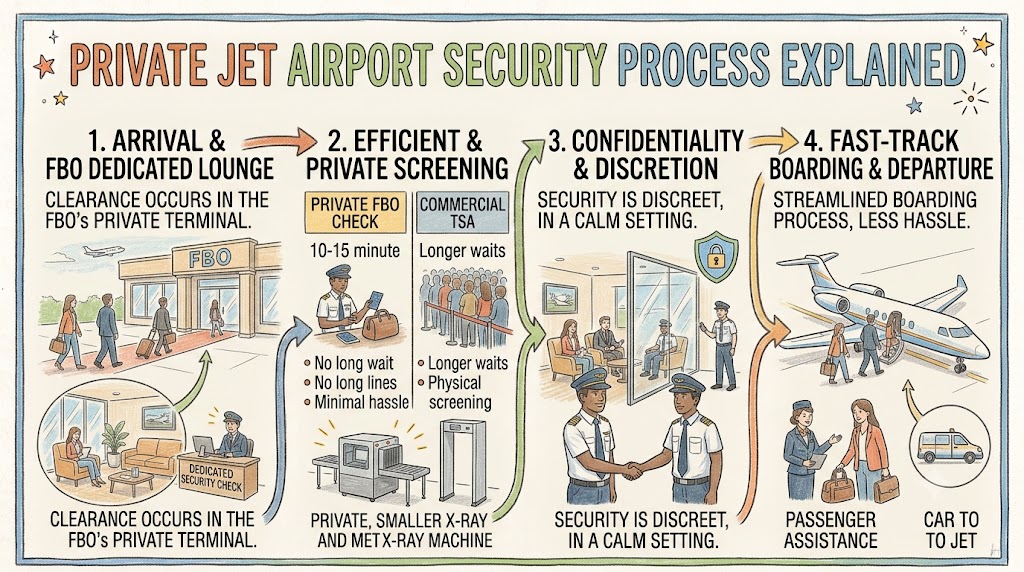
Private jet travel is often associated with shorter waiting times, private terminals, direct aircraft access, and a more personalized airport experience. However, private aviation does not operate without security procedures.
Passengers, baggage, vehicles, crew members, and aircraft may all be subject to identity verification, screening, access controls, and safety checks. The exact process depends on the country, airport, route, aircraft operator, passenger profile, and whether the flight is domestic or international.
At many airports, private jet passengers use a Fixed-Base Operator, commonly known as an FBO, instead of the main commercial terminal. Security may therefore feel faster and more discreet, but important aviation and border-control rules still apply.
This guide explains the private jet airport security process and helps first-time passengers understand what to expect before boarding.
Do Private Jet Passengers Go Through Airport Security?
Yes. Private jet passengers must follow applicable aviation security requirements.
The procedure may not always look like the large security checkpoint used at a commercial airport, but passengers can still be required to complete:
- Identity verification
- Passenger manifest checks
- Baggage screening
- Restricted-item inspections
- Metal detection
- Vehicle-access checks
- Customs and immigration procedures
- Ramp security controls
- Aircraft access authorization
Some airports use dedicated screening equipment inside the private terminal. Others rely on operator-approved procedures, airport security personnel, or checks completed before passengers enter the aircraft parking area.
Private aviation may provide a more efficient process, but it does not remove security obligations.
Why Private Jet Security Feels Different
Commercial airports are designed to process thousands of passengers through standardized security checkpoints.
Private jet terminals usually handle a much smaller number of travellers. This allows staff to provide a more personal and controlled process.
The main differences often include:
- Fewer passengers
- Shorter queues
- Dedicated terminal access
- Pre-submitted passenger information
- Direct communication with the operator
- Private screening areas
- Individual escorts to the aircraft
- Restricted ramp access
- Faster baggage transfer
The reduced waiting time comes from lower passenger volume and advance coordination, not from the absence of security.
Where Does Private Jet Security Take Place?
Private jet security procedures may take place in several locations.
Inside the FBO
Many passengers complete identification and security checks inside a private aviation terminal.
The FBO may have:
- Reception desk
- Private screening room
- Baggage scanner
- Metal detector
- Security personnel
- Restricted ramp entrance
- Customs inspection room
At an Airport Security Facility
At certain airports, passengers may need to visit a separate security facility before reaching the aircraft.
This may be required when the FBO does not have dedicated screening equipment.
At the Aircraft
In some situations, authorized personnel may verify documents or inspect baggage beside the aircraft.
Before Entering the Airport Ramp
Passengers travelling directly to the aircraft by vehicle may be checked at an airport access gate.
The process may include:
- Driver identification
- Vehicle inspection
- Passenger-list confirmation
- Security-pass verification
- Escort arrangement
Who Is Responsible for Private Jet Security?
Private jet security involves several organizations and individuals.
Airport Authority
The airport authority controls access to restricted areas and establishes local security procedures.
It may manage:
- Airport entry gates
- Security personnel
- Ramp access
- Vehicle permissions
- CCTV monitoring
- Security zones
- Emergency response
Aircraft Operator
The private jet operator is responsible for following applicable aviation security requirements.
The operator may:
- Collect passenger details
- Verify identification
- Prepare the passenger manifest
- Review baggage information
- Communicate restricted-item rules
- Coordinate screening
- Protect the aircraft
- Report security concerns
FBO
The FBO may provide the physical facilities and staff needed to support passenger security.
Its responsibilities may include:
- Receiving passengers
- Checking flight details
- Controlling lounge access
- Securing ramp entrances
- Coordinating baggage screening
- Escorting passengers
- Contacting airport security
Flight Crew
The crew confirms that only authorized passengers and items enter the aircraft.
Pilots or cabin crew may:
- Verify passenger identities
- Review the manifest
- Monitor boarding
- Confirm baggage loading
- Inspect the cabin
- Report suspicious activity
- Provide safety instructions
Passenger
Passengers are responsible for:
- Carrying valid identification
- Providing accurate personal information
- Declaring restricted items
- Following staff instructions
- Respecting controlled areas
- Cooperating with screening
- Avoiding prohibited goods
Passenger Information Before the Flight
Security preparation often begins before the passenger arrives at the airport.
The charter company or aircraft operator may request:
- Full legal name
- Date of birth
- Nationality
- Passport or identity-card details
- Contact information
- Departure and destination details
- Baggage information
- Pet information
- Details of special equipment
This information is used to prepare the flight manifest and complete required checks.
Passenger names should match the identification documents exactly. Errors or last-minute changes can delay departure.
Step-by-Step Private Jet Airport Security Process
Confirming the Correct Private Terminal
Before travelling to the airport, passengers should confirm the exact FBO or private terminal.
Large airports may have several private aviation facilities located far from the commercial terminal.
Passengers should check:
- FBO name
- Address
- Entry gate
- Contact number
- Arrival time
- Parking instructions
- Required identification
Arriving at the wrong terminal can create delays and may require additional airport access procedures.
Arrival at the FBO
Passengers usually arrive by:
- Private car
- Taxi
- Chauffeur-driven vehicle
- Hotel transfer
- Rental car
Staff may greet passengers at the entrance and confirm the aircraft registration, operator, destination, or passenger name.
Access to the private lounge is normally limited to authorized travellers, crew members, staff, and approved visitors.
Identity Verification
Passengers must present acceptable identification.
For domestic travel, this may include:
- Government-issued identity card
- Driving licence where accepted
- Passport
- Other approved travel document
For international travel, passengers normally require:
- Passport
- Visa or travel authorization
- Residence permit where applicable
- Supporting border documents
The staff may compare the document with the passenger manifest.
An individual who is not listed or whose details do not match may not be allowed to board until the discrepancy is resolved.
Passenger Manifest Confirmation
A passenger manifest is an official list of people travelling on the aircraft.
It may include:
- Passenger names
- Dates of birth
- Nationalities
- Identification details
- Departure airport
- Destination airport
- Crew information
The operator may be required to submit this information to aviation, security, customs, or immigration authorities.
Last-minute passenger additions should be reported immediately. A person cannot normally board simply because another passenger invited them at the terminal.
Baggage Declaration
Passengers may be asked about the number and type of bags they are carrying.
The operator should be informed in advance about:
- Large suitcases
- Sports equipment
- Musical instruments
- Medical equipment
- Firearms
- Batteries
- Tools
- Valuable cargo
- Unusual liquids
- Pet carriers
Baggage details matter for both security and aircraft weight planning.
Baggage Screening
Private jet baggage may be screened through:
- X-ray equipment
- Manual inspection
- Explosive-detection systems
- Security-dog inspection
- Visual examination
- Operator-approved screening procedures
The level of screening depends on the airport and regulatory environment.
Bags are normally transferred directly from the FBO or vehicle to the aircraft, but this does not mean they are exempt from inspection.
Security personnel may ask a passenger to open a bag when an item cannot be clearly identified.
Passenger Screening
Passenger screening may include:
- Walk-through metal detector
- Handheld metal detector
- Body scanner
- Physical search
- Shoe inspection
- Clothing inspection
- Trace detection
- Identity questioning
At some private terminals, screening is completed in a small dedicated room. The process may take only a few minutes when passenger numbers are low.
Passengers should cooperate fully and ask for clarification when they do not understand an instruction.
Restricted-Item Check
Private aviation passengers must follow rules covering dangerous or restricted items.
Items that may be prohibited or require advance approval include:
- Explosives
- Fireworks
- Flammable liquids
- Compressed gases
- Toxic chemicals
- Certain batteries
- Firearms
- Ammunition
- Sharp tools
- Medical oxygen
- Fuel containers
- Defensive sprays
- Radioactive materials
Rules vary depending on whether an item is carried in the cabin, stored in the baggage compartment, transported as cargo, or declared as dangerous goods.
Passengers should never assume that an item is acceptable simply because the aircraft is private.
Lounge Access Control
After completing initial checks, passengers may wait inside the private lounge.
Access may be controlled through:
- Reception verification
- Electronic doors
- Security passes
- Staff escorts
- CCTV
- Restricted corridors
Guests who are not travelling may be permitted in some areas, but they usually cannot enter the airport ramp without authorization.
Ramp Access Security
The airport ramp is a restricted area where aircraft, fuel trucks, service vehicles, and ground crews operate.
Passengers normally enter only under escort.
Ramp security may include:
- Controlled doors
- Security badges
- Staff escorts
- Vehicle permits
- Passenger-list checks
- CCTV
- Airport security patrols
Passengers should remain with the escort and follow the approved route to the aircraft.
They should not approach other aircraft, enter hangars, walk behind running engines, or leave the designated path.
Aircraft Boarding Verification
Before boarding, the crew or ground staff may confirm:
- Passenger identity
- Passenger count
- Manifest accuracy
- Baggage quantity
- Special items
- Seating requirements
- Security clearance
The aircraft door is controlled by the crew, and only approved passengers, staff, and service providers should enter.
Cabin Security Check
Before departure, the crew may inspect the aircraft cabin.
The check can include:
- Seats
- Storage compartments
- Lavatory
- Galley
- Emergency exits
- Baggage areas
- Cabin doors
- Safety equipment
- Unattended items
Crew members may also confirm that catering, baggage, and supplies came from approved sources.
Safety Briefing
Security and safety are closely connected.
Before takeoff, passengers receive a briefing covering:
- Seat-belt use
- Emergency exits
- Oxygen masks
- Life jackets where applicable
- Smoking restrictions
- Electronic-device rules
- Baggage storage
- Emergency communication
- Cabin movement
Passengers should listen carefully even if they have flown privately before. Aircraft layouts and emergency procedures differ.
Security for Domestic Private Jet Flights
Domestic flights may involve fewer border formalities, but security still applies.
The process may include:
- Identity verification
- Passenger manifest confirmation
- Baggage checks
- Restricted-item controls
- Ramp escort
- Aircraft boarding verification
Requirements vary by country and airport.
A domestic private flight is not automatically exempt from screening.
Security for International Private Jet Flights
International flights involve additional procedures.
Passengers may need to complete:
- Passport checks
- Visa verification
- Customs declarations
- Immigration clearance
- Advance passenger reporting
- Health-document checks
- Agricultural inspection
Customs and immigration may take place:
- Inside the FBO
- In a dedicated inspection room
- Beside the aircraft
- At a government facility
- At another approved airport of entry
International passengers should carry original documents and allow additional time for processing.
Private Jet Security Versus Commercial Airport Security
| Security Feature | Private Jet Terminal | Commercial Airport |
|---|---|---|
| Passenger volume | Low | High |
| Screening location | FBO or private facility | Central public checkpoint |
| Identity check | Personalized | Standardized |
| Waiting time | Usually shorter | Often longer |
| Passenger manifest | Specific to the aircraft | Managed by the airline |
| Baggage handling | Direct to aircraft | Large baggage network |
| Ramp access | Escorted and restricted | Passenger access through gates |
| Privacy | Greater | Limited |
| Customs and immigration | Private or dedicated area where available | Main border-control hall |
| Security rules | Fully applicable | Fully applicable |
Are Liquid Rules the Same on Private Jets?
Liquid restrictions can vary depending on the country, airport, operator, and screening procedure.
Private jet passengers may sometimes face different cabin-liquid arrangements than commercial airline passengers. However, liquids may still be restricted when they are:
- Flammable
- Toxic
- Corrosive
- Pressurized
- Unidentified
- Classified as dangerous goods
Passengers should declare unusual liquids and confirm requirements before arriving.
International customs rules may also apply to alcohol, medicines, food products, and commercial goods.
Firearms and Ammunition
Transporting firearms on a private jet requires careful legal and operational coordination.
Potential requirements include:
- Operator approval
- Firearm licence
- Export permission
- Import permit
- Transit authorization
- Customs declaration
- Police notification
- Secure unloaded storage
- Approved ammunition packaging
A firearm that is legal at the departure point may be prohibited at the destination.
Passengers should never bring a firearm to the airport without written confirmation that all requirements have been completed.
Medical Equipment and Medicines
Passengers carrying medical equipment should inform the operator before the flight.
Items requiring additional review may include:
- Oxygen cylinders
- Portable oxygen concentrators
- Injectable medicines
- Controlled drugs
- Mobility batteries
- Medical cooling equipment
- Large diagnostic devices
Passengers may need:
- Prescription
- Doctor’s letter
- Medical certificate
- Import authorization
- Equipment specifications
Security staff may inspect medical equipment while respecting the passenger’s medical needs.
Lithium Batteries and Electronic Devices
Lithium batteries can create a fire risk if they are damaged, incorrectly packed, or too powerful for normal passenger transport.
Passengers should provide details about:
- Spare batteries
- Power banks
- Camera batteries
- Drone batteries
- Mobility-device batteries
- Professional equipment
- Battery-powered tools
Terminals and operators may apply restrictions based on battery type, capacity, condition, and storage location.
Battery terminals may need to be protected against short circuits.
Travelling with Pets
Pets are subject to both security and animal-entry requirements.
The operator may request:
- Pet type and breed
- Weight
- Carrier dimensions
- Health certificate
- Vaccination record
- Microchip information
- Import permit
Security staff may inspect the pet carrier. Passengers should follow instructions about temporarily removing the animal during screening.
The pet must remain controlled while on the airport ramp.
Vehicle-to-Aircraft Security
Some private terminals allow authorized vehicles to approach the aircraft.
This service may involve:
- Advance vehicle registration
- Driver identification
- Passenger verification
- Security-gate inspection
- Escort vehicle
- Ramp driving permission
- Vehicle search
Not every passenger or driver can enter the airport ramp.
Local airport security rules determine whether direct aircraft access is permitted.
Aircraft Security While Parked
Private jets may remain parked for several hours or days.
Security measures may include:
- Locked cabin doors
- Aircraft seals
- Ramp patrols
- CCTV
- Guard services
- Hangar storage
- Restricted access
- Tamper checks
- Crew inspections
Additional security may be arranged for:
- Government flights
- Public figures
- High-value passengers
- Sensitive business travel
- Valuable cargo
- Remote parking locations
Cybersecurity and Passenger Information
Private aviation security also includes protecting passenger and flight information.
Operators and handlers may store:
- Passport details
- Travel itineraries
- Contact information
- Payment information
- Aircraft schedules
- Passenger preferences
Professional providers should restrict access to sensitive information and use secure communication systems.
Passengers should avoid publicly sharing precise aircraft locations, departure times, or personal travel details when privacy is important.
Security for High-Profile Passengers
Executives, celebrities, government officials, and public figures may require enhanced security planning.
Services may include:
- Private terminal entrance
- Separate lounge
- Secure ground transport
- Close-protection personnel
- Controlled passenger information
- Ramp-side vehicle access
- Aircraft guards
- Coordinated arrival timing
Security teams must still follow airport rules. Personal protection officers cannot enter restricted areas automatically without proper authorization.
Common Private Jet Security Misconceptions
Private Jet Passengers Avoid Security
Private passengers still undergo applicable checks. The process is often less visible and more personalized.
Any Item Can Be Carried on a Private Aircraft
Dangerous-goods, customs, operator, and airport restrictions still apply.
Anyone Can Join at the Last Minute
New passengers may need to be added to the manifest and reported to the appropriate authorities.
Private Vehicles Can Always Drive to the Aircraft
Ramp access depends on airport permission, vehicle approval, and security controls.
Baggage Is Never Screened
Private jet baggage may be screened, inspected, or manually checked.
International Flights Avoid Passport Control
All applicable customs and immigration requirements remain in force.
What Can Cause a Security Delay?
Common causes include:
- Passenger name mismatch
- Missing identification
- Unreported passenger changes
- Undeclared restricted items
- Unclear baggage contents
- Firearm documentation problems
- Medical-equipment questions
- Vehicle-access issues
- International document errors
- Security alerts
- Airport restrictions
- Late passenger information
Providing complete information before the flight reduces the risk of delay.
What Happens When a Prohibited Item Is Found?
The response depends on the item and local regulations.
Possible actions include:
- Removing the item
- Transferring it to approved storage
- Placing it in checked baggage where permitted
- Surrendering the item
- Contacting airport security
- Notifying police or customs
- Delaying the flight
- Refusing passenger boarding
Serious or illegal items may lead to investigation or legal action.
Passengers should declare anything they are unsure about before screening begins.
Private Jet Security Checklist
Before the Flight
- Confirm the FBO address.
- Provide accurate passenger names.
- Submit passport or identity details.
- Declare unusual baggage.
- Confirm firearm or dangerous-goods rules.
- Report medical equipment.
- Provide pet information.
- Review international documentation.
- Confirm ground-transport access.
At the Terminal
- Present valid identification.
- Follow staff instructions.
- Complete baggage screening.
- Declare restricted items.
- Keep children and pets supervised.
- Remain in approved passenger areas.
- Wait for the aircraft escort.
Before Boarding
- Confirm the correct aircraft.
- Allow staff to load baggage.
- Follow ramp safety rules.
- Keep loose items secured.
- Listen to the crew briefing.
- Do not invite unregistered passengers.
- Report suspicious or unattended items.
Tips for a Smooth Security Experience
Passengers can make the process easier by following a few practical steps:
- Send identification details early.
- Use the exact legal name shown on the passport.
- Confirm baggage restrictions before packing.
- Keep medicines in original packaging.
- Carry supporting documents for special equipment.
- Declare firearms and valuable goods in advance.
- Avoid last-minute passenger changes.
- Arrive at the recommended time.
- Follow the escort while on the ramp.
- Cooperate with security and crew members.
Frequently Asked Questions
Do private jet passengers go through metal detectors?
They may. The requirement depends on the airport, operator, route, and local security regulations.
Is private jet baggage scanned?
Baggage may be X-rayed, manually inspected, checked with detection equipment, or screened under another approved procedure.
Do passengers need identification for domestic private flights?
Valid identification is generally required. The accepted document depends on national and operator rules.
Can a passenger bring liquids on a private jet?
Some liquids may be allowed, but dangerous, flammable, toxic, or restricted substances remain prohibited or controlled.
Can firearms be carried on private jets?
They may be transported only when all legal, customs, security, packaging, and operator requirements are satisfied.
Can passengers drive directly to the aircraft?
Some airports permit authorized ramp-side vehicle access. Others require passengers to enter through the FBO.
Are private jet passengers searched?
Passengers may be screened or searched when required by airport security, the operator, or government authorities.
Can a last-minute guest join the flight?
The person must be added to the passenger manifest and may require security or border approval before boarding.
Do children go through private jet security?
Yes. Children must follow applicable identity, screening, and travel-document rules.
Is private jet security faster than commercial airport security?
It is often faster because fewer passengers are processed, but the time depends on the airport, route, documentation, and required checks.
Conclusion
The private jet airport security process is generally faster, quieter, and more personalized than commercial airport screening, but it still includes important safeguards. Passengers may undergo identity verification, baggage screening, restricted-item checks, manifest confirmation, controlled ramp access, and aircraft boarding checks. International flights also require customs and immigration clearance. By providing accurate passenger information, declaring special items, carrying valid documents, and following terminal and crew instructions, travellers can complete the security process smoothly and safely.
