
Introduction
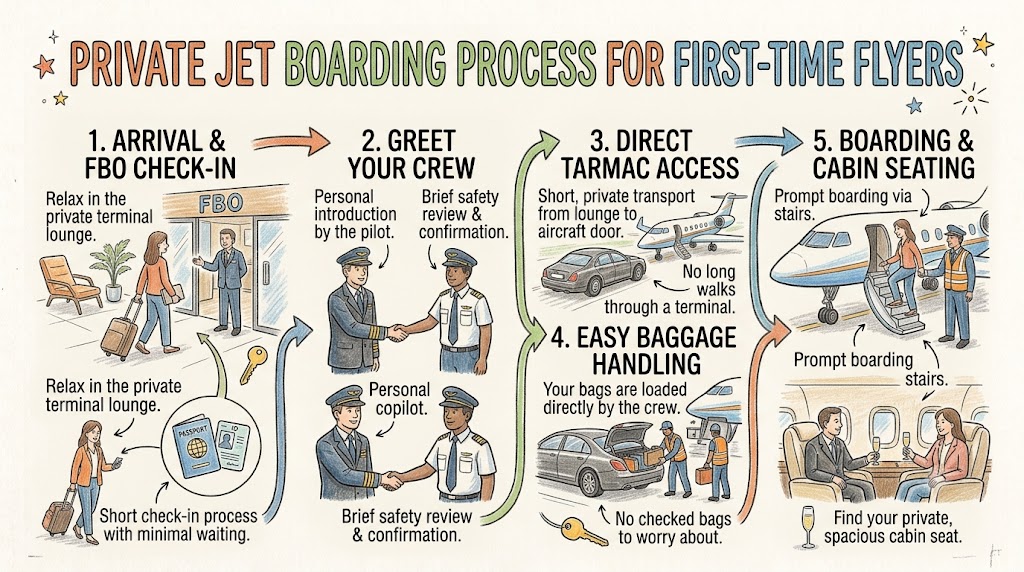
Boarding a private jet is usually faster, quieter, and more personalized than boarding a commercial airline flight. Instead of entering a crowded terminal, standing in long queues, and waiting for a boarding group to be called, private jet passengers normally travel through a dedicated private aviation terminal.
These facilities are often operated by a Fixed-Base Operator, commonly known as an FBO. The FBO supports passengers, crew members, aircraft operators, baggage handling, ground transportation, fueling, and other services required before departure.
For first-time flyers, the process may feel unfamiliar because it is less standardized than commercial travel. Procedures can vary according to the airport, country, aircraft operator, route, security requirements, and whether the flight is domestic or international.
This guide explains each stage of the private jet boarding process so that first-time passengers can arrive prepared and enjoy a smooth travel experience.
What Makes Private Jet Boarding Different?
Private aviation is designed around a specific aircraft and passenger group rather than hundreds of travellers sharing one scheduled flight.
The main differences usually include:
- Shorter arrival times
- Smaller and quieter terminals
- Personalized check-in
- Limited passenger queues
- Direct baggage handling
- Private security procedures
- Individual aircraft escort
- Flexible departure arrangements
- Greater privacy
- Faster boarding
Although the process is more convenient, private jet passengers must still follow identification, security, customs, immigration, baggage, and safety requirements.
Where Do Private Jet Passengers Board?
Private jet passengers usually board through an FBO or dedicated business aviation terminal.
An FBO may provide:
- Passenger reception
- Private lounges
- Aircraft parking
- Crew facilities
- Baggage assistance
- Catering coordination
- Refueling
- Ground transportation
- Customs support
- Flight-handling services
At some airports, private jets operate from a separate building located far from the main commercial terminal. At smaller airports, the FBO may be a simple facility with a reception area and direct access to the aircraft parking ramp.
Passengers should confirm the exact FBO name and address before leaving for the airport. Entering the main commercial terminal by mistake can cause unnecessary delays.
How Early Should First-Time Flyers Arrive?
Private jet passengers do not usually need to arrive two or three hours before departure.
For a domestic private flight, the operator may recommend arriving approximately 15 to 30 minutes before the scheduled departure time.
International flights may require passengers to arrive earlier because of:
- Passport verification
- Visa checks
- Immigration procedures
- Customs declarations
- Security screening
- Health documentation
- Pet travel requirements
The recommended arrival time depends on the airport and flight arrangements. Passengers should follow the instructions provided by the charter company, aircraft operator, or FBO.
Private aviation offers flexibility, but arriving late can still affect airport slots, crew duty limits, and the overall schedule.
Step-by-Step Private Jet Boarding Process
Confirming the Terminal Before Departure
Before travelling to the airport, passengers should confirm:
- FBO or private terminal name
- Complete terminal address
- Departure time
- Recommended arrival time
- Aircraft operator
- Required identification
- Baggage allowance
- Ground transportation details
- Contact number for assistance
Some major airports have several FBOs. Knowing only the airport name may not be enough to locate the correct departure facility.
Arriving at the Private Terminal
Passengers normally arrive by private car, taxi, chauffeur-driven vehicle, hotel transfer, or rental car.
At some airports, vehicles stop directly outside the private terminal entrance. At others, passengers may pass through an airport access gate before reaching the FBO.
Staff members may already have the passenger manifest and flight details. A representative may greet passengers by name and guide them through the next steps.
The arrival environment is usually calm because only a small number of passengers are processed at one time.
Passenger Identification and Document Checks
Passengers must carry valid identification even when flying privately.
For domestic flights, required documents may include:
- Government-issued identity card
- Driving licence where accepted
- Passport where required
- Child identification documents
For international flights, passengers may need:
- Valid passport
- Visa
- Entry permit
- Return or onward travel documents
- Health certificates
- Customs declarations
- Pet travel documents
The passenger’s name should match the details submitted for the flight manifest.
Private aviation does not remove immigration or border-control responsibilities. Passengers are responsible for ensuring their documents are valid for the destination.
Private Jet Check-In
Private jet check-in is normally much faster than commercial airline check-in.
Instead of using a large counter or self-service kiosk, passengers may simply provide identification to an FBO representative or flight coordinator.
Staff may verify:
- Passenger name
- Flight number or aircraft registration
- Destination
- Contact information
- Baggage details
- Special requests
- Travel documents
Printed boarding passes are usually unnecessary, although some operators may provide digital or printed travel information.
Security Screening
Private jet passengers must still follow applicable aviation security rules.
The screening process varies according to the airport, route, country, and operator. It may include:
- Identity verification
- Passenger-list confirmation
- Baggage scanning
- Metal detection
- Restricted-item checks
- Customs inspection
- Vehicle-access control
Security may take place in a dedicated room inside the FBO rather than in a large public checkpoint.
The process is generally faster because fewer passengers are involved, but first-time flyers should never assume that private aviation allows prohibited items.
Waiting in the Private Lounge
After document and security checks, passengers may wait in a private lounge while the aircraft is prepared.
Private jet lounges may provide:
- Comfortable seating
- Wi-Fi
- Workspaces
- Meeting rooms
- Coffee and refreshments
- Television
- Charging points
- Private restrooms
- Shower facilities
- Children’s areas
- Quiet rooms
The waiting period is often brief. If the aircraft is ready and all operational approvals are complete, passengers may proceed directly to boarding.
Smaller regional FBOs may provide only basic seating and refreshments, while major business aviation terminals may offer premium facilities.
Baggage Collection and Loading
Private jet baggage is normally transferred directly to the aircraft rather than entering a large airline baggage system.
FBO or ground-handling staff may:
- Collect bags from the vehicle
- Confirm the number of items
- Weigh baggage if required
- Check for oversized items
- Transport bags to the aircraft
- Load baggage under crew supervision
Baggage allowance depends on the aircraft rather than a standard airline rule.
A light private jet may have limited storage, while a large-cabin aircraft may accommodate several suitcases and larger items.
Passengers should inform the operator in advance about:
- Golf clubs
- Skis
- Musical instruments
- Wheelchairs
- Medical equipment
- Large suitcases
- Fragile items
- Heavy baggage
The crew may decide where baggage must be placed because weight distribution affects aircraft balance and performance.
Boarding Through the Airport Ramp
When the aircraft is ready, an FBO representative or crew member escorts passengers from the lounge to the aircraft.
Boarding may involve:
- A short walk across the ramp
- A private vehicle transfer
- Direct access from the terminal
- A controlled airport bus transfer
The ramp is an active operational area containing aircraft, fuel trucks, baggage vehicles, and other equipment.
Passengers should:
- Follow the escort
- Stay within the approved route
- Keep children close
- Avoid walking near aircraft engines
- Avoid touching ground equipment
- Follow all staff instructions
- Keep loose items secure
Passengers should not approach or photograph other aircraft without permission, especially at private terminals where discretion is important.
Meeting the Flight Crew
Before boarding, passengers may meet the captain, first officer, and cabin attendant.
The crew may welcome passengers and provide information about:
- Expected flight time
- Weather conditions
- Route
- Possible turbulence
- Cabin facilities
- Arrival arrangements
- Safety procedures
Smaller private jets may operate without a cabin attendant. In that situation, the pilots provide the required passenger briefing before departure.
Passengers should share any medical, mobility, or comfort concerns with the crew before the aircraft leaves the ground.
Entering the Aircraft
Private jets generally use built-in stairs or portable boarding steps rather than a large airport jet bridge.
First-time flyers should board carefully because:
- Steps may be narrow
- Cabin doors may be low
- The aircraft may move slightly in windy weather
- Handrails may be smaller
- Cabin entrances can require passengers to bend
Passengers should use the handrail, watch their head, and follow crew guidance.
High heels, loose clothing, and large handbags may make boarding more difficult on smaller aircraft.
Choosing or Confirming a Seat
Some private jet flights allow passengers to select seats freely, while others require specific seating positions.
Seat assignments may depend on:
- Aircraft balance
- Passenger weight
- Emergency-exit access
- Children travelling onboard
- Mobility requirements
- Crew instructions
- Takeoff and landing limitations
Passengers should not change seats during takeoff or landing unless the crew approves the change.
Seats may face forward, sideways, or toward another passenger, depending on the cabin layout.
Storing Personal Items
Small personal items may be placed in approved storage areas.
These may include:
- Side compartments
- Cabin cabinets
- Seat storage
- Overhead compartments
- Dedicated wardrobes
- Baggage areas
Not all private jets have commercial-style overhead bins.
Loose items can become dangerous during turbulence, takeoff, or landing. Passengers should allow the crew to secure larger bags, laptops, coats, and other belongings.
Emergency exits and cabin aisles must remain clear.
The Passenger Safety Briefing
The safety briefing is a required and important part of the boarding process.
The crew may explain:
- Seat-belt operation
- Emergency-exit locations
- Life-jacket location
- Oxygen-mask use
- Fire-extinguisher locations
- Smoking restrictions
- Electronic-device rules
- Seat positioning
- Cabin movement restrictions
- Emergency communication
Even experienced private jet passengers should listen carefully because each aircraft may have a different cabin layout and emergency equipment arrangement.
Passengers should ask questions when any instruction is unclear.
Securing the Cabin Before Departure
Before the aircraft begins moving, the crew checks that:
- Passengers are seated
- Seat belts are fastened
- Bags are secured
- Tables are stored
- Seats are positioned correctly
- Cabin doors are closed
- Emergency exits are clear
- Electronic devices follow operator rules
- Catering items are secured
The aircraft may then begin taxiing toward the runway.
Passengers must remain seated with their seat belts fastened until the crew advises that movement is safe.
Does a Private Jet Leave Immediately After Boarding?
Private jets often depart shortly after passengers board, but immediate departure is not guaranteed.
The flight may still be waiting for:
- Air traffic control clearance
- Airport slot approval
- Final fuel delivery
- Baggage loading
- Catering
- Customs completion
- Weather improvement
- Runway availability
- Aircraft checks
- Flight-plan approval
Private aviation reduces many delays but remains part of the wider airport and air traffic system.
Domestic Private Jet Boarding
Domestic private flights usually involve fewer formalities than international flights.
The process may include:
- Arrival at the FBO
- Identity verification
- Security checks
- Baggage collection
- Lounge waiting
- Direct aircraft escort
- Safety briefing
- Departure
Passengers should still carry appropriate identification and follow all operator requirements.
International Private Jet Boarding
International private jet boarding involves additional border procedures.
Passengers may need to complete:
- Passport control
- Visa verification
- Customs declarations
- Immigration clearance
- Health-document checks
- Agricultural declarations
- General declaration forms
Some FBOs have customs and immigration officers onsite. At smaller airports, officials may need to be scheduled before the flight.
Incorrect passenger information or missing documents can delay or prevent departure.
Boarding with Children
Private aviation can make family travel easier because of shorter queues and quieter terminals.
Parents should confirm:
- Child identification requirements
- Passport and visa rules
- Infant seating arrangements
- Child-restraint requirements
- Stroller storage
- Food preferences
- Cabin temperature needs
- Baggage space
Children must remain supervised on the airport ramp.
Parents should explain the boarding process before arrival so that children understand the need to follow crew instructions.
Boarding with Pets
Many private jet operators permit pets, but approval must be arranged in advance.
Passengers may need:
- Veterinary health certificates
- Vaccination records
- Microchip documentation
- Import permits
- Approved pet carriers
- Customs forms
- Quarantine approvals
Pet rules vary between countries and destinations.
The operator may also specify where the pet can remain during takeoff, landing, and turbulence.
Boarding with Reduced Mobility
Private terminals can often provide personalized assistance for passengers with limited mobility.
Possible services include:
- Wheelchair assistance
- Vehicle-to-aircraft transfer
- Reduced walking distance
- Ramp transport
- Boarding assistance
- Medical-equipment handling
- Ambulance access
However, smaller private jets may have narrow doors and limited cabin space.
Passengers should provide details about mobility equipment and assistance needs before the flight so that a suitable aircraft and boarding plan can be arranged.
Boarding for Medical Flights
Medical or air ambulance flights require specialized coordination.
The boarding process may involve:
- Ambulance access to the aircraft
- Stretcher loading
- Medical team boarding
- Oxygen equipment
- Patient documentation
- Hospital-transfer coordination
- Customs priority where available
- Privacy controls
These flights follow strict medical, safety, and aircraft-loading procedures.
Catering Before Boarding
Private jet catering is normally ordered before the flight and delivered directly to the aircraft.
Passengers may request:
- Light snacks
- Breakfast
- Hot meals
- Vegetarian food
- Vegan meals
- Children’s meals
- Allergy-sensitive options
- Beverages
- Celebration cakes
- Restaurant collections
Catering options depend on the aircraft’s galley facilities and the airport’s available suppliers.
Special requests should be submitted early, particularly when departing from a small or remote airport.
Ground Transportation and Vehicle-to-Aircraft Boarding
At selected airports, passengers may be allowed to travel by vehicle directly to the aircraft.
This service can reduce walking and improve privacy.
Vehicle-to-aircraft access depends on:
- Airport rules
- Security approval
- FBO procedures
- Driver authorization
- Aircraft location
- Passenger requirements
At airports where ramp vehicle access is restricted, passengers must enter the FBO before being escorted to the aircraft.
Clothing Tips for First-Time Flyers
Private jet travel does not usually have a formal dress code unless the journey is connected to a business event or special occasion.
Comfortable clothing is practical because private jet cabins may have:
- Narrow entrances
- Limited standing height
- Compact restrooms
- Smaller aisles
- Temperature changes
Passengers may wish to wear:
- Comfortable shoes
- Layered clothing
- Flexible business wear
- Clothing suitable for the destination climate
Very high heels can make narrow aircraft stairs more difficult to use safely.
Items That May Be Restricted
Private jet passengers should confirm rules for carrying:
- Firearms
- Ammunition
- Sharp objects
- Flammable liquids
- Compressed gases
- Large batteries
- Medical oxygen
- Chemicals
- Sporting equipment
- Alcohol
- Certain medicines
Private flights are still governed by dangerous-goods and airport security regulations.
Items requiring special handling must be declared in advance.
Private Jet Boarding Etiquette
Private aviation is relaxed, but passengers should follow basic etiquette.
Recommended practices include:
- Arrive at the agreed time.
- Carry valid identification.
- Provide accurate passenger details.
- Confirm baggage before departure.
- Respect staff and crew instructions.
- Avoid entering restricted ramp areas.
- Ask before bringing extra passengers.
- Declare pets and special items.
- Listen to the safety briefing.
- Avoid distracting pilots during critical flight stages.
Passengers should also respect the privacy of other travellers and aircraft owners using the terminal.
Common First-Time Flyer Mistakes
Going to the Main Commercial Terminal
Private jets usually depart from a separate FBO. Confirm the correct address before travelling.
Arriving Too Late
Private flights are flexible, but airport slots and crew schedules still matter.
Bringing Too Much Baggage
Smaller jets may have limited baggage space. Send baggage details in advance.
Forgetting Identification
Valid identification is required even when the flight is private.
Ignoring International Entry Rules
Private passengers still need passports, visas, and customs documentation.
Assuming Every Request Is Included
Premium catering, special transport, oversized baggage, and additional services may involve extra charges.
Skipping the Safety Briefing
Private aircraft differ significantly. The safety briefing should always receive full attention.
Private Jet Boarding Checklist
Before Leaving for the Airport
- Confirm the FBO name and address.
- Check the departure time.
- Carry valid identification.
- Confirm passport and visa validity.
- Review baggage allowance.
- Declare special items.
- Confirm pet or child arrangements.
- Save the operator’s contact number.
- Confirm ground transportation.
At the Private Terminal
- Provide identification.
- Complete required security checks.
- Confirm baggage details.
- Inform staff about special requirements.
- Remain available for boarding updates.
Before Takeoff
- Follow the aircraft escort.
- Board carefully.
- Store personal items safely.
- Fasten the seat belt.
- Listen to the safety briefing.
- Follow electronic-device instructions.
- Ask the crew about any concerns.
Private Jet Boarding Versus Commercial Boarding
| Feature | Private Jet Boarding | Commercial Airline Boarding |
|---|---|---|
| Terminal | Private FBO | Main passenger terminal |
| Arrival time | Often 15–30 minutes before departure | Usually 2–3 hours before departure |
| Check-in | Personalized | Standard airline system |
| Security | Dedicated or private | Large public checkpoint |
| Boarding pass | Often unnecessary | Usually required |
| Boarding queue | Rare | Common |
| Aircraft access | Direct escort | Gate or airport bus |
| Baggage | Loaded directly | Processed through baggage system |
| Passenger group | Small | Large |
| Departure flexibility | Greater | Fixed airline schedule |
| Privacy | High | Limited |
Questions First-Time Flyers Should Ask
Before departure, passengers may ask the operator:
- Which FBO should I use?
- How early should I arrive?
- What identification is required?
- What is the baggage allowance?
- Can I bring a pet?
- Is catering included?
- Will a cabin attendant be onboard?
- Can ground transportation meet the aircraft?
- Are there additional terminal fees?
- What international documents are required?
- Can the aircraft accommodate mobility equipment?
- Are there restrictions on liquids or special items?
Clear communication helps prevent confusion and delays.
Tips for a Smooth First Private Jet Flight
A comfortable boarding experience begins with preparation.
First-time flyers should:
- Send accurate passenger names early.
- Verify the FBO location.
- Share baggage dimensions and quantities.
- Inform the operator about children and pets.
- Submit catering requests in advance.
- Carry all required documents.
- Arrive at the recommended time.
- Wear comfortable clothing and footwear.
- Follow ramp safety instructions.
- Listen carefully to the flight crew.
Conclusion
The private jet boarding process is generally faster, quieter, and more personalized than commercial airline boarding. First-time flyers can expect a dedicated terminal, quick document verification, discreet security checks, direct baggage handling, private lounge access, and an individual escort to the aircraft. However, identification, safety, baggage, customs, and immigration rules still apply. By confirming the correct FBO, preparing travel documents, sharing special requirements, and following crew instructions, passengers can enjoy a smooth and confident first private aviation experience.
