
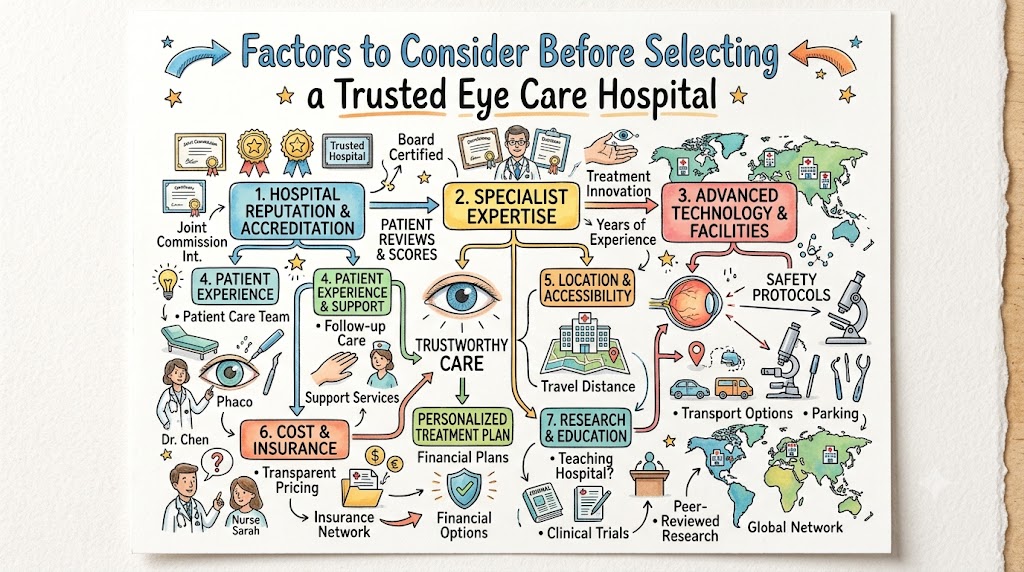
Choosing an eye care hospital is an important decision because the quality of examination, diagnosis, treatment planning, surgery, and follow-up support can influence both patient safety and the overall care experience. A hospital should not be selected only because it is popular, conveniently located, or equipped with recently advertised technology. Patients should compare the qualifications of ophthalmologists, available specialties, diagnostic facilities, safety standards, treatment costs, communication practices, and continuity of care. A structured comparison can help patients identify a hospital that is suitable for their specific eye condition and personal circumstances.
Why Selecting the Right Eye Hospital Matters
Eye conditions can vary significantly in their cause, severity, progression, and treatment requirements. A patient seeking a routine vision examination may need different services from someone requiring cataract surgery, retina treatment, corneal care, glaucoma monitoring, pediatric ophthalmology, or LASIK evaluation.
An ophthalmologist is a physician trained in medical and surgical eye care. Some ophthalmologists also undertake additional training in areas such as the retina, cornea, glaucoma, pediatric ophthalmology, or oculoplastic surgery. Patients requiring advanced treatment should confirm that the hospital has an appropriate specialist for their condition.
Selecting an appropriate hospital may help patients receive:
- A detailed and condition-specific examination
- Access to the correct ophthalmology specialist
- Clear information about available treatment options
- Appropriate diagnostic testing before treatment
- Safer surgical and infection-control processes
- Realistic guidance about benefits, risks, and recovery
- Organized follow-up and emergency support
1. Verify the Qualifications of the Ophthalmologist
The doctor’s qualifications and relevant clinical experience should be among the first factors considered.
Patients should confirm:
- Medical and ophthalmology qualifications
- Professional registration or licensing
- Area of specialization
- Experience managing the relevant eye condition
- Experience performing the proposed procedure
- Participation in continuing medical education
- Availability for postoperative follow-up
- Whether another specialist will be involved in care
A doctor may have extensive experience in cataract surgery but limited involvement in complex retina, corneal, pediatric, or glaucoma cases. Therefore, patients should look for experience related to their specific diagnosis rather than relying only on the doctor’s total number of years in practice.
Questions to Ask About the Doctor
- What is the ophthalmologist’s area of specialization?
- How frequently does the doctor manage this condition?
- Who will perform the examination and procedure?
- Will the same doctor provide follow-up care?
- Who should be contacted if symptoms develop after treatment?
- Is a second opinion appropriate before making a decision?
2. Check Hospital Accreditation and Quality Standards
Accreditation can indicate that a hospital has been evaluated against established standards for patient care, safety, documentation, medication management, infection control, staff training, and facility management.
In India, the National Accreditation Board for Hospitals and Healthcare Providers has a dedicated accreditation programme for standalone eye hospitals and hospitals with ophthalmology departments. Its eye care standards address areas such as access to care, patient assessment, medication management, patient rights, infection control, quality improvement, facility safety, and information management.
International patients may also encounter hospitals referring to international accreditation systems. However, accreditation alone does not guarantee that a hospital is the right choice for every patient or condition. It should be considered alongside specialist expertise, patient communication, infrastructure, treatment planning, and follow-up arrangements.
How to Evaluate Accreditation
Patients should:
- Confirm the accreditation directly through the accrediting organization.
- Check whether the specific hospital location is accredited.
- Verify that the accreditation is current.
- Understand whether it covers the entire hospital or only selected services.
- Avoid assuming that a logo displayed in promotional material proves current accreditation.
3. Confirm the Availability of Relevant Eye Specialties
A trusted eye care hospital should either provide the specialty a patient needs or clearly explain when referral to another centre is necessary.
Common ophthalmology services include:
| Eye Care Area | Conditions or Services Commonly Managed |
|---|---|
| Comprehensive ophthalmology | Routine examinations, common eye diseases and general treatment |
| Cataract services | Cataract evaluation, lens planning, surgery and postoperative care |
| Cornea services | Corneal infections, scars, keratoconus and transplant evaluation |
| Retina services | Diabetic retinopathy, retinal detachment and macular conditions |
| Glaucoma services | Eye-pressure assessment, optic nerve monitoring and treatment |
| Refractive surgery | LASIK and other vision-correction eligibility assessments |
| Pediatric ophthalmology | Childhood eye conditions, squint and developmental vision problems |
| Oculoplastic services | Eyelid, tear-duct and eye-socket conditions |
| Neuro-ophthalmology | Vision problems connected with the nervous system |
A hospital does not need to offer every specialty to provide dependable care. However, it should have the expertise, equipment, and referral network necessary for the services it claims to provide.
4. Review the Diagnostic Facilities
Accurate diagnosis is essential before surgery or long-term treatment. Patients should find out whether the hospital has appropriate diagnostic equipment for their condition and whether results are interpreted by qualified professionals.
Depending on the patient’s needs, testing may include:
- Visual-acuity assessment
- Refraction testing
- Slit-lamp examination
- Dilated retinal examination
- Eye-pressure measurement
- Corneal topography or tomography
- Optical coherence tomography
- Retinal photography
- Visual-field testing
- Ultrasound examination
- Biometry for intraocular lens calculation
- Tear-film or dry-eye assessment
Not every patient needs every test. The ophthalmologist should explain why a test is being recommended and how the result may affect the diagnosis or treatment plan.
Technology Should Support, Not Replace, Clinical Judgment
Modern equipment may improve diagnostic detail and surgical planning, but the presence of advanced technology does not automatically make one hospital better than another. The competence of the medical team, appropriate patient selection, equipment maintenance, accurate interpretation, and quality-control processes are equally important.
5. Examine Infection-Control and Patient-Safety Practices
Infection prevention is particularly important in hospitals that conduct eye injections, laser procedures, cataract operations, corneal surgery, and other invasive treatments.
The World Health Organization describes infection prevention and control as an evidence-based approach intended to protect patients and healthcare workers from avoidable infections. It applies to every healthcare facility and every clinical interaction.
Patients may not be able to inspect every technical process, but they can observe whether the hospital appears organized and follows basic safety practices.
Look for:
- Clean consultation and procedure areas
- Visible hand-hygiene practices
- Proper handling of instruments and disposables
- Documented patient identification
- Verification of the correct eye before a procedure
- Clear consent procedures
- Medication and allergy checks
- Safe biomedical-waste handling
- Staff training in infection prevention
- Written instructions for urgent postoperative symptoms
NABH eye care standards also include documented infection-control programmes, sterilization procedures, biomedical-waste management, staff training, and management support for infection-control activities.
6. Assess the Preoperative Evaluation Process
Surgery should not be planned only on the basis of a brief consultation or a standard package.
A responsible preoperative process may include:
- Confirmation of the diagnosis
- Review of previous eye treatments or surgeries
- Assessment of both eyes
- Review of current medicines and allergies
- Discussion of diabetes, blood pressure, and other medical conditions
- Measurements required for surgical planning
- Explanation of available treatment approaches
- Discussion of expected benefits and limitations
- Review of possible risks and complications
- Written postoperative instructions
- Planning for transportation and recovery support
For procedures such as LASIK, eligibility cannot be determined from age or spectacle power alone. Corneal condition, prescription stability, dry-eye status, pupil characteristics, eye health, occupation, lifestyle, and realistic expectations may all influence suitability.
7. Evaluate Communication and Informed Consent
Patients should receive understandable information before agreeing to a test, injection, laser procedure, or operation.
The hospital team should explain:
- The diagnosis
- The reason treatment is being recommended
- Available alternatives
- What may happen without treatment
- Important risks and limitations
- Expected recovery stages
- Follow-up requirements
- Warning signs requiring urgent attention
- Estimated treatment costs
Patients should not feel pressured to make an immediate decision unless the condition is genuinely urgent.
A trustworthy hospital should allow questions, provide written information when possible, and encourage patients to involve a family member or caregiver when making major treatment decisions.
Warning Signs in Communication
Be cautious when a hospital or representative:
- Promises perfect eyesight
- Describes surgery as completely risk-free
- Guarantees permanent freedom from glasses
- Avoids discussing complications
- Pressures the patient to pay immediately
- Refuses to provide an itemized estimate
- Uses fear to discourage a second opinion
- Recommends surgery without adequate testing
- Gives unclear information about who will perform the procedure
8. Compare Treatment Options Rather Than Packages Alone
Two hospitals may use different names for similar treatment packages. Patients should compare the clinical details rather than focusing only on the package title.
For cataract surgery, comparison points may include:
- Surgeon’s relevant experience
- Surgical technique
- Type and model of intraocular lens
- Diagnostic measurements
- Anaesthesia charges
- Medicines and consumables
- Number of follow-up visits
- Management of existing retinal, corneal, or glaucoma conditions
- Charges if additional treatment becomes necessary
For LASIK or another refractive procedure, patients should compare:
- Eligibility-testing process
- Technology being proposed
- Reason that method is suitable
- Surgeon’s refractive-surgery experience
- Dry-eye evaluation
- Possible alternatives
- Follow-up schedule
- Policy for additional treatment, where medically appropriate
9. Request a Transparent Cost Estimate
The lowest quoted price may not represent the final cost. Patients should request a written estimate that separates the main components of care.
Common Eye Treatment Cost Components
| Cost Component | What Patients Should Clarify |
|---|---|
| Consultation | Whether specialist and follow-up consultations are separate |
| Diagnostic tests | Which tests are included and which are charged additionally |
| Procedure or surgery | Surgeon, facility and equipment charges |
| Implant or consumables | Lens, medicines, disposables or surgical materials |
| Anaesthesia | Whether anaesthetist and monitoring charges are included |
| Medication | Preoperative and postoperative medicines |
| Follow-up care | Number and duration of included visits |
| Additional treatment | Possible charges if another procedure becomes necessary |
| Travel and accommodation | Relevant for patients travelling to another city or country |
Factors Affecting Treatment Costs
Treatment costs may vary according to:
- Type and severity of the condition
- Complexity of the procedure
- Surgeon’s experience
- Hospital location
- Diagnostic tests required
- Technology and surgical method
- Implant or lens selected
- Need for anaesthesia or medical clearance
- Existing health or eye conditions
- Duration of follow-up care
- Insurance coverage
- Need for additional medicines or procedures
For this reason, cataract surgery cost in India, LASIK surgery cost in India, or the cost of any other eye procedure should be treated as an estimated range until a complete examination has been performed.
10. Review Follow-Up and Emergency Support
Successful eye care does not end when the patient leaves the operating room. Follow-up visits allow the doctor to monitor healing, check vision, review eye pressure, adjust medication, and identify possible complications.
Before treatment, ask:
- How many follow-up appointments are expected?
- Are follow-up visits included in the quoted price?
- Who will examine the patient after surgery?
- Is urgent support available outside normal working hours?
- What symptoms require immediate medical attention?
- Can follow-up be arranged closer to home?
- How will records be shared with another ophthalmologist?
This is especially important for patients travelling from another city or country.
11. Consider Location, Accessibility, and Travel Planning
Location should not be the only selection factor, but it can affect convenience, expenses, and continuity of care.
Patients should consider:
- Travel time to the hospital
- Availability of local transportation
- Accessibility for older adults or people with disabilities
- Availability of a family member or caregiver
- Accommodation near the hospital
- Length of stay required after treatment
- Ability to return for follow-up visits
- Restrictions on driving or air travel
- Availability of local emergency eye care after returning home
International patients should also ask about medical reports, visa documentation, language support, payment methods, follow-up coordination, and communication with their local doctor.
12. Review Insurance and Payment Arrangements
Before treatment, patients should verify whether the hospital and proposed procedure are covered under their insurance policy.
Questions may include:
- Is the hospital part of the insurer’s network?
- Is preauthorization required?
- Which tests, implants, or procedures are excluded?
- Is refractive surgery covered?
- What documents are needed for reimbursement?
- Are medicines and follow-up visits covered?
- What portion must the patient pay directly?
Insurance coverage does not necessarily mean that every treatment option or premium implant is included.
13. Seek a Second Opinion for Major Decisions
A second opinion may be useful when:
- The diagnosis is unclear
- Surgery is being recommended urgently without a clear explanation
- Several treatment options are available
- The proposed procedure is complex
- The expected result is uncertain
- Treatment costs differ significantly
- The patient is uncomfortable with the explanation
- A previous treatment has not produced the expected progress
Seeking another opinion does not necessarily mean that the first doctor is incorrect. It can help the patient understand the diagnosis, compare treatment approaches, and make a more informed decision.
Important Questions to Ask an Eye Hospital
Before selecting a hospital, patients can use the following checklist:
- Is the hospital appropriately accredited?
- Is the ophthalmologist qualified in the relevant specialty?
- Who will conduct the examination and perform the procedure?
- What tests are required before treatment?
- Why is the recommended treatment suitable?
- What alternatives are available?
- What are the important risks and limitations?
- What results can realistically be expected?
- What is included in the written cost estimate?
- How many follow-up visits will be required?
- Who should be contacted in an emergency?
- Can I obtain copies of my test results and medical records?
- Is a second opinion advisable?
- What support is available after I return home?
Common Mistakes Patients Should Avoid
Selecting a Hospital Only by Price
A low initial quote may exclude important tests, implants, medicines, follow-up visits, or additional procedures.
Relying Only on Online Reviews
Reviews may describe waiting time, staff behaviour, or convenience, but they cannot confirm clinical suitability or medical quality for an individual patient.
Choosing Technology Without Understanding Its Purpose
Newer technology is not automatically necessary or suitable for every condition.
Ignoring the Doctor’s Subspecialty
A well-known general eye hospital may not have the right specialist for a complex retinal, corneal, glaucoma, or pediatric condition.
Accepting Guaranteed Results
No ethical provider can guarantee perfect vision, permanent correction, painless treatment, or complete freedom from risk.
Skipping a Complete Examination
Treatment decisions made without appropriate diagnostic testing may overlook factors that affect safety, eligibility, or expected results.
Failing to Plan Follow-Up Care
Travelling home immediately without a follow-up plan may make it difficult to manage postoperative concerns.
Not Asking for Written Costs
Verbal estimates can lead to confusion about inclusions, exclusions, and possible additional charges.
Practical Tips for Choosing Eye Care
- Compare at least two suitable hospitals for a major procedure.
- Match the ophthalmologist’s specialty with the eye condition.
- Verify accreditation through the official accrediting body.
- Request an itemized written estimate.
- Keep copies of prescriptions, scans, reports, and consent documents.
- Take a trusted family member to important consultations.
- Ask the doctor to explain medical terms in simple language.
- Do not delay urgent care solely to compare prices.
- Discuss existing medical conditions and medicines honestly.
- Confirm the complete follow-up schedule before travelling.
- Seek a second opinion when the diagnosis or treatment plan remains unclear.
- Base the final decision on safety, expertise, communication, and continuity of care—not advertising alone.
How BestEyeHospitals.com Can Support Hospital Research
BestEyeHospitals.com is an informational resource designed to help patients research and compare eye hospitals, ophthalmologists, procedures, treatment costs, technology, locations, and recovery support.
Patients can use such comparative information to prepare questions and identify possible care options. However, online research should not replace a comprehensive eye examination or personalized medical guidance from a qualified ophthalmologist.
Key Takeaways
- Select a hospital according to the specific eye condition and required specialty.
- Verify the qualifications and relevant experience of the ophthalmologist.
- Consider accreditation as one indicator of structured quality and safety systems.
- Review diagnostic facilities, infection-control practices, and surgical processes.
- Ask for a clear explanation of treatment options, risks, limitations, and alternatives.
- Obtain an itemized estimate rather than comparing headline prices alone.
- Confirm follow-up care and emergency support before treatment.
- Be cautious of guaranteed outcomes, pressure-based selling, and incomplete examinations.
- Seek a second opinion for complex, expensive, or unclear treatment decisions.
- Consult a qualified ophthalmologist for diagnosis and individualized advice.
Frequently Asked Questions
1. What makes an eye care hospital trustworthy?
A trustworthy hospital generally has qualified ophthalmologists, appropriate accreditation, suitable diagnostic facilities, clear safety procedures, transparent communication, written cost estimates, and organized follow-up support. No single feature can confirm quality on its own.
2. Is accreditation compulsory when choosing an eye hospital?
Accreditation is an important quality indicator, but it should not be the only selection factor. Patients should also evaluate specialist expertise, diagnostic services, infection control, communication, treatment planning, and follow-up care.
3. How can I verify an ophthalmologist’s qualifications?
Ask the hospital for the doctor’s medical qualifications, professional registration details, specialty training, and experience with the relevant condition or procedure. Where possible, verify registration through the appropriate medical authority.
4. Should I choose a specialist or a general ophthalmologist?
A general ophthalmologist may be suitable for routine examinations and many common eye conditions. Complex retina, cornea, glaucoma, pediatric, neurological, or surgical cases may require a subspecialist.
5. Is advanced technology always better?
Not necessarily. Technology is useful only when it is suitable for the patient’s condition, operated correctly, maintained properly, and supported by clinical expertise.
6. Why do eye surgery costs vary between hospitals?
Costs may differ because of the surgeon, location, diagnostic tests, procedure complexity, technology, implant type, medicines, anaesthesia, follow-up care, and insurance arrangements.
7. Should I get a second opinion before eye surgery?
A second opinion can be helpful for complex surgery, uncertain diagnoses, significantly different cost estimates, or situations in which the patient does not fully understand or feel comfortable with the proposed plan.
8. Can online reviews identify the best eye hospital?
Online reviews may provide information about patient experiences, but they cannot reliably measure clinical quality or determine whether a hospital is suitable for a particular condition. Reviews should be considered together with verified qualifications, accreditation, facilities, and direct consultation.
9. What should be included in an eye surgery cost estimate?
The estimate should clarify consultation, testing, surgeon charges, facility charges, implant or lens costs, medicines, consumables, anaesthesia, follow-up visits, and possible additional expenses.
10. Can an eye hospital guarantee perfect vision after treatment?
No responsible hospital or ophthalmologist should guarantee perfect eyesight or a completely risk-free result. Outcomes vary according to the condition, examination findings, procedure, healing response, surgeon, technology, and other individual factors.
Conclusion
Selecting a trusted eye care hospital requires more than comparing advertisements, popularity, or treatment prices. Patients should evaluate the ophthalmologist’s relevant expertise, hospital accreditation, diagnostic facilities, safety practices, treatment options, cost transparency, communication, and follow-up support. A careful comparison can help patients ask better questions and make a more informed decision. Treatment suitability, recovery, cost, and results vary between individuals, so every patient should consult a qualified ophthalmologist for a complete examination and personalized medical guidance.
