
Introduction
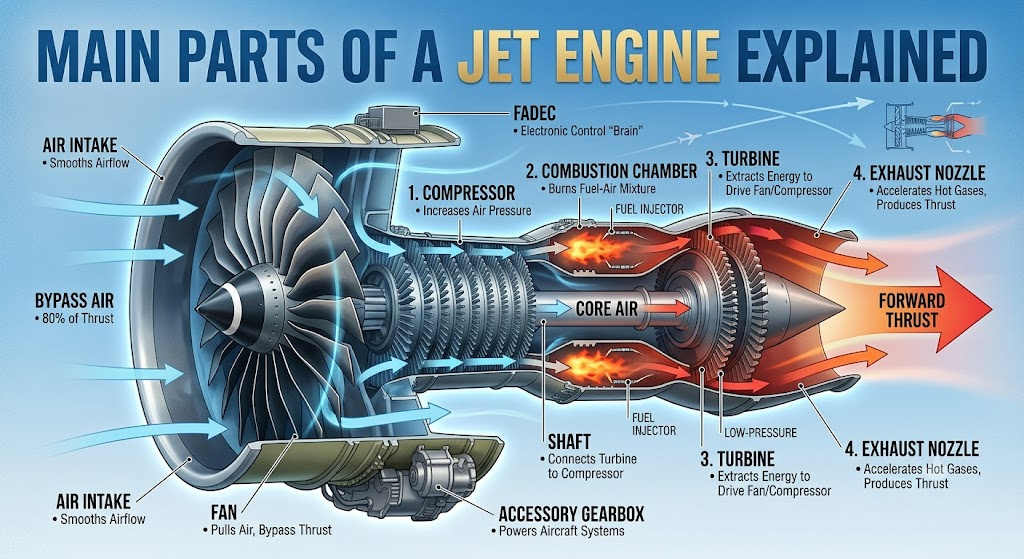
Jet engines are among the most remarkable engineering achievements in aviation. Every commercial airliner, military fighter, and many business jets rely on these powerful machines to generate the thrust needed for flight. While a jet engine may appear as a single cylindrical unit from the outside, it actually consists of numerous interconnected components, each performing a specific role.
Understanding the main parts of a jet engine helps aspiring pilots, aviation students, aircraft engineers, and aviation enthusiasts appreciate how modern aircraft operate safely and efficiently. Every section—from the air intake to the exhaust nozzle—plays a vital role in converting fuel into the immense power required to propel an aircraft through the sky.
In this guide, we’ll explore the main components of a jet engine, explain how they function, discuss how they work together, compare different engine types, and answer some of the most common questions about aircraft propulsion.
What Is a Jet Engine?
A jet engine is a type of gas turbine engine that produces thrust by drawing in air, compressing it, mixing it with fuel, igniting the mixture, and expelling hot gases at high speed through the exhaust nozzle.
Unlike piston engines used in smaller aircraft, jet engines operate continuously. This continuous cycle enables them to produce enormous amounts of thrust while maintaining excellent efficiency at high altitudes and high speeds.
Modern commercial aircraft primarily use turbofan engines because they provide an ideal balance between fuel efficiency, noise reduction, and performance.
Main Parts of a Jet Engine
1. Air Intake
The air intake is the first component encountered by incoming air.
Function
- Directs outside air smoothly into the engine.
- Reduces turbulence.
- Maximizes airflow efficiency.
A well-designed air intake ensures that clean, uninterrupted airflow reaches the fan and compressor, which is essential for stable engine operation.
2. Fan
The fan is the large rotating blade assembly located at the front of most modern turbofan engines.
Function
- Pulls massive amounts of air into the engine.
- Produces a significant portion of the engine’s thrust.
- Improves fuel efficiency.
In many modern airliners, nearly 80% of total thrust comes from bypass air generated by the fan.
3. Compressor
After passing through the fan, air enters the compressor.
Function
- Compresses incoming air.
- Increases air pressure before combustion.
- Improves combustion efficiency.
Compressors consist of multiple rotating and stationary blade stages that progressively squeeze the air to many times atmospheric pressure.
Higher compression results in greater engine performance and fuel efficiency.
4. Combustion Chamber (Combustor)
The combustion chamber is often called the heart of the engine.
Function
- Mixes compressed air with aviation fuel.
- Burns the fuel-air mixture.
- Produces extremely hot, high-pressure gases.
Temperatures inside the combustor may exceed 2,000°C, although advanced cooling techniques protect surrounding engine components.
5. Turbine
The turbine is positioned directly behind the combustion chamber.
Function
- Extracts energy from expanding hot gases.
- Drives the compressor.
- Powers the fan.
- Supplies energy to aircraft accessories.
The turbine blades are made from advanced nickel-based superalloys capable of withstanding extreme temperatures.
6. Exhaust Nozzle
The exhaust nozzle is the final stage of the engine.
Function
- Accelerates hot gases.
- Produces forward thrust.
- Converts pressure into velocity.
According to Newton’s Third Law of Motion, the backward expulsion of gases creates the forward motion that propels the aircraft.
7. Shaft
The shaft connects the turbine to the compressor.
Function
- Transfers rotational energy.
- Synchronizes compressor and turbine operation.
- Maintains continuous engine rotation.
Modern engines often use multiple concentric shafts that rotate independently for greater efficiency.
8. Bearings
Bearings support the rotating shafts.
Function
- Reduce friction.
- Maintain alignment.
- Allow smooth high-speed rotation.
Some engine shafts rotate at over 15,000 RPM, making high-quality bearings essential.
9. Fuel System
The fuel system supplies precisely controlled amounts of fuel to the combustion chamber.
Components
- Fuel pumps
- Fuel filters
- Fuel injectors
- Fuel control unit
Accurate fuel delivery ensures optimal engine performance while minimizing fuel consumption.
10. Accessory Gearbox
The accessory gearbox powers several important aircraft systems.
It drives:
- Hydraulic pumps
- Oil pumps
- Fuel pumps
- Electrical generators
- Air conditioning compressors
Without the accessory gearbox, many aircraft systems would not function.
11. Engine Control System (FADEC)
FADEC stands for Full Authority Digital Engine Control.
It is the electronic “brain” of the engine.
Functions
- Controls fuel flow
- Monitors engine performance
- Prevents engine exceedances
- Optimizes efficiency
- Assists pilots during operation
Modern FADEC systems continuously analyze hundreds of engine parameters every second.
How These Parts Work Together
A jet engine follows a continuous operating cycle:
Step 1
Air enters through the intake.
↓
Step 2
The fan draws in large volumes of air.
↓
Step 3
The compressor increases air pressure.
↓
Step 4
Fuel is injected into the combustion chamber.
↓
Step 5
The fuel-air mixture ignites.
↓
Step 6
Expanding gases spin the turbine.
↓
Step 7
The turbine powers the compressor and fan.
↓
Step 8
Hot gases exit through the exhaust nozzle, generating thrust.
This process repeats continuously while the engine is operating.
Types of Jet Engines
| Engine Type | Common Use | Main Advantage |
|---|---|---|
| Turbojet | Military aircraft | High speed |
| Turbofan | Commercial airlines | Fuel efficient |
| Turboprop | Regional aircraft | Excellent short-distance performance |
| Turboshaft | Helicopters | Efficient rotor power |
Why Each Component Matters
Every component contributes to:
- Safe flight operations
- Maximum fuel efficiency
- Reliable engine performance
- Reduced emissions
- Longer engine lifespan
- Lower maintenance costs
If even one major component fails, engine performance can be significantly affected.
Common Jet Engine Problems
Compressor Stall
Disrupted airflow causes a temporary loss of compression.
Causes
- Sudden throttle changes
- Foreign object ingestion
- Damaged compressor blades
Bird Strike
Birds entering the engine can damage the fan or compressor.
Modern engines undergo rigorous certification tests to withstand certain bird impacts.
Foreign Object Damage (FOD)
Objects such as stones, ice, or runway debris can damage engine blades.
Airports implement strict FOD prevention programs to reduce this risk.
Turbine Blade Wear
High temperatures gradually weaken turbine blades over time.
Routine inspections help detect wear before it becomes a safety concern.
Overheating
Excessive temperatures may result from cooling issues or abnormal operating conditions.
Engine monitoring systems continuously track temperatures to help prevent damage.
Maintenance of Jet Engines
Jet engines require regular inspections to maintain safety and reliability.
Common Maintenance Activities
- Visual inspections
- Borescope inspections
- Oil analysis
- Compressor cleaning
- Blade replacement
- Engine performance testing
- Scheduled overhauls
Aircraft maintenance engineers follow manufacturer-approved maintenance schedules to ensure engines remain airworthy.
Interesting Facts About Jet Engines
- A modern turbofan engine can produce over 100,000 pounds of thrust.
- Fan blades are engineered to withstand bird strikes.
- Turbine blades operate in temperatures hotter than molten lava but remain protected through advanced cooling techniques.
- Modern jet engines are among the most fuel-efficient aircraft propulsion systems ever developed.
- Airlines continuously monitor engine performance using advanced digital diagnostic systems.
Frequently Asked Questions (FAQ)
1. What are the main parts of a jet engine?
The main parts include the air intake, fan, compressor, combustion chamber, turbine, shaft, bearings, accessory gearbox, fuel system, FADEC, and exhaust nozzle.
2. Which part of the jet engine produces thrust?
The exhaust nozzle generates thrust by expelling high-speed gases, while the fan produces a significant portion of thrust in turbofan engines.
3. What is the purpose of the compressor?
The compressor increases air pressure before combustion, improving engine efficiency and power.
4. What happens inside the combustion chamber?
Compressed air mixes with fuel and burns to create high-temperature, high-pressure gases.
5. Why is the turbine important?
The turbine extracts energy from hot gases to drive the compressor, fan, and accessory systems.
6. What is FADEC?
FADEC is a computerized engine control system that automatically manages engine performance and fuel flow.
7. How often are jet engines serviced?
Jet engines undergo routine inspections after specific flight hours or cycles, with major overhauls scheduled according to manufacturer recommendations.
8. How long does a jet engine last?
With proper maintenance, commercial jet engines can remain in service for several decades before retirement or replacement.
Key Takeaways
- A jet engine consists of several interconnected components working as one system.
- The compressor, combustor, turbine, and exhaust nozzle form the engine’s core.
- Modern turbofan engines prioritize fuel efficiency and lower noise.
- Digital control systems such as FADEC improve safety and performance.
- Regular maintenance ensures reliability and extends engine life.
Featured Snippet
The main parts of a jet engine include the air intake, fan, compressor, combustion chamber, turbine, shaft, bearings, fuel system, accessory gearbox, FADEC, and exhaust nozzle. Together, these components compress air, burn fuel, extract energy, and generate the thrust needed to power modern aircraft safely and efficiently.
Conclusion
Jet engines are marvels of modern engineering, combining advanced aerodynamics, thermodynamics, and materials science to power aircraft across the globe. Each component—from the air intake to the exhaust nozzle—has a distinct role in ensuring reliable and efficient flight.
Whether you’re beginning your aviation journey, preparing for pilot training, or simply fascinated by aircraft technology, understanding the main parts of a jet engine provides valuable insight into how modern aviation works. As aircraft technology continues to evolve, jet engines will remain at the forefront of innovation, delivering greater efficiency, sustainability, and performance.
Explore more aviation guides, pilot resources, and educational content on JETEXE.COM to deepen your understanding of the world of flight.
