
Introduction
Jet engines are one of the most important inventions in aviation. They allow aircraft to fly faster, higher, and farther than traditional piston engines. From commercial airliners and business jets to cargo aircraft and military planes, jet engines power much of modern aviation.
For new aviation students, understanding how jet engines create thrust is a key part of learning aircraft propulsion. Thrust is the force that moves an aircraft forward. Without thrust, an aircraft cannot overcome drag, gain speed, or maintain flight.
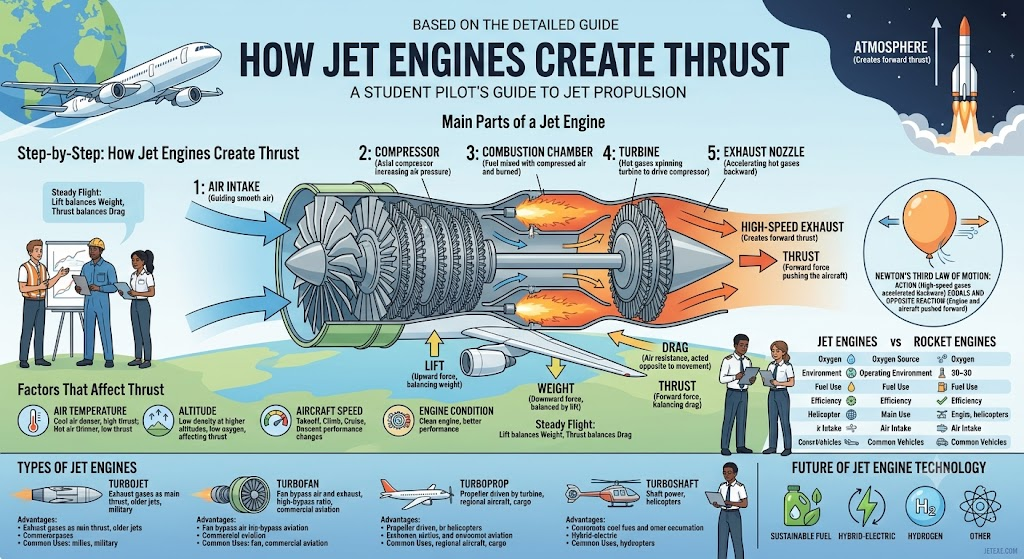
A jet engine may look complex from the outside, but its basic working principle is simple: it takes in air, compresses it, mixes it with fuel, burns the mixture, and pushes hot gases out at high speed. This high-speed exhaust produces forward motion.
In this guide, JETEXE.COM explains how jet engines create thrust in a clear, beginner-friendly way.
What Is Thrust?
Thrust is the forward force that moves an aircraft through the air. In simple words, thrust pushes the aircraft forward.
An aircraft needs thrust to overcome drag. Drag is the resistance created when the aircraft moves through the air. If thrust is greater than drag, the aircraft accelerates. If thrust equals drag, the aircraft flies at a steady speed. If thrust is less than drag, the aircraft slows down.
Thrust is not the same as lift. Lift helps the aircraft rise and stay in the air, while thrust moves the aircraft forward.
A simple example is a balloon. When you release an inflated balloon, air rushes out in one direction and the balloon moves in the opposite direction. A jet engine works on a similar principle, but in a much more controlled and powerful way.
The Basic Principle Behind Jet Engine Thrust
Jet engines create thrust using Newton’s Third Law of Motion:
For every action, there is an equal and opposite reaction.
Inside a jet engine, air and hot gases are accelerated backward. As these gases move backward at high speed, the engine and aircraft are pushed forward.
This is the basic idea behind jet propulsion. The engine does not simply “push against the air.” Instead, it increases the speed and energy of the airflow passing through it. The faster the exhaust gases leave the engine, the more thrust the engine can produce.
What Is a Jet Engine?
A jet engine is an aircraft engine that produces thrust by accelerating air and exhaust gases. It is also called a gas turbine engine.
Jet engines are used because they are powerful, reliable, and suitable for high-speed flight. Compared with older piston engines, jet engines can produce more power at higher altitudes and higher speeds.
Jet engines are commonly found in:
- Commercial aircraft
- Business jets
- Military jets
- Cargo aircraft
- Some helicopters
- Special mission aircraft
The main purpose of a jet engine is to convert fuel energy into forward motion.
Main Parts of a Jet Engine
Air Intake
The air intake is the front opening of the engine. Its job is to guide outside air smoothly into the engine.
Smooth airflow is very important. If air enters the engine unevenly, it can reduce performance and cause operating problems.
The intake must work efficiently during takeoff, climb, cruise, and different flight speeds.
Compressor
The compressor increases the pressure of incoming air. It squeezes the air into a smaller space, making it denser and more suitable for combustion.
Compressed air is important because fuel burns more efficiently when mixed with high-pressure air.
There are two common compressor types:
- Axial compressor
- Centrifugal compressor
Large modern jet engines usually use axial compressors, where air flows through multiple rotating and stationary blade stages.
Combustion Chamber
The combustion chamber is where fuel is mixed with compressed air and burned.
Jet fuel is sprayed into the chamber through fuel nozzles. The fuel mixes with compressed air and ignites. Unlike a car engine, combustion in a jet engine is continuous.
This burning process creates very hot, high-energy gases.
Turbine
The turbine sits behind the combustion chamber. Hot gases flow through the turbine blades, causing them to spin.
The turbine is connected to the compressor by a shaft. As the turbine spins, it powers the compressor at the front of the engine.
This is one of the most important parts of the engine because it keeps the engine cycle running.
Exhaust Nozzle
The exhaust nozzle is at the rear of the engine. Its job is to accelerate the remaining hot gases and direct them backward.
As gases leave the nozzle at high speed, they create forward thrust.
The nozzle shape helps control gas speed, pressure, and direction.
Step-by-Step: How Jet Engines Create Thrust
Step 1: Air Enters the Engine
Air enters through the intake at the front of the engine. The intake guides the airflow smoothly toward the compressor.
Step 2: The Compressor Increases Air Pressure
The compressor squeezes the incoming air. As pressure rises, the air becomes hotter and denser.
Step 3: Fuel Mixes with Compressed Air
Fuel is sprayed into the combustion chamber. It mixes with the compressed air to create a burnable air-fuel mixture.
Step 4: Combustion Produces Hot Gases
The air-fuel mixture burns continuously. This creates hot, fast-moving gases with high energy.
Step 5: Hot Gases Spin the Turbine
The hot gases pass through turbine blades. The turbine extracts some energy from the gases to drive the compressor.
Step 6: Gases Accelerate Through the Nozzle
After passing the turbine, the remaining gases move through the exhaust nozzle. The nozzle speeds them up and directs them backward.
Step 7: High-Speed Exhaust Creates Forward Thrust
As exhaust gases rush backward, the aircraft moves forward. This is jet thrust.
The Four Forces of Flight
Every aircraft in flight is affected by four main forces:
Lift
Lift is the upward force created mainly by the wings. It helps the aircraft rise and stay airborne.
Weight
Weight is the downward force caused by gravity. It pulls the aircraft toward the Earth.
Drag
Drag is air resistance. It acts opposite to the direction of movement.
Thrust
Thrust is the forward force produced by the engine.
For steady flight, lift balances weight and thrust balances drag. During takeoff, the engine produces high thrust so the aircraft can accelerate and climb.
Types of Jet Engines
Turbojet Engine
A turbojet is one of the earliest types of jet engines. It produces thrust mainly from high-speed exhaust gases.
Advantages
- High speed capability
- Simple jet engine concept
- Good for fast aircraft
Limitations
- High fuel consumption
- More noise
- Less efficient at lower speeds
Turbojets are mostly associated with older military and high-speed aircraft.
Turbofan Engine
A turbofan is the most common jet engine type used in modern commercial aircraft and business jets.
It has a large fan at the front. Some air passes through the engine core, while a large amount bypasses the core and flows around it. This bypass air creates much of the thrust.
Advantages
- Better fuel efficiency
- Lower noise
- Strong thrust
- Suitable for commercial aviation
Modern airliners commonly use high-bypass turbofan engines.
Turboprop Engine
A turboprop uses a turbine engine to drive a propeller. Most thrust comes from the propeller, not from exhaust gases.
Advantages
- Very efficient at lower speeds
- Good for short routes
- Useful for regional aviation
Turboprops are commonly used in regional aircraft, cargo aircraft, and utility aircraft.
Turboshaft Engine
A turboshaft engine is similar to a turboprop, but it is designed to produce shaft power instead of direct thrust.
It is commonly used in helicopters, where the engine powers the rotor system.
Common Uses
- Helicopters
- Auxiliary power units
- Some specialized aircraft
How Fuel Becomes Thrust
Jet engines convert fuel energy into motion through several energy changes.
First, jet fuel contains chemical energy. When fuel burns inside the combustion chamber, this chemical energy becomes heat energy. The hot gases expand and move rapidly.
Some of this energy spins the turbine, which keeps the compressor running. The remaining energy exits through the nozzle as high-speed exhaust.
This exhaust produces kinetic energy, and that kinetic energy creates thrust.
The process can be understood as:
Fuel energy → heat energy → gas expansion → high-speed exhaust → forward thrust
Why Modern Jet Engines Are Efficient
Modern jet engines are far more efficient than earlier designs. Engineers have improved almost every part of the engine.
Important improvements include:
- High-bypass turbofan designs
- Better compressor efficiency
- Advanced turbine materials
- Lightweight fan blades
- Digital engine controls
- Improved combustion systems
- Better aerodynamics
- Noise reduction technology
- More accurate engine monitoring
High-bypass turbofan engines are especially efficient because they move a large amount of air at a lower speed, instead of relying only on very hot, high-speed exhaust.
This improves fuel economy and reduces noise.
Factors That Affect Thrust
Jet engine thrust can change depending on flight conditions.
Air Temperature
Cooler air is denser and helps engines produce more thrust. Hot air is thinner, which can reduce engine performance.
Altitude
At higher altitudes, air density is lower. Engines receive less oxygen, which can affect thrust.
Air Density
Dense air improves engine performance because the engine can take in more air mass.
Aircraft Speed
Air entering the engine changes with aircraft speed. Engine performance varies during takeoff, climb, cruise, and descent.
Engine Condition
A clean, well-maintained engine performs better than an engine with worn parts or airflow restrictions.
Humidity
Moist air can slightly affect engine performance because it changes air density and oxygen content.
Fuel Quality
Proper fuel quality is important for safe and efficient combustion.
Jet Engine Performance During Flight
Takeoff
During takeoff, the engine produces high thrust. The aircraft needs strong acceleration to reach safe flying speed.
Climb
During climb, engines continue producing high power so the aircraft can gain altitude.
Cruise
During cruise, engines operate efficiently to maintain speed and altitude over long distances.
Descent
During descent, engine thrust is usually reduced. The aircraft uses gravity and aerodynamic control to descend safely.
Landing
During landing, thrust is low. After touchdown, some jet aircraft use reverse thrust to help slow down.
Jet Engine Safety Systems
Jet engines are designed with many safety features.
Fire Detection
Sensors can detect abnormal heat or fire in the engine area.
Fire Suppression
Aircraft have systems that can release fire-extinguishing agents if needed.
Bird Strike Resistance
Engines are tested to handle certain bird strike conditions and continue operating safely when possible.
Engine Monitoring
Modern engines use sensors to track temperature, pressure, vibration, fuel flow, and performance.
Digital Diagnostics
Engine control systems help detect problems early and support preventive maintenance.
Redundant Systems
Aircraft are designed with backup systems to improve safety during abnormal situations.
Common Misconceptions About Jet Engines
Jet Engines Work Like Rockets
Jet engines and rockets are different. Jet engines need outside air for oxygen, while rockets carry their own oxidizer and can work in space.
Engines Create Lift Directly
Engines create thrust, not lift. Wings create most of the lift in fixed-wing aircraft.
Bigger Engines Always Produce More Thrust
Size matters, but design, airflow, bypass ratio, temperature, and efficiency also affect thrust.
More Fuel Always Means More Thrust
Fuel must be mixed properly with air. Too much fuel without enough air does not automatically create better thrust.
Jet Engines Simply Blow Air Backward
Jet engines do move air and gases backward, but the process includes compression, combustion, turbine work, and nozzle acceleration.
Jet Engines vs Rocket Engines
| Feature | Jet Engine | Rocket Engine |
|---|---|---|
| Oxygen Source | Uses outside air | Carries its own oxidizer |
| Operating Environment | Atmosphere | Atmosphere and space |
| Fuel Use | Jet fuel | Rocket propellant |
| Efficiency | Efficient in air travel | Designed for extreme acceleration |
| Main Use | Aircraft propulsion | Space launch and missiles |
| Air Intake | Required | Not required |
| Common Vehicles | Airliners, jets | Rockets, spacecraft |
Comparison of Jet Engine Types
| Engine Type | Main Thrust Source | Fuel Efficiency | Speed Range | Noise Level | Common Use |
|---|---|---|---|---|---|
| Turbojet | Exhaust gases | Lower | Very high speed | Higher | Older jets, military aircraft |
| Turbofan | Fan bypass air and exhaust | High | Subsonic to high speed | Lower | Airliners, business jets |
| Turboprop | Propeller | Very high at lower speeds | Low to medium | Moderate | Regional aircraft |
| Turboshaft | Shaft power | Mission dependent | Not direct thrust | Moderate | Helicopters |
Real-World Applications of Jet Engines
Commercial Airlines
Commercial airlines use turbofan engines because they are efficient, reliable, and suitable for carrying passengers over long distances.
Business Jets
Business jets use turbofan engines for speed, comfort, and flexible travel.
Military Aircraft
Military aircraft may use turbojet or turbofan engines depending on mission requirements. Fighter jets need high thrust, speed, and rapid acceleration.
Cargo Aircraft
Cargo aircraft use powerful engines to carry heavy loads across long distances.
Private Aviation
Many private jets use compact turbofan engines that provide strong performance and smooth operation.
Future of Jet Engine Technology
Jet engine technology continues to evolve.
Future developments include:
- Sustainable Aviation Fuel
- Hydrogen-powered engines
- Hybrid-electric propulsion
- Electric aircraft
- Open rotor designs
- Geared turbofan engines
- Smarter engine monitoring
- Lower emissions
- Quieter aircraft engines
The goal is to make aviation cleaner, quieter, safer, and more efficient.
Why Aviation Students Should Understand Thrust
Understanding thrust helps aviation students learn how aircraft move, accelerate, climb, and maintain speed.
It is useful for:
- Pilot training
- Aerospace engineering
- Aircraft maintenance
- Flight safety
- Airline operations
- Aircraft performance study
A student who understands thrust will find it easier to understand takeoff performance, climb rate, fuel burn, engine limitations, and aircraft handling.
Tips for Beginners Learning Jet Engines
- Learn the four forces of flight first.
- Study basic airflow and pressure.
- Understand Newton’s Third Law.
- Look at simple jet engine diagrams.
- Watch engine cutaway animations.
- Compare turbojet and turbofan engines.
- Learn the role of each engine component.
- Visit aviation museums if possible.
- Use flight simulators to understand thrust changes.
- Read beginner aviation guides regularly.
Key Takeaways
- Jet engines create thrust by accelerating air and gases backward.
- Thrust moves the aircraft forward.
- The main parts of a jet engine are the intake, compressor, combustion chamber, turbine, and nozzle.
- Compressed air helps fuel burn efficiently.
- Combustion creates hot, high-energy gases.
- The turbine powers the compressor.
- The exhaust nozzle accelerates gases to produce thrust.
- Turbofan engines are common in modern airliners.
- Jet engines need atmospheric air, while rocket engines do not.
- Future propulsion may include hydrogen, hybrid, and electric technologies.
Frequently Asked Questions
1. What is thrust?
Thrust is the forward force that moves an aircraft through the air. In a jet aircraft, thrust is created when the engine accelerates air and exhaust gases backward. According to Newton’s Third Law, this backward movement creates an equal and opposite forward reaction. Thrust helps the aircraft overcome drag, gain speed, take off, climb, and maintain flight.
2. How does a jet engine create thrust?
A jet engine creates thrust by taking in air, compressing it, mixing it with fuel, burning the mixture, and pushing hot gases out through the exhaust nozzle. These gases leave the engine at high speed. As they move backward, the aircraft is pushed forward. This process is called jet propulsion.
3. Why is compressed air important in a jet engine?
Compressed air is important because fuel burns more effectively when mixed with high-pressure air. The compressor increases the pressure and temperature of incoming air before it reaches the combustion chamber. This helps create strong combustion, which produces the hot gases needed for turbine rotation and thrust generation.
4. What is the role of the turbine?
The turbine extracts energy from hot gases after combustion. As the gases pass through turbine blades, they make the turbine spin. The turbine is connected to the compressor by a shaft, so it powers the compressor and keeps air flowing through the engine. Without the turbine, the engine cycle could not continue.
5. What is the difference between turbojet and turbofan engines?
A turbojet produces most of its thrust from high-speed exhaust gases. A turbofan uses a large front fan, and much of its thrust comes from bypass air flowing around the engine core. Turbofan engines are usually more fuel-efficient and quieter, which is why they are widely used in modern commercial aircraft.
6. Why are turbofan engines quieter?
Turbofan engines are quieter because they move a larger amount of air at a lower speed compared with older turbojet engines. High-bypass turbofans reduce exhaust noise and improve efficiency. Their design makes them suitable for commercial aviation, where fuel economy and noise reduction are important.
7. Can jet engines work in space?
No, normal jet engines cannot work in space because they need atmospheric air. Jet engines use oxygen from the air for combustion. Space has no usable atmospheric oxygen, so rockets carry their own oxidizer. This is why rockets can operate in space, but jet engines cannot.
8. Why do jet engines produce less thrust in hot weather?
Hot air is less dense than cold air. When air is less dense, the engine takes in less oxygen and less air mass. This can reduce combustion efficiency and thrust output. That is why aircraft performance calculations consider temperature, altitude, runway length, and aircraft weight.
9. What fuel do jet engines use?
Most jet engines use aviation turbine fuel, commonly known as jet fuel. Common types include Jet A and Jet A-1. Jet fuel is designed to burn efficiently in turbine engines and perform safely under aviation conditions. Future engines may also use sustainable aviation fuel or hydrogen-based systems.
10. Which jet engine is most common in commercial aviation?
The turbofan engine is the most common jet engine in commercial aviation. Modern airliners use turbofan engines because they provide strong thrust, good fuel efficiency, lower noise, and reliable long-distance performance. High-bypass turbofan engines are especially common on passenger aircraft.
Conclusion
Jet engines create thrust through a powerful but understandable process. Air enters the engine, gets compressed, mixes with fuel, burns inside the combustion chamber, spins the turbine, and exits through the nozzle at high speed. This backward flow of gases pushes the aircraft forward.
Every part of the engine has an important role. The intake manages airflow, the compressor increases pressure, the combustion chamber adds energy, the turbine powers the compressor, and the nozzle produces the final high-speed exhaust.
For aviation students, learning how jet engines create thrust builds a strong foundation in aircraft propulsion, flight performance, and modern aviation technology. Whether you are interested in flying, engineering, maintenance, or aircraft design, understanding jet engine thrust is an essential step in your aviation journey.
JETEXE.COM helps new learners explore aircraft, engines, and aviation technology in a simple and practical way.
