
Introduction
Modern jets rely on electronic systems to help pilots navigate, communicate, monitor the aircraft, and manage different stages of flight.
These systems, collectively known as avionics, have transformed the cockpit by bringing large amounts of information onto integrated digital displays.
For beginners, avionics can initially seem complicated because many systems work together at the same time.
This guide explains the main modern jet avionics systems and their role in everyday flight operations.
What Are Aircraft Avionics?
The word avionics combines aviation and electronics. It refers broadly to the electronic systems used in aircraft for functions such as communication, navigation, flight guidance, monitoring, and information management.
Older aircraft relied heavily on mechanical instruments and individual analog gauges. Modern jets increasingly use digital computers, sensors, displays, and integrated systems to provide pilots with information and control functions.
Avionics are not limited to one device. They form a collection of systems that communicate with one another and provide the flight crew with information needed to operate the aircraft.
The exact avionics configuration depends on the aircraft’s design, generation, operator, and certification requirements. Therefore, two modern jets can have different equipment while performing many similar functions.
Why Modern Jet Avionics Matter
Flying a modern jet involves monitoring a large amount of information. Pilots need to know the aircraft’s attitude, altitude, airspeed, position, route, engine condition, fuel status, weather conditions, and other operational details.
Avionics help organize this information so that pilots can understand the aircraft’s condition and make appropriate decisions.
For example, navigation information can be combined with the planned route and displayed in a way that helps the crew understand where the aircraft is going. Similarly, engine and aircraft system information can be presented electronically rather than requiring pilots to monitor numerous independent gauges.
The objective is not simply to automate flying. Modern avionics are designed to provide information, guidance, alerts, and control capabilities while keeping the flight crew involved in monitoring and decision-making.
The Modern Glass Cockpit
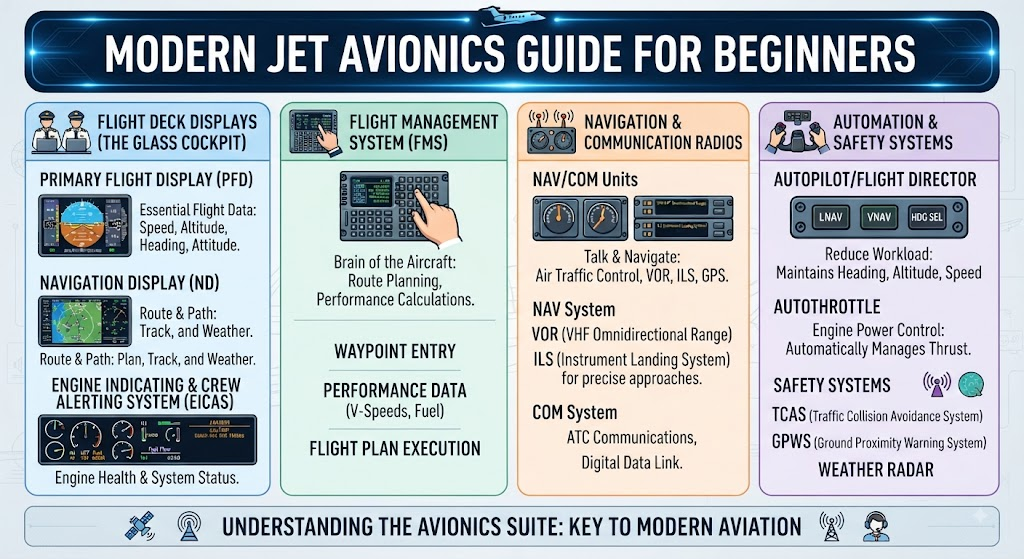
A glass cockpit is a cockpit that uses electronic displays instead of relying primarily on traditional analog instruments.
Rather than having a large collection of individual gauges, pilots can receive important flight information through integrated displays.
Primary Flight Display
The Primary Flight Display (PFD) presents important flight information such as attitude, airspeed, altitude, and other relevant parameters.
It gives pilots a central view of the aircraft’s current flight condition.
Navigation Display
The Navigation Display (ND) can present information related to the aircraft’s route, navigation, nearby points, and other flight information depending on the aircraft’s system configuration.
Electronic Flight Instrument System
The Electronic Flight Instrument System (EFIS) refers to an electronic flight-instrument arrangement that uses displays to present information that was traditionally provided by mechanical or electromechanical instruments.
Together, these technologies allow pilots to view important information in a more integrated format.
Flight Management System
The Flight Management System (FMS) is one of the key computer-based systems found on many modern aircraft.
In simple terms, it helps manage information related to the aircraft’s flight plan and performance. Depending on the aircraft, an FMS can support functions such as route management, navigation, performance calculations, and interaction with flight guidance systems.
Before a flight, pilots may enter or verify information associated with the planned route. During flight, the system can help manage navigation information and provide data to other systems.
The exact capabilities and interfaces vary between aircraft, so pilots must be trained on the specific system installed in the aircraft they operate.
Communication Systems
Communication avionics allow pilots to exchange information with air traffic control and other relevant stations.
VHF Communication
Very High Frequency, or VHF, communication is widely used for aviation voice communication, particularly during many phases of flight.
Pilots can use VHF radios to communicate with air traffic control and coordinate with other aviation services.
HF Communication
High Frequency (HF) communication can be used for longer-range communication in situations where appropriate. Its use depends on the aircraft, operating environment, and communication requirements.
Data Link Communication
Modern aircraft can also use digital data communication systems for certain types of information exchange. These systems can reduce the need to communicate every message through voice radio.
Together, communication systems provide pilots with different ways to receive instructions and exchange operational information.
Navigation Systems
Navigation avionics help pilots determine the aircraft’s position and manage its intended route.
Modern jets can use several sources of navigation information, depending on the aircraft and operating environment.
GNSS
Global Navigation Satellite System (GNSS) technology, which includes GPS as one of its systems, can provide highly useful position information from satellites.
Inertial Navigation
An Inertial Navigation System (INS) or related inertial reference system uses motion sensors and calculations to estimate aircraft movement and position.
Unlike satellite navigation, inertial systems do not depend directly on receiving signals from navigation satellites.
Radio Navigation
Aircraft can also use ground-based radio navigation systems where applicable. These systems can provide navigation information that may complement other sources.
Modern aircraft can integrate information from different navigation sources to support the flight crew and other onboard systems.
Weather Radar
Airborne weather radar helps pilots identify areas of precipitation ahead of the aircraft.
The information can contribute to weather awareness and help crews make informed decisions about the route.
However, weather radar does not show every possible aviation hazard. For example, not all forms of turbulence or weather-related risk are necessarily represented in the same way on a radar display.
Pilots therefore use weather radar together with forecasts, reports, visual information, and other available sources.
Traffic and Collision Awareness Systems
Modern aircraft can use systems designed to improve awareness of nearby traffic.
One important example is TCAS, or Traffic Collision Avoidance System. Related terminology can also include ACAS, depending on the regulatory and operational context.
These systems can detect or receive information about nearby aircraft and provide traffic information and, when appropriate, guidance intended to help reduce the risk of collision.
The system supports pilots but does not replace proper air traffic procedures, lookout practices where applicable, and professional flight crew decision-making.
Terrain Awareness and Warning Systems
Terrain-related warning systems help crews recognize situations where the aircraft may be approaching terrain in an unsafe manner.
Common terms include:
- Ground Proximity Warning System (GPWS)
- Enhanced Ground Proximity Warning System (EGPWS)
- Terrain Awareness and Warning System (TAWS)
The exact system and capabilities depend on the aircraft.
These systems can provide alerts or warnings when certain conditions suggest a potential terrain hazard, giving the crew additional time to assess the situation and respond.
Autopilot and Flight Guidance
Modern jets often use automated flight guidance systems to help maintain selected flight parameters.
The autopilot can control certain aircraft movements according to selected modes and inputs. The exact capabilities vary between aircraft.
A flight director provides visual guidance cues that show the pilot how to control the aircraft to follow selected commands.
Some aircraft also use autothrottle or autothrust systems to manage engine thrust according to selected targets.
These systems can reduce workload, but they do not remove the need for pilots to monitor the aircraft, understand the active modes, and respond appropriately when conditions change.
Engine and Aircraft Systems Monitoring
Modern jets contain numerous systems that need continuous monitoring. Avionics help collect and display information about these systems.
Depending on the aircraft, pilots may receive information about:
- Engine parameters
- Fuel quantity and usage
- Hydraulic systems
- Electrical systems
- Environmental systems
- Flight-control information
- Warnings and cautions
Instead of requiring pilots to manually interpret a large collection of separate instruments, modern electronic systems can organize information and provide alerts when certain conditions require attention.
This helps the crew maintain awareness of the aircraft’s overall condition.
Integrated Modular Avionics
Integrated Modular Avionics (IMA) is an approach in which multiple aircraft functions can use shared computing resources rather than depending entirely on separate dedicated hardware for every function.
This can make the avionics architecture more integrated and flexible.
At a beginner level, it can be understood as a move toward shared computing infrastructure within the aircraft, where different software-based functions can operate using common resources under carefully controlled certification and safety requirements.
The exact architecture varies between aircraft, so IMA should not be considered a single identical system used on every modern jet.
Major Modern Jet Avionics Systems
The following table summarizes several important avionics systems in simple terms.
| Avionics System | Main Purpose | Simple Beginner Explanation |
|---|---|---|
| Flight Management System | Flight planning and navigation management | Helps manage the aircraft’s route and related flight information |
| Primary Flight Display | Presents primary flight information | Shows important information such as attitude, altitude, and airspeed |
| Navigation Display | Presents navigation information | Helps pilots view route and navigation-related information |
| Communication Systems | Voice and digital communication | Allow pilots to communicate with air traffic control and other stations |
| Weather Radar | Weather awareness | Helps identify areas of precipitation ahead |
| Traffic Awareness Systems | Traffic and collision awareness | Helps pilots identify nearby aircraft and potential collision risks |
| Terrain Warning Systems | Terrain awareness | Provides alerts related to potential terrain hazards |
| Autopilot and Flight Guidance | Automated flight control and guidance | Helps maintain selected flight parameters |
| Aircraft Systems Monitoring | System and engine information | Displays information about aircraft and engine conditions |
Avionics and Pilot Workload
One of the major benefits of modern avionics is the ability to organize large amounts of information.
A well-designed display can allow pilots to understand several aspects of the aircraft without constantly switching between numerous independent instruments.
Automation can also reduce the workload associated with repetitive tasks.
However, automation creates its own responsibilities. Pilots need to understand what the automated system is doing, which modes are active, what information the system is using, and what action may be necessary if the system behaves unexpectedly.
This is why modern pilot training places significant emphasis on automation management and system awareness.
Avionics Reliability and Redundancy
Aircraft avionics are designed with reliability and safety in mind. A modern aircraft may have alternative sources of information or backup capabilities for important functions.
This concept is known as redundancy.
For example, an aircraft may have multiple sources of navigation or multiple systems that can provide important flight information. If one component becomes unavailable, another source may continue to support the required function, depending on the aircraft’s design.
The exact level and type of redundancy vary between aircraft and systems.
How Avionics Work Together During a Flight
Modern avionics are most useful when viewed as an interconnected system rather than a collection of unrelated devices.
Pre-Flight
Before departure, pilots review the aircraft’s condition, route, weather, navigation information, and performance data. The flight management system may be configured with the planned route, while aircraft systems are checked through appropriate displays and procedures.
Takeoff
During takeoff, the flight crew monitors primary flight information, engine parameters, navigation data, and relevant warnings.
Flight guidance systems may provide selected guidance according to the aircraft’s configuration and operating procedures.
Climb
During the climb, navigation systems and the flight management system help manage the route. Communication systems allow the crew to remain in contact with air traffic control.
Cruise
In cruise, pilots monitor navigation, aircraft systems, fuel, weather, traffic, and engine information. Automation can handle certain tasks while the crew continues to monitor the aircraft and surrounding environment.
Descent and Approach
As the aircraft approaches its destination, navigation and flight guidance systems become increasingly important. Pilots also monitor weather, traffic, terrain information, and aircraft configuration.
Landing
During landing, primary flight information, navigation information, flight guidance, aircraft systems monitoring, and communication all contribute to the crew’s situational awareness.
Avionics During Different Phases of Flight
Different avionics functions become especially useful during different parts of a flight.
| Flight Phase | Important Avionics Functions | General Purpose |
| Pre-flight | FMS, displays, aircraft monitoring | Prepare the route and review aircraft information |
| Takeoff | PFD, engine monitoring, flight guidance | Monitor flight parameters and aircraft performance |
| Climb | FMS, navigation, communication | Manage route and communicate with ATC |
| Cruise | Navigation, weather radar, traffic awareness, monitoring | Maintain situational awareness and manage the flight |
| Descent | FMS, navigation, terrain awareness, flight guidance | Prepare and manage the arrival |
| Approach | Navigation, flight guidance, terrain and traffic awareness | Support accurate approach and monitoring |
| Landing | PFD, navigation, communication, system monitoring | Support final flight operations and situational awareness |
What Happens if an Avionics System Fails?
Modern aircraft are designed with procedures and system architecture intended to manage various equipment failures.
If an avionics component becomes unavailable, the flight crew follows the aircraft’s approved procedures. Depending on the failure, another system may provide the required information or function.
Pilots are trained to recognize system failures, understand their effects, and determine the appropriate response.
This is another reason why pilots need to understand both automated systems and basic aircraft operation.
Are Avionics the Same on Every Modern Jet?
No. Modern jets can have very different avionics configurations.
Aircraft manufacturers, operators, aircraft generations, mission requirements, and certification standards all influence the equipment installed.
Two aircraft may both have glass cockpits, flight management systems, weather radar, and autopilot systems while using different interfaces, displays, software, and operating procedures.
Pilots therefore need aircraft-specific training even when they already have experience with modern avionics on another aircraft.
FAQs
1. What exactly are aircraft avionics?
Avionics are the electronic systems used in aircraft for functions such as navigation, communication, flight guidance, monitoring, and information management.
2. What is the difference between avionics and aircraft instruments?
Avionics generally refers to electronic aviation systems, while aircraft instruments are the devices used to present information to pilots. In modern aircraft, many instruments are electronic displays connected to larger avionics systems.
3. What does an FMS do?
A Flight Management System helps manage flight-plan and navigation information and can support functions such as route management and performance calculations, depending on the aircraft.
4. What is a glass cockpit?
A glass cockpit uses electronic displays to present flight information instead of relying primarily on traditional mechanical or analog instruments.
5. Do pilots still manually control modern jets?
Yes. Automation can assist with many aspects of flight, but pilots remain responsible for monitoring the aircraft, managing systems, making decisions, and controlling the aircraft as required.
6. What happens if an avionics system fails?
The response depends on the affected system and aircraft. Pilots follow approved procedures and may use alternative systems or sources of information when available.
7. Are avionics the same on every modern jet?
No. Avionics vary between aircraft types, manufacturers, generations, operators, and missions. Pilots must learn the specific systems installed on the aircraft they operate.
Conclusion
Modern jet avionics bring together navigation, communication, flight guidance, aircraft monitoring, weather awareness, traffic information, terrain awareness, and digital displays to support flight crews.
For beginners, the most important idea is that avionics are not simply a collection of electronic gadgets. They form an interconnected part of the modern cockpit, helping pilots understand the aircraft and its environment while carrying out flight operations.
Technology can automate and organize many tasks, but trained pilots remain essential for monitoring systems, interpreting information, handling unexpected situations, and making sound decisions. Understanding the basic purpose of each avionics system is therefore an important first step toward understanding the modern jet cockpit.
