
Introduction
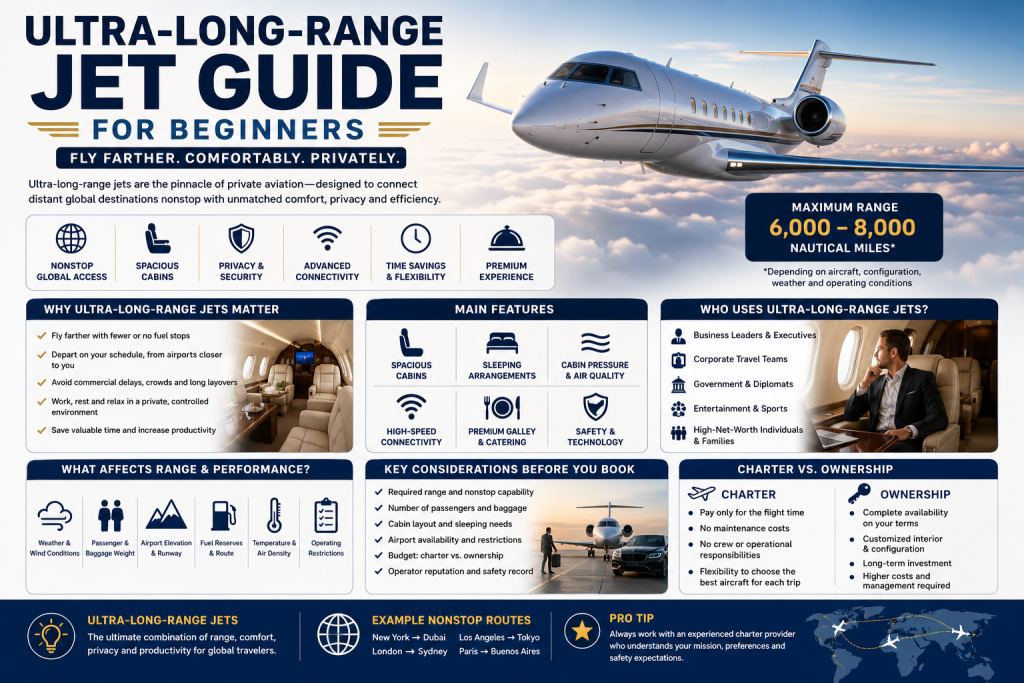
Ultra-long-range jets represent the highest level of private aviation for passengers who need to travel between distant international destinations with fewer stops. These aircraft combine long-distance performance with spacious cabins, advanced technology, privacy, and facilities designed for journeys lasting many hours.
Unlike light and mid-size private jets, ultra-long-range aircraft may include multiple cabin zones for working, dining, relaxing, and sleeping. They are commonly used by global business leaders, corporate travel teams, government representatives, entertainers, professional athletes, high-net-worth families, and other passengers with demanding international schedules.
However, selecting an ultra-long-range jet is not simply about choosing the aircraft with the highest published range. Passenger count, baggage, weather, airport conditions, cabin layout, operating restrictions, and budget can all influence the final decision.
This beginner’s guide explains how ultra-long-range jets work, what features they offer, who uses them, what affects their performance, and how travelers can choose the right aircraft for a long-distance private flight.
What Is an Ultra-Long-Range Jet?
An ultra-long-range jet is a large business aircraft designed to operate very long international routes without requiring frequent fuel stops. Depending on the aircraft, configuration, weather, payload, and operating conditions, some jets in this category have published maximum ranges of approximately 6,000 to 8,000 nautical miles.
That level of performance can make it possible to connect many major global business and leisure destinations nonstop. For example, certain aircraft may be capable of operating routes connecting North America with Asia, Europe with South America, or the Middle East with distant destinations in Asia-Pacific.
Ultra-long-range jets generally offer:
- A large, stand-up cabin
- Multiple seating and living areas
- Long-range fuel capacity
- High cruising speeds
- Advanced flight-deck technology
- Dedicated crew-rest facilities on some aircraft
- Comfortable sleeping arrangements
- Premium catering and galley facilities
- Private lavatories
- High-speed communication and entertainment systems
Aircraft manufacturers calculate published maximum range under defined conditions. The actual distance an aircraft can fly on a particular trip may be lower because of headwinds, passenger weight, baggage, fuel reserves, temperature, airport elevation, and route requirements.
Why Ultra-Long-Range Jets Matter
International travel can involve connections, crowded terminals, rigid airline schedules, long security lines, and unpredictable disruptions. Ultra-long-range private jets are designed to reduce many of these challenges.
Passengers can usually depart through private aviation terminals, select convenient departure times, use airports closer to their actual destinations, and continue working or resting during the journey.
For businesses, this may make it possible for executives and specialist teams to visit multiple destinations within a limited period. For private travelers, these aircraft can provide greater privacy, controlled cabin access, flexible catering, and a more personalized experience.
Their main value is not simply luxury. It is the combination of time savings, nonstop capability, cabin comfort, privacy, and schedule control.
Main Features of Ultra-Long-Range Jets
Spacious Cabins
Ultra-long-range jets have some of the largest cabins in purpose-built business aviation. Instead of providing one continuous seating area, many configurations divide the cabin into separate zones.
Depending on the aircraft, these zones may include:
- A forward seating area
- A conference or dining section
- A private office
- An entertainment lounge
- A bedroom or sleeping area
- A crew-rest compartment
- One or more lavatories
Cabin layouts vary significantly. Two aircraft of the same model may offer different seating capacities and facilities because owners and operators can select customized interiors.
Sleeping Arrangements
Long international flights frequently cross several time zones, making rest an important part of the experience. Seats may convert into flat or nearly flat sleeping surfaces, while some configurations include permanent beds or private sleeping areas.
Travelers should not assume that every passenger seat can become a comfortable bed. Before booking, they should ask:
- How many approved passenger seats are available?
- How many seats convert into beds?
- Are the beds suitable for adults?
- Is bedding included?
- Is there a private bedroom?
- Will crew-rest requirements affect passenger space?
A jet may be certified for a relatively high number of passengers but provide comfortable sleeping arrangements for fewer people.
Cabin Pressure and Air Quality
Modern long-range aircraft are engineered to create a more comfortable cabin environment at cruising altitude. Depending on the model, features may include lower cabin altitude, fresh-air circulation, filtration systems, temperature controls, and improved humidity management.
These features may help passengers feel more comfortable during lengthy journeys. However, individual responses to long flights vary, and cabin technology cannot completely eliminate fatigue or jet lag.
Connectivity
Many ultra-long-range aircraft offer satellite-based internet, voice communication, entertainment systems, wireless cabin controls, and charging facilities.
Passengers may be able to:
- Join video conferences
- Access cloud applications
- Send and receive large files
- Stream entertainment
- Communicate with ground teams
- Continue normal business operations
Internet speed and availability depend on the installed system, geographic coverage, service plan, weather, and operator. Travelers who need reliable connectivity should confirm the aircraft’s actual system rather than assuming that every large jet has the same capability.
Galley and Catering Facilities
Large business jets usually have more capable galleys than smaller aircraft. Depending on the configuration, the crew may be able to heat prepared meals, serve multiple courses, prepare beverages, and store food for long journeys.
Catering can often be customized for:
- Dietary restrictions
- Medical needs
- Religious requirements
- Children
- Business meetings
- Special occasions
- Regional cuisine preferences
The galley is not normally equivalent to a full restaurant kitchen. Most onboard meals are prepared on the ground and heated, assembled, or served during the flight.
Baggage Capacity
Ultra-long-range aircraft generally offer substantial baggage capacity, but limitations still apply. The number of suitcases that can be carried depends on baggage size, passenger count, total weight, fuel requirements, and aircraft configuration.
Travelers carrying oversized items such as sports equipment, musical instruments, exhibition materials, or medical equipment should provide dimensions and weights before booking.
How Far Can an Ultra-Long-Range Jet Fly?
Aircraft range refers to the distance a jet can travel under specified conditions before it must refuel. Manufacturers usually calculate published range using assumptions about passenger count, crew, cruise speed, fuel reserves, and atmospheric conditions.
A published maximum range should therefore be treated as a performance reference rather than a guarantee for every trip.
Factors That Affect Actual Range
Passenger and Baggage Weight
Every passenger, suitcase, catering item, and piece of equipment adds weight. A heavily loaded aircraft may require more fuel or may be unable to carry the maximum possible fuel load.
Headwinds
Strong winds blowing against the direction of travel can increase flight time and fuel consumption. Long westbound routes are often more affected by headwinds than equivalent eastbound journeys.
Weather
Thunderstorms, turbulence, volcanic activity, tropical weather, and other conditions may require route changes. A longer route can reduce the aircraft’s practical nonstop capability.
Fuel Reserves
Aircraft must carry legally required fuel reserves. Additional fuel may also be needed for holding, diversions, expected congestion, remote routes, or airports with limited fuel availability.
Airport Elevation and Temperature
High-altitude airports and hot weather can reduce aircraft performance. In some cases, an aircraft may need to carry fewer passengers, less baggage, or less fuel to depart safely.
Runway Length
Large jets require suitable runway length for takeoff and landing. Wet, icy, contaminated, sloping, or short runways may introduce further limitations.
Airspace Restrictions
Military zones, political restrictions, closed airspace, permit requirements, and overflight limitations can force aircraft to use a longer route than the direct distance between two cities.
Popular Ultra-Long-Range Jet Models
1- Gulfstream G700
The Gulfstream G700 is a large-cabin business jet designed for long-distance international travel. It focuses on providing a spacious and flexible interior, high-speed cruise capability, advanced flight-deck systems, and several possible living areas.
Its cabin can be arranged for meetings, dining, entertainment, relaxation, and sleeping. It is well suited to corporate groups, private owners, government users, and passengers who want a large cabin for extended journeys.
The manufacturer publishes a range of up to approximately 7,750 nautical miles at a long-range cruise condition, while faster cruise settings reduce the maximum range. Actual capability depends on operational conditions.
Best suited for:
- Long international business missions
- Large private travel groups
- Travelers requiring multiple cabin zones
- Passengers who prioritize cabin space and connectivity
2- Gulfstream G650ER
The Gulfstream G650ER is one of the most recognized ultra-long-range business jets. It combines high-speed performance with a large cabin, long-range capability, large windows, and flexible interior arrangements.
Depending on the cabin configuration, it can accommodate work areas, conference seating, entertainment spaces, and sleeping positions. It has been widely used for international business, private ownership, government transport, and specialized missions.
Best suited for:
- Intercontinental executive travel
- Small groups requiring premium comfort
- Time-sensitive international journeys
- Travelers seeking an established long-range platform
3- Bombardier Global 7500
The Bombardier Global 7500 is designed around long-range performance and a large cabin divided into multiple living spaces. Configurations may include a club suite, conference area, entertainment zone, and private sleeping space.
Bombardier publishes a baseline range of approximately 7,700 nautical miles under specified conditions. Its size and cabin arrangement make it particularly suitable for long missions where passengers need to work, dine, relax, and sleep during the same journey.
Best suited for:
- Long-duration corporate missions
- Private owners traveling internationally
- Groups needing separate living spaces
- Overnight flights requiring sleeping facilities
4- Bombardier Global 8000
The Global 8000 is positioned as Bombardier’s flagship long-range business aircraft. The manufacturer has announced a published range of up to approximately 8,000 nautical miles and a maximum operating speed of Mach 0.94 under specified conditions.
Its cabin design builds on the multi-zone concept associated with the Global 7500. It is intended for passengers seeking a combination of high speed, very long range, cabin space, and international mission flexibility.
Best suited for:
- Some of the longest business-aviation routes
- Global corporate and government missions
- Passengers prioritizing speed and range
- International trips requiring several cabin zones
5- Dassault Falcon 10X
The Falcon 10X is Dassault Aviation’s large, ultra-long-range business-jet program. Dassault lists a planned maximum range of approximately 7,500 nautical miles and a top speed of Mach 0.925.
The aircraft is designed around a wide and tall cabin that can be divided into multiple areas. Its positioning combines long-distance capability, cabin flexibility, modern cockpit systems, and access to a broad range of international airports.
Because aircraft programs and delivery schedules may change, travelers should confirm operational availability with a qualified provider.
Best suited for:
- Future-focused fleet planning
- Long-distance executive transportation
- Passengers seeking a wide cabin
- Missions requiring range and airport flexibility
6- Dassault Falcon 8X
The Falcon 8X is a three-engine long-range business jet known for combining intercontinental range with airport-access flexibility. Dassault publishes a range of approximately 6,450 nautical miles under specified conditions.
Its cabin can be configured with separate areas for working, dining, resting, and sleeping. The aircraft may be especially attractive for travelers who value long-range performance but also need access to airports that can be more operationally demanding.
Best suited for:
- International corporate travel
- Routes involving challenging airports
- Smaller groups seeking cabin flexibility
- Travelers who value a proven long-range platform
Ultra-Long-Range Jets vs Other Private Jets
| Jet Category | General Range Capability | Cabin Space | Typical Passenger Use | Common Applications | Relative Cost |
|---|---|---|---|---|---|
| Light jet | Short regional routes | Compact | Small groups | Short business and leisure trips | Lower |
| Mid-size jet | Regional and medium-distance routes | Moderate | Small to medium groups | Domestic and regional travel | Moderate |
| Super mid-size jet | Longer domestic and some international routes | Stand-up cabin on many models | Medium groups | Transcontinental and shorter international travel | Moderate to high |
| Heavy jet | Long-distance international routes | Large | Medium to larger groups | International business and premium leisure travel | High |
| Ultra-long-range jet | Very long intercontinental routes | Very large, often with several zones | Small executive groups to larger private parties | Nonstop global travel and extended missions | Very high |
These categories overlap. A super mid-size or heavy jet may be more practical for many routes because it can deliver sufficient range at a lower operating cost.
An ultra-long-range jet is most useful when passengers genuinely require:
- Very long nonstop capability
- Several cabin zones
- Sleeping arrangements
- Extensive baggage space
- Long-duration connectivity
- Maximum schedule flexibility
Using a large aircraft for a short regional flight may be unnecessary unless passenger count, cabin needs, airport conditions, or aircraft availability justify it.
Who Uses Ultra-Long-Range Jets?
International Business Leaders
Executives may use these aircraft to travel between major financial, manufacturing, technology, or energy centers while continuing to work during the journey.
Corporate Travel Teams
Companies may transport leadership teams, technical specialists, legal advisers, or project staff together. This can simplify scheduling and protect confidential discussions.
Government Representatives
Governments may use large business aircraft for diplomatic travel, official transport, emergency response, and specialized missions.
High-Net-Worth Individuals and Families
Private travelers may value personalized schedules, controlled cabin access, privacy, and the ability to travel with family members, assistants, or security personnel.
Sports and Entertainment Professionals
Athletes, performers, production teams, and managers may need to travel between events on demanding schedules while carrying specialized baggage.
Medical and Specialist Groups
Certain aircraft may be adapted or arranged to transport medical teams, equipment, patients, or specialists. Such missions require appropriately approved operators and configurations.
Benefits of Ultra-Long-Range Jet Travel
Fewer Fuel Stops
The ability to fly longer distances can reduce or eliminate technical fuel stops. This may shorten the overall journey and reduce the risk of delays during intermediate landings.
Flexible Scheduling
Private flights can often be planned around the traveler’s schedule instead of a fixed airline timetable. Changes still depend on aircraft availability, crew duty limits, permits, airport slots, and operational conditions.
Greater Privacy
Access to the cabin is controlled, and passengers can conduct confidential discussions with fewer interruptions. Private terminals may also reduce exposure to crowded public spaces.
Productive Travel Time
Meeting tables, power outlets, connectivity, and quiet cabin areas can allow passengers to work during the flight.
Better Rest
Convertible seats, sleeping areas, controlled lighting, and quieter cabins may help passengers rest on overnight journeys.
Access to More Airports
Private jets can use many airports that are not served by scheduled long-haul airlines. This can bring travelers closer to their final destinations.
Personalized Service
Passengers can request catering, ground transportation, cabin arrangements, and other services based on their needs.
Limitations and Challenges
High Cost
Ultra-long-range jets are among the most expensive aircraft to charter, own, operate, maintain, crew, insure, and store.
Fuel Consumption
Large aircraft consume significant quantities of fuel, particularly on long missions. Passenger load and route efficiency strongly influence the environmental impact per traveler.
Airport Restrictions
Not every airport can support large business jets. Runway length, pavement strength, parking space, customs availability, operating hours, and ground equipment may create restrictions.
Crew Requirements
Very long flights may require additional pilots or cabin crew. Crew duty-time regulations can also affect departure schedules and itinerary planning.
Maintenance Complexity
Large modern jets contain advanced engines, avionics, environmental systems, and cabin technology. Maintenance requires qualified personnel, approved facilities, parts support, and careful scheduling.
Limited Peak-Period Availability
Demand may increase during major events, holidays, conferences, festivals, and seasonal travel periods. The preferred aircraft may not be available at short notice.
Possible Fuel Stops
Even an ultra-long-range aircraft may require a stop because of strong winds, heavy payload, runway limitations, weather, fuel availability, or route restrictions.
Chartering vs Buying an Ultra-Long-Range Jet
Chartering
Chartering allows a customer to reserve an aircraft for a specific journey without owning it.
Advantages
- No aircraft acquisition cost
- No direct maintenance responsibility
- Ability to choose different aircraft
- Suitable for occasional travel
- Access to professional operators
- No need to employ a permanent flight department
Limitations
- Aircraft availability is not guaranteed
- Pricing changes by route and demand
- Cabin configuration varies
- Repositioning charges may apply
- Last-minute changes can be expensive
Chartering is generally more practical for travelers who fly privately only when needed.
Full Ownership
Full ownership gives an individual or company control over a specific aircraft.
Advantages
- Greater control over scheduling
- Familiar and customized cabin
- Consistent onboard equipment
- Ability to select preferred crew
- Stronger control over service standards
Limitations
- Very high acquisition cost
- Crew salaries and training
- Scheduled and unscheduled maintenance
- Insurance and regulatory expenses
- Hangar and parking costs
- Aircraft management fees
- Depreciation
- Periods when the aircraft is unavailable
Ownership may make sense for organizations or individuals with frequent, predictable private-flight requirements and the resources to operate the aircraft responsibly.
Other Access Options
Fractional Ownership
Fractional programs allow customers to purchase a share of an aircraft or fleet and receive a defined level of access. They can provide more consistency than on-demand charter but involve contracts, management fees, and operating charges.
Jet Cards
Jet cards typically allow customers to purchase flight hours or deposit funds under specified terms. Availability, aircraft category, service area, and pricing conditions vary by provider.
Membership Programs
Some providers offer membership-based access with negotiated benefits. Customers should review aircraft availability, cancellation policies, peak-day restrictions, and additional fees.
What Does an Ultra-Long-Range Jet Trip Cost?
There is no universal price for an ultra-long-range charter. Each trip is quoted according to its individual requirements.
Important cost factors include:
- Aircraft model
- Flight time
- Departure and arrival airports
- Aircraft positioning
- Passenger count
- Crew requirements
- Landing and parking charges
- Ground-handling services
- International permits
- Airport slots
- Catering
- Ground transportation
- De-icing
- Overnight expenses
- Taxes
- Peak-period demand
- Wi-Fi or special cabin requests
A quote should clearly explain what is included and what may be charged separately.
Travelers should compare complete trip costs rather than only the stated hourly rate. A lower hourly figure may not include positioning, international handling, catering, taxes, or other expenses.
What Is the Cabin Experience Like?
Private Terminal Departure
Passengers commonly depart through a fixed-base operator or private aviation terminal. Check-in and security procedures may be more streamlined than those at a commercial terminal, but identification, customs, immigration, and security requirements still apply.
Customized Catering
Meals and beverages can often be selected before departure. Complex or special requests may require additional notice and may add to the trip cost.
Work and Meeting Areas
Conference tables, power connections, screens, and internet systems may allow passengers to conduct business during the flight.
Sleeping and Rest
Seats may convert into beds, and some aircraft have private sleeping sections. Passengers should confirm the number and size of sleeping positions before selecting the aircraft.
Entertainment
Cabin systems may include large displays, audio equipment, streaming capability, moving maps, and personal device connections.
Lighting and Temperature
Passengers may be able to adjust cabin lighting, window shades, and temperature in different zones.
Arrival
International arrivals still require customs and immigration processing. The exact procedure depends on the airport, country, passenger nationality, and type of journey.
Safety and Operational Standards
Aircraft size or appearance should never be treated as proof of safety. Travelers should evaluate the operator, crew, maintenance program, and flight-planning process.
Important questions include:
- Is the operator properly authorized for commercial charter?
- Who has operational control of the flight?
- What experience do the pilots have on the aircraft type?
- How is the aircraft maintained?
- Is appropriate insurance in place?
- Has the operator completed recognized independent safety audits?
- Does the operator have international flight-planning experience?
- How are emergencies and disruptions managed?
- Are all costs, terms, and responsibilities clearly documented?
Bookings should be arranged through reputable organizations that clearly identify the operating carrier. Travelers should avoid unverified arrangements in which responsibility for the flight is unclear.
Environmental Considerations
Ultra-long-range private flights can have a substantial environmental footprint. Large aircraft require significant fuel, especially on intercontinental routes with a small number of passengers.
Potential steps for improving efficiency include:
- Choosing the smallest suitable aircraft
- Filling more available seats
- Combining related trips
- Avoiding unnecessary repositioning
- Selecting efficient routings
- Using newer aircraft where practical
- Considering sustainable aviation fuel where available
- Reviewing credible emissions-accounting programs
- Avoiding flights that can be completed efficiently by other transport
Sustainable aviation fuel and newer technology may reduce certain lifecycle emissions, but they do not make a flight impact-free. Availability, blend levels, verification methods, and claimed benefits should be examined carefully.
How to Choose the Right Ultra-Long-Range Jet
1. Define the Route
Provide the exact departure and arrival airports rather than only the cities. Airports serving the same region may have different runway, slot, customs, operating-hour, and handling conditions.
2. Confirm the Passenger Count
Include passengers, children, security staff, assistants, medical personnel, and other travelers. Crew members are counted separately for operational planning.
3. Describe the Baggage
Provide the number, approximate weight, and dimensions of suitcases and oversized equipment.
4. Evaluate the Cabin Layout
Ask for the aircraft floor plan and recent cabin photographs. Verify:
- Seating arrangement
- Sleeping positions
- Conference space
- Lavatories
- Galley facilities
- Entertainment systems
- Baggage access
5. Confirm Nonstop Feasibility
Request an operational assessment based on the planned date, passenger load, weather expectations, runway conditions, and required fuel reserves.
6. Review Connectivity
Ask which internet system is installed, where it provides coverage, whether usage charges apply, and whether performance is suitable for video calls or large files.
7. Compare Complete Costs
Review positioning, catering, ground handling, permits, taxes, Wi-Fi, de-icing, parking, and cancellation terms.
8. Examine the Operator
Confirm the operator’s authorization, safety standards, insurance, crew experience, and international operating capability.
9. Consider a Smaller Aircraft
A heavy or super mid-size jet may meet the mission requirements at a lower cost. The largest aircraft is not automatically the best choice.
Common Beginner Mistakes
Choosing by Maximum Range Alone
Range is only one part of aircraft selection. Cabin layout, baggage, airport suitability, passenger comfort, and cost are equally important.
Assuming Every Seat Becomes a Bed
Certified seating capacity does not equal sleeping capacity. Ask for a bed-layout plan before booking an overnight flight.
Ignoring Repositioning
The aircraft may need to fly empty to the departure airport or return to its home base. These movements can affect pricing.
Overlooking Baggage Details
Large suitcases, sports equipment, samples, and instruments may create weight or space problems.
Comparing Only Hourly Rates
Hourly rates do not always show the complete trip cost. Review every included and excluded charge.
Assuming Wi-Fi Is Guaranteed
Coverage and speed vary by aircraft, system, region, and service plan.
Ignoring Airport Restrictions
A nearby airport may have a short runway, limited operating hours, no customs facility, or insufficient parking for a large jet.
Booking Through an Unclear Provider
Passengers should understand whether they are dealing with the aircraft operator, a charter broker, or another intermediary.
Selecting More Aircraft Than Necessary
A smaller jet may provide adequate range, comfort, and capacity while reducing the cost and environmental impact.
Frequently Asked Questions
1- What qualifies a jet as ultra-long-range?
There is no single worldwide definition based on one exact range number. The term generally refers to large business jets designed for very long intercontinental flights, often with published capabilities exceeding approximately 6,000 nautical miles. These aircraft also tend to have large cabins, substantial fuel capacity, multiple living areas, and facilities suitable for lengthy journeys.
2- How many hours can an ultra-long-range jet fly nonstop?
Some missions may last well over 12 hours, while certain flights can approach or exceed 15 hours depending on the aircraft, route, winds, speed, payload, and fuel reserves. Published endurance does not guarantee that every route can be flown nonstop. Operational planning is required for each journey.
3- How many passengers can these aircraft carry?
Many ultra-long-range jets can be configured for approximately 12 to 19 passengers, although actual charter configurations vary. A lower-density cabin may provide more beds and private areas, while a higher-density layout may carry more seated passengers. Always confirm the certified seating and sleeping capacity.
4- Can passengers sleep comfortably onboard?
Yes, many aircraft offer seats that convert into beds, divans, or dedicated sleeping areas. Comfort depends on the specific layout, passenger height, bedding, cabin temperature, turbulence, and privacy requirements. Request photographs and a sleeping plan before booking.
5- Do ultra-long-range jets have showers?
Some specially configured aircraft may include shower facilities, but showers are not standard across the category. They add weight, consume water, require additional systems, and take up cabin space. Travelers requiring a shower should verify the exact aircraft rather than relying on the model name.
6- Can these jets fly between any two cities nonstop?
No. Even the longest-range business jets have operational limits. Distance, winds, payload, runway length, airport elevation, temperature, airspace restrictions, fuel reserves, and weather can make a fuel stop necessary.
7- Are ultra-long-range jets faster than commercial airliners?
Many large business jets have high cruising speeds and may fly at altitudes above much commercial traffic. Their major time advantage often comes from direct routing, private terminals, flexible schedules, and fewer connections rather than cruise speed alone.
8- How much baggage can passengers bring?
Baggage allowance depends on the aircraft, passenger count, fuel requirement, and size of the baggage compartment. Large jets usually carry more baggage than smaller private aircraft, but capacity is not unlimited. Oversized or unusually heavy items must be declared in advance.
9- Is chartering better than owning?
Chartering is usually more practical for occasional travelers because it avoids acquisition, staffing, maintenance, insurance, and management responsibilities. Ownership may benefit frequent users who require greater control, a consistent cabin, and predictable availability. The best option depends on annual usage and financial priorities.
10- How early should an international private flight be booked?
Booking earlier usually provides more aircraft choices and additional time for permits, airport slots, catering, visas, and ground arrangements. Peak periods and special events may require significant advance planning. Urgent flights may still be possible, but options can be limited and more expensive.
11- Can ultra-long-range jets use smaller airports?
Some can operate from airports unavailable to commercial wide-body aircraft, but they still need suitable runway length, pavement strength, parking, handling, fuel, and regulatory facilities. Airport suitability must be assessed for the specific aircraft and conditions.
12- What documents are needed for international private-jet travel?
Passengers generally need valid passports and any required visas, permits, health documents, or travel authorizations. Customs and immigration rules still apply to private aviation. Requirements vary by nationality, destination, transit country, and purpose of travel.
13- Are pets allowed on ultra-long-range private jets?
Many operators permit pets, subject to their policies and destination regulations. Vaccination records, import permits, health certificates, microchips, quarantine rules, and cleaning charges may apply. Pet arrangements should be discussed before confirming the flight.
14- Is a fuel stop always a major inconvenience?
A planned fuel stop can add time, but it may improve safety margins, permit a heavier payload, provide crew flexibility, or reduce the need to use a larger aircraft. In some cases, accepting one efficient stop may significantly reduce the charter cost.
Conclusion
Ultra-long-range jets are designed for travelers who need to cover great distances while maintaining privacy, comfort, productivity, and control over their schedules. Their large cabins, multiple living areas, sleeping arrangements, advanced technology, and intercontinental capabilities make them valuable for demanding global missions.
However, the aircraft with the longest published range is not automatically the right choice. Travelers must consider the actual route, number of passengers, baggage, cabin configuration, airport limitations, connectivity needs, safety standards, availability, and complete trip cost.
Beginners should work with a qualified aviation provider, request detailed aircraft information, confirm the operating carrier, and compare suitable alternatives before booking. A carefully selected aircraft can provide a more efficient and comfortable experience without paying for unnecessary size or performance.
