
Introduction
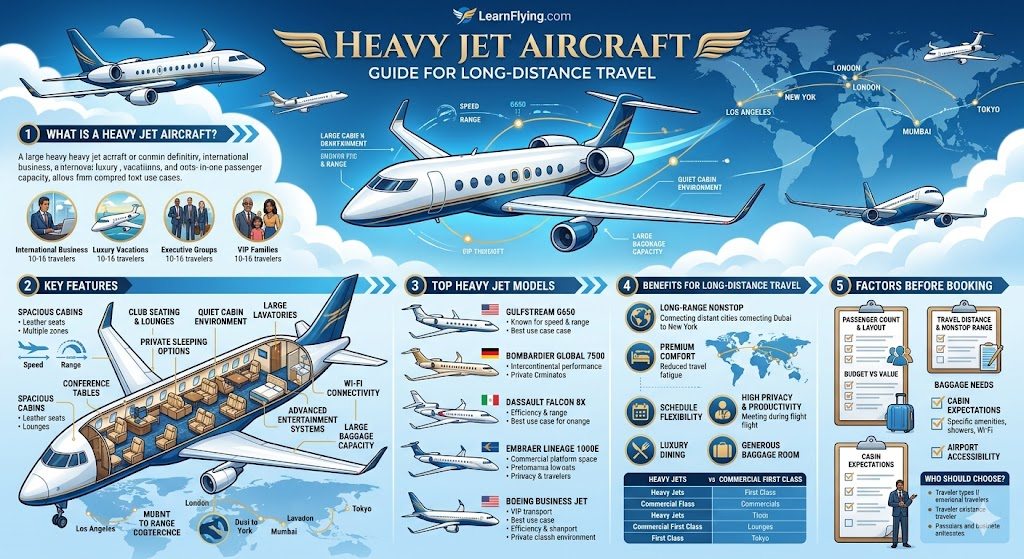
Heavy jet aircraft are designed for travelers who need comfort, range, privacy, and performance on long-distance journeys. These aircraft are larger and more capable than light or mid-size jets, making them ideal for international travel, executive trips, luxury vacations, and group travel. For passengers who want to fly farther with fewer stops and enjoy a premium cabin experience, heavy jets offer one of the best options in private aviation.
A heavy jet is not just about size. It is about creating a complete travel environment in the sky. These aircraft often include spacious cabins, multiple seating areas, enclosed lavatories, advanced entertainment systems, large baggage capacity, and sleeping options. For long-distance travel, this level of comfort can make a major difference.
What Is a Heavy Jet Aircraft?
A heavy jet aircraft is a large private business jet built for long-range travel and higher passenger capacity. Compared with mid-size jets, heavy jets offer more cabin space, longer flight range, better onboard amenities, and improved comfort for extended flights.
Heavy jets are commonly used for:
- International business travel
- Long-distance luxury vacations
- Executive group travel
- Government and diplomatic travel
- Entertainment industry travel
- High-net-worth family travel
- Multi-city global itineraries
Most heavy jets can carry around 10 to 16 passengers, depending on the aircraft model and cabin layout. Some larger corporate aircraft can carry even more passengers.
Key Features of Heavy Jet Aircraft
Spacious Cabins
Heavy jets provide larger cabins with more room to move, relax, dine, and work. Many aircraft have multiple cabin zones, allowing passengers to separate work areas from relaxation spaces.
Common cabin features include:
- Club seating
- Conference tables
- Lounge-style seating
- Private sleeping areas
- Large lavatories
- Entertainment zones
Long-Range Performance
The biggest advantage of heavy jets is long-range capability. Many heavy jets are designed for nonstop or near-nonstop international routes. This helps travelers save time and avoid unnecessary fuel stops.
Premium Passenger Comfort
Long flights require comfort. Heavy jets often include wide seats, reclining chairs, lie-flat options, softer cabin lighting, better noise control, and improved cabin pressurization. These features help reduce travel fatigue.
Advanced Technology
Heavy jets often include modern avionics and advanced cabin systems. Passengers may have access to Wi-Fi, entertainment controls, satellite communication, lighting control, and productivity tools.
Large Baggage Capacity
For long-distance trips, baggage is important. Heavy jets usually offer generous baggage space for suitcases, business equipment, sports gear, luxury shopping, and family travel needs.
Benefits of Choosing a Heavy Jet for Long-Distance Travel
Heavy jets are especially useful when the journey is long, the group is larger, or passenger comfort is a top priority.
Major benefits include:
- Long-range nonstop travel
- More cabin space
- Better comfort on extended flights
- Higher privacy
- Flexible departure schedules
- Reduced airport waiting time
- Better productivity during travel
- Luxury dining and relaxation options
- More baggage room
- Suitable for international routes
For business travelers, heavy jets allow executives to work, hold meetings, and rest during travel. For families and luxury travelers, they provide privacy, comfort, and convenience that commercial travel cannot always offer.
Popular Heavy Jet Aircraft Models
1- Gulfstream G650
The Gulfstream G650 is one of the most recognized long-range private jets. It is known for speed, range, and a highly comfortable cabin. It is often chosen by executives and global travelers who need premium performance.
Best for: International business travel, luxury long-distance routes, executive travel
Cabin highlights: Spacious cabin, large windows, premium seating, advanced cabin systems
Ideal traveler type: CEOs, global executives, luxury travelers
2- Gulfstream G700
The Gulfstream G700 is designed for ultra-long-range travel with an extremely spacious cabin. It offers multiple living areas and advanced onboard comfort features.
Best for: Ultra-long-distance private travel and premium global routes
Cabin highlights: Multiple cabin zones, luxury seating, advanced connectivity
Ideal traveler type: High-net-worth travelers, corporate leaders, global families
3- Bombardier Global 7500
The Bombardier Global 7500 is a long-range business jet known for its large cabin and premium comfort. It is designed for travelers who need serious intercontinental performance.
Best for: Nonstop international travel, long-haul executive trips
Cabin highlights: Multiple zones, lounge area, workspaces, sleeping options
Ideal traveler type: Business leaders, luxury groups, international travelers
4- Bombardier Global 6500
The Bombardier Global 6500 offers strong range, comfort, and performance. It is suitable for long-distance business and leisure travel.
Best for: Corporate travel, long-range private routes, luxury trips
Cabin highlights: Comfortable cabin, advanced technology, refined seating
Ideal traveler type: Executives, business teams, luxury travelers
5- Dassault Falcon 8X
The Dassault Falcon 8X is known for efficiency, range, and flexible airport performance. It is a strong choice for travelers who want long-range capability with refined French aircraft design.
Best for: Long-distance routes, business travel, flexible airport access
Cabin highlights: Quiet cabin, comfortable layout, multiple seating options
Ideal traveler type: Business travelers, families, executive groups
6- Dassault Falcon 10X
The Dassault Falcon 10X is designed as a next-generation heavy jet with a large cabin and long-range capability. It focuses on comfort, performance, and premium passenger experience.
Best for: Premium long-haul travel and international private aviation
Cabin highlights: Large cabin concept, advanced comfort features, modern design
Ideal traveler type: Luxury travelers, executives, private aviation clients
7- Embraer Lineage 1000E
The Embraer Lineage 1000E is a large business aircraft based on a commercial aircraft platform. It offers a spacious cabin with multiple zones and strong comfort for long journeys.
Best for: Group travel, luxury family travel, VIP transport
Cabin highlights: Large interior space, separate cabin areas, premium layout options
Ideal traveler type: VIP groups, families, entertainment professionals
8- Boeing Business Jet
The Boeing Business Jet is a large private aircraft designed for VIP and corporate travel. It offers exceptional cabin space and customization options.
Best for: Government travel, large corporate groups, ultra-luxury private travel
Cabin highlights: Large cabin, private rooms, office areas, dining zones
Ideal traveler type: Heads of state, corporate groups, ultra-luxury travelers
9- Airbus Corporate Jet
The Airbus Corporate Jet offers large-cabin private aviation with extensive customization. It is designed for travelers who want maximum space and long-distance comfort.
Best for: VIP travel, large groups, luxury global routes
Cabin highlights: Spacious interior, private suites, meeting areas, dining spaces
Ideal traveler type: Government delegations, corporate leaders, luxury travelers
10- Gulfstream G550
The Gulfstream G550 is a proven long-range business jet. It remains popular because of its range, reliability, and comfortable cabin.
Best for: Long-distance business routes, international private travel
Cabin highlights: Comfortable seating, long-range performance, practical cabin design
Ideal traveler type: Executives, business teams, international travelers
Heavy Jets vs Mid-Size Jets
| Factor | Heavy Jets | Mid-Size Jets |
|---|---|---|
| Passenger Capacity | Usually 10 to 16 passengers | Usually 6 to 9 passengers |
| Range | Long-range and international travel | Medium-range travel |
| Cabin Space | Large cabin with multiple zones | Comfortable but smaller cabin |
| Sleeping Capability | Often available | Limited |
| Baggage Capacity | Larger baggage space | Moderate baggage space |
| Cost | Higher operating and charter cost | More cost-efficient |
| Best Use Case | Long-distance and global travel | Regional and cross-country travel |
Heavy Jets vs Commercial First Class
| Factor | Heavy Jets | Commercial First Class |
|---|---|---|
| Privacy | Fully private cabin | Shared aircraft environment |
| Schedule Flexibility | Traveler controls departure time | Fixed airline schedule |
| Airport Experience | Private terminals and faster boarding | Standard airport process |
| Comfort | Customized cabin experience | Premium airline seat |
| Productivity | Private meeting and work space | Limited privacy |
| Security | More controlled travel environment | Public airport and airline process |
| Time Savings | Significant time savings | Depends on airline and airport process |
Ideal Long-Distance Routes for Heavy Jets
Heavy jets are best suited for routes where nonstop performance, comfort, and privacy matter.
Examples include:
- New York to London
- Los Angeles to Tokyo
- Dubai to New York
- Singapore to Sydney
- Mumbai to London
- Paris to Dubai
- Hong Kong to Los Angeles
- London to Dubai
- New York to Paris
- Delhi to Singapore
These routes often require longer flight times, more comfort, and better onboard facilities. Heavy jets allow travelers to rest, work, dine, and arrive more refreshed.
Cabin Experience on a Heavy Jet
The cabin experience is one of the biggest reasons travelers choose heavy jets. These aircraft are designed to make long-distance travel more comfortable and productive.
Common cabin experiences include:
- Spacious seating
- Private work areas
- Conference tables
- Entertainment systems
- Wi-Fi connectivity
- Dining arrangements
- Sleeping options
- Large lavatories
- Quiet cabin environment
- Premium lighting and temperature control
Some heavy jets may include private suites, bedrooms, showers, or dedicated crew rest areas depending on the aircraft type and configuration.
Safety and Reliability
Safety is an essential part of private aviation. Before booking a heavy jet, travelers should choose reputable operators and charter providers.
Important safety factors include:
- Certified and experienced pilots
- Proper aircraft maintenance
- Regulatory compliance
- Operator safety history
- Insurance coverage
- Safety audits
- Clear operational procedures
A trusted operator should be transparent about aircraft details, crew qualifications, and safety standards.
Factors to Consider Before Booking a Heavy Jet
Before selecting a heavy jet, travelers should consider the complete travel requirement.
Passenger Count
Heavy jets are ideal for larger groups, but cabin layouts vary. Always confirm the number of comfortable seats, not just the maximum capacity.
Travel Distance
For long international routes, range is critical. Confirm whether the aircraft can complete the trip nonstop or requires a fuel stop.
Budget
Heavy jets cost more than mid-size jets because they offer greater range, space, and amenities. Travelers should compare aircraft options based on value, not only price.
Baggage Needs
Long-distance travelers often carry more luggage. Confirm baggage space, especially for sports equipment, large suitcases, or business materials.
Cabin Expectations
Some travelers need Wi-Fi, sleeping areas, dining space, or private suites. These features vary by aircraft and operator.
Airport Accessibility
Heavy jets may require longer runways than smaller jets. Confirm whether your preferred departure and arrival airports can handle the selected aircraft.
Who Should Choose a Heavy Jet?
Heavy jets are ideal for travelers who need long-distance performance and premium comfort.
They are suitable for:
- CEOs and executives
- International business travelers
- Corporate teams
- Government delegations
- High-net-worth families
- Sports teams
- Entertainment professionals
- Luxury vacation groups
- Travelers with large luggage needs
- Travelers who value privacy and time savings
Future Trends in Heavy Jet Travel
Heavy jet travel continues to evolve as passengers expect better comfort, improved connectivity, and more efficient aircraft.
Key trends include:
- Better onboard Wi-Fi
- More sustainable aviation initiatives
- Improved cabin technology
- Quieter cabins
- More flexible cabin layouts
- Enhanced entertainment systems
- Increased focus on fuel efficiency
- More personalized passenger experiences
Frequently Asked Questions
1- What is considered a heavy jet?
A heavy jet is a large private business aircraft designed for long-distance travel, larger passenger groups, and premium cabin comfort. It typically offers more range, cabin space, baggage capacity, and onboard amenities than light or mid-size jets.
2- How many passengers can a heavy jet carry?
Most heavy jets can carry around 10 to 16 passengers, depending on the model and cabin layout. Some larger corporate aircraft can carry more, especially VIP-configured business aircraft based on commercial platforms.
3- How far can a heavy jet fly nonstop?
The nonstop range depends on the aircraft model, passenger load, baggage, weather, and route conditions. Many heavy jets are designed for international and intercontinental travel, making them suitable for long-distance routes.
4- Are heavy jets suitable for international travel?
Yes, heavy jets are one of the best private aviation options for international travel. They provide long-range performance, comfortable cabins, larger baggage space, and onboard amenities suited for extended flights.
5- Do heavy jets have beds?
Many heavy jets offer lie-flat seating or sleeping arrangements. Some larger aircraft may include private bedrooms or dedicated rest areas, depending on the cabin configuration.
6- Is Wi-Fi available onboard heavy jets?
Wi-Fi is commonly available on many modern heavy jets, but availability depends on the aircraft and operator. Travelers should confirm internet speed, coverage, and connectivity before booking.
7- How much luggage can passengers bring?
Heavy jets usually offer generous baggage capacity compared with smaller jets. However, exact baggage limits depend on the aircraft model, passenger count, and flight distance.
8- Are heavy jets safer than commercial flights?
Private jets and commercial aircraft both follow strict safety rules. Safety depends on the operator, maintenance standards, aircraft condition, crew training, and regulatory compliance.
9- What airports can heavy jets use?
Heavy jets can use many major and private airports, but they may require longer runways than smaller jets. Airport access depends on runway length, weather, airport rules, and aircraft performance.
10- Who should charter a heavy jet?
A heavy jet is best for travelers who need long-distance range, larger cabin space, privacy, comfort, and premium amenities. It is especially suitable for executives, families, VIP groups, and international travelers.
Conclusion
Heavy jet aircraft are the preferred choice for long-distance private travel because they combine range, comfort, privacy, and productivity. They allow travelers to fly across countries and continents with fewer stops, more cabin space, and a highly personalized experience. For executives, heavy jets support work and rest during travel. For families and luxury travelers, they provide privacy, comfort, and convenience. The right heavy jet depends on route distance, passenger count, baggage needs, budget, and desired cabin experience. By understanding the features and benefits of heavy jets, travelers can make smarter decisions and enjoy a smoother long-distance private aviation journey.
