
Introduction
A turbofan engine is the most widely used jet engine in modern aviation and powers the majority of commercial aircraft flying today. It is designed to generate thrust efficiently by combining a large front fan with a gas turbine core. This combination allows aircraft to fly long distances with better fuel efficiency, reduced noise, and improved overall performance.
In simple terms, a turbofan engine takes in air, compresses it, mixes it with fuel, burns it to produce energy, and then uses that energy to generate thrust that moves the aircraft forward. This guide explains turbofan engines in a clear and beginner-friendly way, covering how they work, their components, types, advantages, and real-world applications.
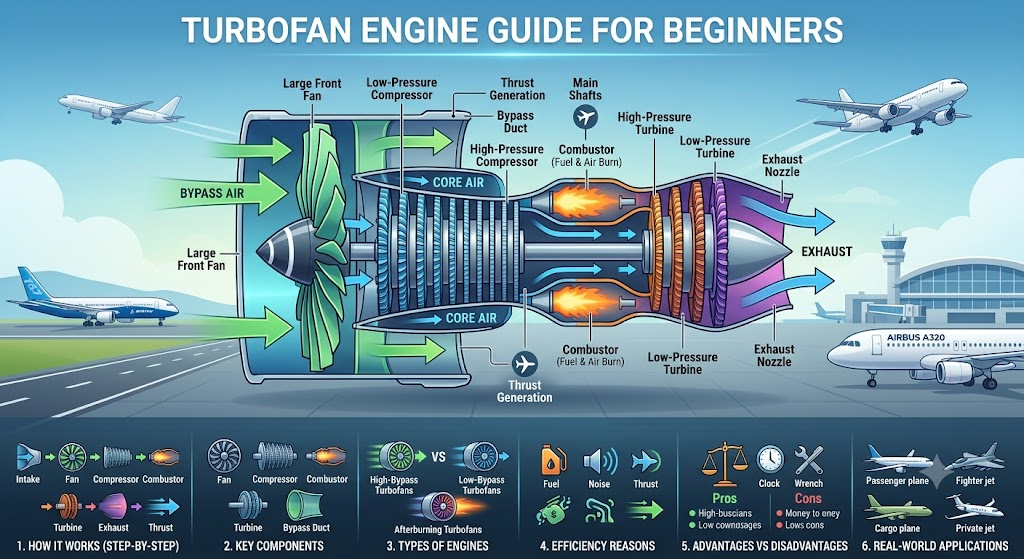
How a Turbofan Engine Works
A turbofan engine operates on a continuous airflow cycle that produces thrust through both bypass air and exhaust gases.
Air Intake
Air enters the engine through the large front fan, which draws in a high volume of air.
Fan Section
The fan divides air into two streams:
- Bypass air that flows around the engine core
- Core air that enters the engine for combustion
Compressor Stage
The core air is compressed using multiple rotating blades, increasing its pressure and temperature.
Combustion Chamber
Fuel is injected into the compressed air and ignited, producing high-energy gases.
Turbine Section
The hot gases spin turbine blades, which power both the compressor and fan.
Exhaust Nozzle
Remaining gases exit the engine at high speed, producing thrust that pushes the aircraft forward.
Key Components of a Turbofan Engine
Fan Blades
Large rotating blades at the front that generate most of the thrust in modern high-bypass engines.
Compressor
A system of rotating and stationary blades that compress incoming air to high pressure.
Combustor
The chamber where fuel and compressed air mix and burn to produce energy.
Turbine
Extracts energy from hot gases to power the compressor and fan.
Bypass Duct
Allows air to bypass the engine core, improving efficiency and reducing noise.
Nozzle
Directs exhaust gases to generate controlled thrust.
Types of Turbofan Engines
Low-Bypass Turbofan
- Smaller fan size
- More air passes through the engine core
- Higher speed capability
- Used in some military aircraft
High-Bypass Turbofan
- Large fan size
- Majority of air bypasses the core
- High fuel efficiency
- Common in commercial aircraft
Afterburning Turbofan
- Used in fighter jets
- Adds extra fuel in the exhaust for temporary thrust boost
- Very high fuel consumption during afterburner use
Why Turbofan Engines Are Efficient
Turbofan engines are designed for maximum efficiency in modern aviation.
Key reasons include:
- High fuel efficiency due to bypass airflow
- Reduced noise levels compared to older jet engines
- Strong thrust generation for commercial aircraft
- Better performance for long-distance flights
Advantages vs Disadvantages
| Feature | Advantages | Disadvantages |
|---|---|---|
| Fuel Efficiency | Excellent in high-bypass designs | Less efficient at supersonic speeds |
| Noise | Significantly quieter than turbojets | Still produces noticeable noise during takeoff |
| Performance | Ideal for long-haul travel | Complex engineering increases maintenance needs |
| Cost | Cost-effective over long-term use | High manufacturing cost |
| Reliability | Highly reliable in modern aviation | Requires advanced monitoring systems |
Real-World Applications
Commercial Aviation
Used in passenger aircraft such as Airbus A320, Boeing 737, and Boeing 787.
Military Aviation
Used in fighter jets, often with afterburning capability.
Business Aviation
Used in private jets for fast and efficient travel.
Cargo Aviation
Used in freight aircraft carrying goods across global routes.
Common Misconceptions About Turbofan Engines
Misconception 1: Jet engines burn all fuel instantly
Reality: Fuel is burned in a controlled and continuous process.
Misconception 2: More thrust always means more speed
Reality: Aircraft speed depends on aerodynamics and drag, not just thrust.
Misconception 3: Turbofan engines only push air backward
Reality: Both bypass air and exhaust gases contribute to thrust generation.
Misconception 4: Turbofan engines are outdated technology
Reality: They are the most advanced and widely used jet engine type today.
FAQs
1. What is a turbofan engine?
A turbofan engine is a jet engine that produces thrust using a combination of a large fan and a gas turbine core.
2. Where are turbofan engines used?
They are used in commercial aircraft, military jets, business jets, and cargo planes.
3. What is the main advantage of a turbofan engine?
Its main advantage is high fuel efficiency combined with strong thrust output.
4. How does a turbofan engine generate thrust?
It generates thrust by accelerating air through both bypass flow and exhaust gases.
5. What is bypass air?
Bypass air is the portion of incoming air that flows around the engine core instead of entering it.
6. Why are turbofan engines quieter?
They are quieter because most thrust comes from slower-moving bypass air.
7. What powers the fan in a turbofan engine?
The turbine section powers the fan using energy from hot exhaust gases.
8. What is the difference between turbojet and turbofan engines?
Turbojets use only exhaust gases for thrust, while turbofans use both exhaust and bypass air.
9. Are turbofan engines fuel efficient?
Yes, especially high-bypass turbofan engines used in commercial aviation.
10. Can turbofan engines fail in flight?
Failures are extremely rare due to advanced safety systems and redundancy designs.
Conclusion
Turbofan engines are one of the most important innovations in modern aviation. They combine efficiency, reliability, and performance, making global air travel possible at scale. By using a dual airflow system, they maximize thrust while minimizing fuel consumption and noise levels.
From commercial airliners to military jets, turbofan engines play a crucial role in powering modern aircraft. Understanding how they work provides a strong foundation for anyone interested in aviation, aerospace engineering, or pilot training.
As technology continues to advance, turbofan engines will become even more efficient, sustainable, and powerful, shaping the future of air transportation worldwide.
