
Introduction
Modern aviation depends on one of the most important engineering innovations in history: the jet engine. From commercial airliners crossing continents to executive jets used for business travel, jet engines make fast, efficient, and long-distance flight possible.
This blog explains how jet engines work, why they are essential in modern aircraft, and how they power different types of aviation in a simple and structured way.
Introduction
Air travel today is faster, safer, and more efficient than ever before. At the core of this transformation is the jet engine, a system designed to generate thrust by using air compression and fuel combustion.
Jet engines are the driving force behind:
- Commercial aviation networks
- Private and executive jets
- Military aircraft operations
Understanding how they work helps explain how modern aircraft achieve high speed, long range, and reliable performance.
What Is a Jet Engine?
A jet engine is a propulsion system that generates thrust by taking in air, compressing it, mixing it with fuel, and igniting it to produce high-speed exhaust gases.
Simple Definition
A jet engine is a machine that moves an aircraft forward by releasing fast-moving gases backward.
Where Jet Engines Are Used
- Commercial airplanes
- Executive and private jets
- Military fighter aircraft
- High-speed unmanned aircraft
Jet engines are widely used because they are powerful, efficient at high speeds, and suitable for long-distance travel.
How Jet Engines Work (Step-by-Step)
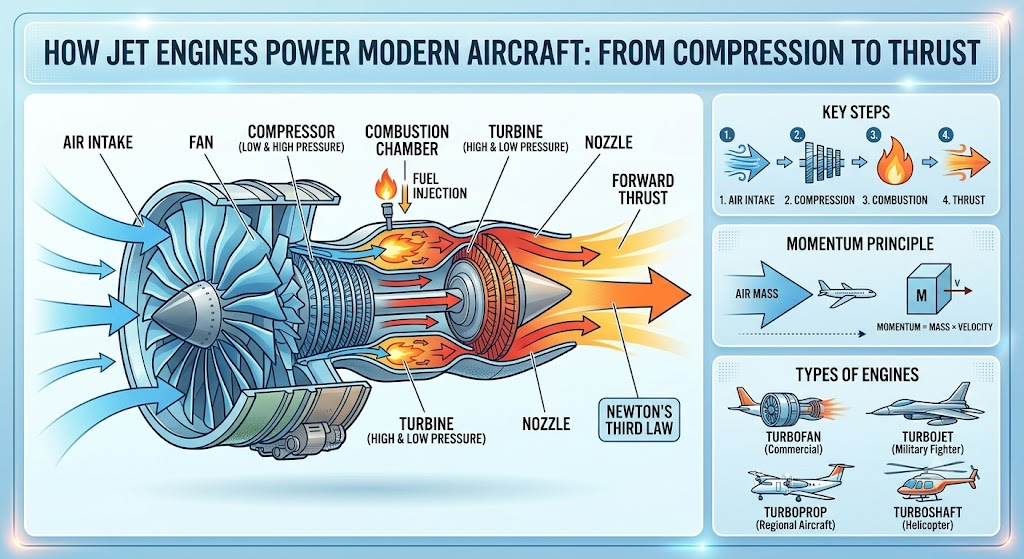
Jet engines operate on a simple principle based on Newton’s Third Law: every action has an equal and opposite reaction.
1. Air Intake
The engine draws in large amounts of air through the front as the aircraft moves forward.
2. Compression
The incoming air is compressed using rotating compressor blades, increasing its pressure and temperature.
3. Combustion
Fuel is injected into the compressed air and ignited, producing high-energy combustion.
4. Exhaust and Thrust
The hot gases are expelled from the back of the engine at high speed, pushing the aircraft forward.
Key Principle
The backward force of exhaust gases creates forward thrust that moves the aircraft.
Physics Behind Jet Engine Thrust
genui{“physics_learning_block”:{“type_id”:”MOMENTUM”}}
Jet engines work on the principle of momentum. When air is accelerated backward at high speed, the aircraft gains forward motion. The greater the mass and velocity of the exhaust gases, the higher the thrust produced.
Types of Jet Engines
Different aircraft use different jet engine types depending on their purpose and performance requirements.
Turbojet
- Simple jet engine design
- Produces high speed
- Less efficient at low speeds
Turbofan (Most Common)
- Used in commercial aircraft
- High fuel efficiency
- Quiet and powerful operation
Turboprop
- Combination of jet engine and propeller
- Best for short regional flights
- Highly fuel efficient at lower speeds
Turboshaft
- Used mainly in helicopters
- Powers rotors instead of direct thrust
Why Jet Engines Are Important in Modern Aircraft
Jet engines play a critical role in modern aviation because they provide:
High Speed Travel
Allow aircraft to travel faster than traditional propeller-driven aircraft.
Long-Distance Capability
Enable nonstop intercontinental flights.
High Altitude Efficiency
Operate efficiently in thin air at high altitudes.
Reliability
Designed for long-duration, continuous performance.
Jet Engines in Different Aircraft Types
Commercial Aircraft
Commercial airplanes use large turbofan engines designed for fuel efficiency, passenger comfort, and long-haul travel.
Executive Jets
Private and executive jets use smaller, efficient turbofan engines focused on speed, flexibility, and premium travel experience.
Military Aircraft
Fighter jets use high-thrust turbojet or advanced turbofan engines designed for speed, agility, and performance.
Advantages and Limitations of Jet Engines
Advantages
- High thrust and speed capability
- Efficient at high altitudes
- Suitable for long-distance travel
- Reliable performance over long hours
Limitations
- High fuel consumption
- Expensive maintenance
- Noise generation
- Environmental impact due to emissions
Future of Jet Engine Technology
Jet engine technology is continuously evolving to improve efficiency and reduce environmental impact.
Key developments include:
- More fuel-efficient engine designs
- Use of sustainable aviation fuels (SAF)
- Hybrid-electric propulsion systems
- AI-based predictive maintenance and monitoring
These innovations aim to make aviation cleaner, smarter, and more efficient.
Real-World Example
A commercial aircraft uses large turbofan engines to carry hundreds of passengers across continents efficiently. These engines are designed to balance fuel consumption with long-range performance.
In contrast, executive jets use smaller turbofan engines optimized for speed, shorter runways, and flexible travel schedules.
Conclusion
Jet engines are the foundation of modern aviation. They power commercial airliners, executive jets, and military aircraft by converting fuel energy into thrust that enables flight.
Their ability to deliver speed, efficiency, and long-range performance has transformed global travel and connectivity. As technology advances, jet engines will continue to become more efficient, quieter, and more environmentally friendly, shaping the future of aviation.
FAQs
1. What is a jet engine?
A jet engine is a propulsion system that generates thrust by expelling high-speed gases backward to move an aircraft forward.
2. How do jet engines work?
They work by taking in air, compressing it, mixing it with fuel, igniting it, and releasing exhaust gases to produce thrust.
3. What is the most common type of jet engine?
The turbofan engine is the most widely used, especially in commercial aircraft.
4. Why are jet engines important?
They enable fast, long-distance, and efficient air travel.
5. Do all aircraft use jet engines?
No, some aircraft use propellers or turboprops, but most modern aircraft rely on jet engines.
6. Are jet engines fuel efficient?
They are highly efficient at cruising altitudes and high speeds, especially modern designs.
7. Can jet engines work in space?
No, they require air to operate, so they cannot function in space.
8. What powers a jet engine?
Jet engines are powered by aviation fuel, typically jet fuel (kerosene-based).
9. Are jet engines safe?
Yes, they are designed with strict safety standards and undergo continuous monitoring.
10. What is the future of jet engines?
Future engines will be more fuel-efficient, quieter, and more environmentally friendly.
