
Introduction
Air travel has become one of the most important parts of modern transportation, connecting cities, countries, and continents within hours. In today’s aviation world, two major categories define how people travel by air: executive jets and commercial aircraft. While both fly in the same sky, they are built for completely different purposes, audiences, and travel experiences.
This blog explains the key differences in a simple, structured, and practical way so you can clearly understand how each aircraft type works and which one suits different travel needs.
Introduction to Modern Air Travel
Aviation today is divided into two major experiences:
- One focused on luxury, speed, and privacy
- Another focused on affordable mass transportation and global connectivity
Executive jets and commercial aircraft represent these two extremes. Understanding their differences helps travelers, business professionals, and aviation enthusiasts make smarter decisions based on time, cost, comfort, and purpose.
What Are Executive Jets?
Executive jets, also known as business jets or private jets, are aircraft designed for personalized and premium travel experiences. They are typically used by corporate leaders, VIPs, celebrities, and individuals who value time, privacy, and comfort.
✈️ Key Features of Executive Jets
- Seating capacity: 4 to 18 passengers
- Flexible flight schedules (on-demand travel)
- Access to private and smaller airports
- High-end luxury interiors with meeting and rest areas
- Fast boarding with minimal waiting time
- Personalized in-flight services
Common Use Cases
- Corporate business travel between cities
- VIP and celebrity transportation
- Emergency or urgent travel needs
- Luxury family or group trips
- Charter-based private travel services
Advantages of Executive Jets
- Complete privacy and confidentiality
- Saves significant travel time
- Flexible departure and arrival options
- Access to remote airports closer to destinations
- Premium comfort and customized experience
Limitations of Executive Jets
- Very high operating and charter costs
- Limited passenger capacity
- Not suitable for mass travel
- Availability depends on booking and demand
Executive jets are designed for exclusivity, efficiency, and luxury rather than large-scale transportation.
What Are Commercial Aircraft?
Commercial aircraft are large airplanes operated by airlines to transport hundreds of passengers on scheduled routes. They form the backbone of global air travel and are the most widely used form of aviation.
Key Features of Commercial Aircraft
- Seating capacity: 100 to 500+ passengers
- Fixed schedules and routes
- Operated by airlines
- Multiple seating classes (economy, business, first class)
- Global route networks covering thousands of destinations
- Designed for cost efficiency and mass travel
Common Use Cases
- Domestic and international passenger travel
- Tourism and holiday travel
- Budget-friendly mass transportation
- Cargo and passenger services
Advantages of Commercial Aircraft
- Affordable ticket pricing
- High availability of flights
- Global connectivity across destinations
- Suitable for all types of travelers
- Frequent flight schedules
Limitations of Commercial Aircraft
- Fixed departure times reduce flexibility
- Longer airport procedures and security checks
- Less privacy compared to private jets
- Possible delays due to high traffic
Commercial aircraft are built for scale, efficiency, and accessibility.
Key Differences Between Executive Jets and Commercial Aircraft
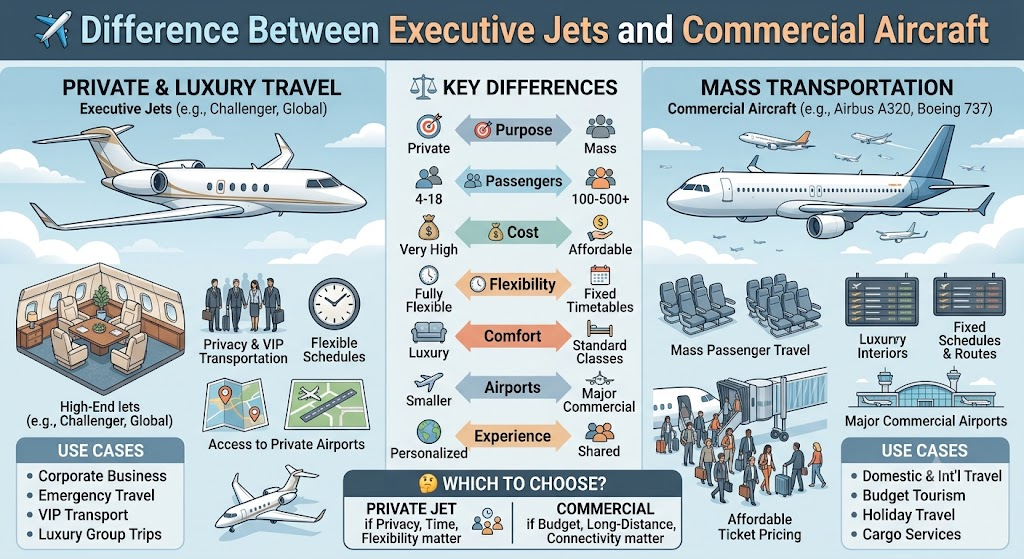
Purpose
- Executive Jets: Private, luxury, and business travel
- Commercial Aircraft: Mass passenger transportation
Passenger Capacity
- Executive Jets: 4–18 passengers
- Commercial Aircraft: 100–500+ passengers
Cost
- Executive Jets: Very high cost per flight hour
- Commercial Aircraft: Affordable ticket-based pricing
Flexibility
- Executive Jets: Fully flexible schedules
- Commercial Aircraft: Fixed timetables
Comfort Level
- Executive Jets: Luxury interiors with privacy and space
- Commercial Aircraft: Standard seating with class-based comfort
Airport Access
- Executive Jets: Can use smaller and private airports
- Commercial Aircraft: Require major commercial airports
Travel Experience
- Executive Jets: Personalized and time-saving experience
- Commercial Aircraft: Structured and shared travel experience
Executive Jets vs Commercial Aircraft: Which One Should You Choose?
Choose Executive Jets if:
- You prioritize time and privacy
- You travel frequently for business
- You need flexible scheduling
- You travel in small groups or VIP arrangements
Choose Commercial Aircraft if:
- You want cost-effective travel
- You are traveling long distances on a budget
- You are comfortable with fixed schedules
- You are traveling with large groups or family
In simple terms:
- Executive jets = luxury, speed, flexibility
- Commercial aircraft = affordability, accessibility, scale
Advantages and Limitations Summary
Executive Jets
Advantages:
- Maximum privacy
- Time-saving travel
- Luxury experience
Limitations:
- Very expensive
- Limited seating capacity
- Less availability
Commercial Aircraft
Advantages:
- Budget-friendly travel
- Wide global network
- High passenger capacity
Limitations:
- Fixed schedules
- Less privacy
- Longer airport processing time
Real-World Use Cases
Corporate Travel
Executives often use private jets to attend multiple meetings in different cities within a single day.
Tourism & International Travel
Families and tourists rely on commercial aircraft for affordable long-distance travel.
Emergency Situations
Executive jets are frequently used for urgent medical or high-priority business travel where time is critical.
Future of Aviation
The aviation industry is evolving rapidly with new technologies and travel models:
- Growth of private aviation and charter services
- More fuel-efficient and eco-friendly aircraft
- Digital booking and smart travel systems
- Increasing accessibility of private jet services
Both executive jets and commercial aircraft will continue to play important roles in shaping global air travel.
Frequently Asked Questions (FAQs)
1. What is the main difference between executive jets and commercial aircraft?
Executive jets are private and flexible with luxury services, while commercial aircraft are scheduled flights designed for mass transportation.
2. Which is more expensive: executive jet or commercial aircraft?
Executive jets are significantly more expensive due to privacy, luxury services, and low passenger capacity.
3. Who uses executive jets?
They are commonly used by business executives, celebrities, government officials, and high-net-worth individuals.
4. Are commercial aircraft safer than executive jets?
Both are equally safe as they follow strict aviation regulations and safety standards.
5. Can executive jets land at small airports?
Yes, executive jets can access smaller regional and private airports.
6. Why are commercial aircraft more popular?
They are affordable, widely available, and operate on global routes.
7. Do executive jets follow fixed schedules?
No, they operate on-demand based on customer requirements.
8. How many passengers can commercial aircraft carry?
Depending on the aircraft, they can carry from 100 to over 500 passengers.
9. Which is better for business travel?
Executive jets are better for time-sensitive and high-priority business travel.
10. What is the biggest advantage of commercial aircraft?
The biggest advantage is affordability and global connectivity.
Conclusion
Executive jets and commercial aircraft serve completely different purposes in the aviation ecosystem. Executive jets are designed for privacy, luxury, flexibility, and time efficiency, making them ideal for business leaders and premium travelers. In contrast, commercial aircraft focus on affordability, accessibility, and large-scale transportation, making air travel available to millions of people worldwide.
The right choice depends on your priorities—whether you value time and exclusivity or affordability and connectivity. Both aircraft types are essential to modern aviation and continue to shape how the world travels every day.
