
Introduction
Flying on a private jet is very different from travelling through a busy commercial airport. Instead of crowded check-in halls, long queues, fixed boarding gates, and complex terminal procedures, private aviation offers a quieter and more personalized journey.
Most private jet passengers use a dedicated private aviation terminal, commonly operated by a Fixed-Base Operator, or FBO. These terminals are designed to make departures and arrivals faster, more comfortable, and more private.
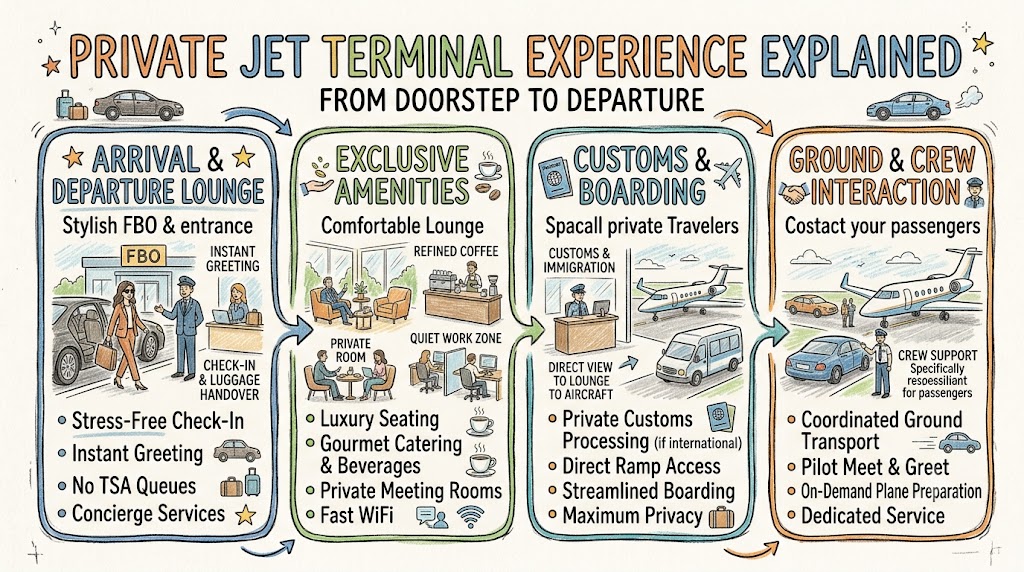
The private jet terminal experience usually includes quick check-in, comfortable lounges, direct aircraft access, discreet security procedures, personalized baggage assistance, and coordinated ground transportation. However, the exact process can vary depending on the airport, country, operator, and type of flight.
This guide explains what passengers can generally expect before, during, and after using a private jet terminal.
What Is a Private Jet Terminal?
A private jet terminal is a dedicated facility used by passengers, pilots, aircraft owners, charter companies, and business aviation operators.
Unlike commercial terminals, private terminals are usually smaller, quieter, and designed around individual flight schedules rather than large airline operations.
Many private terminals are operated by FBO companies that provide services such as:
- Passenger reception
- Aircraft parking
- Fuel services
- Crew facilities
- Flight support
- Baggage handling
- Catering coordination
- Ground transportation
- Lounge access
- Customs and immigration assistance
Some airports may have several private terminals operated by different FBO providers.
Arriving at the Private Jet Terminal
Passengers are usually advised to arrive closer to departure time than they would for a commercial flight.
For domestic private flights, passengers may arrive around 15 to 30 minutes before departure. International flights may require an earlier arrival because of passport control, customs, immigration, or additional documentation.
The arrival experience is generally simple.
Passengers may drive directly to the private terminal entrance, where staff members greet them and confirm their flight details. At some airports, vehicles may be allowed to approach the aircraft directly, depending on local security rules.
The terminal team may already know the passenger’s name, aircraft registration, destination, and departure time before arrival.
A Faster and More Personal Check-In Process
Private aviation does not usually involve large check-in counters or long lines.
A staff member may verify:
- Passenger identification
- Passport details
- Flight manifest
- Visa documents
- Travel permits
- Baggage information
- Special passenger requests
For domestic travel, the identification process may take only a few minutes. International flights can require more formal checks.
Passengers should still carry all required documents. Flying privately does not remove passport, visa, customs, or immigration responsibilities.
Security Screening at a Private Terminal
Private jet passengers are still subject to aviation security regulations.
However, the security process may be faster and more discreet than the process inside a commercial airport.
Depending on the country, airport, aircraft type, and route, passengers may experience:
- Identity verification
- Baggage screening
- Metal detection
- Restricted-item checks
- Customs inspection
- Passenger manifest verification
Some private terminals use dedicated security lanes, while others complete checks in a separate room.
Passengers should not assume that private aviation allows prohibited items. Dangerous goods, weapons, liquids, medicines, and special equipment may be subject to aviation rules and operator approval.
Inside the Private Jet Lounge
One of the most noticeable parts of the private jet terminal experience is the lounge.
Private aviation lounges are usually quieter and less crowded than airline lounges. They are designed for short waiting periods, business meetings, relaxation, and privacy.
Facilities may include:
- Comfortable seating
- Private meeting rooms
- Wi-Fi access
- Television
- Refreshments
- Coffee and beverages
- Workspaces
- Charging points
- Restrooms
- Children’s areas
- Shower facilities
- Quiet rooms
High-end terminals may also offer concierge support, luxury retail arrangements, private suites, or direct limousine coordination.
The quality of the lounge depends on the airport and FBO. Some terminals are highly luxurious, while smaller regional airports may provide only basic seating and refreshments.
Personalized Passenger Assistance
Private terminal staff often provide a more personalized level of service because fewer passengers are using the facility at one time.
Assistance may include:
- Escorting passengers through the terminal
- Coordinating baggage
- Arranging catering
- Booking ground transport
- Supporting elderly passengers
- Helping families with children
- Managing pet travel requirements
- Coordinating special mobility assistance
- Communicating flight updates
- Handling last-minute passenger changes
Passengers should share special requirements with the charter company or operator before departure whenever possible.
How Baggage Is Handled
Baggage handling is generally more direct in private aviation.
Instead of checking bags through a large airline baggage system, passengers usually hand their luggage to private terminal staff or the flight crew. The bags are then taken directly to the aircraft.
This reduces handling stages, but baggage limits still apply.
Private jet baggage capacity depends on:
- Aircraft size
- Baggage compartment dimensions
- Passenger count
- Weight restrictions
- Flight distance
- Fuel requirements
- Type of luggage
A light jet may have limited luggage space, while a large-cabin jet may carry several suitcases, sports equipment, and other items.
Passengers should inform the operator in advance about oversized bags, golf clubs, skis, musical instruments, medical equipment, or heavy luggage.
Private Jet Catering and Refreshments
Catering can be arranged before departure and loaded onto the aircraft through the private terminal or an approved catering provider.
Depending on the aircraft and journey, passengers may request:
- Light snacks
- Breakfast
- Sandwiches
- Hot meals
- Desserts
- Fruit platters
- Vegetarian meals
- Vegan meals
- Children’s meals
- Dietary-specific options
- Beverages
Some aircraft have full galley facilities, while smaller jets may only support cold food or reheated meals.
Premium or highly customized catering may involve additional charges. Passengers should place special requests early, especially when travelling from smaller airports.
Waiting Time Before Boarding
Private jet passengers generally spend less time waiting in the terminal.
If the aircraft is ready, the crew is prepared, and all required clearances are complete, boarding may begin shortly after arrival.
However, private flights can still face delays caused by:
- Weather conditions
- Air traffic control
- Airport congestion
- Technical inspections
- Crew duty limitations
- Customs clearance
- Passenger delays
- Slot restrictions
- Aircraft repositioning
Private aviation offers flexibility, but it cannot avoid every operational limitation.
Direct Boarding from the Terminal
Boarding a private jet is usually simple and fast.
A staff member or crew member escorts passengers from the lounge to the aircraft. The distance may be a short walk, a private vehicle transfer, or a direct exit from the terminal onto the aircraft parking area.
Passengers do not normally wait in a large boarding group. Once everyone is ready, the crew completes the final safety procedures and prepares for departure.
At certain airports, passengers may be driven directly to the aircraft without entering a traditional terminal building.
Meeting the Flight Crew
Before departure, passengers may meet the pilots and cabin crew.
The captain may provide a brief update about:
- Flight duration
- Weather conditions
- Expected turbulence
- Route information
- Arrival time
- Safety procedures
Passengers should pay attention to the safety briefing, even if they have flown privately before. Aircraft layouts, emergency exits, seat belts, and onboard procedures can differ.
Smaller private jets may not have a dedicated cabin attendant. In these cases, the pilots may also provide passenger instructions before departure.
Privacy and Discretion
Privacy is one of the main reasons people choose private aviation.
Private terminals often provide:
- Separate entrances
- Limited public access
- Private waiting rooms
- Discreet staff assistance
- Controlled vehicle access
- Reduced passenger interaction
- Confidential scheduling
These features can be useful for executives, public figures, families, government officials, medical travellers, and passengers who prefer a quieter journey.
However, private aviation is still subject to legal passenger records, immigration reporting, airport security, and regulatory oversight.
Ground Transportation Coordination
Private terminals often coordinate ground transportation before arrival or departure.
Available services may include:
- Chauffeur-driven cars
- Limousines
- Rental vehicles
- Hotel transfers
- Corporate transport
- Taxis
- Helicopter transfers
- Secure vehicle services
In some locations, a vehicle may meet passengers beside the aircraft. At other airports, passengers must first enter the private terminal before continuing their journey.
Advance coordination helps reduce waiting time.
The International Private Jet Terminal Experience
International private jet travel includes additional procedures.
Passengers may need to complete:
- Passport control
- Visa verification
- Customs declarations
- Immigration checks
- Health documentation
- Agricultural inspection
- Entry permits
Some private terminals have customs and immigration officers available onsite. At smaller airports, clearance may need to be arranged in advance.
The charter company or flight operator usually coordinates the process, but passengers remain responsible for carrying valid travel documents.
Arriving at the Destination
The arrival process is often as convenient as departure.
After landing, the aircraft taxis to the private aviation area. Passengers may then walk or travel by vehicle to the terminal.
Staff members usually help unload baggage and coordinate onward transportation.
For domestic flights, passengers may leave the terminal within minutes. International arrivals can take longer because of immigration and customs requirements.
Travelling with Children
Private terminals can make family travel easier because there are fewer crowds, shorter waiting periods, and more flexible boarding arrangements.
Families may benefit from:
- Private seating areas
- Faster baggage handling
- Flexible catering
- Direct aircraft access
- Reduced walking distance
- Easier stroller handling
- Personalized assistance
Parents should still confirm child-seat policies, infant documentation, passports, visas, and onboard safety requirements before departure.
Travelling with Pets
Many private jet operators allow pets, but approval depends on the aircraft, route, operator policy, and destination regulations.
The private terminal may assist with:
- Pet documentation
- Health certificates
- Import permits
- Crate handling
- Customs checks
- Ground transport
International pet travel may require vaccinations, microchips, quarantine documents, and veterinary certificates.
Passengers should never assume that a pet can travel without advance approval.
Accessibility and Special Assistance
Private terminals can often provide personalized support for passengers with reduced mobility or medical requirements.
Services may include:
- Wheelchair assistance
- Vehicle-to-aircraft transfers
- Reduced walking distances
- Priority processing
- Medical equipment coordination
- Ambulance access
- Special seating assistance
Not every private jet can accommodate every mobility device. Aircraft cabin dimensions, door size, and baggage space should be checked in advance.
Private Terminal Versus Commercial Airport Terminal
| Feature | Private Jet Terminal | Commercial Terminal |
|---|---|---|
| Arrival time | Often closer to departure | Usually much earlier |
| Passenger volume | Low | High |
| Check-in | Personalized | Standard airline process |
| Security | Private or dedicated screening | Large public screening areas |
| Boarding | Direct or individually escorted | Group boarding |
| Lounge | Quiet and private | Shared with many passengers |
| Baggage handling | Direct to aircraft | Airline baggage system |
| Ground transport | Often pre-coordinated | Passenger usually arranges separately |
| Schedule flexibility | Greater | Based on fixed airline schedules |
| Privacy | High | Limited |
Common Misconceptions About Private Jet Terminals
Private Jet Passengers Avoid Security
Private passengers must still follow security and aviation regulations. The process is usually more discreet, not absent.
Passengers Can Arrive at Any Time
Flights still follow airport slots, crew schedules, air traffic restrictions, and operational deadlines. Late passengers can cause delays or additional charges.
Every Terminal Is Extremely Luxurious
Some private terminals are luxurious, while others are small and functional. Service quality depends on the airport and facility.
Baggage Is Unlimited
Every aircraft has weight and space limits. Excess or oversized baggage may require a larger aircraft.
International Travel Requires No Immigration Checks
Private flights must follow passport, customs, immigration, visa, and border-control rules.
Tips for First-Time Private Jet Passengers
To make the terminal experience smoother:
- Confirm the correct terminal or FBO address.
- Carry valid identification and travel documents.
- Arrive at the recommended time.
- Share baggage details in advance.
- Confirm catering requests early.
- Inform the operator about children, pets, or mobility needs.
- Keep restricted-item rules in mind.
- Provide accurate passenger names for the flight manifest.
- Confirm ground transportation before departure.
- Listen carefully to the crew safety briefing.
Questions to Ask Before Your Flight
Before travelling, passengers may ask the charter provider:
- Which private terminal should I use?
- How early should I arrive?
- What identification is required?
- What is the baggage allowance?
- Is catering included?
- Can I travel with a pet?
- Is ground transport arranged?
- Are customs services available at the terminal?
- Will there be a cabin attendant?
- Are there extra terminal or handling charges?
Clear communication helps prevent last-minute confusion.
Conclusion
A private jet terminal offers a faster, quieter, and more personalized alternative to the traditional commercial airport experience. Passengers can generally expect discreet check-in, comfortable lounges, direct baggage handling, quick boarding, personalized assistance, and coordinated ground transport. However, security, documentation, baggage limits, and international travel rules still apply. Understanding the process in advance helps first-time passengers enjoy a smoother and more confident private aviation journey.
