
Introduction
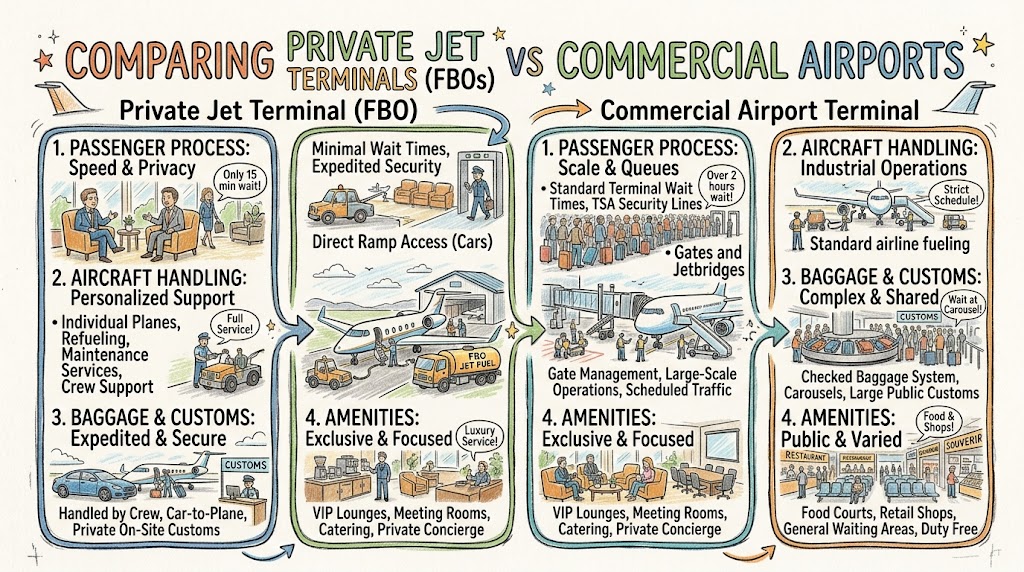
Private jet terminals and commercial airports serve the same basic purpose: helping passengers begin or complete an air journey. However, the experience they provide is very different.
Commercial airports are designed to handle thousands of passengers travelling on fixed airline schedules. Private jet terminals are built around smaller passenger groups, flexible departure times, personalized services, and greater privacy.
For first-time private aviation travellers, the contrast can be noticeable from the moment they arrive. Instead of large check-in halls, crowded security areas, and group boarding, private jet passengers often use a smaller facility known as a private terminal or Fixed-Base Operator, commonly called an FBO.
This guide explains the main differences between private jet terminals and commercial airports.
What Is a Private Jet Terminal?
A private jet terminal is a facility used mainly by private, charter, corporate, and business aviation passengers.
Many private terminals are operated by FBO companies. These facilities may provide:
- Passenger reception
- Private lounges
- Aircraft parking
- Fuel services
- Baggage handling
- Crew support
- Catering coordination
- Ground transportation
- Customs and immigration assistance
- Flight-planning support
Private terminals are usually located away from the busiest commercial passenger areas of an airport.
What Is a Commercial Airport Terminal?
A commercial airport terminal is designed for passengers travelling with scheduled airlines.
It manages large numbers of people and includes facilities such as:
- Airline check-in counters
- Self-service kiosks
- Security checkpoints
- Immigration counters
- Boarding gates
- Baggage claim areas
- Retail shops
- Restaurants
- Airline lounges
- Public transportation access
Commercial terminals follow highly standardized processes because they serve many airlines, aircraft, routes, and passengers.
Key Differences at a Glance
| Feature | Private Jet Terminal | Commercial Airport |
|---|---|---|
| Passenger volume | Low | High |
| Arrival time | Often 15–30 minutes before departure | Commonly 2–3 hours before departure |
| Check-in | Personalized and quick | Standard airline check-in |
| Security | Dedicated and discreet | Centralized public screening |
| Boarding | Direct or individually escorted | Group boarding through gates |
| Waiting areas | Quiet private lounges | Busy public areas |
| Baggage handling | Direct to aircraft | Processed through airline systems |
| Flight schedule | More flexible | Fixed timetable |
| Ground access | Often close to aircraft | Usually separate from aircraft |
| Privacy | High | Limited |
| Cost | Premium | More affordable |
| Destination access | More airports available | Mainly major commercial routes |
Difference in Arrival Time
One of the biggest differences is how early passengers need to arrive.
At a commercial airport, travellers are often advised to arrive two or three hours before departure. This allows time for:
- Check-in
- Baggage drop
- Security screening
- Immigration
- Walking to the gate
- Boarding procedures
At a private jet terminal, passengers may arrive much closer to departure time. For many domestic flights, arrival 15 to 30 minutes before departure may be sufficient.
International flights can require additional time because of passport checks, customs, and immigration procedures.
Private aviation saves time because fewer passengers are processed at once.
Check-In Process
Private Jet Terminal Check-In
Private jet check-in is usually simple and personalized.
Passengers may be greeted by name when they arrive. Staff members verify identification, passenger details, and travel documents.
There are generally no long check-in lines, crowded counters, or self-service kiosks.
Commercial Airport Check-In
Commercial passengers must usually:
- Find the correct airline counter
- Check baggage
- Receive a boarding pass
- Confirm seat assignments
- Follow airline check-in deadlines
Online check-in can reduce waiting, but passengers must still complete security and boarding procedures.
Security Screening
Both private and commercial passengers must follow aviation security regulations.
Security at Private Jet Terminals
Private terminals may use:
- Dedicated security rooms
- Baggage screening
- Identity verification
- Passenger manifest checks
- Restricted-item inspections
The process is usually faster because only a small number of passengers are being screened.
Security at Commercial Airports
Commercial airport security usually involves:
- Large passenger queues
- Document checks
- Carry-on baggage screening
- Metal detectors
- Body scanners
- Liquid restrictions
- Separate screening for certain items
The rules may be similar, but the commercial process usually takes longer because of passenger volume.
Passenger Privacy
Privacy is one of the main advantages of private jet terminals.
Passengers often use:
- Separate entrances
- Private lounges
- Restricted-access areas
- Dedicated staff
- Direct vehicle transfers
- Confidential travel arrangements
This makes private aviation attractive to executives, celebrities, government officials, families, and travellers who value discretion.
Commercial airports are public spaces where passengers move through shared check-in halls, security queues, gates, and baggage areas.
Lounge Experience
Private Jet Lounges
Private jet lounges are usually quiet and designed for short waiting periods.
They may include:
- Comfortable seating
- Meeting rooms
- Workspaces
- Wi-Fi
- Refreshments
- Private restrooms
- Shower facilities
- Children’s areas
- Crew rooms
Passengers may only spend a few minutes in the lounge before boarding.
Commercial Airport Lounges
Commercial airport lounges can offer premium facilities, but they are shared by many passengers.
Access may depend on:
- Travel class
- Airline membership
- Frequent-flyer status
- Paid lounge access
- Credit card benefits
Even premium lounges can become crowded during busy travel periods.
Boarding Experience
Boarding a Private Jet
Private jet boarding is usually direct and personal.
Passengers may walk from the lounge to the aircraft or be driven across the airport ramp. There are no boarding groups, gate announcements, or long boarding lines.
Once passengers are onboard and operational approvals are complete, the aircraft can prepare for departure.
Boarding a Commercial Aircraft
Commercial boarding follows a structured process.
Passengers may board according to:
- Travel class
- Seat row
- Loyalty status
- Family priority
- Special assistance needs
Boarding hundreds of passengers can take significant time.
Baggage Handling
Private Jet Baggage
Private jet baggage is normally handled directly.
Passengers hand their bags to terminal staff or the crew, who load them onto the aircraft.
This reduces the number of handling stages, but baggage limits still apply. Smaller private jets may have limited storage capacity.
Passengers should provide advance notice about:
- Heavy luggage
- Golf clubs
- Skis
- Musical instruments
- Medical equipment
- Oversized bags
Commercial Airline Baggage
Commercial baggage travels through a large airport handling system.
Checked bags are:
- Tagged
- Screened
- Sorted
- Transported to the aircraft
- Unloaded at the destination
- Sent to baggage claim
This system handles high volumes but may involve longer waiting times and more transfer points.
Flight Schedule Flexibility
Private aviation offers greater scheduling flexibility.
Passengers can often choose:
- Departure time
- Preferred airport
- Route
- Aircraft type
- Ground transportation
- Catering arrangements
Changes may still depend on aircraft availability, airport slots, crew duty limits, weather, and air traffic control.
Commercial airlines operate fixed schedules. Passengers must select from available flights and follow published departure times.
Airport Access
Private jets can often use smaller regional or executive airports that commercial airlines do not serve.
This may allow passengers to land closer to:
- Business locations
- Resorts
- Remote destinations
- Private estates
- Industrial areas
- Smaller cities
Commercial airlines mainly operate through airports that support scheduled passenger services and larger aircraft.
Using a smaller airport can reduce ground travel time after landing.
Ground Transportation
Private terminals often coordinate ground transport as part of the travel experience.
Services may include:
- Chauffeur-driven cars
- Limousines
- Rental vehicles
- Hotel transfers
- Corporate transport
- Helicopter connections
At some airports, vehicles may drive close to the aircraft.
Commercial airport passengers usually collect baggage, exit the terminal, and then arrange taxis, buses, trains, or rental cars.
Customs and Immigration
Private jet passengers do not avoid customs or immigration rules.
For international flights, passengers may still need:
- Valid passports
- Visas
- Customs declarations
- Entry permits
- Health documents
- Pet travel certificates
Some private terminals have dedicated customs and immigration services. At smaller airports, these services may need to be arranged before the flight.
Commercial airports generally have permanent immigration and customs areas designed to process large passenger volumes.
Customer Service
Private jet terminal service is usually highly personalized.
Staff may assist with:
- Passenger preferences
- Catering
- Hotel bookings
- Ground transport
- Special baggage
- Pet travel
- Mobility support
- Last-minute changes
Commercial airport service is standardized. Airline employees assist passengers, but they may be responsible for hundreds of travellers at the same time.
Aircraft Access
At private terminals, passengers can often see and approach their aircraft directly.
Staff may escort them across a controlled ramp area. This creates a more direct connection between the terminal and the flight.
Commercial passengers access aircraft through:
- Jet bridges
- Boarding gates
- Airport buses
- Remote stands
Direct access is limited because of security and passenger-volume controls.
Overall Travel Time
Private terminals can reduce total journey time by shortening:
- Check-in
- Security
- Boarding
- Baggage handling
- Airport walking
- Ground transportation
Commercial air travel often requires more time before and after the actual flight.
For business travellers, the value of private aviation may come from time savings rather than luxury alone.
Cost Difference
Commercial air travel is significantly more affordable for most passengers.
The ticket price covers a seat on a shared aircraft operating a scheduled route.
Private aviation costs can include:
- Aircraft charter
- Fuel
- Crew
- Airport fees
- Landing charges
- FBO handling
- Catering
- Ground transport
- Aircraft positioning
- Overnight crew expenses
Private jets are usually chosen for flexibility, privacy, access, convenience, or time efficiency rather than low cost.
Comfort and Cabin Experience
Private jet passengers often have greater control over the onboard environment.
Depending on the aircraft, they may enjoy:
- Private seating
- Business workspaces
- Customized catering
- Flexible cabin layouts
- Fewer passenger interruptions
- More personal service
- Pet-friendly travel options
Commercial cabins provide standardized seating and service based on economy, premium economy, business, or first class.
Delays and Operational Limitations
Private jets can avoid some commercial airport delays, but they are not immune to disruption.
Private flights may still be affected by:
- Weather
- Air traffic control
- Aircraft maintenance
- Airport slots
- Crew duty limits
- Customs availability
- Runway restrictions
Commercial flights may face similar issues, along with delays caused by passenger boarding, connecting baggage, and airline network disruptions.
Advantages of Private Jet Terminals
Private terminals offer several benefits:
- Shorter arrival times
- Faster processing
- Greater privacy
- Direct aircraft access
- Personalized support
- Quiet lounges
- Flexible scheduling
- Easier baggage handling
- Better ground transport coordination
- Access to smaller airports
Advantages of Commercial Airports
Commercial airports remain the practical choice for most travellers because they offer:
- Lower travel costs
- Extensive scheduled networks
- Frequent international services
- Public transportation
- Large passenger facilities
- Retail and dining choices
- Standardized procedures
- Broad airline competition
Who Should Consider Private Aviation?
Private aviation may be suitable for:
- Executives with tight schedules
- Groups travelling together
- Passengers visiting remote locations
- Families seeking privacy
- Travellers carrying special equipment
- Public figures
- Medical travel passengers
- People requiring flexible departure times
The value depends on the route, number of passengers, schedule, and travel priorities.
Common Misconceptions
Private Terminals Have No Security
Private passengers still follow security regulations. The process is simply more private and efficient.
Private Jets Can Depart Whenever They Want
Flights remain subject to airport slots, weather, crew limitations, and air traffic control.
Private Jet Baggage Is Unlimited
Every aircraft has weight and storage restrictions.
Every Private Terminal Is Luxurious
Some are premium facilities, while others are small and functional.
Commercial Airports Are Always Slower
At quieter airports or on efficient domestic routes, commercial processing may be relatively quick.
Choosing Between a Private Jet Terminal and Commercial Airport
The right choice depends on several factors.
Choose private aviation when priorities include:
- Time savings
- Privacy
- Flexible scheduling
- Direct routing
- Personalized service
- Access to smaller airports
Choose commercial aviation when priorities include:
- Lower cost
- Frequent routes
- Solo travel
- Long-distance scheduled service
- Broad destination networks
Conclusion
The main difference between private jet terminals and commercial airports is the way passengers are processed and supported. Private terminals focus on speed, privacy, flexibility, and personalized service, while commercial airports are designed to move large numbers of passengers through standardized systems. Private aviation can significantly reduce waiting and ground time, but it comes at a premium cost. Commercial air travel remains more affordable and widely available, making each option suitable for different travel needs.
