
Introduction
When passengers travel on a commercial airline, they usually enter a busy terminal, check in at a counter, pass through security, wait near a boarding gate, and walk through a jet bridge to reach the aircraft.
Private aviation often works differently.
Private jet passengers frequently arrive at a smaller and quieter facility located elsewhere on the airport grounds. Instead of entering the main airline terminal, they may be welcomed into a private lounge, meet their crew, complete the required formalities, and board the aircraft directly from the ramp.
This facility is generally operated by an FBO, or Fixed Base Operator.
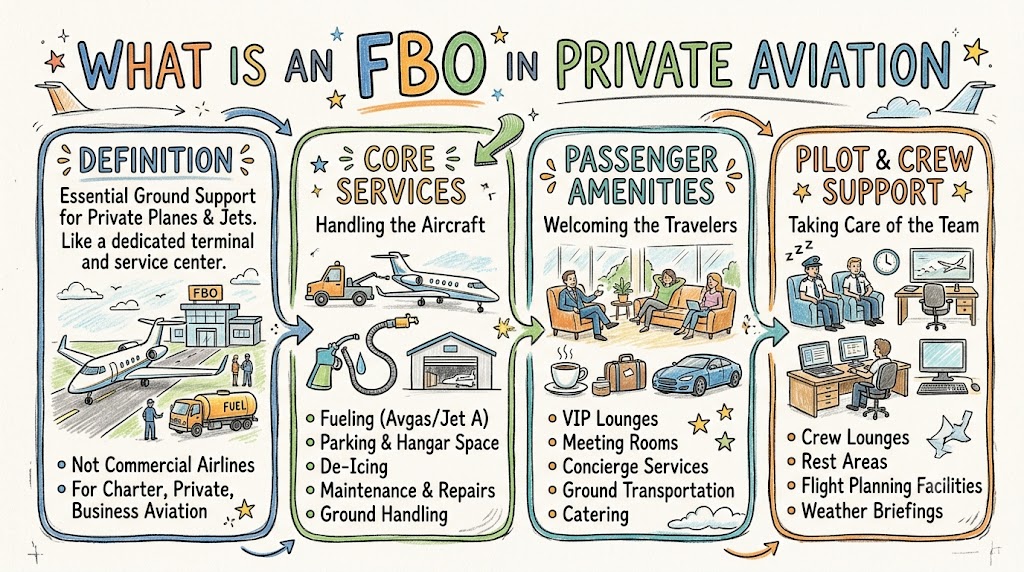
An FBO is an important part of private and business aviation. It provides essential services to aircraft, pilots, flight crews, passengers, charter companies, and aircraft owners. These services may include fuel, parking, hangar space, baggage assistance, catering, ground transportation, flight planning support, and passenger lounges.
Understanding the role of an FBO makes it much easier to understand how private flights operate while they are on the ground.
What Is an FBO in Private Aviation?
An FBO, or Fixed Base Operator, is an airport-based business that provides aviation services to aircraft operators, pilots, crews, and passengers. Common services include aircraft fuel, parking, hangar space, ground handling, maintenance coordination, passenger lounges, catering, and transportation assistance.
The Federal Aviation Administration describes FBOs as businesses that provide flight and aircraft support services to airport users, including fuel sales, aircraft maintenance, and hangar facilities.
The National Air Transportation Association also describes FBOs as primary service providers for general aviation aircraft operators.
An FBO is therefore more than a comfortable waiting room for private jet passengers. It is an operational centre that helps prepare, service, manage, and support aircraft while they are on the ground.
What Does FBO Mean in Aviation?
FBO stands for Fixed Base Operator.
The name can be understood in three parts:
- Fixed means the business operates from a permanent location.
- Base refers to its established facility at an airport.
- Operator means the company manages and provides aviation-related services.
An FBO normally operates from property leased or authorised by an airport. Depending on the airport and the size of the business, its facilities may include:
- An executive passenger terminal
- Aircraft parking areas
- Fuel storage and fuel trucks
- One or more aircraft hangars
- Pilot and crew rooms
- Ground-handling equipment
- Offices and meeting rooms
- Maintenance facilities
Some FBOs provide only basic fuel and parking services. Others operate large executive terminals with extensive passenger, crew, aircraft, and concierge facilities.
Why Is It Called a Fixed Base Operator?
The expression “Fixed Base Operator” has historical roots in the early development of civil aviation in the United States.
After the First World War, many pilots travelled from one town to another and operated from temporary locations. These pilots were often known as barnstormers. They offered passenger rides, flight demonstrations, air shows, and other aviation services without having a permanent operating base.
The Air Commerce Act of 1926 introduced federal responsibilities related to pilot licensing, aircraft certification, air traffic rules, airways, and navigational support.
As civil aviation became more organised, pilots, mechanics, instructors, and aviation businesses began establishing permanent operations at airports. These permanent businesses became known as fixed-base operations, distinguishing them from travelling or temporary aviation businesses. An FAA publication connects the emergence of fixed-base operators with the aviation changes that followed the 1926 legislation.
Although the term originated in the United States, FBO is now widely used throughout international business and private aviation.
How Does an FBO Work?
An FBO serves as the connection between the aircraft, airport, flight crew, passengers, and local service providers.
Before an aircraft arrives, the pilot, flight department, charter company, or handling agent contacts the FBO. The FBO receives information such as:
- Aircraft registration
- Aircraft type
- Estimated arrival time
- Number of passengers
- Fuel requirements
- Parking duration
- Catering requests
- Ground transportation needs
- Customs or immigration requirements
- Special passenger or crew requests
The FBO then coordinates the required services.
A Typical Private Jet Arrival
A private aircraft lands and leaves the runway under the direction of air traffic control.
After reaching the FBO area, ground personnel may guide the aircraft to a designated parking position. This is known as aircraft marshalling.
Once the aircraft is safely parked:
- The engines are shut down.
- Ground staff secure the aircraft.
- Passenger steps may be positioned.
- Baggage is unloaded.
- Passengers enter the FBO terminal or go directly to a waiting vehicle.
- The aircraft receives fuel or other requested services.
- The crew completes flight planning and departure preparation.
When it is time to depart, the process is reversed. Passengers arrive at the FBO, complete any required security or travel formalities, meet the flight crew, and board the aircraft.
Main Services Provided by an FBO
The services available depend on the airport, the FBO, the aircraft, and local regulations. However, the following services are commonly associated with Fixed Base Operators.
Aircraft Fueling
Aircraft fueling is one of the most important FBO services.
An FBO may supply:
- Jet A or Jet A-1 for turbine aircraft
- Aviation gasoline for certain piston-powered aircraft
- Sustainable aviation fuel where available
Before the aircraft arrives, the flight crew or operator can request a specific amount of fuel. The FBO then schedules a fuel truck or directs the aircraft to a suitable fueling position.
Fuel handling must follow strict operational and quality-control procedures. The correct type and quantity of fuel are essential because an error could affect aircraft safety, range, weight, and performance.
Fuel purchases can also influence other FBO charges. Some operators reduce or waive certain handling or facility fees when an aircraft purchases a minimum amount of fuel.
Aircraft Parking and Hangar Services
Aircraft do not always depart immediately after landing. They may remain at the airport for several hours, overnight, or for multiple days.
An FBO may provide:
- Short-term ramp parking
- Overnight parking
- Aircraft tie-down positions
- Covered storage
- Heated hangars
- Long-term hangar rental
Hangar space can protect an aircraft from strong sunlight, snow, hail, heavy rain, dust, ice, wind, and other environmental conditions.
Availability may be limited, particularly during busy events, holiday periods, or severe weather. Aircraft operators should therefore reserve hangar space in advance whenever possible.
Private Jet Ground Handling
Private jet ground handling includes the practical services required while an aircraft is on the ground.
These services may include:
- Aircraft marshalling
- Towing and repositioning
- Baggage loading and unloading
- Ground power supply
- Lavatory servicing
- Potable-water servicing
- Aircraft cleaning
- Cabin preparation
- De-icing coordination
- Waste removal
The exact handling requirements depend on the aircraft. A small propeller aircraft needs different equipment and support than a large long-range business jet.
Ground personnel must also work carefully around aircraft surfaces, engines, propellers, wings, and sensors. Damage caused by ground equipment can be expensive and may make an aircraft temporarily unfit to fly.
Passenger Terminal Services
Many FBOs operate a private aviation terminal, sometimes called an executive terminal.
Passenger facilities may include:
- Private lounges
- Comfortable seating
- Wi-Fi
- Refreshments
- Coffee and snacks
- Conference rooms
- Workspaces
- Restrooms
- Television
- Charging points
- Concierge assistance
Unlike a commercial terminal, an FBO usually handles a much smaller number of passengers. This can provide a quieter and more private environment.
However, the experience varies considerably. A small regional airport may have a simple waiting room, while an international business aviation centre may offer luxury lounges, private meeting rooms, showers, sleeping areas, and premium concierge support.
Pilot and Crew Services
Flight crews often spend significant time at an FBO preparing for the next flight.
Pilot and crew services may include:
- Flight-planning rooms
- Weather-information access
- Computers and printers
- Crew lounges
- Quiet rest rooms
- Showers
- Refreshments
- Hotel reservations
- Local transportation
- Laundry coordination
- Catering assistance
Some FBOs also provide crew cars or courtesy vehicles for short local journeys. Availability and usage conditions depend on the individual operator.
Aircraft Catering
Private jet catering is more flexible than standard airline catering because meals can be prepared for a particular passenger group.
An FBO may arrange:
- Breakfast
- Snacks
- Hot meals
- Cold meals
- Beverages
- Fruit platters
- Business-class meal presentation
- Children’s meals
- Vegetarian or vegan options
- Meals for medical or religious dietary requirements
Catering requests should normally be placed in advance. Last-minute orders may be possible, but the available choices could be limited.
The FBO may receive the catering, inspect the delivery, store it correctly, and coordinate with the cabin crew to load it onto the aircraft.
Ground Transportation
FBOs often help passengers and crew arrange transportation between the airport and their destination.
Options may include:
- Chauffeur-driven cars
- Limousines
- Hotel transfers
- Rental cars
- Taxis
- Ride-hailing vehicles
- Shuttle services
- Crew transportation
At some FBOs, an approved vehicle may drive close to the aircraft. Passengers can then transfer directly between the private jet and the car, subject to airport security and operational rules.
This reduces walking distance and can provide additional privacy.
Aircraft Maintenance Support
Not every FBO operates a complete maintenance centre. However, many can provide basic technical support or coordinate with an approved maintenance organisation.
Support may include:
- Minor inspections
- Fluid servicing
- Tire-pressure checks
- Battery assistance
- Technical troubleshooting
- Replacement-part coordination
- Maintenance technician access
- Approved repair-station referrals
Serious mechanical problems require qualified and appropriately authorised maintenance personnel. The FBO may assist with coordination, but it should not perform work outside its technical approvals or capabilities.
Customs and Immigration Assistance
Some FBOs serve international flights and help coordinate customs, immigration, health, agricultural, or border requirements.
Assistance may include:
- Sharing arrival information with authorities
- Preparing passenger and crew documentation
- Confirming operating hours
- Reserving customs appointments
- Directing passengers to inspection areas
- Coordinating international waste handling
- Supporting visa and passport checks
An FBO does not replace a government border authority. Customs and immigration clearance is only available where it is legally authorised and where the appropriate government officers and facilities are available.
Aircraft operators must confirm requirements before departure because procedures differ by airport and country.
FBO Versus a Commercial Airport Terminal
An FBO and a commercial airline terminal may be located at the same airport, but they serve different operational needs.
| Feature | FBO or Private Terminal | Commercial Airline Terminal |
|---|---|---|
| Passenger volume | Usually low | Frequently high |
| Main users | Private, charter and business aviation | Scheduled airline passengers |
| Check-in process | Coordinated with the operator or crew | Airline counter, kiosk or application |
| Waiting time | Often shorter | Depends on airline and airport |
| Privacy | Generally higher | Limited in public areas |
| Boarding | Often from the ramp | Usually through a gate or bus |
| Lounge access | Often included for private-flight users | Usually ticket or membership dependent |
| Baggage handling | Coordinated directly with the aircraft | Managed through airline systems |
| Ground transport | Often arranged personally | Public pickup and drop-off zones |
| Aircraft services | Fuel, parking and handling available | Managed by airlines and ground handlers |
| Passenger experience | Personalised and low-volume | Standardised for large passenger numbers |
An FBO does not automatically allow passengers to avoid legal requirements. Passengers and crews must still follow applicable security, customs, immigration, passport, visa, health, and airport-access regulations.
Who Uses an FBO?
FBOs support far more than luxury private jet travel.
Private Jet Passengers
Passengers travelling on privately owned or chartered aircraft use FBO terminals for arrival, departure, waiting, meetings, baggage handling, and ground transportation.
Aircraft Owners and Operators
Aircraft owners depend on FBOs for fuel, parking, hangar space, cleaning, technical coordination, and routine ground support.
Charter Companies
Air charter operators work with FBOs to coordinate passenger movements, catering, handling, fuel, and aircraft turnaround services.
Corporate Flight Departments
Companies operating business aircraft use FBOs to support executives, employees, customers, and flight crews travelling on corporate missions.
Government and Military Flights
Government aircraft may use approved FBOs for fuel, handling, transportation, security coordination, and logistical support.
Medical Aviation Operators
Air ambulances and medical flights may require rapid fueling, direct ambulance access, medical-equipment handling, and careful coordination with hospitals.
NATA has highlighted that FBOs support essential public-service missions, including emergency medical services, law enforcement, fire management, and military operations.
Flight Schools and Student Pilots
Some FBOs provide flight instruction, aircraft rental, pilot supplies, fueling, and facilities for student pilots.
Cargo and Special-Mission Aircraft
Survey aircraft, aerial photography operators, emergency-response flights, cargo aircraft, and other specialised operations may also receive support from FBOs.
Facilities Passengers Can Expect at an FBO
Passenger facilities differ from one location to another. Common amenities include:
- Reception desk
- Passenger lounge
- Private seating area
- Meeting room
- Business workspace
- Wireless internet
- Refreshments
- Restrooms
- Television
- Local transport desk
- Rental-car assistance
- Hotel-booking support
Larger FBOs may also offer:
- Shower rooms
- Sleeping rooms
- Children’s play areas
- Pet relief areas
- Private dining rooms
- Prayer rooms
- Premium concierge services
- Direct vehicle-to-aircraft transfers
Passengers should not assume that every private aviation terminal provides luxury facilities. A small airport FBO may be functional and comfortable but relatively basic.
How FBOs Improve the Private Flying Experience
Greater Privacy
An FBO usually handles fewer passengers than an airline terminal. Public exposure is therefore more limited, which can be valuable to executives, public figures, families, and travellers who prefer discretion.
Reduced Waiting
Private-flight schedules are coordinated around the aircraft and passengers. Travellers may avoid airline check-in lines, large boarding areas, and baggage carousels.
Passengers must still arrive with enough time to complete all required security, documentation, customs, and immigration procedures.
Faster Aircraft Access
At many locations, passengers move from the lounge to the aircraft within a short period. Some airports permit direct vehicle access near the aircraft under controlled conditions.
Personalised Assistance
FBO staff can coordinate individual requests such as:
- Special meals
- Mobility assistance
- Pet handling
- Hotel reservations
- Private transportation
- Meeting rooms
- Last-minute supplies
Better Crew Coordination
Pilots can receive fuel, weather information, transportation, rest facilities, and operational assistance from one location. This helps the crew prepare the aircraft efficiently.
Efficient Aircraft Turnaround
An aircraft may require fuel, cleaning, catering, water, lavatory servicing, and baggage loading before departure.
By coordinating these services, an FBO helps reduce unnecessary ground delays.
How Much Do FBO Services Cost?
There is no universal price for using an FBO.
Costs depend on several factors, including:
- Airport location
- Aircraft type
- Maximum aircraft weight
- Fuel quantity
- Length of stay
- Ramp congestion
- Parking requirements
- Hangar requirements
- Passenger facilities
- Ground-handling needs
- Customs arrangements
- Local taxes and airport fees
Common FBO Charges
Fuel Charges
Fuel is normally priced per litre, gallon, or other local unit. Prices vary by airport, region, supplier, fuel type, and purchased quantity.
Handling Fees
A handling fee may cover the coordination of aircraft arrival, departure, ground staff, passenger support, and basic services.
Ramp or Facility Fees
An FBO may charge for the use of its ramp, terminal, or operational facilities.
Aircraft Parking Fees
Parking may be charged by the hour, day, night, or aircraft-weight category.
Hangar Fees
Indoor aircraft storage normally costs more than outdoor ramp parking. Rates depend on aircraft size, duration, and hangar availability.
Ground-Service Charges
Additional fees may apply for:
- Ground power
- Towing
- Lavatory servicing
- Water servicing
- De-icing
- Aircraft cleaning
- Baggage assistance
- International waste handling
Transportation and Catering
Meals, rental cars, hotel transfers, and chauffeur services are normally billed separately.
Some FBOs waive or reduce particular fees when the aircraft purchases a minimum quantity of fuel. Operators should request a written estimate before arrival, especially at major airports or during high-demand periods.
Are All FBOs the Same?
No. FBOs can differ significantly.
A basic FBO at a small airport may provide:
- Aviation fuel
- Outdoor parking
- A waiting room
- Restrooms
- Basic pilot assistance
A large international FBO may provide:
- Multiple passenger lounges
- Large aircraft hangars
- International handling
- Customs coordination
- Premium catering
- Crew sleeping rooms
- Executive meeting facilities
- 24-hour ground handling
- Dedicated concierge services
Differences may also exist in:
- Operating hours
- Fuel prices
- Safety programmes
- Staff experience
- Aircraft-size limitations
- Ground-equipment availability
- Hangar capacity
- Customer-service standards
Passengers and aircraft operators should evaluate an FBO based on operational suitability rather than appearance alone.
How to Choose the Right FBO
Some airports have only one FBO, while larger airports may have several. When choices are available, consider the following points.
Confirm Aircraft Compatibility
Make sure the ramp, hangar, towing equipment, fuel equipment, and ground-support resources are suitable for the aircraft.
Review Operating Hours
Confirm whether the FBO operates 24 hours or requires advance notice outside normal business hours.
Check Fuel Availability
Verify the required fuel type, expected price, minimum purchase conditions, and fueling schedule.
Ask About Parking
Confirm ramp availability, parking costs, security arrangements, and restrictions during busy periods.
Reserve Hangar Space
Hangar space should be booked in advance, particularly during winter, severe weather, major events, or peak travel seasons.
Review Passenger Facilities
Check whether the FBO provides appropriate lounges, meeting rooms, internet access, accessibility support, pet facilities, and refreshments.
Evaluate Crew Support
Confirm the availability of crew rooms, rest facilities, transportation, weather access, hotels, and flight-planning resources.
Confirm International Requirements
For an international flight, verify customs availability, operating hours, documentation deadlines, visa requirements, and border-clearance procedures.
Request Transparent Pricing
Ask for a complete estimate covering:
- Fuel
- Handling
- Parking
- Ramp use
- Hangar storage
- Ground services
- Airport charges
- Taxes
- After-hours services
Consider Safety and Reputation
Aircraft operators should review staff qualifications, safety procedures, service history, handling capabilities, and recognised industry standards.
Role of FBOs in Business Aviation
Business aviation depends on flexibility, efficiency, privacy, and reliable scheduling.
An executive may need to visit several locations in a single day, reach an airport that has limited airline service, or travel according to a confidential schedule. An FBO supports this type of operation by coordinating ground services around the aircraft’s arrival and departure.
FBOs help business aviation by providing:
- Rapid aircraft servicing
- Private passenger reception
- Meeting facilities
- Reliable ground transportation
- Crew support
- Flexible operating hours
- Shorter ground turnaround
- Access to regional airports
- Confidential handling
They also support the aircraft itself. Without fuel, safe parking, ground equipment, baggage handling, and operational coordination, the advantages of private aviation would be significantly reduced.
Common Misconceptions About FBOs
An FBO Is a Private Airport
An FBO is usually a business operating at an airport. It is not necessarily the airport itself.
Several independent FBOs may operate at the same public airport.
An FBO Is an Airline
An FBO does not normally sell scheduled airline seats. It supports aircraft and aviation customers on the ground.
Some companies may operate both an FBO and other aviation businesses, but the activities remain operationally distinct.
FBOs Only Serve Wealthy Travellers
FBOs serve private jet passengers, but they also support flight schools, piston aircraft, medical flights, emergency operations, government aircraft, charter services, maintenance providers, and other general aviation activities.
An FBO Only Sells Fuel
Fuel is a major service, but many FBOs also provide parking, hangars, ground handling, passenger lounges, crew support, transportation, catering, and maintenance coordination.
Every FBO Is Luxurious
Some FBOs have premium executive facilities, while others offer only basic operational services.
FBO Passengers Avoid All Security Procedures
Private aviation may use different procedures from commercial airline travel, but passengers must still comply with applicable laws, airport controls, security requirements, customs rules, and immigration procedures.
Future of FBO Services
FBO services continue to develop as business aviation adopts new technology and environmental practices.
Digital Service Requests
Pilots and operators increasingly use digital systems to request fuel, catering, parking, transportation, and handling before arrival.
Sustainable Aviation Fuel
Where supply and infrastructure permit, some FBOs are providing sustainable aviation fuel. NATA has also developed standardised documentation that allows operators to record sustainable aviation fuel deliveries.
Electric Ground Equipment
Electric tugs, service vehicles, and ground-support equipment may help reduce local emissions and noise.
Contactless Passenger Services
Digital documentation, electronic payments, and online coordination can make passenger and crew processing more efficient.
Smarter Ramp Management
Digital scheduling and aircraft-tracking systems can help FBOs manage parking, equipment, fuel trucks, and ground personnel more effectively.
Improved Environmental Practices
FBOs may adopt energy-efficient buildings, recycling programmes, water-saving systems, electric vehicles, and responsible waste-management procedures.
Key Takeaways
- FBO stands for Fixed Base Operator.
- An FBO is an airport-based company that supports aircraft, passengers, pilots, and crews.
- Its services may include fuel, parking, hangars, ground handling, catering, transportation, maintenance coordination, and passenger lounges.
- An FBO is not the same as an airport, airline, or charter company.
- Private jet passengers often use an FBO instead of the main commercial terminal.
- Facilities and service standards differ significantly between locations.
- FBO fees depend on the aircraft, airport, fuel purchase, parking duration, and services requested.
- Passengers and crews must still follow applicable security, customs, immigration, and airport regulations.
- FBOs also serve flight schools, medical aviation, government missions, emergency services, and other general aviation users.
Frequently Asked Questions
1. What does FBO stand for in aviation?
FBO stands for Fixed Base Operator. It is a business based at an airport that provides services to aircraft, passengers, pilots, crews, and aviation operators.
2. What is the main purpose of an FBO?
The main purpose of an FBO is to support aircraft and aviation customers while they are on the ground. Services may include fuel, parking, passenger lounges, ground handling, hangar storage, catering, and transportation.
3. Is an FBO the same as a private airport?
No. An FBO is normally a company operating at an airport. The airport may be publicly or privately owned, and more than one FBO may operate there.
4. Can private jet passengers avoid the main airport terminal?
At many airports, private jet passengers use an FBO terminal instead of the commercial airline terminal. However, they must still follow all applicable security, border-control, and airport-access procedures.
5. Do FBOs provide aircraft fuel?
Yes. Aircraft fueling is one of the primary services provided by many FBOs. Available fuel may include Jet A, Jet A-1, aviation gasoline, and sustainable aviation fuel at selected locations.
6. Can commercial aircraft use an FBO?
Certain commercial, charter, cargo, government, or special-mission aircraft may use an FBO when the facility can accommodate the aircraft and suitable arrangements have been made.
7. Do FBOs provide customs and immigration services?
Some FBOs are located at airports with customs and immigration facilities. The government authorities, not the FBO itself, make border-clearance decisions. Availability should be confirmed before the flight.
8. How much does it cost to use an FBO?
The cost depends on the airport, aircraft size, fuel purchased, parking duration, handling requirements, hangar use, and additional services. Operators should request an itemised estimate in advance.
9. Are FBO lounges available at every airport?
No. Many FBOs have passenger waiting areas, but the quality and range of facilities vary. Small airports may have basic lounges, while major business aviation airports may offer premium executive facilities.
10. How should passengers or operators choose an FBO?
They should compare location, operating hours, aircraft compatibility, fuel availability, parking, facilities, safety practices, crew support, customer service, customs access, and total cost.
Conclusion
An FBO is the operational centre that supports many private and business flights while they are on the ground. By bringing together aircraft fueling, parking, handling, passenger facilities, crew support, catering, and transportation, a Fixed Base Operator helps make private aviation more organised, efficient, and comfortable. Understanding what an FBO does allows passengers, aviation students, aircraft owners, and business travellers to better understand the complete private-flight experience.
