
Introduction
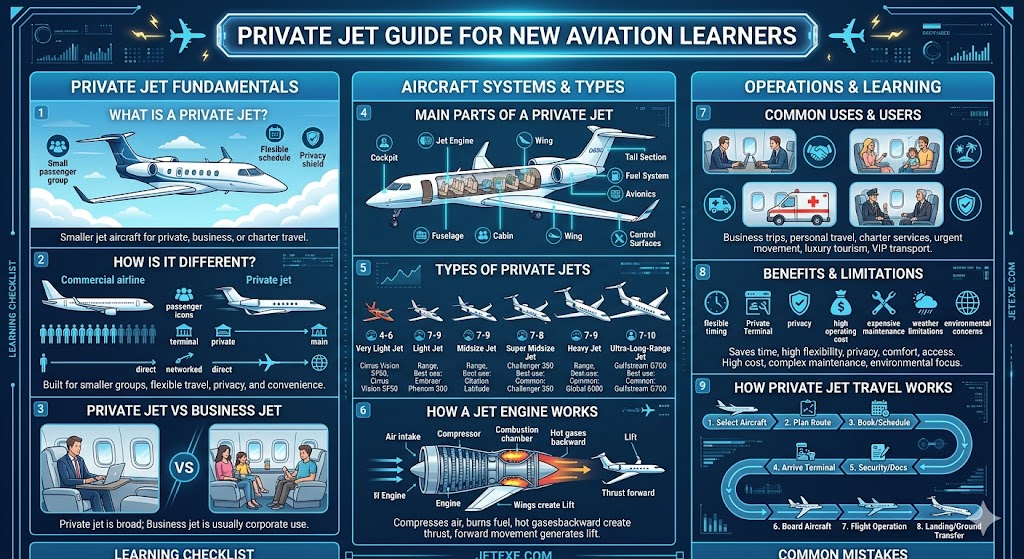
A private jet is one of the most interesting aircraft categories for new aviation learners. Many people connect private jets with luxury travel, but from an aviation learning point of view, they are much more than that. Private jets are advanced aircraft designed for flexible, comfortable, and time-saving travel. They are used for business trips, personal travel, charter services, emergency movement, luxury tourism, VIP transportation, and access to destinations that may not be easily served by regular airlines.
For beginners, private aviation can feel confusing because it includes different aircraft sizes, ownership models, charter services, airport terminals, pilots, maintenance teams, safety rules, and operating costs. However, the basic idea is simple. A private jet is a jet aircraft used by a smaller group of passengers instead of a large airline crowd. It offers more privacy, flexible scheduling, and direct route options.
This guide from JETEXE.COM explains private jets in simple language. You will learn what a private jet is, how it works, how it differs from commercial aircraft, the main types of private jets, common uses, benefits, limitations, cabin features, safety basics, and key terms every new aviation learner should understand.
What Is a Private Jet?
A private jet is a smaller jet aircraft used for private, business, or charter travel instead of regular airline passenger service. It is designed to carry fewer passengers than a commercial aircraft and usually offers more flexibility, privacy, and comfort.
Private jets may be owned by individuals, companies, governments, or aviation operators. Some private jets are used by business executives for corporate travel, while others are rented through charter companies for specific trips.
In simple words, a private jet is an aircraft that allows passengers to travel privately without using a regular airline flight. It can often fly directly to smaller airports, follow flexible schedules, and provide a more personalized travel experience.
How Is a Private Jet Different from a Commercial Aircraft?
Private jets and commercial aircraft are both used for air travel, but they are designed for different purposes. Commercial aircraft are mainly built to carry many passengers on scheduled airline routes. Private jets are built for smaller groups, flexible travel, privacy, and convenience.
| Feature | Private Jet | Commercial Aircraft |
|---|---|---|
| Passenger Capacity | Usually carries fewer passengers | Carries many passengers |
| Travel Schedule | More flexible | Fixed airline schedule |
| Airport Experience | Often uses private terminals | Uses main airport terminals |
| Privacy | High privacy | Shared cabin with many passengers |
| Comfort | Personalized cabin experience | Standard airline seating classes |
| Route Planning | More direct route options | Based on airline network |
| Boarding Process | Usually faster | Longer check-in and boarding process |
| Operating Cost | Higher per passenger | Lower per passenger |
| Common Users | Individuals, companies, charter customers, VIPs | General public, tourists, business travelers |
A commercial aircraft is best for mass transportation. A private jet is best for travelers who need privacy, flexibility, and time-saving travel.
Why Do People Use Private Jets?
People use private jets for many practical reasons. While comfort is one reason, the biggest benefit is often time efficiency. Private jets can reduce waiting time, offer flexible departure schedules, and sometimes access airports closer to the final destination.
Common reasons people use private jets include:
- Time-saving travel: Passengers can avoid many long airport procedures.
- Flexible schedules: Flights can often be arranged based on the passenger’s timing.
- Privacy: Passengers can travel without sharing the cabin with unknown travelers.
- Comfort: Cabins are designed for a calm and premium experience.
- Business productivity: Executives can work, discuss plans, or rest during travel.
- Access to smaller airports: Some private jets can use airports not served by major airlines.
- Direct routes: Private jets can often fly closer to the destination.
- Emergency or urgent travel: They can support urgent movement when timing matters.
Private jets are useful when time, privacy, convenience, and route flexibility are important.
Main Parts of a Private Jet
A private jet has many important parts that work together to make flight possible. New aviation learners should understand these basic components first.
Jet Engine
The jet engine is the power source of the aircraft. It creates thrust by taking in air, compressing it, mixing it with fuel, burning the mixture, and pushing hot gases backward.
Wings
Wings create lift. As the private jet moves forward, air flows around the wings and helps raise the aircraft into the sky.
Fuselage
The fuselage is the main body of the aircraft. It contains the cockpit, cabin, luggage area, systems, and structural sections.
Cockpit
The cockpit is where pilots control the aircraft. It includes flight controls, navigation displays, communication systems, engine controls, and safety instruments.
Cabin
The cabin is the passenger area. In private jets, the cabin may include comfortable seating, tables, lighting, luggage space, and other travel features.
Tail Section
The tail section helps with stability and control. It includes vertical and horizontal stabilizers that help keep the aircraft balanced during flight.
Landing Gear
Landing gear includes the wheels and support structure used during takeoff, landing, and taxiing on the ground.
Fuel System
The fuel system stores and delivers aviation fuel to the engines. Fuel is often stored in wing tanks or other aircraft tank areas.
Avionics
Avionics are the electronic systems used for navigation, communication, monitoring, and flight control support.
Control Surfaces
Control surfaces are movable parts on the wings and tail. They help pilots control direction, speed, lift, and aircraft movement.
How Does a Private Jet Work?
A private jet works in the same basic way as other jet aircraft. Its engines create thrust, and its wings create lift. The aircraft moves forward through engine power, and the wing shape helps lift it into the air.
The working process is simple:
1- Air Enters the Engine
Air enters the engine through the intake at the front. The engine needs air to support combustion and produce thrust.
2- Air Is Compressed
Inside the engine, compressor blades squeeze the air and increase its pressure. Compressed air helps the fuel burn efficiently.
3- Fuel Is Mixed and Burned
Aviation fuel is sprayed into the compressed air. The mixture is ignited inside the combustion chamber, creating hot, high-pressure gases.
4- Hot Gases Move Backward
The hot gases rush toward the back of the engine at high speed.
5- Thrust Pushes the Jet Forward
As gases move backward, the aircraft is pushed forward. This forward force is called thrust.
6- Wings Generate Lift
As the private jet moves forward, air flows over and under the wings. This creates lift, which allows the aircraft to take off and fly.
7- Pilots Control the Aircraft
Pilots use cockpit controls, avionics, and flight instruments to manage speed, altitude, direction, engine power, and flight path.
Types of Private Jets
Private jets are commonly classified by size, range, passenger capacity, and mission type. New aviation learners can understand them more easily by looking at these main categories.
1- Very Light Jets
Very light jets are small private jets designed for short trips and fewer passengers. They are useful for quick regional travel, short business trips, and access to smaller airports.
These jets usually have compact cabins and lower operating costs compared to larger private jets. They are often chosen when a small group needs fast and flexible travel over shorter distances.
2- Light Jets
Light jets are slightly larger than very light jets. They offer better comfort, more cabin space, and improved range. They are popular for short business trips, leisure travel, and regional private flights.
Light jets are often considered a practical entry-level private jet category because they balance comfort, speed, and operating efficiency.
3- Midsize Jets
Midsize jets provide more cabin space, better range, and improved passenger comfort compared to light jets. They are suitable for medium-distance travel and can often carry more passengers.
These jets may include better luggage space, more comfortable seating, and cabin features useful for business or family travel.
4- Super Midsize Jets
Super midsize jets offer a strong balance of range, speed, cabin space, and performance. They are designed for longer trips than midsize jets while still being more efficient than larger heavy jets in many cases.
They are commonly used for business travel, executive movement, and premium private aviation needs.
5- Heavy Jets
Heavy jets are larger private jets suitable for longer routes and more passengers. They usually offer spacious cabins, better onboard comfort, and higher range capability.
Heavy jets are often used for international business travel, long family trips, VIP travel, and premium charter services.
6- Ultra-Long-Range Jets
Ultra-long-range jets are designed for long-distance private travel. They can connect faraway destinations with fewer stops and provide a high level of cabin comfort.
These jets are often used by global business travelers, international charter customers, and passengers who need long-range private aviation options.
Private Jet vs Business Jet
The terms private jet and business jet are closely related. In many cases, the same aircraft can be called both. The difference is usually based on how the aircraft is used.
A private jet is a broad term for a jet aircraft used privately by individuals, companies, or charter customers. A business jet is usually a private jet used mainly for corporate or executive travel.
For example, if a company uses a jet to move executives between meetings, it is often called a business jet. If an individual uses a similar aircraft for family travel or private trips, it may be called a private jet.
Private Jet vs Charter Jet
A private jet may be owned by a person, company, or operator. A charter jet is a private jet rented for a specific trip.
Chartering means the traveler does not own the aircraft. Instead, they book a private flight through a charter operator or private aviation service. The operator manages the aircraft, crew, maintenance, scheduling, and flight planning.
In simple words:
- Private jet: The aircraft category.
- Charter jet: A private jet rented for a trip.
- Owned private jet: A private jet owned by an individual or company.
This difference is important for beginners because not every private jet passenger owns the aircraft.
Common Uses of Private Jets
Private jets are used for many types of travel. Some uses are business-related, while others are personal, medical, or official.
Common uses include:
Business Meetings
Executives and business teams use private jets to attend meetings, visit multiple cities, and save travel time.
Personal Vacations
Families and individuals may use private jets for holidays, special trips, or convenient travel to remote destinations.
Family Travel
Private jets provide privacy and flexibility for families traveling together, especially when schedules are complex.
Luxury Tourism
Some travelers use private jets for premium travel experiences, private tours, and high-comfort journeys.
Sports and Entertainment Travel
Athletes, entertainers, and production teams may use private jets to move between events, performances, or competitions.
Medical and Emergency Travel
In some cases, private aircraft may support urgent medical movement, emergency travel, or special transport needs.
Remote Destination Access
Private jets may reach smaller airports closer to remote or less-connected destinations, depending on aircraft capability and airport conditions.
Government and VIP Movement
Officials, diplomats, and VIP passengers may use private jets for secure, flexible, and time-sensitive travel.
Benefits of Private Jets
Private jets offer several advantages for passengers and organizations.
Flexible Travel Timing
Private jet schedules are often more flexible than airline schedules. This helps passengers travel according to their own timing.
Faster Airport Process
Private jets often use private terminals, which may reduce waiting time and simplify boarding.
Direct Route Options
Private jets can sometimes fly directly to airports closer to the final destination, reducing extra travel time.
Privacy and Comfort
Passengers can travel in a private cabin with fewer people, quiet surroundings, and personalized seating arrangements.
Time-Saving for Business Travelers
Business travelers can attend meetings in different cities more efficiently and use flight time productively.
Access to Smaller Airports
Some private jets can use smaller airports that are not served by commercial airlines, depending on runway length and local rules.
Customized Travel Experience
Private jet travel may allow customized cabin arrangements, flight timing, and route planning.
Useful for Urgent Trips
When timing is critical, private jets may provide faster travel planning compared to regular airline routes.
Limitations of Private Jets
Private jets are useful, but they also have important limitations that learners should understand.
High Operating Cost
Private jets are expensive to operate. Costs may include fuel, crew, maintenance, insurance, parking, handling, and airport fees.
Expensive Maintenance
Jet aircraft require regular inspections and professional maintenance. This is essential for safety and reliability.
Fuel Cost
Jet fuel is a major operating expense. Larger jets and longer flights usually require more fuel.
Crew and Pilot Requirements
Private jets need trained pilots, and many larger jets require two pilots. Some aircraft may also include cabin crew.
Airport and Handling Fees
Private jet operations may involve airport charges, ground handling, parking, and terminal fees.
Weather and Operational Limitations
Weather, runway length, airport rules, aircraft range, and air traffic conditions can affect private jet operations.
Environmental Concerns
Private aviation faces environmental questions related to fuel use, emissions, and noise.
Regulatory Requirements
Private jets must follow aviation rules, safety standards, airspace regulations, and operational procedures.
Private Jet Cabin Features
Private jet cabins vary by aircraft size and category. A very light jet may have a simple cabin, while an ultra-long-range jet may have a large and highly comfortable interior.
Common cabin features include:
Comfortable Seating
Private jets usually have soft, comfortable seats. In larger jets, seats may recline, rotate, or convert for rest.
Work Tables
Many private jet cabins include fold-out or fixed tables for laptops, documents, meals, or meetings.
Cabin Lighting
Cabin lighting helps create a comfortable travel environment and may be adjustable in larger jets.
Refreshment Area
Some private jets include a small refreshment area for drinks and light food service.
Luggage Space
Private jets include luggage areas, though storage capacity depends on aircraft size.
Quiet Cabin Design
Many private jets are designed to reduce cabin noise and provide a calm travel experience.
Communication Systems
Some private jets may offer communication systems, Wi-Fi, or connectivity features depending on aircraft type and service availability.
Lavatory
Many midsize, heavy, and ultra-long-range jets include a lavatory. Smaller jets may have limited or no lavatory depending on design.
How Private Jet Travel Works Step by Step
Private jet travel is different from regular airline travel. The process is usually more flexible and personalized.
1- Choosing the Aircraft Type
The aircraft is selected based on passenger count, travel distance, luggage needs, airport conditions, and budget.
2- Planning the Route
The route is planned based on departure airport, destination airport, weather, airspace rules, fuel needs, and flight permits where required.
3- Booking or Scheduling the Flight
If chartering, the passenger books the aircraft through a charter provider or operator. If the aircraft is owned, the flight is scheduled through the owner’s aviation team.
4- Arriving at a Private Terminal
Passengers often arrive at a private terminal or fixed-base operator instead of the main airline terminal.
5- Security and Document Checks
Passengers still complete required identity, security, customs, or immigration checks depending on the route and country rules.
6- Boarding the Aircraft
Boarding is usually quicker and more direct than commercial airline boarding.
7- Flight Operation
Pilots operate the aircraft using flight plans, air traffic control communication, cockpit systems, and safety procedures.
8- Landing and Ground Transfer
After landing, passengers may exit through a private terminal and continue by ground transport arranged in advance.
Who Operates a Private Jet?
Private jet operations involve several trained professionals. Each person has a specific role in safe and smooth flight operations.
Pilot
The pilot controls the aircraft and is responsible for safe flight operation.
Co-Pilot
The co-pilot assists the pilot with navigation, communication, checklists, and aircraft control. Larger jets usually require two pilots.
Aircraft Owner
The owner may be an individual, company, government body, or aviation organization.
Charter Company
A charter company arranges private flights for customers and manages booking, aircraft selection, and service coordination.
Ground Staff
Ground staff help with aircraft movement, fueling, baggage handling, passenger support, and terminal operations.
Maintenance Team
Maintenance engineers inspect, repair, and service the aircraft to keep it safe and airworthy.
Flight Dispatcher
A flight dispatcher may help with route planning, weather review, scheduling, fuel planning, and operational coordination.
Cabin Crew
Larger private jets may include cabin crew to assist passengers during flight.
What Is a Private Jet Charter?
A private jet charter means renting a private jet for a specific trip. The traveler does not own the aircraft. Instead, they pay to use it for a selected route and schedule.
Charter services are useful for people who need private jet access occasionally but do not want the cost and responsibility of ownership.
A private jet charter may include:
- Aircraft selection
- Route planning
- Crew arrangement
- Ground handling
- Flight scheduling
- Passenger support
- Safety and operational coordination
For new aviation learners, chartering is one of the easiest ways to understand how private jet access works without ownership.
What Is Fractional Jet Ownership?
Fractional jet ownership means multiple users share access to an aircraft or aircraft program. Instead of owning an entire jet, a person or company owns a share of access.
This model can be useful for travelers who fly privately often but do not want full aircraft ownership. Fractional ownership programs usually include aircraft management, crew, maintenance, scheduling, and operational support.
In simple words, fractional ownership is like sharing private jet access under a structured aviation program.
What Is Jet Card Membership?
A jet card membership is a private aviation access model where travelers buy prepaid flight hours or membership-based access under defined terms.
Jet cards can make private aviation easier for users who want predictable access without owning an aircraft. Rules, pricing, aircraft availability, and service terms vary by provider.
For beginners, a jet card can be understood as a prepaid or membership-style way to book private jet travel.
Safety in Private Jets
Private jets follow aviation safety rules, maintenance requirements, pilot training standards, and operational procedures. Safety depends on professional crews, approved aircraft, proper maintenance, weather planning, and regulatory compliance.
Important safety elements include:
- Qualified pilots
- Aircraft inspections
- Maintenance records
- Weather planning
- Flight planning
- Air traffic control coordination
- Safety checklists
- Emergency procedures
- Avionics and navigation systems
Aviation safety is not based on aircraft luxury. It is based on training, maintenance, regulations, procedures, and disciplined operation.
Private Jet Airports and Terminals
Private jets often use private terminals known as fixed-base operators. These terminals provide services for private aviation, such as passenger lounges, aircraft parking, fueling, ground handling, and crew support.
Private jets may also access smaller airports, but this depends on:
- Runway length
- Aircraft size
- Weather conditions
- Airport rules
- Fuel availability
- Ground support
- Local regulations
Not every private jet can land anywhere. The airport must be suitable for the aircraft’s performance and safety requirements.
Popular Examples of Private Jets
There are many well-known private jet families used around the world. New aviation learners may hear these names often when studying private aviation.
Cessna Citation Series
The Cessna Citation series includes several popular private and business jets across different size categories. They are commonly used for business and charter operations.
Embraer Phenom Series
The Embraer Phenom series includes light and executive jet options. These aircraft are known in private aviation for short to medium-range travel.
Bombardier Challenger Series
The Bombardier Challenger series includes larger business jets used for longer trips, executive travel, and premium private aviation.
Bombardier Global Series
The Bombardier Global series includes long-range and ultra-long-range business jets designed for international travel.
Gulfstream Business Jets
Gulfstream jets are widely recognized in business aviation. They are often used for long-range executive and private travel.
Dassault Falcon Series
Dassault Falcon jets are business aircraft known for private and corporate aviation roles.
Pilatus PC-24
The Pilatus PC-24 is a business jet used for flexible private aviation operations, including access to a wide range of airports depending on conditions.
Private Jet Comparison Table
| Private Jet Type | Typical Use | Cabin Comfort | Range Level | Best For |
|---|---|---|---|---|
| Very Light Jet | Short private trips | Basic to moderate | Short range | Small groups and quick regional travel |
| Light Jet | Short business or leisure trips | Moderate | Short to medium range | Business travelers and small families |
| Midsize Jet | Medium-distance trips | Good | Medium range | More comfort and longer routes |
| Super Midsize Jet | Longer private trips | High | Medium to long range | Executive travel and premium flexibility |
| Heavy Jet | Long-distance travel | Very high | Long range | Larger groups and international routes |
| Ultra-Long-Range Jet | Global private travel | Premium | Very long range | Long international flights and VIP travel |
Private Jet Learning Checklist for Beginners
New aviation learners can use this checklist to build a strong foundation in private jet knowledge:
- Understand what a private jet is
- Learn how private jets differ from commercial aircraft
- Study the main types of private jets
- Learn basic jet engine operation
- Understand cabin and cockpit parts
- Learn the role of pilots and aviation teams
- Understand charter, ownership, fractional ownership, and jet cards
- Study safety and maintenance basics
- Learn how private terminals and airports work
- Compare private jets with commercial aircraft
- Understand aircraft range and runway requirements
- Learn basic private aviation terms
Common Mistakes New Aviation Learners Make
New aviation learners often misunderstand private jets because they are usually shown as luxury machines. In reality, private jets are complex aircraft with serious operational, safety, and technical requirements.
Thinking All Private Jets Are the Same
Private jets vary by size, range, cabin design, passenger capacity, and operating purpose. A very light jet is very different from an ultra-long-range jet.
Confusing Private Jets with Commercial Jets
Private jets and commercial jets both use aviation technology, but they serve different travel needs. Commercial jets carry many passengers on scheduled routes, while private jets support flexible and private travel.
Ignoring Operating Costs
Private aviation is expensive because of fuel, crew, maintenance, airport fees, insurance, and aircraft management.
Thinking Private Jets Can Land Anywhere
Private jets cannot land anywhere. They need suitable runways, airport permissions, weather conditions, and ground support.
Not Understanding Aircraft Range Limits
Every aircraft has a range limit. A small private jet cannot fly as far as an ultra-long-range jet without stopping.
Assuming Charter and Ownership Are the Same
Chartering means renting a jet for a trip. Ownership means owning the aircraft or having structured access through ownership models.
Focusing Only on Luxury Instead of Aviation Function
Private jets are comfortable, but they are also highly engineered aircraft. Learners should focus on safety, systems, operations, and aviation purpose.
Future of Private Jets
Private jet technology continues to improve. The future of private aviation is expected to focus on efficiency, safety, comfort, noise reduction, and environmental responsibility.
More Fuel-Efficient Engines
Engine manufacturers are working toward better fuel efficiency to reduce operating cost and environmental impact.
Sustainable Aviation Fuel
Sustainable aviation fuel is becoming an important part of the aviation industry’s effort to reduce emissions.
Quieter Cabin and Engine Design
Future private jets may offer quieter cabins and engines, making flights more comfortable and reducing airport-area noise.
Improved Avionics
Modern avionics help pilots with navigation, communication, weather awareness, system monitoring, and decision-making.
Better Safety Systems
Future aircraft will continue to improve with better sensors, warning systems, automation support, and maintenance monitoring.
Hybrid-Electric Research
Researchers are studying hybrid-electric aircraft systems that may support cleaner and more efficient aviation in the future.
Smarter Flight Planning Technology
Digital tools are improving route planning, fuel planning, weather tracking, and operational efficiency.
Frequently Asked Questions
1- What is a private jet?
A private jet is a smaller jet aircraft used for private, business, or charter travel instead of regular airline passenger service. It usually carries fewer passengers and offers more privacy, comfort, and schedule flexibility. Private jets may be owned by individuals, companies, or aviation operators.
2- How does a private jet work?
A private jet works by using jet engines to create thrust. Air enters the engine, gets compressed, mixes with fuel, burns, and exits as high-speed gases. This pushes the aircraft forward. As the jet moves, its wings generate lift, allowing it to take off and fly.
3- What is the difference between a private jet and a commercial aircraft?
A private jet is designed for smaller groups, flexible schedules, privacy, and direct travel. A commercial aircraft is designed to carry many passengers on fixed airline routes. Private jets often use private terminals, while commercial aircraft use regular airport terminals.
4- Are private jets and business jets the same?
Private jets and business jets are often similar aircraft. The term private jet is broader and can include personal, charter, and company use. A business jet usually refers to a private jet used mainly for corporate or executive travel.
5- What are the main types of private jets?
The main types of private jets include very light jets, light jets, midsize jets, super midsize jets, heavy jets, and ultra-long-range jets. These categories are based on size, range, cabin comfort, and passenger capacity.
6- What is a private jet charter?
A private jet charter means renting a private jet for a specific trip. The traveler does not own the aircraft. Instead, a charter company or operator provides the aircraft, crew, scheduling, and flight support for the journey.
7- Can private jets land at small airports?
Some private jets can land at smaller airports, but not all of them can. It depends on runway length, aircraft size, weather, airport rules, and ground support. Larger private jets may need longer runways and more airport facilities.
8- How many passengers can a private jet carry?
Passenger capacity depends on the type and size of the private jet. Very light jets carry only a small number of passengers, while heavy and ultra-long-range jets can carry larger groups. The exact number varies by aircraft model and cabin layout.
9- Are private jets safe?
Private jets can be safe when operated under proper aviation rules, maintenance standards, pilot training, and safety procedures. Safety depends on the aircraft condition, crew qualifications, weather planning, operational discipline, and regulatory compliance.
10- What should new aviation learners know first about private jets?
New learners should first understand what a private jet is, how it differs from commercial aircraft, how jet engines create thrust, and why private jets are used. They should also learn about jet types, charter models, safety basics, aircraft range, and airport limitations.
Conclusion
A private jet is much more than a luxury travel symbol. It is a specialized jet aircraft designed for flexible, private, and efficient travel. Private jets are used for business trips, personal travel, charter services, urgent movement, VIP transport, and access to destinations that may not be easily reached by regular airlines. For new aviation learners, understanding private jets starts with simple basics: how they work, what parts they have, how they differ from commercial aircraft, and why different private jet categories exist. It is also important to understand safety, maintenance, operating costs, airport requirements, and charter models. As private aviation continues to evolve, future private jets may become more efficient, quieter, smarter, and more environmentally responsible. Keep learning with JETEXE.COM to build a clear and practical understanding of private jets, jet aircraft, and modern aviation.
