
Introduction
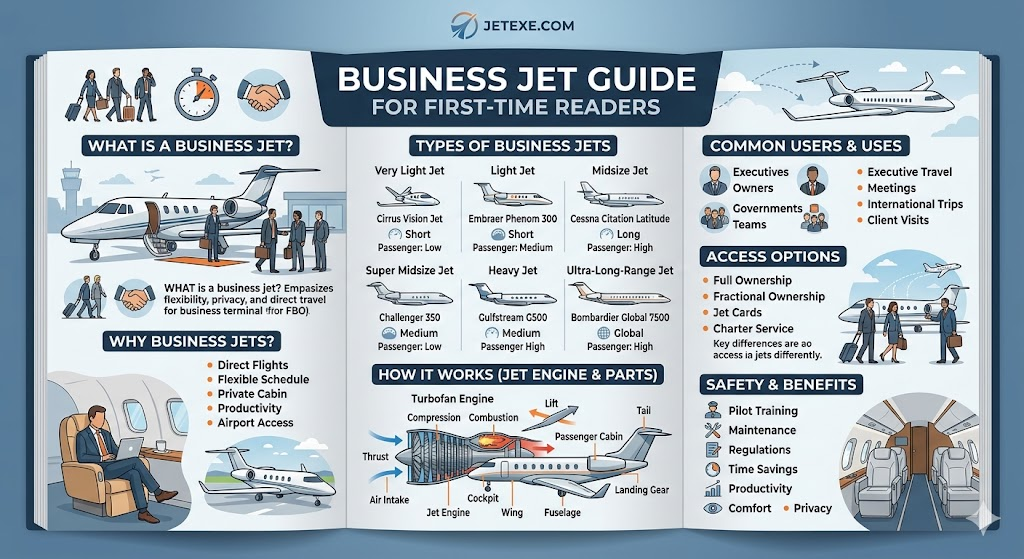
A business jet is a special type of jet aircraft used mainly for business, executive, corporate, and private travel. These aircraft are commonly used by companies, entrepreneurs, executives, government officials, charter operators, and high-value travel users who need flexible and time-saving transportation.
For first-time readers, business jets may look like luxury aircraft, but they are also important aviation tools. They help people travel directly, attend meetings faster, reach smaller airports, save working time, and maintain privacy during travel. A business jet is not just about comfort; it is also about efficiency, planning, productivity, and mobility.
This guide from JETEXE.COM explains business jets in simple language. You will learn what a business jet is, how it works, how it differs from commercial aircraft and private jets, who uses it, what types exist, and why business aviation matters.
What Is a Business Jet?
A business jet is a jet aircraft designed mainly for business and executive travel. It usually carries fewer passengers than a commercial airliner and provides more flexibility, privacy, and comfort.
Business jets may be owned by companies, individuals, governments, or aviation operators. Some are also available through charter services, fractional ownership programs, or jet card memberships.
In simple words, a business jet is a private-style aircraft used to help people travel quickly and efficiently for business or executive needs.
Why Are Business Jets Important?
Business jets are important because they help save time and improve travel flexibility. In business, time is often valuable, and commercial airline schedules may not always match urgent travel needs.
Business jets are useful because they offer:
- Direct travel options
- Flexible scheduling
- Private cabin space
- Faster airport experience
- Access to smaller airports
- Better productivity during travel
- Reduced dependency on airline routes
- Support for urgent or special travel needs
They are especially useful for companies and professionals who need to visit multiple cities, reach remote locations, or travel on tight schedules.
Business Jet vs Commercial Airliner
| Feature | Business Jet | Commercial Airliner |
|---|---|---|
| Passenger Capacity | Carries fewer passengers | Carries many passengers |
| Travel Flexibility | Highly flexible | Fixed airline schedules |
| Airport Access | Can often use smaller airports | Usually uses major airports |
| Privacy | High privacy | Shared cabin with many passengers |
| Flight Scheduling | Based on user needs | Based on airline timetable |
| Boarding Experience | Often faster through private terminals | Longer check-in and boarding process |
| Typical Users | Executives, companies, charter customers, officials | General public, tourists, business travelers |
| Operating Cost | Higher per passenger | Lower per passenger |
A commercial airliner is designed for mass transportation. A business jet is designed for flexible, private, and time-focused travel.
Business Jet vs Private Jet
Business jets and private jets are closely related. In many cases, the same aircraft can be called both. The difference is mostly based on how the aircraft is used.
A private jet is a broad term for a jet aircraft used privately instead of regular airline service. A business jet is usually a private jet used mainly for corporate, executive, or professional travel.
For example, if a company uses a jet to move executives to meetings, it is often called a business jet. If a family uses a similar jet for personal travel, it may simply be called a private jet.
How Does a Business Jet Work?
A business jet works like other jet aircraft. It uses jet engines to create thrust and wings to create lift.
The basic process is:
1- Air Intake
Air enters the jet engine through the front intake section.
2- Compression
Inside the engine, compressor blades squeeze the air and increase its pressure.
3- Fuel Combustion
Fuel is mixed with compressed air and burned inside the combustion chamber. This creates hot, high-pressure gases.
4- Thrust Generation
The hot gases move backward at high speed. This pushes the aircraft forward. This forward force is called thrust.
5- Lift Creation
As the business jet moves forward, air flows over and under the wings. The wings create lift, allowing the aircraft to take off and fly.
6- Aircraft Control Systems
Pilots use cockpit controls, avionics, and flight instruments to manage speed, altitude, direction, engine power, and flight path.
Main Parts of a Business Jet
A business jet has many important parts that work together during flight.
Jet Engine
The jet engine produces thrust. It takes in air, compresses it, mixes it with fuel, burns the mixture, and releases high-speed gases backward.
Wings
Wings generate lift. Their shape helps air flow in a way that raises the aircraft into the sky.
Fuselage
The fuselage is the main body of the aircraft. It holds the cockpit, cabin, luggage area, systems, and structure.
Cockpit
The cockpit is where pilots control the aircraft. It includes flight controls, displays, navigation tools, communication systems, and engine controls.
Passenger Cabin
The passenger cabin is where travelers sit. In business jets, the cabin may include comfortable seating, work areas, lighting, storage, and refreshment space.
Tail Section
The tail section helps with aircraft stability and control. It includes vertical and horizontal stabilizers.
Landing Gear
Landing gear includes the wheels and support structure used for takeoff, landing, and ground movement.
Fuel System
The fuel system stores and supplies aviation fuel to the engines. Fuel may be stored in the wings or other aircraft tank areas.
Avionics
Avionics are electronic systems used for navigation, communication, weather monitoring, aircraft control, and safety support.
Control Surfaces
Control surfaces are movable parts on the wings and tail. They help pilots control direction, climb, descent, turning, and speed management.
Types of Business Jets
Business jets are commonly grouped by size, range, cabin comfort, and passenger capacity.
1- Very Light Business Jets
Very light business jets are small jets designed for short-distance travel. They usually carry a small number of passengers and are suitable for quick regional business trips.
They are often used by small teams, individual executives, or charter users who need short and efficient flights.
2- Light Business Jets
Light business jets offer more comfort and range than very light jets. They are useful for regional business travel, short meetings, and trips between nearby cities.
They are popular because they provide a practical balance of cost, speed, and flexibility.
3- Midsize Business Jets
Midsize business jets provide more cabin space, better comfort, and longer range than light jets. They are suitable for medium-distance business travel.
These jets may include better seating, more luggage capacity, and improved passenger comfort.
4- Super Midsize Business Jets
Super midsize business jets offer stronger performance, longer range, and more cabin space. They are often used for executive travel and longer domestic or international routes.
They are useful for travelers who need more comfort without moving into the largest jet categories.
5- Heavy Business Jets
Heavy business jets are larger aircraft designed for long-distance executive travel. They usually have spacious cabins, more seating, and better onboard facilities.
These jets are often used for international business trips, VIP transport, and premium charter operations.
6- Ultra-Long-Range Business Jets
Ultra-long-range business jets are designed for global travel. They can fly very long distances with fewer stops and provide high cabin comfort for long journeys.
They are commonly used by global companies, international executives, governments, and long-distance charter customers.
Who Uses Business Jets?
Business jets are used by many types of people and organizations.
Common users include:
- Corporate executives
- Business owners
- Entrepreneurs
- Government officials
- Charter customers
- Sports teams
- Entertainment professionals
- High-level consultants
- Emergency travel users
- Aviation service providers
The main reason these users choose business jets is flexibility. Business jets help them travel when and where they need to.
Common Uses of Business Jets
Business jets are used for many professional and operational purposes.
Executive Travel
Executives use business jets to attend meetings, visit offices, and travel between cities efficiently.
Corporate Meetings
Companies may use business jets to move leadership teams or project teams to important meetings.
International Business Trips
Large companies may use long-range business jets for international travel.
Client Visits
Business jets help companies reach clients, partners, factories, offices, and project sites faster.
Government Transport
Government officials may use business jets for official travel, diplomatic movement, and urgent duties.
Special Missions
Some business jets are adapted for medical, research, surveillance, or special operational missions.
Charter Operations
Charter companies use business jets to provide private flights for customers who do not own aircraft.
Urgent Travel Needs
Business jets can support urgent travel when airline schedules are not suitable.
Benefits of Business Jets
Business jets offer several practical benefits.
Time Savings
Business jets can reduce waiting time and help passengers travel directly to their destination.
Flexible Scheduling
Flights can often be planned around the traveler’s schedule instead of fixed airline timetables.
Direct Flights
Business jets can sometimes fly directly to airports closer to the final destination.
Access to Smaller Airports
Many business jets can use smaller airports, depending on runway length and airport facilities.
Productivity During Travel
Passengers can work, hold discussions, review documents, or rest during the flight.
Privacy
A business jet cabin provides a private environment for travel and sensitive discussions.
Comfort
Cabins are designed for a calmer and more comfortable travel experience.
Reduced Travel Delays
Business jets can reduce some delays related to commercial airline connections, though weather and air traffic can still affect flights.
Limitations of Business Jets
Business jets also have limitations that first-time readers should understand.
High Purchase Cost
Buying a business jet is expensive. The cost depends on aircraft type, size, age, condition, and features.
Fuel Expense
Fuel is one of the major operating costs. Larger aircraft and longer flights usually require more fuel.
Maintenance Requirements
Business jets need regular inspections, repairs, and servicing by trained aviation technicians.
Crew Costs
Pilots, co-pilots, cabin crew, and operational staff add to the cost of business jet operations.
Airport Fees
Business jets may involve landing fees, parking fees, handling fees, and private terminal charges.
Regulatory Compliance
Business aviation must follow aviation rules, safety requirements, documentation, inspections, and operational standards.
Environmental Concerns
Business jets face environmental concerns related to fuel use, emissions, and aircraft noise.
Business Jet Cabin Features
Business jet cabins vary by aircraft size and category. Smaller jets may have basic cabins, while larger jets may offer more space and facilities.
Common cabin features include:
Comfortable Seating
Business jets usually have comfortable seats designed for short or long travel.
Workstations
Many business jets include tables or work areas where passengers can use laptops, documents, or devices.
Meeting Areas
Larger business jets may have cabin layouts that support private discussions or small meetings.
Cabin Lighting
Adjustable lighting helps improve passenger comfort during work, rest, or long flights.
Refreshment Facilities
Some business jets include refreshment areas for drinks, snacks, or light food service.
Communication Systems
Depending on the aircraft and service setup, some business jets may provide communication or connectivity systems.
Luggage Storage
Business jets include luggage space, but capacity depends on aircraft size and design.
Lavatory Facilities
Many midsize and larger business jets include lavatories. Smaller jets may have limited facilities.
How Business Jet Travel Works
Business jet travel usually follows a planned process.
1- Flight Planning
The flight route is planned based on destination, weather, fuel needs, airport rules, and airspace requirements.
2- Aircraft Selection
The aircraft is selected based on passenger count, distance, luggage, runway needs, and budget.
3- Scheduling
The flight is scheduled according to traveler needs and aircraft availability.
4- Private Terminal Arrival
Passengers often arrive at a private terminal or fixed-base operator instead of a main airline terminal.
5- Security Procedures
Required identity checks, security rules, customs, or immigration steps are completed based on the route.
6- Boarding
Boarding is usually faster and more direct than commercial airline boarding.
7- Flight Operation
Pilots operate the aircraft according to flight plans, air traffic control instructions, weather conditions, and safety procedures.
8- Arrival and Ground Transport
After landing, passengers exit through a private terminal and may continue by arranged ground transport.
Business Jet Ownership Options
There are several ways to access business jets.
Full Ownership
Full ownership means a person or company owns the entire aircraft. The owner is responsible for costs such as crew, maintenance, insurance, parking, and operations.
Fractional Ownership
Fractional ownership means sharing aircraft access with other users through a structured program. It is useful for travelers who fly often but do not need full ownership.
Jet Card Programs
Jet card programs offer prepaid or membership-based access to business jet travel. Rules and benefits vary by provider.
Charter Services
Charter services allow travelers to rent a business jet for a specific trip. This is useful for people who need private aviation occasionally without owning an aircraft.
Safety in Business Aviation
Safety is an essential part of business aviation. Business jets must follow aviation safety procedures, maintenance standards, pilot training requirements, and operational rules.
Important safety factors include:
- Pilot training
- Aircraft inspections
- Maintenance standards
- Weather monitoring
- Flight planning
- Air traffic control communication
- Emergency procedures
- Regulatory compliance
- Proper documentation
- Operational discipline
Safety depends on trained crews, maintained aircraft, responsible operators, and strong procedures.
Popular Business Jet Examples
Here are some well-known business jet families that first-time readers may hear about.
Gulfstream G Series
Gulfstream business jets are commonly associated with long-range executive travel and premium business aviation.
Bombardier Global Series
Bombardier Global aircraft are designed for long-distance business travel and international routes.
Bombardier Challenger Series
The Challenger series is used for business and executive travel, offering cabin comfort and longer-range options.
Dassault Falcon Series
Dassault Falcon jets are used in business aviation and are known for corporate and private travel roles.
Embraer Praetor Series
Embraer Praetor jets are modern business aircraft designed for executive travel and private aviation use.
Embraer Legacy Series
The Embraer Legacy series includes business jets used for corporate, charter, and private operations.
Cessna Citation Series
The Cessna Citation series includes many business jet models across light, midsize, and larger categories.
Pilatus PC-24
The Pilatus PC-24 is a business jet known for flexible operations and private aviation use.
Business Jet Comparison Table
| Jet Category | Typical Use | Passenger Capacity Level | Range Level | Best For |
|---|---|---|---|---|
| Very Light Business Jet | Short business trips | Low | Short | Small teams and quick regional flights |
| Light Business Jet | Regional executive travel | Low to moderate | Short to medium | Business owners and short trips |
| Midsize Business Jet | Medium-distance travel | Moderate | Medium | Better comfort and more cabin space |
| Super Midsize Business Jet | Longer executive trips | Moderate to high | Medium to long | Business travelers needing range and comfort |
| Heavy Business Jet | Long-distance travel | High | Long | Larger groups and international trips |
| Ultra-Long-Range Business Jet | Global business travel | High | Very long | Long international journeys and VIP travel |
Business Aviation Learning Checklist
First-time readers can use this checklist to understand business aviation step by step:
- Understand what a business jet is
- Learn how business jets differ from commercial aircraft
- Learn the difference between private jets and business jets
- Study basic jet engine operation
- Learn the main parts of a business jet
- Understand different business jet categories
- Learn who uses business jets
- Understand charter and ownership models
- Study airport and private terminal procedures
- Learn basic aviation safety concepts
- Understand aircraft range and runway limits
- Learn future trends in business aviation
Common Mistakes First-Time Readers Make
Thinking All Business Jets Are Luxury Aircraft
Business jets may be comfortable, but they are also serious transportation tools used for business productivity, urgent travel, and operational flexibility.
Confusing Private Jets and Business Jets
A business jet is often a private jet used mainly for corporate or executive travel. Private jet is the broader term.
Ignoring Operational Costs
Business jets involve major costs such as fuel, maintenance, crew, airport fees, insurance, and management.
Assuming All Jets Can Fly Anywhere
Business jets cannot land anywhere. They need suitable runways, airport permissions, weather conditions, and ground support.
Not Understanding Aircraft Range Limitations
Every aircraft has a range limit. Smaller jets are better for shorter trips, while larger jets are better for long-distance travel.
Overlooking Safety and Maintenance Requirements
Business jets require professional maintenance, trained pilots, inspections, and strict operating procedures.
Future of Business Jets
Business jet technology continues to improve. The future of business aviation is expected to focus on efficiency, safety, comfort, and environmental responsibility.
More Efficient Engines
New engine technologies aim to improve fuel efficiency and reduce operating impact.
Sustainable Aviation Fuel
Sustainable aviation fuel is becoming an important topic in business aviation as the industry looks for cleaner fuel options.
Advanced Avionics
Future business jets will continue to use smarter cockpit systems, better navigation tools, and improved safety alerts.
Quieter Aircraft
Aircraft manufacturers continue working on quieter cabins and engines to improve passenger comfort and reduce airport-area noise.
Better Connectivity
Business travelers often need communication during flights, so improved onboard connectivity is an important trend.
Hybrid-Electric Research
Hybrid-electric aircraft research may influence future aircraft designs and help reduce fuel use.
Improved Operational Efficiency
Digital flight planning, maintenance tracking, and smarter aircraft systems can make business aviation more efficient.
Frequently Asked Questions
1- What is a business jet?
A business jet is a jet aircraft mainly used for business, corporate, executive, or professional travel. It usually carries fewer passengers than a commercial airliner and offers flexible scheduling, privacy, and direct route options.
2- How is a business jet different from a private jet?
A private jet is a broad term for a jet used privately instead of regular airline travel. A business jet is usually a private jet used mainly for corporate or executive purposes. The aircraft may be similar, but the use case is different.
3- Who uses business jets?
Business jets are used by executives, companies, entrepreneurs, government officials, charter customers, sports teams, entertainment professionals, and travelers with urgent or flexible travel needs.
4- How does a business jet work?
A business jet uses jet engines to create thrust. Air enters the engine, gets compressed, mixes with fuel, burns, and exits as high-speed gases. This pushes the aircraft forward, while the wings create lift for flight.
5- What are the different types of business jets?
Business jets are commonly grouped into very light jets, light jets, midsize jets, super midsize jets, heavy jets, and ultra-long-range jets. These categories are based on size, range, cabin comfort, and passenger capacity.
6- Can business jets use small airports?
Many business jets can use smaller airports, but not all can. It depends on runway length, aircraft size, weather, airport facilities, and local aviation rules.
7- What is business jet charter service?
Business jet charter service means renting a business jet for a specific trip. The traveler does not own the aircraft. A charter operator manages aircraft access, crew, scheduling, and flight operations.
8- Are business jets safe?
Business jets can be safe when operated under proper aviation rules, trained pilots, regular maintenance, inspections, weather planning, and professional procedures. Safety depends on responsible operation and compliance.
9- What is fractional ownership?
Fractional ownership means sharing access to a business jet through a structured ownership program. Users own or access a portion of aircraft availability instead of owning the full aircraft.
10- What should first-time readers know about business aviation?
First-time readers should understand that business aviation is about time-saving, flexibility, privacy, and productivity. They should also learn about aircraft types, jet engines, ownership models, safety rules, operating costs, and airport requirements.
Conclusion
A business jet is an important part of modern aviation and business travel. It is designed to help companies, executives, entrepreneurs, officials, and charter users travel with more flexibility, privacy, and efficiency. Business jets are different from commercial airliners because they carry fewer passengers, often use private terminals, and can be scheduled around user needs. They also differ from general private jets because their main purpose is usually corporate or executive travel. For first-time readers, the best way to understand business jets is to learn their purpose, basic working process, main parts, types, ownership options, benefits, limitations, and safety requirements. As technology improves, business jets may become more efficient, quieter, smarter, and more environmentally responsible. Keep learning with JETEXE.COM to build a strong understanding of business jets, private aviation, and modern jet aircraft.
