
Introduction
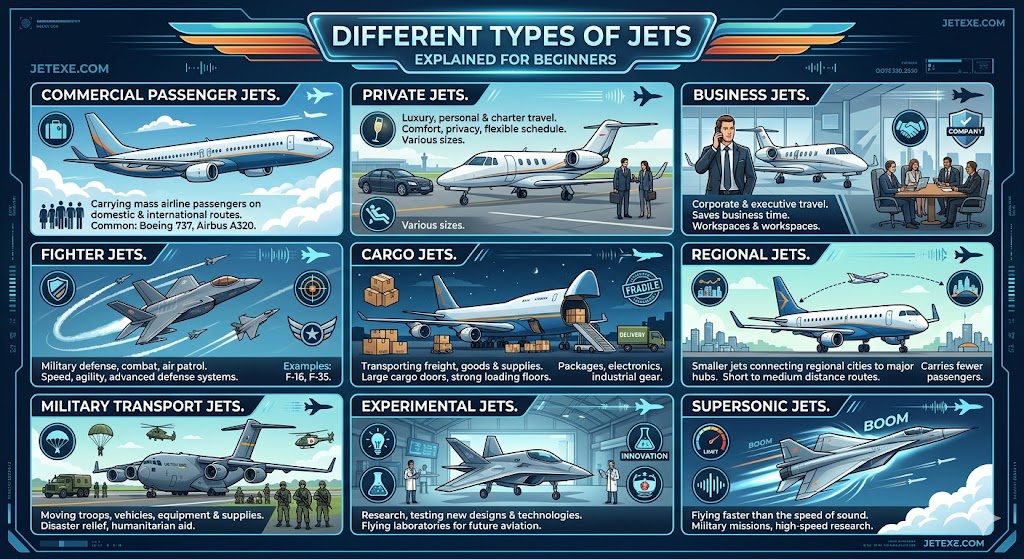
Jets are among the most powerful and advanced aircraft in the world. They are used for passenger travel, business aviation, military missions, cargo transport, pilot training, research, and private flying. For many beginners, the word “jet” may simply mean a fast aircraft, but in aviation, jets come in many different types based on their purpose, size, engine design, speed, and use.
Some jets are designed to carry hundreds of passengers across long distances. Some are made for luxury travel and private flying. Some are built for military defense, while others are used to transport cargo, train pilots, or test future aviation technologies. Understanding the different types of jets helps beginners see how aviation works in a clear and practical way.
In this guide from JETEXE.COM, we will explain the main types of jets in simple language. You will learn what jets are, why different jet categories exist, how they are used, and which types are most common in modern aviation.
What Is a Jet?
A jet is an aircraft powered by a jet engine. A jet engine works by taking in air, compressing it, mixing it with fuel, burning the mixture, and pushing hot gases backward at high speed. This backward push creates forward movement, which is called thrust.
In simple words, a jet moves forward because its engine pushes air or exhaust gases backward. This allows the aircraft to travel fast, climb high, and cover long distances.
Jets are different from many propeller aircraft because they usually fly faster and higher. They are commonly used in commercial airlines, private aviation, military operations, cargo transport, and advanced aerospace research.
Why Are There Different Types of Jets?
There are different types of jets because not every aircraft is built for the same purpose. A passenger airline jet has a different job than a fighter jet. A private jet has different features than a cargo jet. A training jet is designed differently from a supersonic jet.
Jets are designed based on factors such as:
- Purpose of use
- Passenger or cargo capacity
- Flying distance
- Speed requirement
- Airport runway needs
- Engine type
- Comfort level
- Military or civilian operation
- Operating cost
- Safety and performance needs
For example, a commercial jet is designed to carry passengers safely and efficiently. A fighter jet is designed for speed, agility, and defense. A cargo jet is built to carry goods instead of passengers. A private jet focuses on comfort, privacy, and flexible travel.
Basic Difference Between Jet Aircraft and Propeller Aircraft
Jet aircraft and propeller aircraft both fly, but they use different systems to create forward movement.
A jet aircraft uses a jet engine to create thrust by pushing high-speed air or exhaust gases backward. A propeller aircraft uses rotating blades to pull or push the aircraft forward.
| Feature | Jet Aircraft | Propeller Aircraft |
|---|---|---|
| Engine System | Uses jet engines | Uses propellers powered by piston or turbine engines |
| Speed | Usually faster | Usually slower |
| Altitude | Can fly higher | Usually flies lower |
| Distance | Better for long-distance travel | Better for short and regional routes |
| Common Use | Airlines, military, cargo, private flying | Training, regional travel, small aircraft operations |
| Operating Cost | Usually higher | Usually lower |
| Runway Need | Often needs longer runways | Can often use shorter runways |
| Passenger Capacity | Can carry small to very large passenger loads | Usually smaller capacity |
| Flight Experience | Smooth at high altitude | Useful for low-altitude and short-distance travel |
Both types of aircraft are important, but jets are preferred when speed, altitude, and long-distance performance are required.
Main Types of Jets
Jets can be divided into several categories. Each category has a different purpose and design. Below are the main types of jets explained in beginner-friendly language.
1- Commercial Passenger Jets
Commercial passenger jets are aircraft used by airlines to carry people from one place to another. These are the jets most people see at airports. They are designed for regular passenger service on domestic and international routes.
Commercial jets can range from smaller aircraft used on short routes to large wide-body aircraft used for long-distance travel. They usually have passenger cabins, overhead storage, lavatories, safety systems, cockpit controls, and cargo space below the cabin.
Common examples include aircraft families such as Boeing 737, Airbus A320, Boeing 777, and Airbus A350.
What Commercial Passenger Jets Are Used For
Commercial passenger jets are mainly used for:
- Domestic travel
- International travel
- Business travel
- Tourism
- Airline passenger service
- Connecting cities and countries
- Carrying passenger baggage and light cargo
Main Features of Commercial Passenger Jets
Commercial passenger jets usually include:
- Large passenger seating capacity
- Pressurized cabins
- Advanced navigation systems
- Multiple safety systems
- Efficient cruising at high altitude
- Strong engines for long-distance flight
- Professional cockpit and flight control systems
Who Uses Commercial Passenger Jets?
Commercial passenger jets are used by:
- Airlines
- Passengers
- Business travelers
- Tourists
- Airport operators
- Aviation crews
- Cargo handlers for baggage and limited freight
Commercial passenger jets are one of the most important jet categories because they make modern air travel possible for millions of people.
2- Private Jets
Private jets are smaller jet aircraft used for personal, luxury, charter, or business travel. They are popular among business owners, executives, celebrities, high-net-worth individuals, charter customers, and people who need flexible travel schedules.
Private jets are known for comfort, privacy, convenience, and access to smaller airports. Unlike commercial flights, private jet travel allows passengers to choose more flexible departure times and routes.
Main Uses of Private Jets
Private jets are used for:
- Personal travel
- Luxury vacations
- Business trips
- Charter flights
- Emergency travel
- VIP transport
- Flexible short-notice flying
Key Advantages of Private Jets
Private jets offer:
- More privacy
- Flexible schedules
- Comfortable cabins
- Faster airport experience
- Access to smaller airports
- Customized travel experience
- Time-saving for business travelers
Types of Private Jets
Private jets are also divided by size and range:
- Very light jets
- Light jets
- Midsize jets
- Super midsize jets
- Heavy jets
- Ultra-long-range jets
A smaller private jet may be suitable for short trips, while a larger private jet can fly longer distances with more passengers and comfort.
3- Business Jets
Business jets are similar to private jets, but they are mainly used for corporate and executive travel. Companies use business jets to save time, reach multiple locations quickly, and support important business operations.
A business jet may be owned by a company, leased, or used through a charter service. These jets often include comfortable seating, workspaces, communication systems, and premium interiors.
Why Businesses Use Business Jets
Businesses use jets because they help with:
- Faster travel between meetings
- Visiting multiple cities in less time
- Reaching locations with limited airline service
- Improving executive productivity
- Maintaining privacy during travel
- Supporting urgent business decisions
Common Features of Business Jets
Business jets may include:
- Comfortable seating
- Work tables
- Wi-Fi or communication systems where available
- Quiet cabin design
- Private meeting space
- Flexible flight planning
- Premium cabin interiors
Business jets are useful for companies that value time, privacy, and flexible travel.
4- Fighter Jets
Fighter jets are military aircraft designed for speed, agility, defense, and combat missions. They are built to perform high-speed maneuvers and operate in demanding conditions.
Fighter jets are usually smaller than commercial jets but much faster and more agile. They are used by air forces for national defense, air patrol, combat missions, training, and tactical support.
Common examples include aircraft such as F-16, Rafale, Eurofighter Typhoon, and F-35.
Main Uses of Fighter Jets
Fighter jets are used for:
- Air defense
- Combat missions
- Ground support
- Interception
- Surveillance support
- Pilot training
- Tactical operations
Main Features of Fighter Jets
Fighter jets usually have:
- High speed
- Strong maneuverability
- Advanced cockpit systems
- Military communication systems
- Powerful engines
- Aerodynamic design
- Defense-related equipment
Fighter jets are not designed for passenger comfort. They are designed for performance, mission readiness, and national security.
5- Cargo Jets
Cargo jets are aircraft designed to transport goods instead of passengers. They play a major role in logistics, e-commerce, international trade, emergency supplies, and industrial transport.
A cargo jet may look similar to a passenger jet from outside, but the inside is designed for freight. Instead of passenger seats, cargo jets have large open spaces, loading systems, reinforced floors, and wide cargo doors.
What Cargo Jets Carry
Cargo jets can carry:
- Packages
- Electronics
- Medical supplies
- Industrial equipment
- Food products
- Emergency materials
- Heavy freight
- E-commerce shipments
How Cargo Jets Differ from Passenger Jets
Cargo jets differ from passenger jets in several ways:
- They have large cargo doors.
- They do not have normal passenger seating.
- They have stronger loading floors.
- They are designed for freight handling.
- They may operate at night or on special logistics routes.
- They focus on cargo capacity instead of passenger comfort.
Examples include freighter versions of aircraft such as Boeing 747 Freighter and other dedicated cargo aircraft.
6- Training Jets
Training jets are used to teach pilots how to fly faster and more advanced aircraft. They are especially common in military aviation schools and advanced pilot training programs.
Before flying fighter jets or other complex military aircraft, pilots often train on specialized jet trainers. These jets help pilots learn speed control, flight handling, navigation, emergency procedures, and advanced maneuvers.
Main Role of Training Jets
Training jets help pilots learn:
- Jet aircraft handling
- High-speed flying
- Takeoff and landing techniques
- Formation flying
- Navigation
- Emergency response
- Advanced flight control
- Military flying basics
Training jets are usually smaller and simpler than fighter jets, but they still provide valuable experience for pilots moving into advanced aircraft.
7- Regional Jets
Regional jets are smaller passenger jets used for short and medium-distance routes. They often connect smaller cities with major airports. Airlines use regional jets when a large commercial jet is not needed for a route.
Regional jets are important because they help passengers travel from smaller locations to major airline hubs. They support local connectivity and make air travel available in more regions.
Main Uses of Regional Jets
Regional jets are used for:
- Short-distance airline routes
- Medium-distance passenger service
- Connecting smaller cities
- Feeder routes to major airports
- Regional business travel
- Domestic air travel
Beginner Explanation
Think of a regional jet as a smaller airline jet. It carries fewer passengers than a large commercial jet but is still faster and more efficient than many smaller aircraft for regional routes.
8- Military Transport Jets
Military transport jets are aircraft used by armed forces to move people, supplies, vehicles, equipment, and emergency materials. Unlike fighter jets, they are not mainly built for combat speed or agility. Their main job is transportation and logistics.
These jets are important during defense operations, humanitarian missions, disaster relief, and emergency support.
Main Uses of Military Transport Jets
Military transport jets are used for:
- Carrying soldiers
- Moving defense equipment
- Transporting vehicles
- Delivering supplies
- Humanitarian aid
- Disaster relief
- Medical evacuation
- Strategic military movement
Why They Are Important
Military transport jets help move important resources quickly. They can support national defense, emergency response, and international relief missions.
9- Experimental Jets
Experimental jets are aircraft used for research, testing, and innovation. They help engineers, scientists, and aviation companies test new designs, engines, materials, systems, and flight concepts.
These jets may not be used for regular passenger travel. Instead, they help improve future aviation technology.
Main Uses of Experimental Jets
Experimental jets are used for:
- Testing new aircraft designs
- Studying high-speed flight
- Testing engine technology
- Improving safety systems
- Researching aerodynamics
- Developing future aviation concepts
- Exploring advanced materials
Beginner Explanation
An experimental jet is like a flying laboratory. It helps aviation experts understand what works, what needs improvement, and what future aircraft may look like.
10- Supersonic Jets
Supersonic jets are aircraft that can fly faster than the speed of sound. These jets are mostly associated with military aircraft, research aircraft, and limited passenger aviation history.
The word supersonic means faster than sound. When an aircraft crosses the speed of sound, it can create a loud sound called a sonic boom. Because of noise, cost, and technical challenges, supersonic passenger travel is limited compared to regular commercial jet travel.
Main Uses of Supersonic Jets
Supersonic jets are used for:
- Military missions
- High-speed interception
- Aerospace research
- Advanced testing
- Special high-speed aircraft programs
Why Supersonic Jets Matter
Supersonic jets are important because they push the limits of speed, design, and aviation engineering. They help researchers understand high-speed flight and develop future technologies.
Types of Private Jets by Size
Private jets are often classified by size, range, and passenger capacity. Beginners can understand private jets more easily by looking at these categories.
Very Light Jets
Very light jets are small private jets designed for short trips. They usually carry a small number of passengers and can operate from smaller airports. They are useful for quick business or personal travel over shorter distances.
Light Jets
Light jets are slightly larger than very light jets. They offer more comfort and range while still being suitable for shorter routes. They are commonly used for business trips and private travel.
Midsize Jets
Midsize jets provide more cabin space, better range, and improved comfort. They can carry more passengers than light jets and are suitable for medium-distance travel.
Super Midsize Jets
Super midsize jets offer a stronger balance of range, speed, and cabin comfort. They are often used for longer business trips and premium private travel.
Heavy Jets
Heavy jets are larger private jets with spacious cabins, longer range, and premium features. They can carry more passengers and are often used for international travel.
Ultra-Long-Range Jets
Ultra-long-range jets are designed for very long-distance private travel. They offer high comfort, advanced systems, and the ability to connect faraway destinations with fewer stops.
Types of Jet Engines
Different jets may use different types of engines depending on their design and purpose. Here are the main jet engine types explained simply.
Turbojet Engines
Turbojet engines are one of the earliest jet engine types. They create thrust mainly by pushing hot exhaust gases backward. They are powerful and suitable for high-speed flight, but they are generally louder and less fuel-efficient than modern turbofan engines.
Turbofan Engines
Turbofan engines are widely used in modern commercial passenger jets and many business jets. They have a large fan at the front that moves a large amount of air. These engines are efficient, powerful, and quieter than older turbojet designs.
Turboprop Engines
Turboprop engines use a turbine engine to drive a propeller. While they are not usually called pure jet engines by beginners, they use jet engine technology inside. They are commonly used for regional aircraft and shorter routes.
Turboshaft Engines
Turboshaft engines are mainly used in helicopters and some special aircraft. Instead of directly pushing the aircraft forward, they produce shaft power to turn rotors or other mechanical systems.
Ramjet Engines
Ramjet engines are used for very high-speed applications. They have no regular compressor blades and depend on high forward speed to compress incoming air. They are mostly used in specialized aerospace and missile applications.
Comparison Table of Different Types of Jets
| Jet Type | Main Use | Common Users | Key Advantage | Beginner Explanation |
|---|---|---|---|---|
| Commercial Passenger Jets | Carrying airline passengers | Airlines and travelers | Efficient mass travel | Large jets used for regular air travel |
| Private Jets | Personal and luxury travel | Individuals and charter users | Privacy and flexibility | Smaller jets used for private flying |
| Business Jets | Corporate travel | Companies and executives | Saves business travel time | Private-style jets used for work travel |
| Fighter Jets | Defense and combat | Military air forces | Speed and agility | Fast military jets built for missions |
| Cargo Jets | Transporting goods | Logistics and cargo companies | High freight capacity | Jets designed to carry packages and supplies |
| Training Jets | Pilot training | Aviation schools and military | Helps pilots learn jet handling | Smaller jets used for advanced training |
| Regional Jets | Short and medium routes | Regional airlines | Connects smaller cities | Smaller passenger jets for shorter flights |
| Military Transport Jets | Moving troops and equipment | Armed forces | Strong logistics support | Large military jets used for transport |
| Experimental Jets | Research and testing | Engineers and researchers | Innovation and testing | Jets used to test future technologies |
| Supersonic Jets | Very high-speed flight | Military and research programs | Faster-than-sound performance | Jets designed to fly extremely fast |
Which Type of Jet Is Used for Passenger Travel?
The most common jets used for passenger travel are commercial passenger jets and regional jets.
Commercial passenger jets are used by airlines for domestic and international routes. They can carry many passengers and are designed for safety, comfort, and efficiency. Regional jets are smaller and are used for shorter routes between smaller cities and major airport hubs.
For beginners, these are the easiest jets to recognize because they are commonly seen at airports and used by travelers every day.
Which Type of Jet Is Used for Luxury Travel?
Private jets and business jets are commonly used for luxury travel. These aircraft provide privacy, comfort, flexible schedules, and a premium travel experience.
Luxury jet travel is often chosen by people who want to avoid long airport lines, travel on their own schedule, or reach destinations not easily served by regular airlines. Business executives may also use these jets to save time and work while traveling.
Which Type of Jet Is Used by the Military?
The military uses several types of jets depending on the mission.
Military jet categories include:
- Fighter jets
- Training jets
- Military transport jets
- Surveillance-related jets
- Special mission aircraft
- Research and testing jets
Fighter jets are used for defense and combat. Training jets help pilots learn advanced flying. Military transport jets move people, supplies, and equipment. Each type has a specific role in military aviation.
Which Type of Jet Is Fastest?
Fighter jets and supersonic jets are generally among the fastest types of jets. They are built for high-speed performance and advanced flight missions.
Not all jets are designed to be extremely fast. Commercial jets are built for safe and efficient passenger travel, while private jets focus on comfort and flexibility. Cargo jets focus on carrying freight. Fighter jets and supersonic jets are designed with speed as a major priority.
Which Type of Jet Is Best for Beginners to Understand First?
Beginners should start with the most common jet categories:
- Commercial passenger jets
- Private jets
- Cargo jets
- Fighter jets
- Regional jets
These categories are easier to understand because they have clear purposes. Commercial jets carry passengers, private jets support personal travel, cargo jets carry goods, fighter jets support defense, and regional jets connect smaller cities.
Once these basics are clear, it becomes easier to understand more advanced categories such as experimental jets, supersonic jets, and specialized military aircraft.
Benefits of Jet Aircraft
Jets offer many benefits in modern aviation. Their speed, range, and performance make them useful for many different purposes.
Key benefits include:
- Fast travel: Jets can cover long distances in less time.
- Long-distance capability: Many jets can fly across countries and continents.
- High-altitude performance: Jets can fly above much of the weather and turbulence.
- Reliable transportation: Commercial jets support regular passenger travel.
- Cargo movement: Cargo jets help move goods quickly across the world.
- Business convenience: Business jets help companies save time.
- Military support: Fighter and transport jets support defense operations.
- Emergency response: Jets can help move supplies and people during urgent situations.
- Global connectivity: Jets connect cities, markets, and people worldwide.
Limitations of Jets
Jets are powerful and useful, but they also have limitations. These limitations depend on the type of jet and how it is used.
Common limitations include:
- High operating cost: Jets require fuel, maintenance, crew, and airport support.
- Maintenance needs: Jet aircraft must be inspected and maintained regularly.
- Fuel consumption: Many jets use more fuel than smaller aircraft.
- Noise concerns: Jet operations can create noise near airports.
- Trained professionals required: Pilots, engineers, and ground crews need proper training.
- Airport infrastructure: Many jets need suitable runways, hangars, and support systems.
- Complex systems: Modern jets have advanced technology that requires expert handling.
These limitations are managed through strict safety rules, professional training, maintenance schedules, and airport planning.
Future of Jet Technology
The future of jet technology is focused on improving efficiency, safety, comfort, and environmental responsibility. Aviation companies are working on smarter and cleaner ways to design and operate jets.
Important future trends include:
More Fuel-Efficient Jets
Future jets are expected to use fuel more efficiently through improved engines, better aerodynamics, and lighter materials. This can help reduce operating costs and environmental impact.
Sustainable Aviation Fuel
Sustainable aviation fuel is becoming an important part of aviation’s future. It is designed to reduce the environmental impact of jet operations compared to traditional fuel.
Quieter Engines
New engine designs aim to reduce aircraft noise, especially during takeoff and landing. Quieter jets can improve airport-area comfort and support better environmental planning.
Advanced Cockpit Systems
Modern cockpits are becoming more digital and intelligent. Better displays, navigation systems, alerts, and communication tools help pilots make safer and faster decisions.
Hybrid-Electric Research
Some aviation researchers are exploring hybrid-electric systems for future aircraft. These systems may help reduce fuel use and support cleaner aviation technologies.
Improved Safety Systems
Future jets will continue to include better sensors, monitoring systems, automation support, and emergency response technology.
Smarter Aircraft Design
Aircraft design is moving toward better efficiency, lighter structures, stronger materials, and improved passenger comfort.
Frequently Asked Questions
1- What are the main types of jets?
The main types of jets include commercial passenger jets, private jets, business jets, fighter jets, cargo jets, training jets, regional jets, military transport jets, experimental jets, and supersonic jets. Each type is designed for a different purpose, such as carrying passengers, transporting cargo, supporting defense missions, or testing new aviation technology.
2- What is the difference between a jet and an airplane?
An airplane is a broad term for a powered aircraft with wings. A jet is a type of airplane powered by jet engines. This means all jets are airplanes, but not all airplanes are jets. Some airplanes use propellers, while jets use jet engines to create thrust and move forward.
3- Are private jets and business jets the same?
Private jets and business jets are very similar, and the terms are often used together. A private jet may be used for personal or luxury travel, while a business jet is mainly used for corporate or executive travel. The aircraft can be similar, but the purpose of use may be different.
4- What type of jet do airlines use?
Airlines mainly use commercial passenger jets and regional jets. Commercial passenger jets are used for domestic and international routes, while regional jets are used for shorter routes and smaller city connections. These jets are designed to carry passengers safely and efficiently.
5- What type of jet is used by the military?
The military uses fighter jets, training jets, military transport jets, surveillance-related jets, and special mission aircraft. Fighter jets are used for defense and combat, training jets help pilots learn advanced flying, and transport jets move soldiers, equipment, and supplies.
6- What is a cargo jet?
A cargo jet is a jet aircraft designed to carry goods instead of passengers. It may transport packages, mail, medical supplies, electronics, industrial equipment, and emergency materials. Cargo jets are important for logistics, trade, e-commerce, and disaster support.
7- What is a regional jet?
A regional jet is a smaller passenger jet used for short and medium-distance routes. It often connects smaller cities with larger airports. Regional jets help airlines provide service on routes where a large commercial aircraft may not be necessary.
8- What is a supersonic jet?
A supersonic jet is an aircraft that can fly faster than the speed of sound. These jets are mostly used in military aviation and aerospace research. Supersonic flight is impressive, but it also comes with challenges such as high cost, technical complexity, and noise concerns.
9- Which jet is best for long-distance travel?
For airline passengers, large commercial jets are best for long-distance travel. For private travelers, heavy jets and ultra-long-range private jets are suitable for long routes. The best jet depends on passenger needs, distance, comfort level, and operating budget.
10- Can beginners easily understand different types of jets?
Yes, beginners can understand different types of jets by learning their purpose first. Commercial jets carry passengers, cargo jets carry goods, private jets provide personal travel, fighter jets support defense, and training jets teach pilots. Once the purpose is clear, the differences become much easier to understand.
Conclusion
Jets are not all the same. Each type of jet is designed for a specific purpose, whether it is passenger travel, business aviation, luxury flying, military defense, cargo transport, pilot training, or aerospace research. Commercial jets help people travel across cities and countries. Private and business jets offer comfort, flexibility, and privacy. Fighter jets support defense missions, while cargo jets keep goods moving across the world. Regional jets connect smaller cities, and experimental jets help shape the future of aviation.
For beginners, the easiest way to understand jets is to focus on their purpose. Ask what the jet is built to do, who uses it, how far it can fly, and what makes it different from other aircraft. Once these basics are clear, the world of aviation becomes much easier and more exciting to explore. As jet technology continues to improve, future aircraft will become more efficient, safer, quieter, and smarter. Keep learning with JETEXE.COM to build a strong understanding of jet aircraft and modern aviation.
