
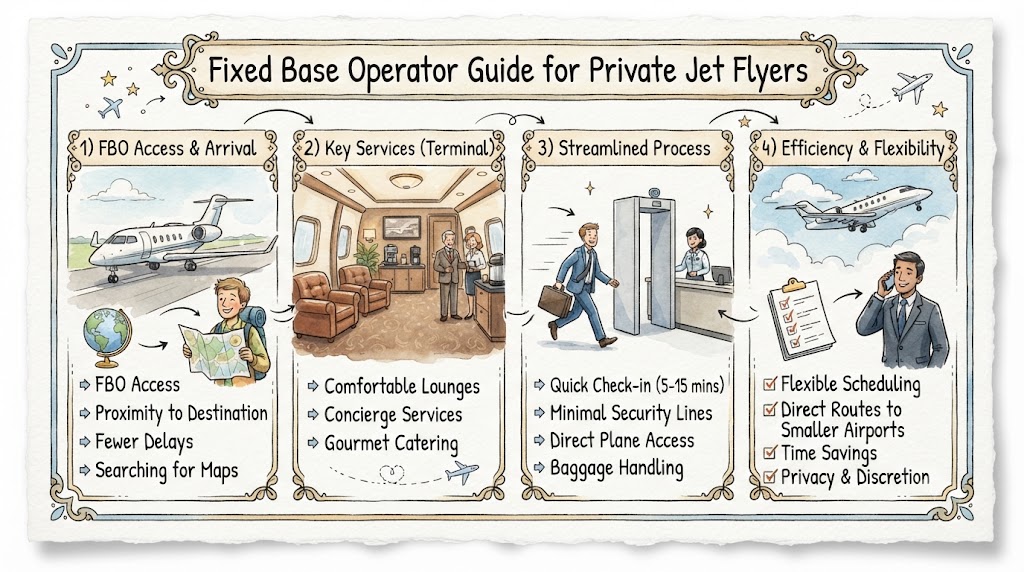
Introduction
A Fixed Base Operator, commonly called an FBO, plays an important role in private aviation. It acts as a service center for private jet passengers, pilots, aircraft owners, charter companies, and flight crews. Instead of using a crowded commercial airline terminal, private jet flyers often arrive and depart through an FBO building. This Fixed Base Operator Guide for Private Jet Flyers explains how FBOs work, what services they provide, what passengers should expect, and how to prepare for a smoother private jet journey. JETEXE.COM provides practical information for travelers researching private aviation, charter flights, airport services, aircraft options, and passenger planning.
What Is a Fixed Base Operator?
A Fixed Base Operator is a private aviation service company operating at an airport. It provides facilities and support for private, charter, corporate, recreational, and general aviation aircraft.
An FBO may serve as:
- A private passenger terminal
- An aircraft fueling station
- A ground handling provider
- A baggage handling center
- A crew support facility
- A transportation coordination point
- An aircraft parking provider
- A customs support location
- A maintenance and servicing center
FBOs are commonly located at:
- Business aviation airports
- Regional airports
- General aviation airports
- Major international airports
- Smaller local airfields
- Remote destination airports
Some airports have one FBO, while larger business aviation airports may have several competing providers.
Why Private Jet Flyers Use FBOs
Private jet passengers usually use an FBO because it provides a more direct and private airport experience than a large airline terminal.
An FBO can help travelers:
- Avoid crowded airline check-in areas
- Complete identity and document checks
- Wait in a quieter lounge
- Coordinate baggage loading
- Arrange catering
- Organize ground transportation
- Meet pilots and cabin crew
- Complete customs procedures
- Reach the aircraft more directly
- Receive special assistance
The exact passenger experience depends on the airport, country, flight type, FBO facilities, security rules, and local regulations.
Private aviation may offer faster processing, but passengers must still follow legal security, immigration, customs, and documentation requirements.
FBO Services for Passengers, Crew, and Aircraft
An FBO supports several parts of a private flight. Some services are designed for passengers, while others are meant for the aircraft and crew.
| Service Area | Common FBO Services | Main Users |
|---|---|---|
| Passenger services | Lounges, Wi-Fi, refreshments, meeting rooms, restrooms, and document support | Private jet passengers |
| Baggage services | Loading, unloading, weighing, storage, and special baggage coordination | Passengers and crew |
| Ground transportation | Chauffeur cars, taxis, rental cars, hotel transfers, and accessible vehicles | Passengers and crew |
| Aircraft services | Fueling, parking, towing, cleaning, and ground power | Aircraft operators |
| Crew services | Rest rooms, weather information, transport, flight planning, and refreshments | Pilots and cabin crew |
| International support | Customs coordination, immigration assistance, and passenger information processing | International travelers |
| Catering support | Meal delivery, special dietary requests, beverages, and cabin supplies | Passengers and cabin crew |
| Maintenance support | Minor inspections, technical assistance, repairs, and hangar coordination | Aircraft owners and operators |
Not every FBO provides every service. A small regional facility may offer only fuel, parking, and basic passenger handling. A large international FBO may provide private lounges, showers, conference rooms, customs support, and extensive aircraft services.
FBOs and Commercial Airport Terminals
FBOs and commercial terminals serve different types of travelers.
A commercial terminal is mainly designed to process large numbers of scheduled airline passengers. An FBO normally serves private aircraft, charter flights, corporate aviation, and general aviation.
An FBO experience may include:
- Private or semi-private entrances
- Smaller passenger waiting areas
- Direct communication with the flight crew
- Shorter distances between the terminal and aircraft
- Personalized baggage handling
- Prearranged ground transport
- Quieter surroundings
- Fewer public areas
However, private jet passengers should not assume that FBO travel means there are no checks or restrictions.
Passengers may still need to:
- Present identification
- Show passports and visas
- Complete security screening
- Declare restricted goods
- Follow customs procedures
- Comply with baggage rules
- Provide passenger details
- Follow airport safety instructions
What Private Jet Passengers Can Expect at an FBO
The experience can vary from a simple waiting room to a high-end private terminal.
Common facilities may include:
- Passenger lounge
- Reception desk
- Comfortable seating
- Wi-Fi
- Television
- Workspaces
- Meeting rooms
- Refreshments
- Coffee and water
- Restrooms
- Charging points
- Children’s areas
- Private rooms
- Showers
- Crew lounges
- Rental car desks
Some FBOs also provide:
- Concierge support
- Hotel reservations
- Restaurant bookings
- Local transportation
- Security coordination
- Event transport
- Pet handling support
- Medical assistance coordination
- Customs and immigration areas
Travelers should confirm available facilities before departure, especially when traveling with children, elderly passengers, pets, business equipment, or mobility needs.
How the FBO Departure Process Works
Private jet departures often begin at the FBO instead of the main airport terminal.
A typical departure may follow these steps:
- The traveler arrives at the FBO.
- Reception staff confirm the flight details.
- Passengers provide identification or travel documents.
- Baggage is accepted and prepared for loading.
- Security or customs checks are completed when required.
- Passengers wait in the lounge.
- The crew confirms that the aircraft is ready.
- Travelers walk or are driven to the aircraft.
- The crew provides a safety briefing.
- The aircraft departs after receiving airport clearance.
The process may be quick for a domestic flight, but international journeys may require extra time for immigration, customs, visas, permits, or passenger data verification.
Passengers should follow the arrival time given by the charter company or aircraft operator.
How the FBO Arrival Process Works
When a private jet lands, the aircraft normally taxis to the FBO ramp or an approved parking position.
A typical arrival may include:
- The aircraft parks in the assigned area.
- Ground staff position passenger steps.
- The crew opens the cabin door after completing safety checks.
- Passengers leave the aircraft.
- Baggage is unloaded.
- Customs and immigration are completed when required.
- Travelers enter the FBO.
- Ground transportation collects the passengers.
- The aircraft is refueled, serviced, parked, or moved.
At some airports, a prearranged vehicle may be allowed near the aircraft. At others, passengers must pass through the FBO building before entering their car.
Passengers must always follow ground staff instructions because the aircraft parking area is an active and restricted environment.
Passenger Lounges and Waiting Areas
One of the most visible FBO services is the passenger lounge.
A lounge may offer:
- Comfortable seating
- Work tables
- Internet access
- Phone charging
- Coffee and snacks
- Quiet rooms
- Television
- Conference areas
- Private meeting rooms
- Restrooms
- Children’s facilities
Business travelers may use the lounge to:
- Attend online meetings
- Review documents
- Make phone calls
- Meet colleagues
- Prepare for a presentation
- Wait for ground transportation
Travelers should remember that a small FBO may have only basic seating and refreshments. Luxury facilities should not be expected at every airport.
FBO Ground Transportation Services
FBOs often coordinate transportation between the airport and the traveler’s final destination.
Available options may include:
- Chauffeur-driven cars
- Rental cars
- Limousines
- Hotel transfers
- Taxis
- Shuttle vehicles
- Security vehicles
- Accessible vans
- Helicopter transfers
- Event transportation
Passengers should provide the following details in advance:
- Number of travelers
- Number of bags
- Destination address
- Vehicle preference
- Child seat needs
- Accessibility requirements
- Security requirements
- Expected arrival time
Travelers carrying large bags, sports equipment, or mobility devices may need a larger vehicle.
Baggage Handling at an FBO
FBO staff often coordinate baggage loading and unloading, but the aircraft operator decides how much baggage can be carried.
Baggage limits depend on:
- Aircraft model
- Storage compartment size
- Passenger count
- Baggage weight
- Fuel load
- Flight range
- Runway conditions
- Weather
- Aircraft balance
Passengers should report special items before the flight, including:
- Golf clubs
- Skis
- Bicycles
- Musical instruments
- Wheelchairs
- Medical equipment
- Baby strollers
- Fragile items
- Large suitcases
- Commercial samples
Soft-sided luggage may be easier to load into a small private jet than large hard-shell suitcases.
The FBO may help handle the baggage, but it cannot increase the aircraft’s approved weight or storage capacity.
Catering Services Through an FBO
FBOs frequently help arrange private jet catering.
Available catering may include:
- Snacks
- Sandwiches
- Hot meals
- Breakfast items
- Fruit
- Desserts
- Tea and coffee
- Soft drinks
- Bottled water
- Special dietary meals
- Children’s meals
- Cabin supplies
Passengers should communicate dietary needs such as:
- Vegetarian meals
- Vegan meals
- Gluten-free meals
- Allergy-safe meals
- Religious dietary preferences
- Low-sodium meals
- Medical dietary requirements
Catering should be ordered early, especially at smaller airports where food providers may be limited.
Late changes, premium meals, special delivery times, and remote airport locations may increase the cost.
FBO Support for International Flights
International private jet travel can require more coordination than domestic travel.
FBO support may include:
- Customs arrangements
- Immigration coordination
- Passenger information submission
- Passport verification
- Visa document checks
- Agricultural inspection support
- Customs declaration assistance
- Ground handling permissions
- International arrival scheduling
Travelers may need to provide:
- Full legal name
- Date of birth
- Nationality
- Passport number
- Passport expiry date
- Visa information
- Country of residence
- Arrival address
- Contact details
Not every FBO has permanent customs and immigration officers. Some locations require advance notice or special arrangements.
After-hours clearance may involve additional charges or may not be available.
Customs and Immigration at an FBO
Customs and immigration procedures may take place:
- Inside the FBO
- In a separate airport facility
- Near the aircraft
- At a designated international terminal
- At another airport before continuing to the destination
The process depends on:
- Country
- Airport
- Passenger nationality
- Flight origin
- Arrival time
- Customs availability
- Local regulations
Private jet passengers cannot avoid customs or immigration laws. Travelers must declare restricted goods and provide truthful travel information.
If the destination airport does not offer customs clearance, the flight may need to land at an approved airport first.
Aircraft Fueling and Ground Handling
FBOs provide important services behind the scenes.
Ground handling may include:
- Aircraft marshaling
- Passenger steps
- Baggage loading
- Towing
- Refueling
- Ground power
- Cabin cleaning
- Water servicing
- Lavatory servicing
- Waste removal
- De-icing
- Hangar coordination
Fueling is one of the main services offered by many FBOs.
The amount of fuel required depends on:
- Flight distance
- Aircraft type
- Weather
- Alternate airport planning
- Passenger and baggage weight
- Operator procedures
- Air traffic conditions
Passengers should allow the crew and operator to make all fuel and operational decisions.
Crew Services Provided by FBOs
Pilots and cabin crew also depend on FBO services.
Crew support may include:
- Flight planning facilities
- Weather information
- Quiet rest areas
- Crew transportation
- Hotel coordination
- Printing services
- Internet access
- Refreshments
- Catering support
- Ground handling communication
FBO staff may also coordinate with:
- Air traffic control
- Airport operations
- Fuel providers
- Customs officers
- Maintenance teams
- Catering companies
- Transportation providers
Good coordination can help reduce delays, but no FBO can guarantee an exact departure time when weather, air traffic, technical issues, or airport restrictions are involved.
FBO Fees and Charges
FBO costs depend on the airport, aircraft type, services requested, duration of stay, local regulations, and operating time.
| FBO Charge | What It May Cover | Factors Affecting Cost |
|---|---|---|
| Handling fee | Passenger and aircraft ground support | Aircraft size, airport, flight type, and services used |
| Ramp fee | Use of the FBO aircraft parking area | Aircraft weight, parking time, and fuel purchase |
| Fuel charge | Aircraft fuel and delivery | Fuel type, quantity, airport, and market conditions |
| Parking fee | Aircraft parking at the airport | Duration, aircraft size, and availability |
| Hangar fee | Indoor aircraft storage | Aircraft dimensions, weather, and length of stay |
| Catering fee | Food, drinks, and cabin supplies | Menu, passenger count, delivery time, and location |
| Customs support fee | Assistance with international clearance | Arrival time, airport rules, and officer availability |
| De-icing fee | Ice removal or prevention | Weather, aircraft size, and fluid used |
Other possible fees include:
- Passenger facility charges
- Security fees
- Towing fees
- Ground power charges
- After-hours handling fees
- Cleaning fees
- Transportation fees
- Lavatory service charges
- Water service charges
- Customs overtime charges
- Special event surcharges
Some fees may be included in the charter quotation. Others may be added later because of schedule changes, parking extensions, extra catering, weather, or additional services.
Passengers should request a clear explanation of what is included in the quoted flight price.
Choosing Between Multiple FBOs
Some airports have several FBO providers. The aircraft operator may select one based on operational needs, contracts, fuel agreements, parking, or service availability.
Factors to compare include:
- Passenger lounge quality
- Location within the airport
- Ground transportation access
- Fuel availability
- Aircraft parking
- Customs support
- Operating hours
- Crew facilities
- Catering coordination
- Security arrangements
- Accessibility
- Service fees
Travelers may request a preferred FBO, but the final selection may depend on:
- Aircraft operator policies
- Airport rules
- Fuel contracts
- Parking availability
- International clearance
- Aircraft size
- Ground handling requirements
A more luxurious FBO is not always the most operationally suitable choice.
FBOs at Small Regional Airports
Small regional FBOs can provide useful access to destinations that are far from major airports.
Potential benefits include:
- Less airport congestion
- Shorter taxi times
- Easier road access
- More personal service
- Quieter waiting areas
- Faster baggage handling
Possible limitations include:
- Limited operating hours
- Basic passenger facilities
- Limited fuel options
- No permanent customs service
- Fewer ground transport choices
- Limited maintenance support
- Reduced catering availability
- Shorter runways
Travelers should confirm the facilities and operating arrangements before selecting a small airport.
FBOs at Major International Airports
Major international airports may have several private aviation facilities.
Advantages can include:
- Long runways
- 24-hour operations
- International customs
- Maintenance support
- Multiple fuel providers
- Strong transportation options
- Better weather infrastructure
Possible challenges include:
- Heavy air traffic
- Airport slot restrictions
- Higher fees
- Limited parking
- Longer taxi times
- Busy arrival periods
- Security restrictions
- Special event congestion
A major airport may be more practical for an international or long-range flight, even when a smaller airport offers a quieter passenger experience.
FBO Support for Travelers With Pets
FBO staff may help coordinate pet arrivals and departures, but the aircraft operator and destination authorities determine whether the pet can travel.
Travelers may need:
- Pet passport
- Microchip record
- Vaccination certificate
- Rabies documentation
- Veterinary health certificate
- Import permit
- Export permit
- Quarantine approval
- Parasite treatment record
Passengers should confirm:
- Whether the operator allows pets
- Whether the FBO handles animal arrivals
- Whether a veterinary inspection is required
- Whether quarantine applies
- Whether the destination has breed restrictions
- How the animal must be secured during flight
Pet documentation should be arranged early because some certificates and treatments must be completed within specific time limits.
Accessibility and Special Assistance
Private jet passengers may request special assistance through the operator and FBO.
Support can include:
- Wheelchair services
- Accessible vehicles
- Help entering the aircraft
- Assistance for elderly passengers
- Medical equipment handling
- Support for visually impaired travelers
- Support for hearing-impaired travelers
- Help with children
- Additional baggage assistance
Travelers should provide detailed information before departure because:
- Aircraft doors differ in size
- Cabin layouts vary
- Airport equipment may be limited
- Some mobility devices require special handling
- Medical equipment may need approval
Early communication helps the operator select a suitable aircraft and coordinate the required FBO support.
Safety at an FBO
An FBO ramp is an active airport area. Aircraft, baggage equipment, fuel trucks, cars, and ground vehicles may be moving nearby.
Passengers should:
- Follow crew instructions
- Remain with an escort
- Keep children close
- Avoid aircraft engines
- Avoid restricted areas
- Never smoke near aircraft
- Do not approach another aircraft
- Keep loose items secure
- Watch for moving vehicles
- Use designated walking routes
Private terminal access does not remove airport safety rules.
Passengers should never enter the ramp without permission.
Security at an FBO
Security procedures vary depending on the airport and country.
They may include:
- Identity checks
- Passport verification
- Baggage screening
- Passenger list confirmation
- Vehicle access control
- Security officer inspection
- Customs checks
- Restricted area passes
Travelers must not carry:
- Illegal items
- Prohibited weapons
- Undeclared restricted goods
- Dangerous materials
- Items banned by the operator
- Goods restricted by customs regulations
Private jet travel may provide greater privacy, but it does not allow passengers to bypass laws.
Common Mistakes Private Jet Flyers Should Avoid
Assuming Every FBO Offers Luxury Facilities
Some FBOs provide premium lounges, while others offer only basic seating and ground support.
Arriving Without Correct Documents
Missing passports, visas, permits, or pet documents can delay or prevent the flight.
Bringing Excess Baggage
The FBO may handle baggage, but the aircraft still has weight and space limits.
Ordering Catering Too Late
Special meals may not be available at short notice, especially at small airports.
Ignoring Customs Operating Hours
International clearance may require advance notice or overtime arrangements.
Failing to Arrange Ground Transportation
Smaller airports may have few taxis or rental cars.
Walking on the Ramp Without Permission
The aircraft parking area is restricted and potentially dangerous.
Expecting the FBO to Control Flight Delays
FBO staff support the flight, but weather, technical issues, air traffic, and crew duty limits are controlled by other parties.
Forgetting to Report Special Assistance Needs
Mobility, medical, child, or pet requirements should be shared before travel.
Assuming All Fees Are Included
Some FBO, customs, catering, parking, or after-hours fees may be charged separately.
Private Jet FBO Planning Checklist
Before departure, travelers should:
- Confirm the correct FBO address
- Check whether the airport has multiple FBOs
- Confirm the required arrival time
- Carry valid identification
- Review passport and visa requirements
- Submit passenger details
- Confirm baggage quantity
- Report oversized items
- Arrange catering
- Share dietary requirements
- Arrange ground transportation
- Confirm pet documents
- Request accessibility assistance
- Check customs availability
- Review estimated FBO charges
- Keep the operator’s contact details available
- Follow all crew and ground staff instructions
Practical Example of Using an FBO
Consider a business traveler flying internationally by private jet.
Before departure, the aircraft operator selects an FBO at the airport. The traveler receives the FBO address, recommended arrival time, and document requirements.
The traveler arrives with a passport and one suitcase. FBO staff confirm the flight information and direct the traveler to the lounge.
While the traveler waits:
- Ground staff load the baggage
- The aircraft is fueled
- Catering is delivered
- The pilots review weather information
- Customs documents are prepared
After customs clearance, the traveler is escorted to the aircraft and receives a safety briefing.
At the destination, the aircraft parks near another FBO. Baggage is unloaded, immigration is completed, and a prearranged chauffeur collects the traveler.
This example shows how an FBO coordinates passenger services, aircraft handling, crew support, customs, and transportation.
Frequently Asked Questions
1. What does FBO mean in private aviation?
FBO means Fixed Base Operator. It is an airport-based company that provides services for private jet passengers, aircraft, pilots, and cabin crew.
2. Do private jet passengers have to use an FBO?
Private jet passengers commonly use an FBO, although procedures depend on the airport. Some airports may use separate private terminals, government facilities, or designated handling areas.
3. How early should passengers arrive at an FBO?
Domestic passengers may be asked to arrive approximately 15 to 30 minutes before departure. International passengers may need additional time for customs, immigration, and document checks.
4. Are security checks required at an FBO?
Yes. Security may be faster and more private, but passengers must still follow identification, baggage, customs, immigration, and prohibited-item rules.
5. Can passengers choose their preferred FBO?
Passengers may request an FBO, but the operator may choose another provider because of parking, fuel contracts, customs, aircraft size, or airport restrictions.
6. Does every FBO have customs and immigration?
No. Some FBOs have permanent customs facilities, while others require advance arrangements. Certain airports do not support international arrivals.
7. Are FBO fees included in a private jet charter price?
Some charter quotes include estimated FBO and handling charges. Other fees may be added for parking, after-hours service, customs, catering, de-icing, or schedule changes.
8. Can an FBO arrange ground transportation?
Many FBOs coordinate chauffeur cars, taxis, rental vehicles, hotel transfers, accessible vans, and other transport services when requested in advance.
9. Can pets travel through an FBO?
Pets may travel when allowed by the aircraft operator and destination regulations. Vaccination records, microchips, veterinary certificates, permits, or quarantine arrangements may be required.
10. Are all FBO lounges luxurious?
No. Facilities vary widely. Large business aviation airports may have premium lounges, while smaller regional FBOs may provide only basic passenger facilities.
Key Takeaways
- An FBO acts as a private aviation service center.
- Private jet passengers often arrive and depart through an FBO.
- FBO services can include lounges, baggage handling, fueling, parking, catering, customs support, and transportation.
- Facilities vary between airports and service providers.
- International flights may require advance customs arrangements.
- Baggage capacity is determined by the aircraft, not the FBO.
- Passengers should arrange catering, transportation, pet travel, and accessibility support early.
- FBO charges may include handling, parking, ramp, fuel, customs, and after-hours fees.
- Passengers must follow all security, immigration, customs, and ramp safety rules.
- The aircraft operator normally coordinates the final FBO selection.
Conclusion
A Fixed Base Operator supports many parts of a private jet journey, from passenger check-in and baggage handling to aircraft fueling, crew services, customs coordination, and ground transportation. Understanding how an FBO works helps travelers arrive prepared, avoid common mistakes, and communicate clearly with their charter provider. JETEXE.COM offers educational information for private jet flyers who want to understand airport services, aircraft operations, charter planning, and passenger responsibilities before traveling.
