
Introduction
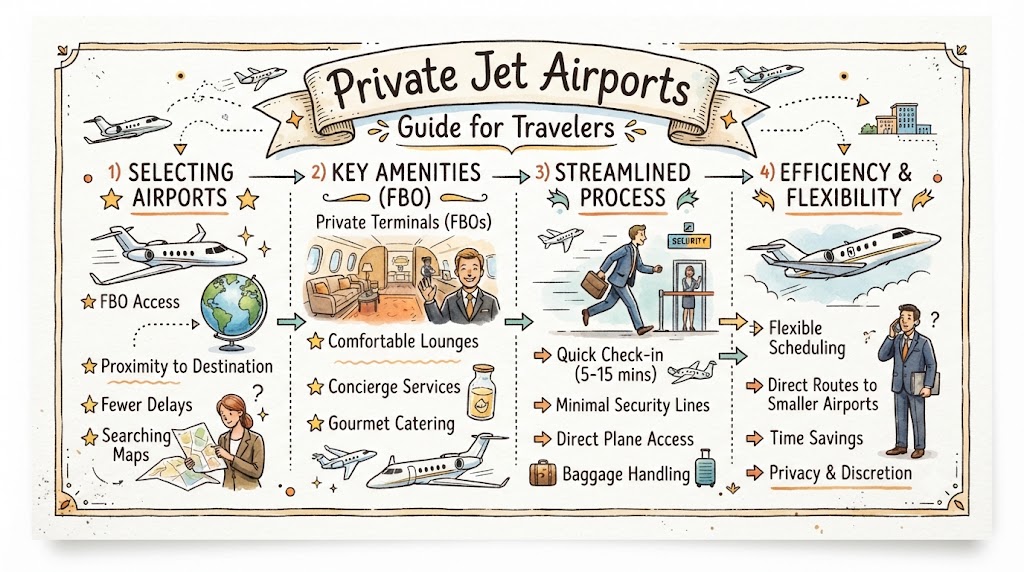
Choosing the right airport is an important part of private jet travel because the closest airport is not always the most suitable one. Runway length, customs availability, operating hours, aircraft size, weather, parking, ground transport, and local restrictions can all affect the journey. This Private Jet Airports Guide for Travelers explains how private aviation airports work, what passengers can expect at an FBO, which documents may be required, and how to prepare for a smooth departure or arrival. JETEXE.COM provides educational guidance for travelers researching private aviation, charter planning, airport facilities, aircraft options, and passenger preparation.
What Is a Private Jet Airport?
The term “private jet airport” does not always describe one specific type of airport. It usually refers to an airport that accepts private, charter, corporate, or general aviation aircraft.
Some airports are designed mainly for business aviation, while others handle both private jets and commercial airlines. Smaller regional airports and local airfields may also accept private aircraft when their runways, facilities, operating hours, and regulations are suitable.
Private jets may operate from:
- Dedicated business aviation airports
- General aviation airports
- Regional airports
- Smaller local airfields
- Major international airports
- Commercial airports with private terminals
- Government or military airports with special authorization
- Remote destination airports
- Island and mountain airports
Passengers should not assume that every small airport can accept every private jet. Aircraft performance, runway conditions, fuel availability, airport permissions, customs services, and local restrictions must be reviewed before the flight is confirmed.
Private Jet Airports and Commercial Airports
Private aviation usually offers a more direct and private passenger experience. However, passengers must still follow legal security, customs, immigration, and documentation requirements.
| Factor | Private Jet Airport | Commercial Airport |
|---|---|---|
| Passenger traffic | Usually lower and less crowded | Often handles large passenger volumes |
| Check-in process | Commonly completed through an FBO or private terminal | Completed at airline counters or self-service areas |
| Security procedures | May be faster but still legally required | Usually follows standard terminal security lines |
| Boarding time | Passengers may board shortly before departure | Passengers normally arrive much earlier |
| Terminal facilities | Private lounges, meeting rooms, and crew areas may be available | Shops, restaurants, gates, and public lounges are common |
| Aircraft access | Passengers may be transported directly to the aircraft | Boarding normally takes place through a gate or bus |
| Privacy | Generally higher | Limited because of public terminal traffic |
| Ground transportation | Can often be coordinated through the FBO | Usually arranged through public airport transport services |
| Flight flexibility | May allow more schedule flexibility | Depends on published airline schedules |
| Possible charges | Handling, parking, FBO, landing, and customs charges may apply | Many airport charges are included in the airline ticket |
Private jet travel can reduce time spent in large terminals, but it does not remove airport rules. The exact experience depends on the airport, country, operator, aircraft, and type of flight.
Understanding FBOs at Private Jet Airports
FBO stands for Fixed-Base Operator. An FBO is a private aviation service provider located at an airport.
It may act as the main arrival and departure point for passengers traveling by private jet. Instead of entering a large airline terminal, travelers may go directly to the FBO building.
An FBO can provide services for passengers, pilots, crew members, and aircraft.
Common passenger services include:
- Private waiting lounges
- Wi-Fi access
- Refreshments
- Meeting rooms
- Restrooms
- Baggage assistance
- Car rental coordination
- Chauffeur arrangements
- Hotel transport
- Customs support
- Catering coordination
- Special assistance for passengers
Aircraft and crew services may include:
- Fueling
- Aircraft parking
- Ground handling
- Towing
- Hangar space
- Maintenance support
- Weather information
- Flight planning support
- Crew rest areas
- Transportation for pilots and cabin crew
Facilities can vary greatly. A major business aviation airport may have several FBOs with premium lounges and extensive services. A remote airfield may offer only basic handling, fuel, and passenger transfer facilities.
Travelers should ask what facilities are available instead of assuming that every private terminal offers the same level of comfort.
Types of Airports Used by Private Jets
Dedicated Business Aviation Airports
These airports mainly serve private, corporate, and charter aircraft. They are often designed for efficient aircraft movements, private passenger handling, and business aviation services.
Possible benefits include:
- Lower passenger congestion
- Faster ground handling
- Several FBO choices
- Better private aircraft parking
- Easier ground transport coordination
- More privacy
Possible limitations include:
- Distance from the city center
- Limited public transportation
- Restricted operating hours
- Night noise restrictions
- Limited international customs services
General Aviation Airports
General aviation airports serve aircraft outside major scheduled airline operations. They may handle training aircraft, helicopters, piston aircraft, turboprops, and private jets.
These airports can be convenient for regional travel, but travelers must confirm:
- Runway suitability
- Fuel availability
- Fire and rescue capability
- Handling support
- Operating hours
- Customs services
- Weather limitations
Regional Airports
Regional airports often serve smaller cities and communities. Some handle scheduled airline flights as well as private jets.
They can provide useful access to destinations far from major international airports. However, services may be limited outside normal working hours.
Major International Airports
Private jets can use many large international airports. These airports may offer strong infrastructure, long runways, customs, immigration, maintenance, and 24-hour services.
However, they may also involve:
- High traffic levels
- Airport slot restrictions
- Longer taxi times
- Higher handling charges
- Limited aircraft parking
- Delays during busy periods
A major international airport may be necessary when customs, long runways, maintenance, or international connections are required.
Remote Airfields and Island Airports
Remote destinations may have smaller airports with limited facilities. Fuel, maintenance, catering, parking, ground transport, and customs may need to be arranged in advance.
Weather changes can also have a greater effect when nearby alternate airports are limited.
Mountain and High-Altitude Airports
Airports located at high elevations can present special operational challenges. Thin air, surrounding terrain, weather, temperature, and runway length may affect aircraft performance.
Flights to these airports require careful planning by experienced operators and qualified crews.
Airports With Short Runways
Some private aircraft are designed to use shorter runways, but larger or heavier jets may not be able to operate safely from them.
Short-runway operations depend on many factors, including aircraft model, weight, weather, surface condition, obstacles, and elevation.
Choosing the Right Private Jet Airport
The best airport is not always the nearest airport. A slightly more distant airport may provide better runway conditions, customs services, parking, or ground transport.
Travelers and operators normally consider the following factors.
Distance From the Final Destination
The airport should provide practical road access to the traveler’s hotel, home, office, resort, event, or meeting location.
A small airport may be closer geographically but slower to reach because of poor roads or limited transport options.
Runway Length and Surface
The runway must be suitable for the aircraft. Runway length is especially important for larger jets, heavily loaded aircraft, high-altitude airports, and hot weather operations.
The runway surface may be:
- Asphalt
- Concrete
- Grass
- Gravel
- Another approved surface
Not every aircraft is approved to operate on every surface.
Airport Operating Hours
Some airports operate 24 hours a day. Others close at night or require advance arrangements for flights outside normal hours.
Travelers should confirm:
- Opening and closing times
- Weekend operations
- Holiday schedules
- Night restrictions
- Curfews
- Overtime handling availability
Customs and Immigration
An airport may accept domestic private flights but not international arrivals.
For international travel, confirm whether the airport provides:
- Customs
- Immigration
- Passport control
- Agricultural inspection
- International arrival approval
- Customs services outside normal hours
Parking Availability
Private jet parking can be limited during:
- Major sporting events
- Festivals
- Business conferences
- Holiday seasons
- Political meetings
- International exhibitions
- Peak tourism periods
An aircraft may be allowed to drop off passengers but then be required to fly to another airport for parking.
Ground Transportation
Travelers should review the availability of:
- Chauffeur-driven vehicles
- Rental cars
- Hotel transfers
- Taxis
- Helicopter transfers
- Secure transportation
- Accessible vehicles
Noise and Local Restrictions
Some airports restrict aircraft movements during early morning or late-night hours. Others limit certain aircraft types because of noise rules.
The flight operator must check these restrictions before confirming the schedule.
Runway Length and Aircraft Compatibility
Every private jet cannot use every airport. Even when an airport has previously accepted a certain aircraft model, conditions on the day of travel may affect whether the flight can operate safely.
Aircraft suitability can depend on:
- Aircraft type
- Aircraft weight
- Number of passengers
- Baggage weight
- Fuel load
- Flight distance
- Runway length
- Runway slope
- Runway surface
- Airport elevation
- Air temperature
- Wind direction
- Crosswind strength
- Rain, snow, or ice
- Nearby terrain
- Obstacles around the airport
A heavily loaded jet may require more runway than the same aircraft carrying fewer passengers and less fuel. Hot temperatures and high airport elevation can also reduce aircraft performance.
Final decisions must be made by qualified pilots, flight planners, aircraft operators, and relevant aviation authorities. Passengers should not pressure a crew to use an airport that has been considered unsuitable.
Private Jet Arrival Experience
Although every airport is different, a typical arrival may follow these steps:
- The aircraft lands and leaves the runway.
- Ground staff direct it to an approved parking position.
- The crew completes the required shutdown procedures.
- Passenger steps are positioned when needed.
- Baggage is removed from the aircraft.
- Customs and immigration are completed for international arrivals.
- Passengers enter the FBO or private terminal.
- Ground transportation collects the passengers.
- The aircraft is parked, refueled, serviced, or moved as required.
Some airports allow a vehicle to meet passengers near the aircraft. Others require passengers to enter the terminal before reaching their transportation.
Passengers should never walk freely around the aircraft parking area. The apron is an active and restricted area where aircraft, fuel vehicles, baggage equipment, and service vehicles may be moving.
Travelers should follow all instructions given by the crew and ground staff.
Private Jet Departure Process
A private jet departure is often simpler than a commercial airline departure, but passengers should still arrive with enough time to complete the required procedures.
The process may include:
- Arriving at the FBO
- Confirming passenger identity
- Presenting passports or travel documents
- Completing security checks
- Handing baggage to the ground staff
- Waiting in the passenger lounge
- Meeting the pilots or cabin crew
- Reviewing any last-minute flight information
- Walking or being driven to the aircraft
- Receiving a passenger safety briefing
- Boarding and preparing for departure
Domestic passengers may be asked to arrive approximately 15 to 30 minutes before departure, depending on the operator and airport. International passengers may need more time for customs, immigration, and document checks.
Travelers should always follow the arrival time provided by their charter company or aircraft operator.
Documents Travelers May Need
Document requirements depend on nationality, destination, flight route, passenger age, and local laws.
A traveler may need:
- A valid passport
- A visa
- A national identity document
- Charter confirmation
- Flight itinerary
- Entry permit
- Transit authorization
- Customs declaration
- Health documents when legally required
- Pet travel documents
- Veterinary certificates
- Parental consent for minors
- Documents for restricted goods
- Permits for high-value or commercial items
Passenger details may need to be submitted before departure. These can include:
- Full legal name
- Date of birth
- Nationality
- Passport number
- Passport expiry date
- Country of passport issue
- Contact details
Names supplied to the operator should match the names shown on the passenger’s legal documents.
Travelers should verify current entry requirements with official government authorities and their flight operator before traveling.
Domestic and International Private Jet Operations
Domestic private jet flights remain within one country. They generally involve fewer border procedures, although identification and security requirements still apply.
International private jet flights cross national borders and can require:
- Passport control
- Immigration approval
- Customs clearance
- Passenger information submission
- Aircraft entry permits
- Overflight permits
- Arrival and departure permissions
- Agricultural inspection
- Visa verification
- Customs declarations
International procedures may take place inside the FBO, in a dedicated customs area, or at the aircraft.
Customs and immigration are not available at every airport. Some airports provide these services only during certain hours or after advance notice.
After-hours customs services may involve additional arrangements and charges. If customs services are unavailable, the aircraft may need to land at another airport before continuing to the final destination.
Private Jet Airport Fees
Private jet airport costs can include more than the charter price of the aircraft. Some charges may already be included in the quotation, while others may be added because of schedule changes, airport selection, weather, parking, or additional services.
| Airport Charge | What It Covers | What Can Affect the Cost |
|---|---|---|
| Landing fee | Use of the runway and airport infrastructure | Aircraft weight, airport category, and time of operation |
| Parking fee | Keeping the aircraft at the airport | Parking duration, aircraft size, and available space |
| Handling fee | Ground support for the aircraft and passengers | Airport, aircraft type, services requested, and operating hours |
| FBO fee | Use of private terminal and aviation services | Facility level, passenger requirements, and location |
| Customs charge | International passenger and aircraft clearance | Arrival time, overtime services, airport, and country |
| De-icing fee | Removal or prevention of ice on the aircraft | Weather, aircraft size, fluid usage, and local rates |
| Hangar fee | Indoor aircraft storage | Aircraft dimensions, duration, and hangar availability |
Other possible charges include:
- Passenger facility fees
- Security fees
- Navigation charges
- Airport slot fees
- Night operation fees
- Noise-related charges
- Ramp fees
- Catering delivery fees
- Ground transportation fees
- International permit fees
- Overnight handling fees
Travelers should ask whether the charter quotation includes estimated airport charges and what circumstances could create additional costs.
Airport Slots and Prior Permission Requirements
An airport slot is an approved arrival or departure time. Busy airports use slots to control aircraft traffic and manage limited runway and parking capacity.
Private jets may need airport slots during:
- Peak travel periods
- Major events
- Holiday weekends
- International conferences
- Sporting events
- Trade shows
- Political gatherings
Some airports also require Prior Permission Required, commonly known as PPR.
PPR means the operator must obtain approval before the aircraft can use the airport. Approval may depend on:
- Aircraft size
- Parking availability
- Operating hours
- Noise restrictions
- Security conditions
- Type of flight
- Local regulations
A flight should not be treated as fully confirmed until required airport permissions, permits, slots, and handling arrangements have been secured.
Last-minute schedule changes may not always be possible at restricted or highly congested airports.
Private Jet Airports Near Major Cities
Large cities may be served by several airports. The main international airport is not automatically the best choice for a private flight.
A smaller business aviation airport outside the city may provide:
- Less congestion
- Shorter taxi times
- More private aircraft parking
- Faster ground handling
- Easier terminal access
- Better privacy
- Lower possible airport charges
However, smaller airports may have disadvantages:
- Longer road travel to the city center
- Limited customs services
- Shorter runways
- Fewer maintenance facilities
- Restricted operating hours
- Limited catering options
- Reduced ground transportation availability
Travelers should compare total journey time instead of looking only at flight time or distance from the city.
Ground Transportation From Private Jet Airports
The journey does not end when the aircraft lands. Ground transportation should be coordinated before arrival, especially at smaller or remote airports.
Available options may include:
- Chauffeur-driven cars
- Hotel transfers
- Rental cars
- Taxis
- Limousines
- Airport shuttles
- Security vehicles
- Accessible vans
- Helicopter transfers
Travelers should provide the operator or FBO with:
- Passenger count
- Baggage quantity
- Destination address
- Required vehicle type
- Child seat requirements
- Accessibility needs
- Security requirements
- Expected arrival time
A standard car may not be large enough for all passengers and baggage. Groups may need multiple vehicles or a van.
Baggage Rules for Private Jet Travel
Private jets do not offer unlimited baggage capacity. Baggage space can be more restricted than passengers expect, especially on light jets.
Baggage allowances depend on:
- Aircraft model
- Baggage compartment size
- Number of passengers
- Total baggage weight
- Fuel requirement
- Flight distance
- Weather
- Runway length
- Aircraft balance
- Type of baggage
Soft-sided bags may be easier to load than large hard-shell suitcases.
Travelers carrying special items should notify the operator in advance. These may include:
- Golf clubs
- Skis
- Snowboards
- Bicycles
- Musical instruments
- Wheelchairs
- Medical equipment
- Baby strollers
- Fragile equipment
- Oversized luggage
An aircraft may technically have enough baggage weight capacity but not enough physical space for large items.
Passengers should send baggage dimensions, photographs, or item descriptions to the operator when requested.
Traveling With Pets Through Private Jet Airports
Private aviation can provide a more comfortable travel environment for pets, but legal entry requirements still apply.
Depending on the destination, pet documents may include:
- Pet passport
- Vaccination record
- Rabies certificate
- Microchip details
- Veterinary health certificate
- Import permit
- Export permit
- Parasite treatment record
- Quarantine documentation
Some countries require health checks or approved arrival airports for animals. Certain breeds may also face restrictions.
Travelers should confirm:
- Whether the aircraft operator accepts pets
- Whether the destination airport handles animal arrivals
- Which documents are required
- Whether quarantine applies
- Whether an approved veterinary inspection is needed
- How the pet will be secured during flight
Pet travel requirements should be checked well before departure because some certificates, treatments, or permits must be completed within specific time periods.
Accessibility and Special Assistance
Passengers who require additional assistance should inform the operator before travel.
Support may include:
- Wheelchair assistance
- Accessible vehicles
- Help boarding the aircraft
- Support for elderly passengers
- Medical equipment handling
- Oxygen arrangements when approved
- Assistance for visually impaired travelers
- Assistance for hearing-impaired travelers
- Child travel support
- Help with reduced mobility
Not every private aircraft has the same door size, cabin layout, or accessibility features. The operator may need detailed information to select a suitable aircraft.
Passengers should explain their needs clearly instead of waiting until departure day.
Weather and Airport Operations
Weather can affect private jet operations at both large and small airports.
Important weather factors include:
- Fog
- Low visibility
- Thunderstorms
- Strong winds
- Crosswinds
- Heavy rain
- Snow
- Ice
- Extreme heat
- Mountain weather
- Runway contamination
Cold weather may require aircraft de-icing before departure. Fog may delay arrival or force the aircraft to use an alternate airport. Strong crosswinds can make some runways unsuitable.
Remote and mountain airports may be more sensitive to weather because of terrain, limited navigation systems, or fewer alternate airports.
The crew and operator make safety decisions based on regulations, aircraft limits, airport conditions, and current weather. Passengers should allow flexibility when weather creates delays or airport changes.
Safety and Security at Private Jet Airports
Private terminals may feel less crowded, but airport security remains important.
Safety and security measures may include:
- Passenger identity checks
- Baggage screening
- Controlled vehicle access
- Secure aircraft parking
- Crew identification
- Restricted apron access
- Customs inspections
- Security staff
- Passenger escort procedures
- Prohibited-item controls
Passengers must not carry illegal or restricted items simply because they are traveling privately.
They should also avoid:
- Approaching an aircraft without permission
- Walking near engines
- Smoking near aircraft
- Entering restricted areas
- Opening aircraft compartments
- Distracting the crew during safety procedures
- Ignoring ground staff instructions
Private aviation can make the passenger process more convenient, but it does not allow travelers to bypass laws or safety standards.
Common Mistakes First-Time Travelers Should Avoid
Choosing an Airport Based Only on Distance
The nearest airport may not have a suitable runway, customs service, fuel, parking, or operating hours.
Bringing Too Much Baggage
Private aircraft can have strict space and weight limits. Confirm baggage capacity before arriving.
Arriving Without Correct Documents
Missing passports, visas, permits, or pet records can delay or prevent departure.
Ignoring Customs Operating Hours
International flights may require advance customs arrangements.
Assuming Every Airport Handles International Flights
Some airports are limited to domestic operations.
Booking Ground Transport Too Late
Cars, vans, secure vehicles, and accessible transport should be arranged before arrival.
Carrying Prohibited Items
Private passengers remain subject to local laws and airport security rules.
Forgetting to Mention Special Assistance
Accessibility and medical needs may affect aircraft and airport selection.
Expecting Every FBO to Be Luxurious
Some FBOs are highly equipped, while others provide only basic facilities.
Treating Departure Time as Flexible Without Notice
Schedule changes can affect crew duty limits, airport slots, permits, weather planning, and handling arrangements.
Private Jet Airport Planning Checklist
Before confirming a private jet journey, travelers should:
- Confirm the departure airport
- Confirm the arrival airport
- Check airport operating hours
- Verify runway and aircraft compatibility
- Confirm customs and immigration availability
- Review passport and visa requirements
- Submit passenger details
- Check baggage capacity
- Declare oversized items
- Confirm pet requirements
- Request accessibility support
- Arrange catering
- Reserve ground transportation
- Review estimated airport charges
- Check weather conditions
- Confirm airport slots or PPR
- Keep the operator’s contact details available
- Reconfirm departure instructions before travel
Practical Airport Selection Example
Consider a traveler attending a business meeting in a major city.
The traveler has two airport choices.
The first option is the city’s main international airport. It is closer to the meeting location and provides 24-hour customs, long runways, extensive maintenance support, and several transportation choices. However, the airport is busy, parking is limited, and arrival slots may be restricted.
The second option is a smaller business aviation airport outside the city. It has less congestion, faster ground handling, a quiet FBO, and better private aircraft parking. However, the airport is farther from the meeting venue and customs services require advance notice.
The best choice depends on the complete journey.
The main international airport may be more suitable when:
- The aircraft requires a long runway
- International customs are needed late at night
- Maintenance support is important
- The city meeting is close to the airport
The smaller airport may be more suitable when:
- Privacy is a priority
- Aircraft parking is available
- The flight is domestic
- Road traffic from the airport is manageable
- Faster ground handling is valuable
The traveler should compare flight operations, ground travel time, airport availability, customs, estimated charges, and schedule reliability before deciding.
Frequently Asked Questions
1. Do private jets use normal commercial airports?
Yes. Private jets can use many commercial airports when the runway, parking, handling services, permissions, and operating conditions are suitable. They may use a separate FBO instead of the main passenger terminal.
2. How early should passengers arrive for a private jet flight?
Passengers may be asked to arrive around 15 to 30 minutes before a domestic departure, but international flights can require more time. Travelers should follow the exact arrival instructions given by their operator.
3. Are security checks required for private jet passengers?
Yes. The process may be quicker and more private, but passengers must still follow airport security rules, identification checks, baggage controls, customs laws, and immigration requirements.
4. What is an FBO at an airport?
An FBO is a private aviation service provider. It may offer passenger lounges, baggage handling, fueling, aircraft parking, transportation coordination, crew facilities, and customs support.
5. Can every airport accept a private jet?
No. Airport suitability depends on runway length, aircraft performance, parking, operating hours, fuel, weather, fire services, permissions, and local regulations.
6. How does customs work on an international private jet flight?
Passengers complete customs and immigration at an approved airport. The process may take place in an FBO, a customs facility, or near the aircraft. Advance passenger information and arrival approval may be required.
7. Are airport fees included in a private jet charter price?
Some quotations include estimated airport and handling charges, while others separate them. Additional charges may arise because of parking, customs overtime, de-icing, schedule changes, or airport changes.
8. How are private jet baggage limits decided?
Limits depend on aircraft storage space, passenger count, baggage weight, fuel load, route distance, runway conditions, and aircraft balance. Passengers should confirm both weight and size limits before travel.
9. Can pets travel through private jet terminals?
Pets may be allowed when accepted by the aircraft operator and permitted by destination regulations. Vaccinations, veterinary certificates, microchips, import permits, or quarantine procedures may be required.
10. How should travelers select the best private jet airport?
Travelers should compare runway suitability, distance from the final destination, customs availability, operating hours, parking, ground transportation, weather, estimated fees, and aircraft compatibility.
Key Takeaways
- Private jets can use dedicated aviation airports, regional airports, and major international airports.
- The nearest airport is not always the most practical option.
- FBOs provide services for passengers, crews, and aircraft.
- Runway length and aircraft performance must be checked before confirming the airport.
- International travel requires approved customs and immigration facilities.
- Airport fees may include landing, parking, handling, FBO, customs, and de-icing charges.
- Baggage capacity depends on both weight and physical storage space.
- Pet, accessibility, and ground transportation needs should be shared in advance.
- Weather, airport slots, parking, and operating hours can affect the schedule.
- Final operational decisions belong to qualified aviation professionals.
Conclusion
A smooth private jet journey begins with careful airport selection and preparation. Travelers should consider runway suitability, aircraft compatibility, customs availability, operating hours, baggage capacity, airport fees, weather, and ground transportation before departure. JETEXE.COM helps travelers understand private aviation planning so they can communicate clearly with charter providers, prepare the correct documents, and make more informed travel decisions.
