
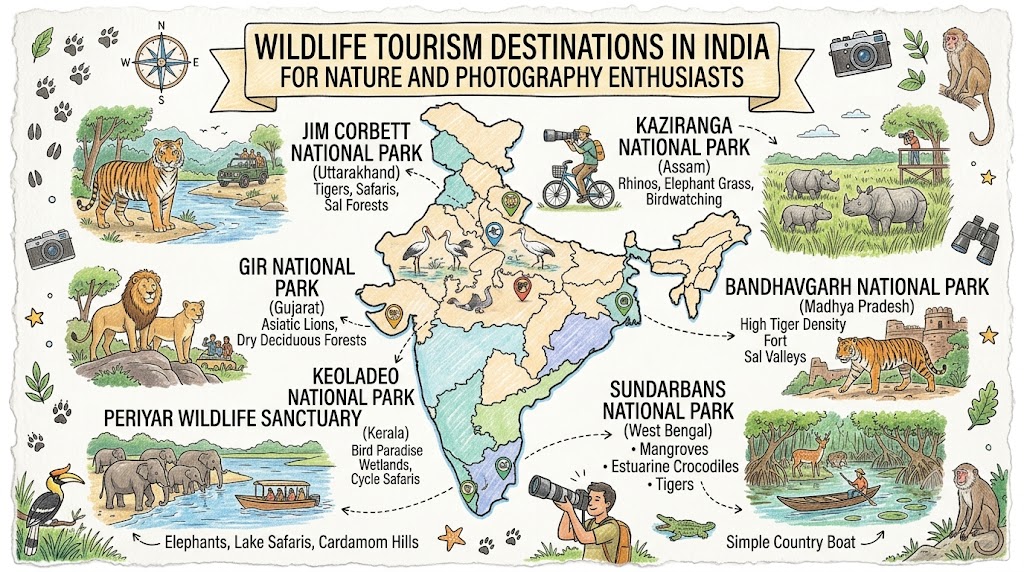
Introduction
India offers much more than tiger safaris. Its protected landscapes include Himalayan forests, dry deciduous woodland, river floodplains, wetlands, tropical hills and mangrove deltas. Together, these habitats support an impressive variety of mammals, reptiles, birds, insects and plant life.
The best wildlife tourism destinations in India allow travellers to observe animals in natural surroundings while learning about conservation, forest ecology and communities living near protected areas. Some destinations are known for tigers and lions, while others are better suited to rhinoceros viewing, birdwatching, elephant observation or landscape photography.
A successful wildlife holiday depends on realistic expectations. Animal sightings cannot be guaranteed, safari access may be limited, and park zones can close because of weather, conservation requirements or local conditions. Good planning is therefore just as important as carrying the right camera.
This guide covers leading wildlife destinations, suitable seasons, meaningful activities, a practical itinerary, transport planning, accommodation, local food, estimated costs and responsible photography. HolidayLandmark can support the research process by helping travellers compare destinations, discover nearby homestays, understand seasonal conditions and connect with local travel providers.
Destination Overview
Wildlife tourism in India is spread across several distinct regions.
Central India contains large tiger landscapes such as Kanha, Bandhavgarh, Pench and Tadoba. Rajasthan combines dry forests, lakes and historic structures in places such as Ranthambore and Keoladeo. Assam’s floodplains protect rhinoceroses, elephants and wetland birds, while Gujarat’s Gir landscape is associated with the Asiatic lion.
In southern India, the Western Ghats offer dense forests, mountain habitats, lakes and high biodiversity. The Sundarbans in eastern India provide a completely different experience through tidal waterways and mangrove islands.
Several Indian natural areas, including Kaziranga, Keoladeo and the Sundarbans, are recognised under the UNESCO World Heritage Convention.
Wildlife trips may involve jeep safaris, guided forest walks, boat journeys, birdwatching, interpretation centres and community-based experiences. The exact activities depend on forest rules and must be booked through authorised systems.
Why Explore Wildlife Destinations in India
Diverse natural landscapes
A single country offers wildlife experiences in grasslands, wetlands, dry forests, tropical forests, mountain valleys and coastal mangroves. This variety allows travellers to choose a destination according to their preferred animals, scenery and photography style.
Opportunities beyond tiger sightings
Tigers attract significant attention, but Indian parks also protect rhinoceroses, Asiatic lions, elephants, wild buffaloes, deer, crocodiles, otters, primates and a rich variety of birds.
Travellers who focus only on one species may miss animal behaviour, tracks, bird calls, changing light, forest vegetation and smaller creatures that make every safari different.
Nature and photography experiences
Morning mist, forest shadows, open grasslands, water reflections and animal movement provide strong photography opportunities. Wildlife photography also teaches patience because the best moments often appear without warning.
Conservation learning
Protected areas help visitors understand habitat protection, species recovery, water conservation and human-wildlife relationships. Responsible tourism can contribute to local employment when travellers use authorised guides, local stays and community-run services.
Local cultures and rural life
Communities around wildlife reserves have their own food, crafts, farming practices and forest knowledge. Respectful village visits and locally managed accommodation can add cultural meaning to a wildlife trip.
Best Wildlife Tourism Destinations in India
Ranthambore National Park, Rajasthan
Ranthambore is known for its dry forest, lakes, rocky hills, historic ruins and tiger habitat. The landscape is particularly attractive to photographers because animals may be seen against open woodland, water bodies or ancient structures. Ranthambore Fort adds a strong heritage element to the wider destination.
Recommended duration: Two to three nights
Experiences: Jeep or canter safari, birdwatching, landscape photography and heritage exploration
Practical advice: Book through the authorised Rajasthan wildlife permit system. Safari permits are connected to specific zones and vehicle categories, so check all details before payment.
Suitable for: First-time safari travellers, families, tiger enthusiasts and photographers
Jim Corbett National Park, Uttarakhand
Corbett contains grasslands, sal forests, river belts and hilly terrain. Elephants, deer, birds, crocodilians and other wildlife are important parts of the experience, even when tigers remain hidden.
Tourism is divided among several zones, each offering different habitats and access conditions. Some zones have seasonal operating periods, while others may remain available during more of the year. The official portal currently explains zone access, booking windows and safari procedures.
Recommended duration: Three nights
Experiences: Jeep safari, canter safari in permitted zones, riverine scenery and bird photography
Practical advice: Choose accommodation near the correct entry gate. A hotel may be in the Corbett region but still require a long transfer to your assigned safari zone.
Suitable for: Families, birdwatchers, nature photographers and travellers combining wildlife with a hill holiday
Kaziranga National Park, Assam
Kaziranga lies within the Brahmaputra floodplain and is internationally recognised for its conservation value. Its grasslands, wetlands and forest patches support the greater one-horned rhinoceros, elephants, wild buffaloes, deer, birds and large carnivores.
The open grassland landscape can be rewarding for wildlife observation, especially for travellers interested in large mammals and environmental photography.
Recommended duration: Two to three nights
Experiences: Authorised jeep safari, wetland birdwatching, grassland photography and nearby cultural experiences
Practical advice: Floods and seasonal conditions influence access. Confirm which ranges are open before finalising accommodation or transport.
Suitable for: Rhinoceros enthusiasts, birdwatchers, families and first-time visitors to Northeast India
Gir National Park and Wildlife Sanctuary, Gujarat
Gir is the world’s best-known wild refuge of the Asiatic lion. Its landscape includes dry deciduous forest, scrubland, rocky areas and seasonal water bodies. Leopards, deer, antelope, crocodiles and birdlife also form part of the ecosystem.
The Gujarat Forest Department warns visitors to use its official permit platform rather than websites claiming to offer guaranteed or premium permits.
Recommended duration: Two to three nights
Experiences: Lion safari, birdwatching, dry-forest photography and local cultural exploration
Practical advice: Do not assume every safari will produce a lion sighting. Avoid crowding an animal when several vehicles gather in one area.
Suitable for: Wildlife photographers, families, lion enthusiasts and Gujarat road-trip travellers
Kanha National Park, Madhya Pradesh
Kanha is known for wide meadows, sal and mixed forests, streams and a strong Central Indian wilderness atmosphere. It has played an important conservation role for the hard-ground barasingha and also supports tigers, leopards, wild dogs, gaur and many bird species.
Its open grasslands are suitable for environmental portraits, animal groups and early-morning landscape photography.
Recommended duration: Three to four nights
Experiences: Jeep safari, meadow photography, birdwatching and authorised nature interpretation
Practical advice: Kanha has several gates. Select your accommodation only after understanding your booked safari zones and entry points.
Suitable for: Serious wildlife travellers, photographers, couples and small groups
Bandhavgarh National Park, Madhya Pradesh
Bandhavgarh combines forest, grassland, rocky hills and historic associations. It is widely known as a tiger reserve, but visitors may also observe deer, langurs, wild boars, birds and smaller forest species.
The hills and forest backdrop provide dramatic compositions, although access to historic areas can be restricted or controlled separately.
Recommended duration: Three nights
Experiences: Jeep safari, bird photography, forest landscapes and interpretation programmes
Practical advice: Avoid judging the entire trip by one safari. Two or three drives improve the opportunity to understand different zones and animal activity.
Suitable for: Tiger enthusiasts, photographers and travellers combining Bandhavgarh with Kanha
Tadoba-Andhari Tiger Reserve, Maharashtra
Tadoba is a dry deciduous forest landscape in the Chandrapur region of Maharashtra. It is known for tiger tourism, but its lakes, bamboo areas, open forest and varied wildlife make it valuable even without a major cat sighting.
Summer conditions can improve visibility around water sources, but high temperatures may be physically demanding.
Recommended duration: Three nights
Experiences: Jeep safari, tiger tracking with authorised naturalists, birdwatching and forest photography
Practical advice: Several entry gates serve the wider reserve. Check the distance between your lodge and allocated gate before booking.
Suitable for: Experienced safari travellers, tiger photographers and small wildlife groups
Sundarbans National Park, West Bengal
The Sundarbans present a water-based wildlife experience rather than a traditional jeep safari. Mangrove islands, mudflats, tidal channels and saline waterways form a landscape shared by India and Bangladesh.
The region protects tigers, crocodiles, reptiles, birds and aquatic life, but wildlife can be difficult to see in dense mangrove conditions. The journey should be valued for the ecosystem, boat experience and landscape rather than treated as a guaranteed tiger-viewing trip.
Recommended duration: Two to three nights
Experiences: Authorised boat safari, mangrove photography, birdwatching and village-based cultural experiences
Practical advice: Select a licensed operator with suitable safety equipment, trained crew and clear permit arrangements.
Suitable for: Landscape photographers, birdwatchers, nature travellers and visitors interested in delta communities
Periyar Tiger Reserve, Kerala
Periyar in the Western Ghats offers forested hills, a large lake and a range of controlled ecotourism experiences. Travellers may observe elephants, deer, primates, birds and other wildlife, although tiger sightings are uncommon and unpredictable.
Boat-based viewing is one of its well-known experiences, while some guided activities may be available through authorised conservation programmes.
Recommended duration: Two to three nights
Experiences: Lake cruise, guided nature activity, birdwatching, spice-region visits and forest-edge photography
Practical advice: Reserve activities early during busy holiday periods and verify age, fitness and clothing requirements for walks.
Suitable for: Families, couples, birdwatchers and travellers combining wildlife with a Kerala itinerary
Keoladeo National Park, Rajasthan
Keoladeo at Bharatpur is a major wetland bird habitat and a UNESCO World Heritage Site. It is especially rewarding for observing waterbirds, raptors, storks, herons, ducks and smaller resident species.
Unlike vehicle-based tiger reserves, Keoladeo can often be explored slowly through walking, cycling or authorised local transport, depending on current rules.
Recommended duration: One full day or two nights
Experiences: Birdwatching, slow photography, wetland observation and guided bird identification
Practical advice: Carry binoculars and allow enough time to remain quietly at productive water areas. A local bird guide can be more valuable than covering the park quickly.
Suitable for: Birdwatchers, families, beginners, senior travellers and telephoto photographers
Things to Do
Join more than one safari
Animal movement changes with weather, water, noise and time of day. Booking two or three drives provides a broader understanding of the forest and reduces pressure to find a tiger during one short outing.
Practise ethical wildlife photography
Maintain distance, avoid flash, follow guide instructions and never ask a driver to block an animal’s path. Do not play recorded bird calls or make sounds to attract wildlife.
Photographs should document natural behaviour rather than create stressful encounters.
Explore birdlife
Birdwatching is possible in nearly every wildlife destination. Keoladeo, Kaziranga, Periyar and the Sundarbans are particularly suitable, but even tiger reserves can provide excellent sightings of raptors, owls, hornbills, kingfishers and woodland birds.
Attend interpretation programmes
Nature centres, local naturalists and guided walks can explain tracks, plants, animal calls and conservation challenges. These experiences make the trip meaningful even when large mammals are not visible.
Try landscape and macro photography
Forests contain interesting textures, mist, reflections, insects, flowers, tree bark and changing light. Travellers should photograph smaller subjects without touching or disturbing them.
Discover local food and crafts
Use free time between safaris to explore regional cuisine and locally made products. Purchase directly from recognised artisans or community groups where possible.
Join permitted nature walks
Walking is allowed only in designated areas and under authorised guidance. Never enter forest land independently, even when a track appears easy or close to a village.
Suggested Four-Day Wildlife Itinerary
Because India’s major reserves are separated by long distances, travellers should avoid combining unrelated parks in a rushed itinerary. The following four-day plan can be adapted to Ranthambore, Corbett, Kaziranga, Gir, Kanha, Bandhavgarh or Tadoba.
Day One: Arrival and orientation
Arrive at the nearest gateway town and continue to your forest accommodation. Keep the first afternoon relaxed.
Complete permit checks, meet your naturalist, understand the entry gate and attend an interpretation programme if available. Use the evening to prepare camera batteries, memory cards, binoculars and suitable clothing.
Day Two: Morning safari and local experience
Take an early authorised safari. Rather than searching only for a tiger or lion, observe tracks, alarm calls, birds and herbivore behaviour.
Return for breakfast and rest during the middle of the day. In the afternoon, visit an approved village experience, craft centre, nature centre or nearby cultural attraction.
Day Three: Two wildlife sessions
Book a morning and an afternoon safari where park rules and energy levels allow.
Use one drive for wider habitat photography and another for animal behaviour. Avoid spending the midday break travelling long distances, especially during summer.
Day Four: Birdwatching and departure
Take a short guided birding session around the lodge, buffer area or approved nature trail.
Have breakfast, check out and leave enough time for the railway station or airport. Do not schedule a safari too close to a flight or long-distance train because forest exits and road transfers can be delayed.
Best Time to Visit
India does not have one universal wildlife season. Conditions vary between Himalayan forests, Central Indian tiger reserves, Assam’s floodplains, Kerala’s Western Ghats and the Sundarbans.
Many major forest zones operate most reliably between the post-monsoon period and early summer. Monsoon closures or restrictions are common, although selected zones in some reserves may operate during part or all of the rainy season. Corbett’s official information, for example, lists different operating periods for different tourism zones. (Corbett National Park)
| Season | Typical Conditions | Suitable Experiences | Travel Advice |
|---|---|---|---|
| October to February | Cooler mornings, clearer skies and greener post-monsoon landscapes | General safaris, birdwatching, family trips and comfortable photography | Carry warm layers for open vehicles and book early for holiday periods |
| March to May | Hotter, drier conditions with reduced vegetation in many central reserves | Waterhole observation and wildlife photography | Use sun protection, drink water and avoid overloading the itinerary |
| June to September | Rain, high humidity, flooding or restricted forest access in many regions | Mangrove landscapes, selected buffer zones and nature stays where officially open | Verify zone access before booking and prepare for road disruption |
| Seasonal transitions | Unpredictable weather and changing park operations | Quieter travel and landscape photography | Keep flexible plans and reconfirm permits, transfers and activities |
Winter is often comfortable for families and birdwatchers. Summer may offer better visibility in dry forests, but it can be physically difficult. The monsoon creates beautiful landscapes but is unsuitable for many conventional safari plans.
How to Reach and Travel Locally
Wildlife reserves are generally reached through a gateway city, followed by a road transfer to a forest gate or accommodation area.
| Wildlife Destination | Common Gateway | Final Travel Planning |
|---|---|---|
| Ranthambore | Jaipur, Delhi or Sawai Madhopur | Sawai Madhopur is the main rail and road base |
| Jim Corbett | Delhi, Dehradun or Ramnagar | Ramnagar connects travellers with different tourism zones |
| Kaziranga | Guwahati or Jorhat | Continue by road to the selected range or accommodation cluster |
| Gir | Rajkot, Diu, Junagadh or Veraval | Continue to Sasan Gir and confirm the assigned safari point |
| Kanha | Jabalpur, Nagpur or Raipur | Road transfer depends on the selected gate |
| Bandhavgarh | Jabalpur, Umaria or Katni | Confirm whether the lodge serves Tala, Magadhi or another gate |
| Tadoba | Nagpur or Chandrapur | Travel time varies considerably between reserve gates |
| Sundarbans | Kolkata | Road transfer is followed by an authorised boat journey |
| Periyar | Kochi, Madurai or Kottayam | Thekkady is the main tourism base |
| Keoladeo | Delhi, Jaipur, Agra or Bharatpur | Bharatpur offers convenient local access |
Transport routes, flight availability and road conditions can change. Travellers should verify the final connection before paying for a non-refundable safari or hotel.
Local transport may include private taxis, shared transfers, lodge vehicles, authorised safari jeeps, boats, bicycles or rickshaws. Ordinary taxis cannot automatically enter protected tourism zones.
Accommodation and Homestays
Accommodation around wildlife reserves ranges from basic guesthouses to forest rest houses, homestays, tented camps, eco-lodges and comfortable resorts.
Budget travellers
Choose a simple stay in the main gateway town or near a frequently used park gate. Confirm hot water, early breakfast, transport availability and distance from the safari entrance.
Families
Look for secure grounds, family rooms, flexible meals and short transfers to the gate. Very young children may find long, cold or dusty safaris tiring.
Couples and photographers
Forest-edge lodges can offer quieter surroundings and early access to bird activity. Photographers should ask about charging facilities, backup electricity and secure equipment storage.
Groups
A small group may reduce transport costs by sharing vehicles, but safari capacity rules still apply. Obtain a written list of permits, guide charges, vehicle charges and included meals.
Homestays
A responsible homestay can introduce travellers to regional food, daily life and local customs. Select properties that respect forest boundaries, manage waste properly and employ local people.
HolidayLandmark can be used to discover accommodation styles and local experiences near major wildlife areas. Travellers should still verify the property’s location, cancellation rules and transport arrangements directly before booking.
Local Tour Guides
A trained local guide or naturalist can explain animal tracks, alarm calls, vegetation, bird identification and forest rules. Guides also help photographers anticipate behaviour without disturbing wildlife.
Before confirming a guide, ask about:
- Official registration or authorisation
- Experience in the selected park
- Languages spoken
- Birding or photography knowledge
- Charges and payment terms
- Duration of service
- Transport and permit inclusions
- Cancellation conditions
Never choose a guide who promises a guaranteed tiger, lion or leopard sighting. Wildlife moves freely, and no responsible professional can guarantee a particular animal.
Official booking systems should be used wherever available. Rajasthan Forest Department and Corbett Tiger Reserve provide government-managed information on permits, while Gujarat’s official Gir platform specifically warns about misleading booking websites.
Village Tourism and Local Experiences
Villages around protected areas should be visited respectfully rather than treated as staged attractions.
Meaningful local experiences may include:
- Regional cooking demonstrations
- Responsible farm visits
- Handicraft workshops
- Folk music or cultural programmes organised by communities
- Tea or spice-growing experiences
- Guided bird walks in buffer landscapes
- Discussions about farming and wildlife coexistence
Ask before photographing residents, homes, ceremonies, children or private workspaces. Do not enter fields or forest-use areas without permission.
Purchasing food, crafts and guiding services directly from local providers can keep a greater share of tourism income within the area. HolidayLandmark can help travellers research village experiences and community-based stays that complement a wildlife itinerary.
Adventure Activities
Wildlife exploration can be adventurous, but activities must remain within forest regulations.
Depending on the destination, authorised experiences may include:
- Jeep safaris
- Canter safaris
- Boat journeys
- Guided forest walks
- Cycling in permitted areas
- Birdwatching trails
- Canoeing or bamboo rafting under authorised programmes
- Nature camping outside restricted forest zones
Activity availability depends on the season, water level, forest conditions and local regulations. Travellers should confirm minimum age, physical fitness, safety equipment and insurance requirements.
Do not attempt independent trekking, night drives or off-road exploration in protected forest areas.
Local Food and Shopping
Wildlife journeys are also opportunities to understand regional food.
Around Assam’s wildlife areas, travellers may find rice-based meals, seasonal greens, fish preparations and traditional snacks. Central Indian destinations commonly offer simple lentils, vegetables, rice, flatbreads and regional dishes. Rajasthan is associated with foods such as dal baati, while Gujarat offers a range of vegetarian thalis and Kathiawadi flavours.
Kerala’s forest regions may offer appam, vegetable preparations, fish dishes and spice-influenced food. In West Bengal, rice, fish, vegetables and sweets are common parts of regional cuisine.
Travellers with allergies or strict dietary requirements should communicate clearly before arrival, especially at remote lodges with limited menus.
Responsible shopping may include:
- Locally woven textiles
- Bamboo products
- Tribal or folk crafts from recognised sellers
- Regional spices and tea
- Nature books and field guides
- Sustainable souvenirs from interpretation centres
Avoid purchasing wildlife products, feathers, shells, skins, teeth, claws or items made from protected plants or animals.
Estimated Travel Budget
The following are flexible planning estimates for Indian travellers, calculated per person per day when sharing accommodation and transport. Long-distance flights or trains are not included.
| Expense Category | Budget Travel | Mid-Range Travel | Comfortable Travel |
|---|---|---|---|
| Accommodation | ₹1,500–₹3,500 | ₹4,000–₹8,000 | ₹9,000–₹18,000+ |
| Food | ₹700–₹1,200 | ₹1,500–₹2,500 | ₹3,000–₹5,000 |
| Local transport | ₹800–₹2,000 | ₹2,500–₹5,000 | ₹5,000–₹9,000 |
| Safaris and activities | ₹1,000–₹3,500 | ₹3,500–₹8,000 | ₹8,000–₹15,000+ |
These figures are not official tariffs. Safari costs may be divided into entry permits, visitor charges, guide fees, vehicle charges and taxes. Some costs apply per vehicle rather than per person.
Prices change according to season, nationality, zone, vehicle type, accommodation plan and group size. Public tariffs already show significant seasonal variation, while reserve portals maintain separate fee structures for permits and activities.
Safety and Responsible Travel
Follow forest instructions
Remain inside the vehicle unless a guide clearly permits otherwise. Never ask a driver to leave the authorised route or move closer than regulations allow.
Keep noise low
Loud conversations, music and shouting disturb animals and reduce everyone’s chance of observing natural behaviour.
Avoid feeding wildlife
Feeding changes animal behaviour and may create dangerous dependence or conflict.
Protect personal belongings
Secure cameras, phones, hats and water bottles in open vehicles. Loose items can fall onto forest tracks.
Prepare for weather
Carry layers in winter, sun protection in summer and suitable rain protection during uncertain weather. Open safari vehicles can feel much colder than the hotel area before sunrise.
Reduce plastic waste
Carry a reusable water bottle where permitted and take all waste back to the lodge. Never throw food packaging from a vehicle or boat.
Request photography permission
Ask before photographing local residents, staff, ceremonies and private homes. Restrictions may also apply to drones, mobile phones and professional filming equipment.
Respect animal space
Do not block crossings, surround resting animals or pressure guides to chase sightings. Tiger-tourism rules in India are governed by conservation guidelines, and individual reserves can impose additional restrictions.
Practical Travel Tips
- Book popular safari permits before reserving a non-refundable hotel.
- Check the exact entry gate written on the permit.
- Carry the identification document used during booking.
- Keep digital and printed copies of permits where possible.
- Bring binoculars even when travelling mainly for photography.
- Carry spare camera batteries because cold mornings reduce battery performance.
- Use neutral, comfortable clothing rather than camouflage uniforms.
- Protect cameras from dust with a simple cover.
- Avoid changing lenses while the vehicle is moving.
- Keep one safari free from photography pressure and observe the forest naturally.
- Allow a rest period between morning and afternoon drives.
- Confirm whether meals are available before an early departure.
- Keep extra time for rural roads and gate formalities.
- Purchase suitable travel insurance for transport disruption and medical emergencies.
How HolidayLandmark Supports Better Travel Planning
HolidayLandmark can help travellers compare different wildlife tourism destinations in India according to landscape, species interest, travel season and trip duration.
The platform can support planning by helping visitors:
- Discover national parks, sanctuaries and lesser-known nature areas
- Compare wildlife, birdwatching and photography experiences
- Explore practical itinerary ideas
- Research suitable travel seasons
- Identify nearby attractions
- Discover local guides and naturalists
- Find homestays and nature-focused accommodation
- Explore village tourism opportunities
- Learn about regional food and culture
- Understand transport connections
- Connect with relevant local travel providers
HolidayLandmark should form one part of the planning process. Safari availability, official permits, zone access, weather warnings and forest regulations must always be reconfirmed through the relevant authority or authorised provider.
Frequently Asked Questions
1. Which wildlife destination is most suitable for a first safari in India?
Ranthambore, Corbett, Kaziranga and Kanha are practical choices because they have established tourism facilities and different accommodation categories. The best option depends on whether the traveller is more interested in tigers, rhinoceroses, birds, landscapes or a family-friendly experience.
2. What is the best season for wildlife photography in India?
October to February generally offers comfortable weather and good bird activity. March to May can provide clearer wildlife visibility in dry forests, but heat and dust require additional preparation.
3. How many days should be planned for one national park?
Three nights are suitable for most major tiger reserves because they allow time for multiple safaris and rest. Bird sanctuaries such as Keoladeo may be explored in one full day, although photographers may prefer two mornings.
4. Are wildlife safaris suitable for children and senior travellers?
Many parks welcome families, but age rules and safari conditions vary. Cold mornings, rough tracks, long sitting periods and limited toilets should be considered before booking for young children or travellers with mobility concerns.
5. Is seeing a tiger or lion guaranteed during a safari?
No animal sighting can be guaranteed. Wildlife moves naturally, and weather, vegetation, water availability and chance all influence what visitors observe.
6. How early should safari permits be booked?
Popular permits can sell out well before travel dates, especially during weekends and holidays. Booking windows differ by reserve; Corbett’s official system, for example, currently explains a progressive advance-booking process for safari types.
7. Is a local wildlife guide necessary?
Authorised guides are compulsory for many safari activities and are valuable even when they are optional. A knowledgeable guide helps identify calls, tracks, birds, behaviour and safe photography positions.
8. What camera equipment is useful for an Indian wildlife trip?
A telephoto lens, spare batteries, memory cards and a dust cover are useful. Binoculars should also be carried because observing wildlife comfortably is more important than trying to photograph every sighting.
9. Are homestays available near wildlife reserves?
Homestays and small locally managed properties are available around several wildlife regions. Check their distance from the assigned gate, early-morning transport arrangements, meal timings and waste-management practices before booking.
10. How much should a traveller budget for a three-night wildlife holiday?
A modest shared trip may begin around ₹20,000–₹35,000 per person, excluding long-distance transport, while private safaris and higher-category lodges can raise the cost considerably. Obtain an itemised estimate covering permits, guides, vehicles, accommodation, meals and transfers.
Conclusion
Wildlife tourism destinations in India offer far more than a brief search for famous animals. They introduce travellers to grasslands shaped by rivers, forests filled with alarm calls, wetlands used by migratory birds, dry landscapes supporting lions and tidal mangroves where life follows the movement of the sea.
Ranthambore, Corbett, Kaziranga, Gir, Kanha, Bandhavgarh, Tadoba, Periyar, Keoladeo and the Sundarbans each provide a different reason to travel. Some are suitable for tiger photography, while others reward visitors with rhinoceroses, lions, elephants, birds, forest scenery or quiet observation.
Good planning improves the experience. Travellers should select the right season, book through authorised systems, choose accommodation close to the correct gate and allow enough time for more than one nature session. A knowledgeable local guide can reveal tracks, calls, plants and animal behaviour that an untrained visitor may overlook.
Homestays, regional food and respectful community experiences can add depth to the journey. They also help tourism income reach people living near conservation landscapes. At the same time, visitors must control noise, avoid plastic waste, maintain distance from animals and request permission before photographing residents.
HolidayLandmark can help travellers research destinations, compare experiences, explore realistic itineraries and discover local guides, homestays and village-based activities. The most rewarding wildlife journey is not always the one with the closest sighting. It is often the journey that leaves the forest undisturbed while giving the traveller a deeper understanding of nature.
