
Introduction
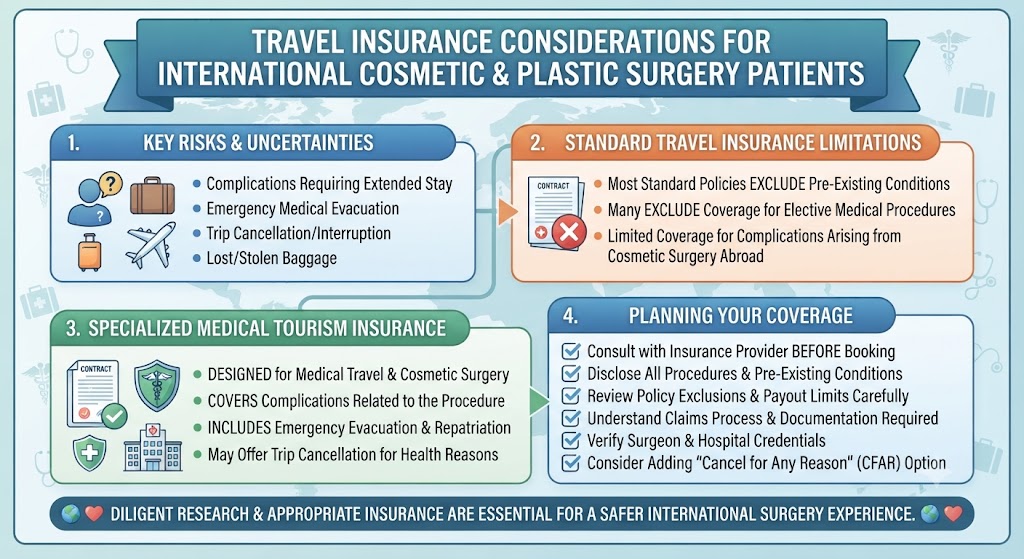
Travel insurance is an important part of planning cosmetic or plastic surgery outside a patient’s home country. However, purchasing a standard holiday policy does not necessarily mean that the procedure, its complications or related travel disruptions will be covered.
Many general travel insurance policies exclude claims connected to planned medical treatment. The UK government’s Travel Aware guidance warns that planned treatment abroad may invalidate standard cover and that patients may require specialist insurance arranged well before departure. Australian government guidance similarly states that basic policies rarely cover medical tourism and recommends confirming coverage for the specific procedure, postoperative care, complications and medical evacuation.
Patients should read the complete policy rather than relying on a brief sales description. Important areas include planned-treatment exclusions, medical complications, evacuation, repatriation, cancellations, extended accommodation, pre-existing conditions and follow-up care after returning home.
BestCosmeticHospitals.com can help patients begin comparing hospitals, surgeons, destinations, procedures and estimated treatment costs. Insurance decisions should still be based on written confirmation from a regulated insurer or qualified insurance professional.
Why Ordinary Travel Insurance May Not Be Enough
Standard travel insurance is generally designed for unexpected events during an ordinary trip, such as sudden illness, accidental injury, lost luggage, flight disruption or emergency medical care.
Cosmetic surgery abroad is different because the medical procedure is planned before departure. The insurer may therefore consider the operation and any related complications to be foreseeable rather than unexpected.
A standard policy might cover an unrelated event, such as an accidental injury while travelling, while excluding:
- The planned cosmetic procedure
- Postoperative infection
- Bleeding connected to surgery
- Wound-healing problems
- An implant complication
- Additional surgery
- Treatment required after returning home
- Extended accommodation caused by recovery
- Flight changes connected to the operation
- Medical evacuation arising from the procedure
Patients should never assume that buying general travel insurance provides protection for cosmetic treatment. The planned surgery must be disclosed, and the insurer should confirm the applicable coverage in writing.
Main Types of Insurance Patients May Need
International cosmetic surgery patients may need more than one form of financial protection. Product names and coverage structures differ between countries and insurers.
Standard Travel Insurance
Standard travel insurance may cover ordinary travel risks, including:
- Trip cancellation for covered reasons
- Lost or delayed baggage
- Passport loss
- Travel delay
- Personal liability
- Emergency care unrelated to the planned procedure
However, it may exclude the operation and every claim medically connected to it.
Patients should ask whether the policy remains valid for unrelated travel claims once the insurer knows that the primary purpose of the journey is cosmetic surgery.
Specialist Medical Tourism Travel Insurance
Specialist medical tourism insurance is designed for people travelling for planned healthcare.
Depending on the policy, it may cover selected risks such as:
- Procedure-related complications
- Emergency hospitalization
- Additional treatment
- Extended accommodation
- Changed return flights
- Medical evacuation
- Repatriation
- Companion travel expenses
- Trip cancellation before treatment
The Australian government advises medical tourists to obtain a specialized policy covering their particular procedure and to ask specifically about postoperative care, complications and evacuation. It also warns that failure to disclose the treatment plan may invalidate coverage.
Specialist cover does not automatically include every risk. Some policies cover travel disruption but exclude medical complications, while others cover complications but not the original procedure.
Surgical Complication Insurance
Some providers offer policies intended specifically to cover complications from elective surgery.
Coverage may apply to specified events such as:
- Infection
- Bleeding
- Emergency readmission
- Additional surgery
- Anesthesia complications
- Implant-related problems
- Wound breakdown
- Hospitalization beyond the planned stay
Patients should check whether the policy pays:
- The overseas hospital
- A hospital in the patient’s home country
- Only a provider within an approved network
- Only the original treating facility
- Through reimbursement after the patient pays personally
Complication coverage should not be confused with dissatisfaction coverage. A patient who is unhappy with the appearance of a result may not have an insured complication.
Medical Evacuation Insurance
Medical evacuation insurance may cover transportation to an appropriate medical facility or, when medically necessary and authorized, transportation to the patient’s home country.
CDC guidance explains that ordinary domestic health coverage may not include care abroad or medical evacuation. It recommends considering supplemental coverage, especially when treatment takes place in a remote destination or where appropriate facilities may be limited.
Evacuation coverage may include:
- Ground ambulance
- Air ambulance
- Medical escort
- Transportation to another city or country
- Repatriation when medically necessary
Ask who decides whether evacuation is necessary. The patient or surgeon may not be able to order an insured evacuation without authorization from the insurer’s assistance team.
Trip Cancellation and Interruption Insurance
Cancellation coverage may help when travel cannot proceed for an insured reason.
Possible covered reasons may include:
- Serious unexpected illness
- Injury
- Death of a close relative
- Certain travel-provider failures
- Severe weather
- Visa problems when specifically covered
However, cancellation because the patient changes their mind, feels nervous or receives an unfavorable treatment quotation may be excluded.
Patients should also ask what happens if:
- Preoperative tests show surgery is unsuitable
- The surgeon becomes unavailable
- The hospital changes
- The procedure is postponed
- The destination becomes unsafe
- The patient develops an unrelated illness
- The return journey must be delayed after surgery
Cancellation insurance and hospital refund policies are separate. An insurer may reject a claim even when the clinic keeps the deposit.
Private Health Insurance
Domestic private health insurance may offer limited or no coverage outside the patient’s country. Some plans cover only emergency care, while others have arrangements with selected overseas hospitals.
CDC recommends that medical tourists check their domestic health plan carefully to understand what services, if any, are covered internationally.
Ask the health insurer:
- Is elective cosmetic surgery covered?
- Are complications from excluded cosmetic treatment covered?
- Is emergency treatment after returning home covered?
- Is preauthorization required?
- Must the surgeon or hospital be approved?
- Are reconstructive procedures treated differently?
- Are implants, medication and rehabilitation covered?
Obtain answers in writing before paying the overseas provider.
Travel Insurance Coverage Comparison
| Insurance Type | Possible Coverage | Common Limitation | Important Question |
|---|---|---|---|
| Standard travel insurance | Unrelated emergencies, baggage and disruption | Planned surgery and related complications may be excluded | Does the policy remain valid when surgery is the main purpose of travel? |
| Specialist medical tourism policy | Procedure-related travel and selected medical risks | Only named procedures or providers may qualify | Is my exact operation covered? |
| Complication insurance | Specified postoperative complications | Cosmetic dissatisfaction and routine aftercare may be excluded | Which complications are listed in the policy? |
| Medical evacuation insurance | Emergency transport or medically necessary repatriation | Insurer authorization may be required | Who decides where I am transported? |
| Cancellation insurance | Covered reasons preventing travel | Change of mind and provider disputes may be excluded | Is cancellation after failed medical clearance covered? |
| Domestic health insurance | Limited overseas or home-country care | Elective treatment abroad may be excluded | Will complications be covered after I return? |
| Provider malpractice insurance | May respond to professional negligence claims | Does not replace the patient’s travel insurance | Does the surgeon and hospital hold valid indemnity cover? |
Planned Medical Treatment Must Be Disclosed
The patient should tell the insurer that the main purpose of the journey is cosmetic or plastic surgery.
The disclosure should include:
- Name of the procedure
- Destination
- Travel dates
- Hospital or clinic
- Surgeon’s name
- Type of anesthesia
- Expected hospital stay
- Recovery accommodation
- Planned return date
- Existing medical conditions
- Current medication
- Previous relevant procedures
Do not describe the journey as an ordinary holiday when surgery has already been planned.
The insurer may reject a claim or invalidate the policy when important facts are not disclosed. Government travel guidance advises patients to declare medical conditions fully and update the insurer when circumstances change.
Ask the insurer to confirm the disclosed information by email or through a policy endorsement.
Declare Pre-Existing Medical Conditions
A pre-existing condition may include more than a serious long-term disease.
Depending on the insurer’s definition, it may include:
- High blood pressure
- Diabetes
- Asthma
- Heart conditions
- Previous blood clots
- Mental health conditions
- Cancer history
- Recent investigations
- Undiagnosed symptoms
- Previous surgery
- Medication changes
- Pregnancy
- Recent hospital treatment
Some insurers require disclosure of conditions affecting travelling companions or close relatives when those conditions could lead to cancellation.
Travel Aware guidance states that failing to declare relevant medical conditions may result in rejection of an emergency claim.
Answer every medical-screening question honestly. When uncertain, contact the insurer rather than guessing.
Confirm Whether the Procedure Is Covered
A policy may cover one cosmetic operation but exclude another.
Ask the insurer to confirm the exact medical name of the planned procedure, such as:
- Rhinoplasty
- Facelift
- Eyelid surgery
- Liposuction
- Tummy tuck surgery
- Breast augmentation
- Breast lift
- Breast reduction
- Body lift
- Hair transplantation
- Revision cosmetic surgery
- Combined procedures
Coverage may also depend on whether the procedure is:
- Purely cosmetic
- Reconstructive
- Medically necessary
- A first operation
- A revision procedure
- Performed with general anesthesia
- Combined with another operation
- Provided by an approved specialist
Do not assume that general wording such as “plastic surgery cover” includes every procedure.
Check Whether the Hospital and Surgeon Must Be Approved
Some policies apply only when treatment is provided through a named hospital, surgeon or medical tourism organizer.
The policy may require:
- A licensed hospital
- Current hospital accreditation
- A registered specialist
- A surgeon with procedure-specific qualifications
- Prior medical assessment
- Insurer preauthorization
- An approved destination
- A treatment plan submitted before departure
Government medical tourism guidance recommends checking whether the surgeon is properly qualified and whether the surgeon and hospital hold professional indemnity or malpractice insurance.
Confirm whether changing the surgeon, facility or procedure after arrival will invalidate the policy.
Understand the Difference Between Complications and Dissatisfaction
Insurance normally defines a medical complication differently from an unsatisfactory cosmetic result.
A possible medical complication may include:
- Infection
- Hemorrhage
- Blood clot
- Wound breakdown
- Severe anesthesia reaction
- Implant rupture
- Tissue damage
- Emergency hospital admission
Cosmetic dissatisfaction may include:
- Disliking the shape
- Expecting greater change
- Minor asymmetry
- Scarring within the expected range
- Disappointment with hair density
- Preferring a different implant size
A policy may pay for urgent medical treatment while excluding corrective surgery intended only to improve appearance.
Ask the insurer to define:
- Medical complication
- Adverse outcome
- Revision surgery
- Corrective surgery
- Pre-existing problem
- Expected postoperative symptom
The hospital’s revision policy should also be reviewed separately.
Review Postoperative Care Coverage
Routine aftercare and emergency complication treatment are not the same.
Routine care may include:
- Dressing changes
- Drain removal
- Stitch removal
- Medication review
- Surgeon examinations
- Compression garments
- Wound checks
- Remote consultations
Insurance may exclude routine treatment because it is considered part of the planned procedure.
Ask whether coverage includes:
- Extra postoperative appointments
- Unplanned medical tests
- Additional medication
- Emergency wound treatment
- Specialist review
- Physiotherapy
- Treatment in the home country
- Long-term complication management
CDC advises medical tourists to create a complication plan with both the overseas provider and a healthcare professional at home. Patients should also obtain complete overseas records for later follow-up.
Check Medical Evacuation and Repatriation Terms
Medical evacuation may become necessary when the local facility cannot provide appropriate care.
Review:
- Coverage limit
- Geographic area
- Destination restrictions
- Hospital selection
- Medical escort
- Air ambulance
- Commercial-flight upgrade
- Companion travel
- Repatriation destination
- Prior authorization rules
- Excluded medical conditions
The insurer may choose to transfer the patient to the nearest suitable hospital rather than directly home.
Travel Aware advises checking that evacuation is included because emergency transportation can create substantial costs.
Patients travelling to remote areas or small surgical facilities should examine evacuation terms particularly carefully.
Extended Stay and Flight-Change Coverage
Recovery may take longer than the package schedule.
Ask whether the policy covers:
- Extra hotel nights
- Additional hospital nights
- Rebooking fees
- A new flight
- Upgraded seating when medically required
- Accommodation for a companion
- Meals during an extended stay
- Local transportation
- Visa-extension expenses
The insurer may require written confirmation that the patient is not fit to fly.
Patients should also ask:
- Which medical professional can issue the certificate?
- Must the insurer approve the delay?
- Is there a daily accommodation limit?
- How many extra days are covered?
- Are non-refundable missed flights covered?
Do not book an inflexible return journey simply because it is cheaper.
Companion and Caregiver Coverage
Some cosmetic procedures make it difficult for patients to travel or manage daily activities alone.
A policy may offer limited coverage for a companion when the patient is hospitalized or medically unable to return as planned.
Possible benefits include:
- Companion accommodation
- Flight changes
- Emergency travel by a family member
- Childcare arrangements
- Medical escort
- Repatriation of dependants
Check whether the companion must be named on the same policy.
A hospital package that includes a hotel room for two people does not necessarily insure the companion’s additional travel or medical expenses.
Destination and Government Travel Advice
Travel insurance may be restricted or invalid when a patient travels against official government advice.
Policies may exclude countries or regions affected by:
- War
- Civil unrest
- Government travel warnings
- Natural disasters
- Sanctions
- Epidemics
- Closed borders
Travel Aware recommends checking official destination advice and confirming that the policy covers the entire journey, including transit countries. It notes that travelling to a destination against official advice may invalidate coverage.
Review travel advice before purchasing the policy and again before departure.
Reciprocal Healthcare Agreements Are Not Full Insurance
Some countries have reciprocal healthcare arrangements that provide visitors with access to limited public medical treatment.
These arrangements generally do not replace insurance and may not cover:
- Planned private cosmetic surgery
- Private hospital care
- Medical evacuation
- Repatriation
- Flight changes
- Extended accommodation
- Companion costs
- Revision surgery
Australian government guidance explains that reciprocal healthcare arrangements cover only certain circumstances and that travellers may still be responsible for treatment or evacuation expenses.
Patients should check the exact agreement applying to their citizenship and destination.
Provider Indemnity Insurance Is Separate
The surgeon or hospital may carry malpractice or professional indemnity insurance.
This is not the same as the patient’s travel or medical complication policy.
Provider indemnity may respond when:
- Professional negligence is established
- A legal claim satisfies policy conditions
- The provider and event fall within the insurer’s jurisdiction
It may not provide immediate payment for:
- Emergency hospital bills
- Accommodation
- New flights
- Medical evacuation
- Routine complications without negligence
- Care after returning home
Ask the surgeon and hospital to confirm that they hold current professional indemnity coverage, but do not rely on it as a replacement for personal insurance.
Read the Policy Exclusions Carefully
Common exclusions may include:
- Planned elective treatment
- Complications from excluded procedures
- Undeclared medical conditions
- Treatment by an unlicensed provider
- Surgery at an unapproved facility
- Experimental procedures
- Revision surgery
- Cosmetic dissatisfaction
- Routine aftercare
- Alcohol or drug-related incidents
- Travel against medical advice
- Flying before medical clearance
- Failure to follow postoperative instructions
- Travel against government advice
- Pregnancy-related claims
- Mental health exclusions
- Claims outside the policy period
- Treatment without prior authorization
The exclusion wording matters more than the policy’s marketing title.
Ask for clarification in writing whenever a term is unclear.
Check Policy Limits, Excesses and Sub-Limits
A policy may advertise a high overall medical limit but place lower limits on individual benefits.
Review:
- Overall medical-expense limit
- Complication-treatment limit
- Evacuation limit
- Accommodation allowance
- Companion benefit
- Cancellation limit
- Excess or deductible
- Co-payment percentage
- Maximum number of covered days
- Per-event limit
- Lifetime limit
- Home-country follow-up limit
A policy covering complications up to a low limit may still leave the patient responsible for substantial expenses.
Calculate the maximum personal exposure after applying excesses, co-payments and exclusions.
Understand Direct Billing and Reimbursement
Some insurers pay approved hospitals directly. Others require the patient to pay first and submit a claim later.
Ask:
- Does the hospital accept direct billing?
- Must the insurer issue a payment guarantee?
- What happens outside office hours?
- Can the patient receive treatment before authorization?
- Which documents are needed?
- Which currency will be used for reimbursement?
- Are bank and conversion fees covered?
- How long does claim processing normally take?
Patients should have access to emergency funds even when insured.
Government guidance warns that patients, families or insurers may have to pay for additional care or evacuation and that governments generally will not settle these bills.
Contact the Insurer Before Receiving Additional Treatment
Except during a life-threatening emergency, the policy may require the patient to contact the insurer before:
- Entering another hospital
- Undergoing additional surgery
- Changing flights
- Extending accommodation
- Arranging evacuation
- Returning home early
- Receiving private follow-up care
Save the insurer’s international emergency number.
Provide the contact information to:
- Travel companion
- Family at home
- Hospital coordinator
- Treating surgeon
Travel Aware recommends carrying a paper copy of the policy and sharing the policy details with trusted people who may need to contact the insurer.
Documentation Needed for an Insurance Claim
Keep printed and digital copies of:
- Policy certificate
- Full policy wording
- Medical-screening answers
- Written disclosure of the surgery
- Insurer’s approval
- Hospital treatment plan
- Surgeon’s credentials
- Itemized quotation
- Payment receipts
- Flight and hotel bookings
- Medical reports
- Test results
- Discharge summary
- Prescriptions
- Complication diagnosis
- Additional hospital invoices
- Fitness-to-fly certificate
- Airline change receipts
- Communication with the insurer
CDC recommends obtaining complete records from the overseas provider and sharing them with professionals providing later care.
Do not leave the destination without requesting copies of relevant medical documents.
Travel Insurance Review Table
| Policy Area | Questions to Ask |
|---|---|
| Planned treatment | Does the policy remain valid when cosmetic surgery is the main purpose of travel? |
| Exact procedure | Is my named procedure covered? |
| Combined operations | Are all planned procedures included? |
| Complications | Which medical complications qualify? |
| Routine aftercare | Are dressing changes, drain removal and reviews covered? |
| Home-country treatment | Will the policy pay for complications after I return? |
| Medical evacuation | Is transport to another hospital or home country covered? |
| Extended stay | Are extra hotel nights and meals included? |
| Flight changes | Will medically necessary rebooking be covered? |
| Companion expenses | Are additional flights and accommodation covered? |
| Pre-existing conditions | Which conditions and investigations must be disclosed? |
| Hospital requirements | Must the hospital be accredited or approved? |
| Surgeon requirements | Must the surgeon hold specified qualifications? |
| Cancellation | Is failed medical clearance a covered reason? |
| Revision surgery | Is corrective treatment included or excluded? |
| Claims process | Is prior authorization required? |
| Payment | Will the insurer pay directly or reimburse later? |
| Policy limits | What are the excess, co-payment and sub-limits? |
Questions to Ask the Insurance Provider
- Does this policy cover travel undertaken specifically for cosmetic surgery?
- Is my exact procedure named as covered?
- Are combined procedures included?
- Does the policy cover postoperative complications?
- Which complications are excluded?
- Is routine aftercare covered?
- Is treatment after returning home included?
- Does the policy cover medical evacuation?
- Does it include medically necessary repatriation?
- Are extended hotel stays covered?
- Are changed flights covered when I am not fit to travel?
- Does the policy cover a travelling companion?
- Must the hospital or surgeon be approved in advance?
- What medical conditions must I disclose?
- Is written preauthorization required?
- What excess or deductible applies?
- Are there separate limits for complications and evacuation?
- Will the insurer pay the hospital directly?
- What documents will be needed for a claim?
- What emergency telephone number should I use abroad?
Warning Signs When Purchasing Insurance
Be cautious when an insurer, clinic or coordinator:
- Says ordinary holiday insurance is automatically sufficient
- Refuses to confirm planned-treatment coverage in writing
- Uses the term “fully covered” without explaining limits
- Cannot identify the actual insurer
- Provides no complete policy wording
- Avoids discussing complications
- Claims every revision procedure is covered
- Does not ask about medical history
- Advises the patient not to disclose surgery
- Provides no international emergency number
- Cannot explain the claim process
- Covers only travel but is marketed as surgical insurance
- Requires an unreasonably low medical limit
- Provides no evacuation coverage
- Pressures the patient to buy immediately
Insurance should be chosen for its terms, exclusions and claims support rather than its lowest premium.
Common Insurance Planning Mistakes
Patients should avoid:
- Purchasing insurance after paying non-refundable expenses
- Buying standard insurance without disclosing treatment
- Assuming complications are automatically covered
- Ignoring pre-existing-condition questions
- Failing to check the surgeon and facility requirements
- Confusing malpractice insurance with travel insurance
- Relying on verbal statements from a coordinator
- Ignoring evacuation limits
- Booking a policy that ends on the original return date
- Having no coverage for an extended stay
- Assuming public healthcare abroad will be free
- Travelling against official advice
- Flying earlier than medically recommended
- Leaving without medical records
- Having no emergency funds
- Failing to arrange follow-up at home
A policy is useful only when it matches the patient’s actual treatment and travel plan.
How BestCosmeticHospitals.com Supports Insurance Research
BestCosmeticHospitals.com helps patients begin comparing:
- Best cosmetic hospitals in the world
- Best cosmetic surgeons in the world
- Cosmetic surgery abroad
- Best countries for plastic surgery
- Plastic surgery cost by country
- International patient services
- Hospital facilities
- Recovery expectations
- Treatment packages
- Aftercare arrangements
- Questions to ask before travelling
Patients researching rhinoplasty cost by country, liposuction cost by country, breast augmentation cost by country, tummy tuck cost by country or hair transplant cost by country should include insurance expenses in the total treatment budget.
The platform can support early research but does not sell insurance, confirm coverage or replace advice from an insurer, broker, doctor or legal professional.
Final Travel Insurance Checklist
Before travelling for cosmetic surgery, confirm that you have:
- Told the insurer that treatment is the main purpose of travel
- Named the exact procedure
- Declared all relevant medical conditions
- Disclosed current medication
- Received written confirmation of coverage
- Checked the surgeon and hospital requirements
- Reviewed complication coverage
- Reviewed aftercare coverage
- Confirmed home-country treatment terms
- Checked medical evacuation and repatriation
- Reviewed cancellation protection
- Checked extended-stay benefits
- Checked flight-change coverage
- Reviewed companion benefits
- Confirmed all geographic exclusions
- Checked government travel advice
- Understood excesses and policy limits
- Confirmed prior-authorization requirements
- Saved the emergency contact number
- Shared policy details with a trusted person
- Carried digital and printed documents
- Prepared an emergency financial reserve
- Arranged follow-up care at home
- Kept copies of all medical and travel receipts
Frequently Asked Questions
1. Does normal travel insurance cover cosmetic surgery abroad?
Often it does not. Planned elective treatment and related complications may be excluded, so patients may require specialist medical tourism or complication coverage.
2. Must patients tell the insurer about their cosmetic procedure?
Yes. The procedure, destination, hospital and relevant health information should be disclosed. Failure to provide important information may result in rejected claims.
3. What is cosmetic surgery complication insurance?
It is coverage designed to pay selected expenses arising from specified medical complications. The exact events, hospitals, countries and limits vary between policies.
4. Does insurance cover an unsatisfactory cosmetic result?
Usually not when the issue is dissatisfaction rather than a medical complication. Revision and appearance-related correction may be excluded unless specifically covered.
5. Is medical evacuation included in every travel policy?
No. Evacuation may be absent, limited or subject to insurer approval. Patients should check transport limits, destinations and repatriation conditions.
6. Will insurance pay for extra hotel nights after surgery?
Some specialist policies may cover medically necessary extended accommodation. The patient may need written medical evidence and prior insurer approval.
7. Are pre-existing health conditions relevant to cosmetic surgery insurance?
Yes. Insurers may require disclosure of diagnosed conditions, recent investigations, medication and previous surgery. Undeclared information may affect a claim.
8. Does health insurance at home cover complications from overseas surgery?
Coverage varies. Some plans exclude elective cosmetic treatment and related complications, while others may cover limited emergency care. Written confirmation is essential.
9. Is the hospital’s malpractice insurance enough protection?
No. Provider indemnity insurance is different from personal travel, evacuation and complication coverage. It may respond only when professional negligence is established.
10. When should patients purchase insurance?
Insurance should be arranged before non-refundable travel and treatment payments whenever possible. The insurer must receive complete information about the planned procedure.
Conclusion
Travel insurance for international cosmetic and plastic surgery requires more careful review than an ordinary holiday policy.
Most patients need to determine whether standard insurance remains valid, whether specialist medical tourism coverage is available and whether procedure-related complications, evacuation, extended stays and home-country follow-up are included.
Patients should disclose the surgery, medical history, destination and complete treatment plan honestly. Every important promise should be confirmed in writing through the policy document or formal insurer endorsement.
Insurance cannot prevent surgical complications or guarantee reimbursement. It can, however, reduce financial exposure when the policy is appropriate, transparent and closely matched to the treatment plan.
BestCosmeticHospitals.com can help patients compare hospitals, specialists, destinations, procedures and estimated costs. Final insurance decisions should be made after reviewing the policy with a regulated insurer, qualified broker or appropriate adviser.
