
Introduction
Aircraft speed has always fascinated aviation students, pilots, engineers, and travelers. A small propeller aircraft may cruise comfortably across short regional routes, while a jet aircraft can cross countries, oceans, and continents at much higher speeds. This difference often creates one common question: why do jet aircraft fly faster than propeller aircraft?
The answer comes from a combination of propulsion, aerodynamics, altitude, engine efficiency, and aircraft design. Jet aircraft are built to operate efficiently at high speeds and high altitudes. Propeller aircraft, on the other hand, are designed for lower-speed efficiency, shorter routes, training, utility missions, and operations from smaller airports.
Both aircraft types are valuable. Jets are not “better” in every situation, and propeller aircraft are not outdated. They simply serve different missions. This guide explains why jet aircraft fly faster, how both propulsion systems work, and why aircraft speed depends on more than engine power alone.
Understanding Aircraft Speed
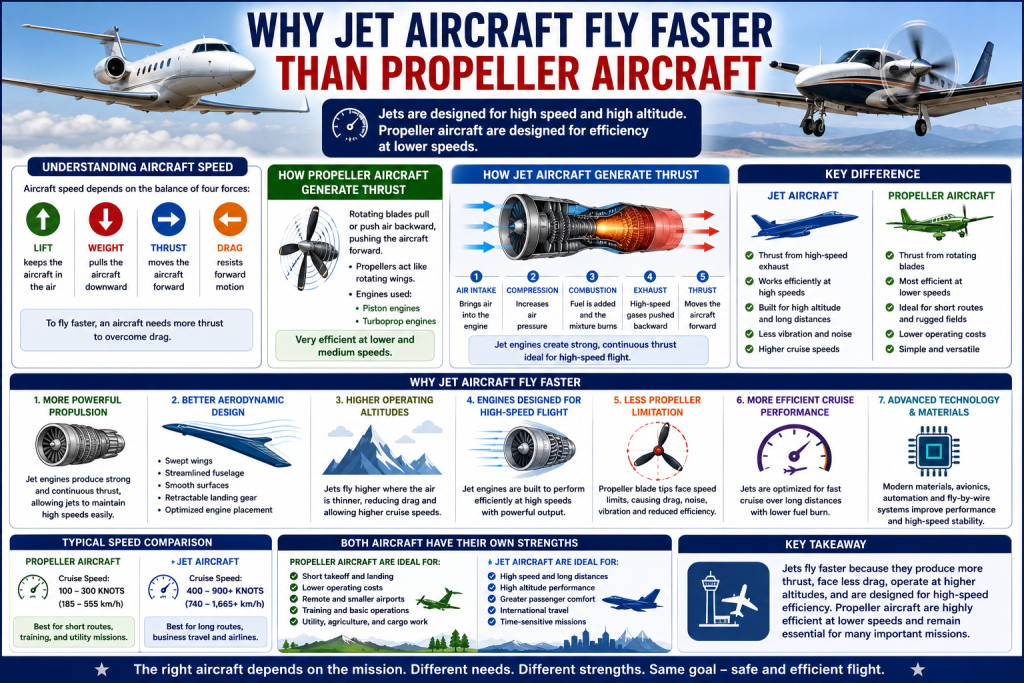
Aircraft speed is controlled by the balance of four major forces of flight:
- Lift keeps the aircraft in the air.
- Weight pulls the aircraft downward.
- Thrust moves the aircraft forward.
- Drag resists forward motion.
For an aircraft to fly faster, it needs enough thrust to overcome drag. As speed increases, drag also increases. This means an aircraft needs stronger propulsion and better aerodynamic design to maintain high-speed flight.
Jet aircraft are designed to reduce drag and produce powerful forward thrust at high speeds. Propeller aircraft are designed to create efficient thrust at lower and medium speeds.
How Propeller Aircraft Generate Thrust
Propeller aircraft use rotating blades to pull or push air backward. As the propeller moves air behind the aircraft, the aircraft moves forward.
A propeller works like a rotating wing. Each blade has an airfoil shape that creates a pressure difference as it spins. This pressure difference produces thrust.
Propeller aircraft may use:
- Piston engines, commonly used in small training aircraft and private planes
- Turboprop engines, commonly used in regional aircraft, cargo aircraft, and utility operations
Propellers are very efficient at lower speeds. This is why they are widely used for flight training, short-distance travel, agriculture, cargo, and remote airport operations.
How Jet Aircraft Generate Thrust
Jet aircraft use jet engines, usually turbofan engines in commercial and business aviation. A jet engine pulls air into the engine, compresses it, mixes it with fuel, burns the mixture, and expels high-speed exhaust backward. This creates forward thrust.
The basic process includes:
- Air intake brings air into the engine.
- Compression increases air pressure.
- Combustion adds fuel and burns the mixture.
- Exhaust pushes high-speed gases backward.
- Forward thrust moves the aircraft ahead.
This process follows Newton’s Third Law: for every action, there is an equal and opposite reaction. When the engine pushes air backward at high speed, the aircraft moves forward.
Why Jet Aircraft Fly Faster
More Powerful Propulsion
Jet engines produce strong and continuous thrust. Instead of relying on spinning blades outside the aircraft, jet engines accelerate large amounts of air through the engine and exhaust system.
This allows jet aircraft to maintain high speed more effectively. At higher speeds, jet propulsion remains efficient, while propeller efficiency begins to drop.
Better Aerodynamic Design
Jet aircraft are built for high-speed airflow. Their shape is carefully designed to reduce drag and improve performance.
Common aerodynamic features include:
- Swept wings to manage high-speed airflow
- Streamlined fuselage to reduce air resistance
- Smooth surfaces for better airflow
- Retractable landing gear to reduce drag
- Optimized engine placement for better performance
These design features help jets move through the air with less resistance.
Higher Operating Altitudes
Jet aircraft usually fly at much higher altitudes than most propeller aircraft. At higher altitudes, the air is thinner, which reduces drag.
Lower drag allows jets to cruise faster and more efficiently. High-altitude flight also helps aircraft avoid much of the lower-level weather and turbulence that can affect smaller propeller aircraft.
This is one major reason commercial jets can maintain high cruise speeds over long distances.
Engines Designed for High-Speed Flight
Jet engines are designed to perform well at high speeds. As air moves into the engine, the engine compresses and accelerates it efficiently. This makes jet propulsion suitable for fast cruise performance.
Propellers work best when blade tips stay below certain high-speed airflow limits. As aircraft speed increases, propeller blade tips can approach very high speeds, creating drag, noise, vibration, and efficiency loss.
Less Propeller Limitation
Propeller aircraft face a natural speed limitation because the propeller blades rotate very fast. Even if the aircraft itself is moving at moderate speed, the blade tips may move much faster.
When blade tips approach the speed of sound, airflow becomes difficult to manage. This can create:
- Reduced efficiency
- Increased drag
- More noise
- Vibration
- Performance limitations
Jet aircraft avoid this limitation because their thrust comes from internal engine airflow and exhaust rather than large external propeller blades.
More Efficient Cruise Performance
Jet aircraft are optimized for fast cruise over medium and long distances. Business jets and commercial jetliners are designed to spend most of their flight at high altitude and high speed.
Propeller aircraft are often better for short routes, smaller airports, and lower-speed missions. Turboprops can be very efficient on short regional flights, but jets usually perform better when distance and speed become more important.
Comparing Typical Aircraft Speeds
| Aircraft Type | Common Use | Approximate Cruise Speed |
|---|---|---|
| Small piston aircraft | Flight training, private flying | Low to moderate speed |
| Turboprop aircraft | Regional travel, cargo, utility flights | Moderate speed |
| Business jets | Executive travel, private aviation | High speed |
| Commercial jetliners | Airline travel | High speed |
| Military fighter jets | Defense and high-performance missions | Very high speed |
This comparison shows that aircraft speed depends on mission, design, engine type, and operating altitude.
Aerodynamics Behind Jet Speed
Aerodynamics plays a major role in why jet aircraft fly faster. At higher speeds, air does not behave exactly the same way it does at lower speeds. Aircraft designers must manage drag, pressure changes, airflow separation, and compressibility effects.
Jet aircraft often use swept wings because swept wings help delay high-speed airflow problems. The wing shape allows the aircraft to fly efficiently near high subsonic speeds.
High-speed jet design focuses on:
- Reducing drag
- Managing airflow over the wings
- Improving lift-to-drag ratio
- Preventing excessive shock wave formation
- Maintaining stability at high speed
- Improving fuel efficiency during cruise
A propeller aircraft does not usually need the same high-speed design because it operates best at lower speeds.
Why Propeller Aircraft Are Still Important
Although jets are faster, propeller aircraft remain extremely important in aviation. They are efficient, practical, and cost-effective for many missions.
Propeller aircraft are commonly used for:
- Pilot training
- Short regional flights
- Agricultural aviation
- Cargo operations
- Remote area access
- Medical evacuation
- Survey and patrol work
- Private flying
- Small airport operations
Propeller aircraft can often operate from shorter runways and smaller airports where jets may not be practical.
Advantages of Jet Aircraft
Jet aircraft offer several major advantages:
- Higher speed for faster travel
- Longer range for cross-country and international flights
- Higher altitude capability for smoother cruise
- Better passenger comfort on long flights
- Improved weather avoidance
- Greater productivity for business travel
- Strong performance for commercial airline operations
Jets are ideal when speed, range, passenger capacity, and time savings are important.
Limitations of Jet Aircraft
Jet aircraft also have limitations. They are powerful and fast, but they are not always the most economical option.
Common limitations include:
- Higher purchase cost
- Higher fuel consumption on short flights
- More complex maintenance
- Longer runway requirements
- Higher operating expenses
- More advanced pilot training needs
- More expensive airport and handling costs
For short distances or low-budget operations, a propeller aircraft may be more practical.
Advantages of Propeller Aircraft
Propeller aircraft provide strong value in many aviation sectors.
Their advantages include:
- Lower operating cost
- Better efficiency on short routes
- Short runway capability
- Easier access to smaller airports
- Lower maintenance cost in many cases
- Excellent training platform for student pilots
- Good performance for low-speed missions
- Practical use in remote regions
This is why propeller aircraft continue to play a major role in aviation.
Common Myths About Jet Aircraft
Myth 1: Jets Are Always More Fuel Efficient
Jets are efficient at high altitude and high speed, especially on longer routes. However, they may not be more fuel efficient on short flights. Turboprops and piston aircraft can be more economical for shorter distances.
Myth 2: Bigger Engines Always Mean Faster Aircraft
Speed depends on more than engine size. Aerodynamics, weight, drag, wing design, altitude, and aircraft structure all affect speed. A powerful engine alone does not guarantee faster flight.
Myth 3: Propeller Aircraft Are Outdated
Propeller aircraft are not outdated. They are still widely used because they are practical, efficient, and reliable for training, regional transport, cargo, agriculture, and utility operations.
Myth 4: All Jets Fly at the Same Speed
Not all jets have the same performance. Business jets, commercial jetliners, military jets, and training jets are designed for different missions and speed ranges.
Myth 5: Faster Always Means Better
Faster is not always better. The best aircraft depends on the mission. For short routes, small airports, and low operating cost, propeller aircraft may be the smarter choice.
Choosing Between Jet and Propeller Aircraft
The choice between a jet aircraft and a propeller aircraft depends on the mission.
Important decision factors include:
- Flight distance
- Passenger capacity
- Budget
- Runway length
- Airport infrastructure
- Required speed
- Fuel cost
- Maintenance cost
- Pilot training requirements
- Cargo or passenger needs
- Weather and route conditions
A jet may be best for long-distance business or airline travel. A propeller aircraft may be best for training, short flights, and cost-efficient operations.
Future of Aircraft Speed
Aircraft technology continues to evolve. Engineers are working on better engines, cleaner fuels, advanced aerodynamics, hybrid propulsion, sustainable aviation systems, and future high-speed aircraft concepts.
Future aviation may include:
- More efficient turbofan engines
- Advanced propeller and open rotor designs
- Hybrid-electric aircraft
- Hydrogen-powered aircraft
- Improved lightweight materials
- Sustainable aviation fuel adoption
- Next-generation supersonic designs
The future of speed will not only focus on flying faster. It will also focus on flying cleaner, safer, quieter, and more efficiently.
Key Takeaways
- Jet aircraft fly faster because they use propulsion systems designed for high-speed flight.
- Jet engines produce strong continuous thrust and work efficiently at high altitude.
- Propeller aircraft are efficient at lower speeds but face propeller blade limitations at high speeds.
- Jet aircraft have aerodynamic designs that reduce drag and support fast cruise performance.
- Propeller aircraft remain important for training, short routes, cargo, and smaller airports.
- The best aircraft depends on mission, cost, distance, and operational requirements.
FAQs
1. Why are jet aircraft faster than propeller aircraft?
Jet aircraft are faster because their engines are designed to produce strong thrust at high speeds. Their aerodynamic shape, swept wings, and high-altitude performance also help reduce drag and improve cruise speed.
2. Can a propeller aircraft fly as fast as a jet?
Most propeller aircraft cannot fly as fast as jet aircraft because propellers lose efficiency at higher speeds. Blade tip speed, drag, and airflow limitations restrict how fast propeller aircraft can practically fly.
3. Why do jets fly at higher altitudes?
Jets fly at higher altitudes because the thinner air reduces drag and allows faster, smoother, and more efficient cruise. High altitude also helps avoid much of the weather and turbulence found at lower levels.
4. What limits propeller aircraft speed?
Propeller aircraft speed is limited by propeller efficiency, blade tip speed, engine power, drag, and aircraft design. As speed increases, propeller blades can create more noise, vibration, and drag.
5. Are jet engines more powerful than propeller engines?
Jet engines generally produce more suitable thrust for high-speed and high-altitude flight. However, propeller engines can be very efficient for lower-speed operations, short flights, and smaller aircraft missions.
6. Which aircraft is more fuel efficient?
It depends on the mission. Propeller aircraft are often more fuel efficient for short routes and lower speeds. Jet aircraft are more efficient for longer routes where high-speed cruise and high-altitude performance provide advantages.
7. Why are turboprops still used?
Turboprops are still used because they are efficient, reliable, and practical for regional flights, cargo, remote airports, and short runway operations. They offer a strong balance of cost and performance.
8. Are jets safer than propeller aircraft?
Safety depends on maintenance, pilot training, weather decisions, operating procedures, and aircraft condition. Jets and propeller aircraft can both be safe when operated professionally and maintained properly.
9. Which aircraft is better for pilot training?
Propeller aircraft are commonly better for basic pilot training because they are cost-effective, easier to operate at training speeds, and suitable for learning fundamental flying skills. Jet training usually comes later in advanced aviation careers.
10. Will future aircraft become even faster?
Future aircraft may become faster, but aviation development is also focused on fuel efficiency, sustainability, noise reduction, safety, and operating cost. Speed will remain important, but efficiency and environmental performance will also shape future aircraft design.
Conclusion
Jet aircraft fly faster than propeller aircraft because they are built for high-speed performance. Their engines generate powerful continuous thrust, their aerodynamic designs reduce drag, and their ability to fly at higher altitudes gives them a major speed advantage.
Propeller aircraft remain valuable because they are efficient, practical, and affordable for many missions. They are ideal for training, short routes, small airports, and utility operations. Jets and propeller aircraft are not competitors in every situation; they are different tools designed for different aviation needs.
Understanding these differences helps students, pilots, and aviation enthusiasts appreciate how aircraft design reflects mission purpose. In aviation, speed matters, but the best aircraft is always the one that fits the mission safely, efficiently, and effectively.
