
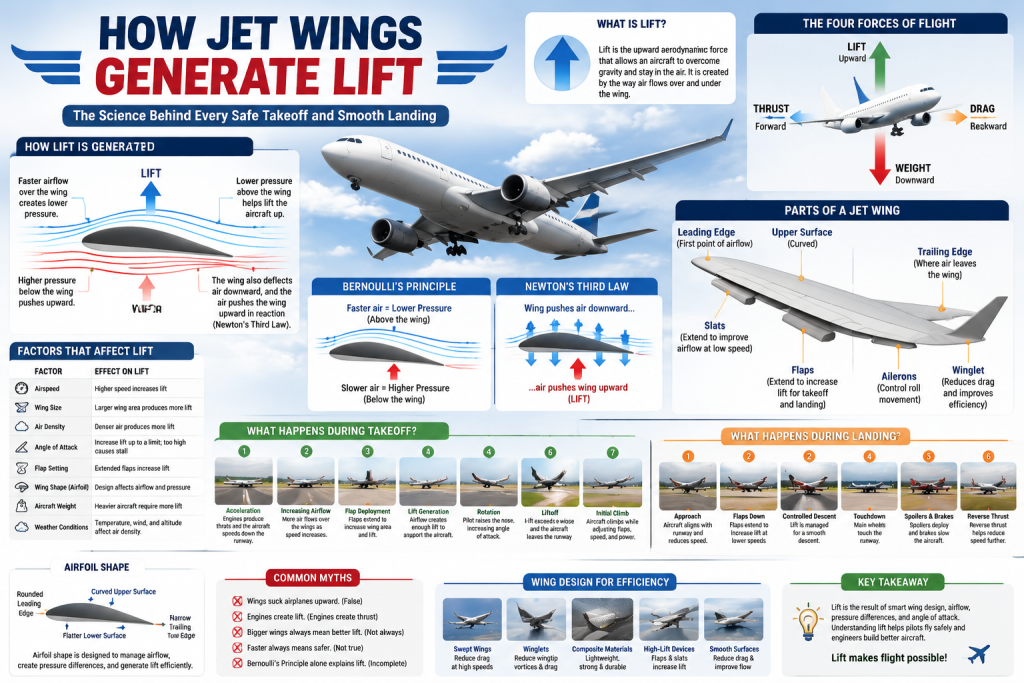
Introduction
Jet aircraft look heavy, powerful, and complex, yet they can rise smoothly into the sky because of one essential force: lift. Lift is the upward force that allows an aircraft to overcome gravity and stay in the air. Without lift, even the most powerful jet engine would not be enough to make an aircraft fly safely.
The wings of a jet are carefully designed to manage airflow, pressure, speed, and stability. Their shape, angle, surface design, and moving parts all work together to produce controlled lift during takeoff, cruise, and landing. Understanding how jet wings generate lift helps aviation students, pilots, engineers, and aircraft enthusiasts appreciate the science behind flight.
What Is Lift?
Lift is the upward aerodynamic force produced when air flows around an aircraft wing. It acts opposite to weight, which pulls the aircraft downward due to gravity.
For a jet to fly, lift must be strong enough to support the aircraft’s weight. During takeoff, the aircraft accelerates until enough airflow moves over the wings. As this airflow increases, the wings generate more lift, allowing the aircraft to rise from the runway.
Lift is not created by one single factor. It is produced by a combination of wing shape, airspeed, pressure difference, angle of attack, and airflow direction.
The Four Forces of Flight
Every aircraft in flight is affected by four main forces:
| Force | Direction | Purpose |
|---|---|---|
| Lift | Upward | Holds the aircraft in the air |
| Weight | Downward | Pulls the aircraft toward Earth |
| Thrust | Forward | Moves the aircraft through the air |
| Drag | Backward | Resists forward motion |
A jet flies safely when these forces are balanced or controlled. During takeoff, thrust and lift increase. During cruise, lift balances weight, and thrust balances drag. During landing, pilots reduce speed and manage lift carefully for a controlled descent.
Basic Anatomy of a Jet Wing
A jet wing has many important parts that help create lift, improve control, and increase efficiency.
Wing Root
The wing root is the part of the wing attached to the aircraft body. It carries heavy structural loads and connects the wing to the fuselage.
Wingtip
The wingtip is the outer end of the wing. Modern jets often use winglets at the tip to reduce drag and improve fuel efficiency.
Leading Edge
The leading edge is the front part of the wing that first meets the airflow. Its shape helps guide air smoothly over and under the wing.
Trailing Edge
The trailing edge is the rear part of the wing where airflow leaves the wing surface. Control surfaces such as flaps and ailerons are often located here.
Upper Surface
The upper surface of a wing is usually curved. This curvature helps air move smoothly and contributes to pressure differences around the wing.
Lower Surface
The lower surface may be flatter or less curved. It helps support pressure below the wing and contributes to upward force.
Flaps
Flaps are movable surfaces on the trailing edge of the wing. They increase lift during takeoff and landing by changing the wing’s shape.
Slats
Slats are movable surfaces on the leading edge. They help improve airflow at lower speeds and reduce the risk of stall.
Spoilers
Spoilers disrupt airflow over the wing and reduce lift. They are often used during landing to help the aircraft slow down and stay firmly on the runway.
Ailerons
Ailerons are control surfaces near the wingtips. They help the aircraft roll left or right.
Winglets
Winglets are upward or angled extensions at the wingtip. They reduce wingtip vortices and improve aerodynamic efficiency.
How Jet Wings Generate Lift
Jet wings generate lift by controlling how air moves around them. When a jet moves forward, air flows over and under the wing. Because the wing has a special airfoil shape, the air behaves differently on each side.
Air moving over the curved upper surface usually travels faster and creates lower pressure. Air moving below the wing often has relatively higher pressure. This pressure difference helps push the wing upward.
At the same time, the wing also deflects air downward. According to Newton’s Third Law, when the wing pushes air downward, the air pushes the wing upward in reaction. This upward reaction is also part of lift generation.
So, lift comes from both pressure differences and downward deflection of air. These two explanations work together, not against each other.
Bernoulli’s Principle Explained
Bernoulli’s Principle says that when air moves faster, its pressure tends to decrease. On many aircraft wings, air flows faster over the curved upper surface than below the wing. This creates lower pressure above the wing.
Below the wing, pressure is comparatively higher. The higher pressure underneath helps push the wing upward toward the lower pressure area above.
However, Bernoulli’s Principle is not the full explanation of lift. It is one important part of the story. Lift also depends on angle of attack, air deflection, wing shape, and aircraft speed.
Newton’s Third Law and Lift
Newton’s Third Law states that for every action, there is an equal and opposite reaction. A jet wing pushes air downward as it moves through the sky. In response, the air pushes the wing upward.
This is why airflow direction matters. A properly designed wing does not simply pass through air; it changes the direction of the air. The downward movement of air creates an upward reaction force on the aircraft.
This explanation is especially important when understanding angle of attack, takeoff, and stall behavior.
Factors That Affect Lift
Several factors influence how much lift a jet wing can generate.
| Factor | Effect on Lift |
| Airspeed | Higher speed usually increases lift |
| Wing Size | Larger wing area can produce more lift |
| Air Density | Denser air helps generate more lift |
| Angle of Attack | Higher angle can increase lift up to a safe limit |
| Flap Setting | Extended flaps increase lift at lower speeds |
| Wing Shape | Airfoil design affects airflow and pressure |
| Aircraft Weight | Heavier aircraft require more lift |
| Weather Conditions | Temperature, wind, and altitude affect air density |
Pilots and engineers carefully manage these factors to ensure safe flight.
What Is an Airfoil?
An airfoil is the cross-sectional shape of a wing. It is designed to produce lift efficiently when air flows around it.
Most airfoils have:
- A curved upper surface
- A flatter or less curved lower surface
- A rounded leading edge
- A narrow trailing edge
The airfoil shape affects how air accelerates, slows down, separates, or stays attached to the wing. Different aircraft use different airfoil designs based on speed, weight, mission type, and performance needs.
Importance of Angle of Attack
Angle of attack is the angle between the wing and the oncoming airflow. It is one of the most important factors in lift generation.
When the angle of attack increases, the wing can produce more lift. This is why aircraft slightly raise their nose during takeoff. However, there is a limit. If the angle becomes too high, airflow can separate from the wing surface, causing a stall.
A stall does not mean the engine has stopped. It means the wing is no longer producing enough smooth lift because airflow has broken away from the wing.
What Happens During Takeoff?
During takeoff, a jet goes through several steps to create enough lift.
- Acceleration
The engines produce thrust, and the aircraft speeds down the runway. - Increasing Airflow
As speed increases, more air flows over the wings. - Flap Deployment
Flaps are extended to increase wing surface area and lift. - Lift Generation
Airflow over and under the wing creates enough lift to support the aircraft. - Rotation
The pilot gently raises the aircraft’s nose, increasing angle of attack. - Liftoff
Once lift exceeds weight, the aircraft leaves the runway. - Initial Climb
The aircraft climbs while pilots adjust flaps, speed, and engine power.
What Happens During Landing?
Landing is the process of reducing speed while keeping enough lift for a controlled descent.
During landing:
- Flaps are extended
- Speed is reduced
- Lift is carefully controlled
- Drag increases
- The aircraft descends gradually
- Spoilers may deploy after touchdown
- Brakes and reverse thrust help slow the aircraft
Flaps allow the aircraft to fly safely at lower speeds. This is important because landing requires slower movement and precise control.
How Wing Design Improves Efficiency
Modern jet wings are designed for strength, safety, and fuel efficiency.
Swept Wings
Many jet aircraft have swept wings, which angle backward from the fuselage. Swept wings help reduce drag at high speeds and improve performance during cruise.
Winglets
Winglets reduce air swirling at the wingtips. This reduces drag and helps improve fuel economy.
Composite Materials
Modern wings often use lightweight composite materials. These materials reduce weight while maintaining strength.
High-Lift Devices
Flaps and slats help aircraft generate more lift during takeoff and landing.
Smooth Wing Surfaces
Smooth surfaces reduce drag and allow air to flow more efficiently over the wing.
Common Myths About Aircraft Lift
Myth 1: Wings Suck Airplanes Upward
Wings do not simply suck airplanes into the sky. Lift is created by pressure differences and downward airflow deflection.
Myth 2: Engines Create Lift
Engines create thrust, not lift. However, thrust helps the aircraft move forward so air can flow over the wings and generate lift.
Myth 3: Bigger Wings Always Mean Better Lift
Bigger wings can produce more lift, but they may also create more drag and weight. Wing design must balance lift, speed, stability, and efficiency.
Myth 4: Faster Always Means Safer
More speed can increase lift, but too much speed can create control and structural challenges. Safe flight depends on proper speed, angle, and configuration.
Myth 5: Bernoulli’s Principle Alone Explains Lift
Bernoulli’s Principle is important, but lift also depends on Newton’s Third Law, angle of attack, airfoil shape, and airflow behavior.
Applications of Lift in Modern Aviation
Lift is essential in every type of aircraft operation.
It supports:
- Commercial airlines
- Business jets
- Military aircraft
- Cargo aircraft
- Private jets
- Training aircraft
- Experimental aircraft
- Spaceplane concepts
Each aircraft uses wing design differently depending on mission needs. A commercial jet needs efficiency and stability. A fighter jet needs speed and maneuverability. A cargo aircraft needs strong lift for heavy loads.
Tips for Aviation Students
Aviation students should build a strong foundation in flight science.
Helpful tips include:
- Study the four forces of flight
- Learn basic wing anatomy
- Understand airfoil shape
- Practice with flight simulators
- Observe aircraft takeoffs and landings
- Study angle of attack and stall behavior
- Learn how flaps and slats work
- Read aviation training materials
- Ask questions from instructors
- Keep learning aerodynamics step by step
Understanding lift makes many other aviation topics easier, including aircraft performance, stall recovery, takeoff planning, and landing technique.
Frequently Asked Questions
1. What creates lift on a jet wing?
Lift is created when air flows around the wing and produces pressure differences and downward air deflection. Faster airflow over the upper surface creates lower pressure, while higher pressure below helps push the wing upward. The wing also pushes air downward, creating an upward reaction force.
2. Why is the upper wing surface curved?
The curved upper surface helps air move smoothly and often faster over the wing. This contributes to lower pressure above the wing. The shape also helps guide airflow and improve aerodynamic performance.
3. Does Bernoulli’s Principle fully explain lift?
No, Bernoulli’s Principle is only part of the explanation. Lift also depends on Newton’s Third Law, angle of attack, airfoil shape, airspeed, and airflow direction. A complete understanding includes both pressure difference and air deflection.
4. What is an airfoil?
An airfoil is the shape of a wing when viewed from the side. It is designed to produce lift efficiently as air flows around it. Different aircraft use different airfoils depending on speed, weight, and purpose.
5. What happens if lift decreases?
If lift decreases too much, the aircraft may descend. During normal flight, pilots adjust speed, angle of attack, and wing configuration to maintain enough lift. If airflow separates from the wing, a stall can occur.
6. Why are flaps used?
Flaps increase lift at lower speeds by changing the shape and surface area of the wing. They are mainly used during takeoff and landing. Flaps allow aircraft to fly safely at slower speeds.
7. What is angle of attack?
Angle of attack is the angle between the wing and the oncoming airflow. Increasing it can increase lift up to a certain limit. If the angle becomes too high, the wing can stall.
8. What causes a stall?
A stall happens when the angle of attack becomes too high and airflow separates from the wing. When this happens, the wing cannot produce enough smooth lift. Pilots are trained to recognize and recover from stalls safely.
9. Why do modern jets have winglets?
Winglets reduce wingtip vortices, which are swirling air patterns that create drag. By reducing this drag, winglets improve fuel efficiency and overall aircraft performance.
10. How do engineers improve wing efficiency?
Engineers improve wing efficiency through better airfoil shapes, lighter materials, winglets, swept wings, smoother surfaces, and high-lift devices. The goal is to create enough lift while reducing drag and fuel use.
Conclusion
Jet wings generate lift by managing airflow, pressure, speed, and direction. Their airfoil shape helps create pressure differences, while the wing’s angle and movement push air downward to create an upward reaction. Together, these aerodynamic effects allow heavy jet aircraft to rise, cruise, maneuver, and land safely.
Understanding lift is one of the most important foundations of aviation. It explains why wings are shaped the way they are, why flaps are used during takeoff and landing, and why pilots carefully manage speed and angle of attack. For students, pilots, engineers, and aviation enthusiasts, learning how jet wings generate lift is a powerful step toward understanding the science of flight.
