
Introduction
Private jet travel is known for privacy, comfort, flexibility, and time-saving. But today, another feature has become very important: connectivity. Passengers no longer want to disconnect completely during a flight. They want to send emails, join meetings, message family, browse the internet, stream content, or stay updated with business work.
This is why private jet Wi-Fi has become one of the most requested cabin features. For business travelers, it turns the aircraft into a flying office. For families, it helps passengers stay entertained and connected. For long-distance flyers, it makes the journey more useful and comfortable.
In this Private Jet Connectivity and Wi-Fi Guide, JETEXE.COM explains how private jet Wi-Fi works, what features passengers can expect, and what to check before booking a private jet.
What Is Private Jet Connectivity?
Private jet connectivity means the systems inside an aircraft that allow passengers to stay connected during flight. This can include Wi-Fi, internet access, email, messaging, phone communication, video calls, streaming, cabin controls, and live flight information.
In simple words, connectivity helps passengers use their digital devices in the air. Phones, tablets, laptops, and other devices can connect to the aircraft’s onboard network, just like connecting to Wi-Fi in a home, office, or hotel.
However, private jet Wi-Fi is not always the same as ground internet. It depends on the aircraft system, route, altitude, satellite coverage, number of users, and service plan.
Why Wi-Fi Matters in Private Jets
Wi-Fi is important because modern travelers depend on digital communication. A passenger may need to reply to urgent emails, join a business call, approve documents, check market updates, or stay in touch with family.
For business travelers, Wi-Fi helps reduce wasted time. Instead of waiting until landing, they can continue working during the flight. This is especially useful for executives, entrepreneurs, consultants, and teams who travel often.
For leisure passengers, Wi-Fi supports entertainment, messaging, social media, travel updates, music, and browsing. It makes the private jet journey smoother and more enjoyable.
How Private Jet Wi-Fi Works
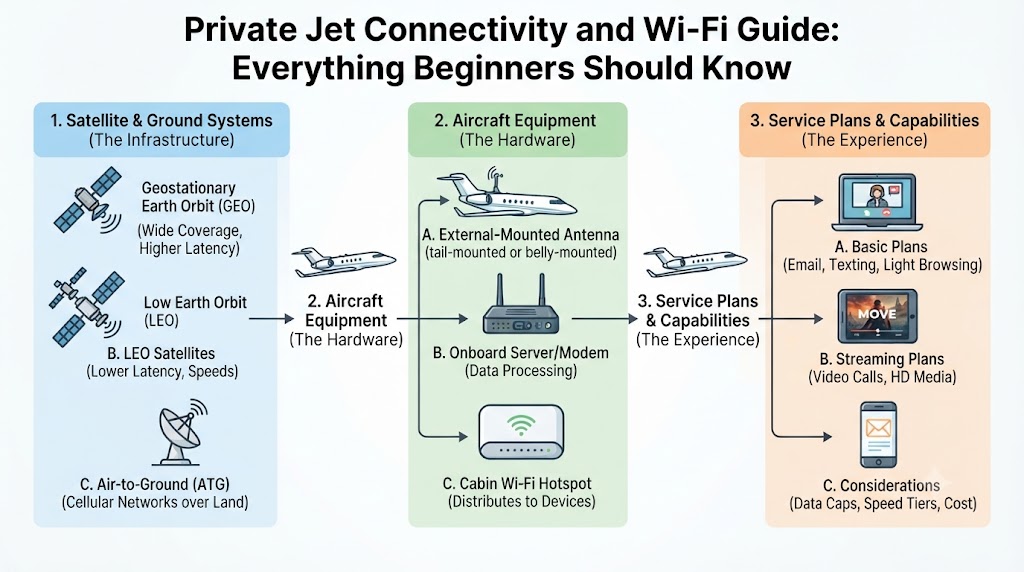
Private jet Wi-Fi usually works by connecting the aircraft to an external network. Once the aircraft receives internet connectivity, it creates a Wi-Fi network inside the cabin for passengers.
There are two common types of aircraft connectivity:
Satellite-Based Connectivity
Satellite connectivity connects the aircraft to satellites above the earth. This is commonly used for long-distance, international, and overwater flights. It can provide coverage in areas where ground-based networks are not available.
Satellite systems are useful for larger private jets and long-range aircraft. However, speed and reliability may still depend on satellite coverage, equipment, weather, and service plan.
Air-to-Ground Connectivity
Air-to-ground connectivity connects the aircraft to towers on the ground. This type may work well over land in supported regions. It is often used for shorter domestic routes where coverage is available.
The limitation is that it may not work well over oceans, remote areas, or international routes without proper network support.
Main Features of Private Jet Connectivity
1. Onboard Wi-Fi Access
Onboard Wi-Fi allows passengers to connect laptops, phones, and tablets to the aircraft network. This is one of the most basic and useful connectivity features.
Passengers can use it for email, messaging, web browsing, business apps, or entertainment depending on speed and data limits.
2. Satellite Internet Connectivity
Satellite internet is important for long-range private jets. It helps passengers stay connected even when flying over remote areas or international routes.
This is especially useful for global business travelers who need communication during long flights.
3. Air-to-Ground Connectivity
Air-to-ground systems are useful for flights over supported land areas. They can provide internet access during domestic or regional travel.
This option may be suitable for shorter routes, but passengers should check availability before flying.
4. Email and Messaging Support
Email and messaging are among the most common uses of private jet Wi-Fi. Passengers can reply to work emails, send updates, and stay connected with teams or family members.
Even if the internet speed is not strong enough for heavy streaming, basic communication often works better than high-data activities.
5. Web Browsing
Private jet connectivity allows passengers to browse websites, check news, review documents, and access online platforms.
Browsing quality depends on internet speed and the number of connected users inside the cabin.
6. Video Calls and Online Meetings
Some private jets support video calls and online meetings, but this depends on the strength of the Wi-Fi system. Video calls need more stable internet than simple messaging or email.
Before planning an important meeting during flight, passengers should confirm whether the aircraft Wi-Fi is suitable for video conferencing.
7. Streaming and Entertainment Use
Wi-Fi can support streaming movies, music, live news, and entertainment content. However, streaming requires stronger internet and may not work smoothly on every private jet.
Passengers should not assume streaming is always available. It is better to ask before booking, especially for long flights or family travel.
8. Business Application Access
Business travelers may need to access cloud files, CRM systems, dashboards, project tools, or company platforms. Private jet Wi-Fi helps them continue work during the flight.
For sensitive work, passengers should also consider network security and safe browsing practices.
9. Personal Device Connectivity
Most passengers prefer using their own devices. Private jet connectivity allows phones, laptops, and tablets to connect to the onboard network.
Some aircraft also provide charging ports, USB connections, power outlets, Bluetooth, or screen-sharing support.
10. Cabin Network Security
Security is important in private aviation, especially for business leaders and VIP passengers. A password-protected network helps control who can access the onboard Wi-Fi.
Passengers should avoid using unknown networks and should use secure company tools when handling confidential information.
11. Voice Communication Options
Some private jets may offer onboard phone or voice communication features. This can help passengers make important calls during flight.
Availability depends on aircraft equipment and service provider.
12. Multi-Device Support
Many passengers carry more than one device, such as a phone, laptop, and tablet. Group travel may include several passengers using Wi-Fi at the same time.
Multi-device support is useful, but too many connected devices can reduce speed. This is why it is important to ask how many devices the system can support comfortably.
13. Charging and Power Support
Connectivity is not useful if devices run out of battery. Good private jet cabins often include power outlets, USB ports, or charging points.
Passengers should check whether the aircraft has enough charging options for laptops, phones, tablets, and business equipment.
14. Smart Cabin Control Integration
Some modern private jets connect Wi-Fi and cabin controls into one smart system. Passengers may control lighting, temperature, entertainment, window shades, and media through touchscreens or mobile apps.
This makes the cabin more comfortable and personalized.
15. Flight Tracking and Map Display
Many private jets offer live flight maps or tracking displays. Passengers can see route progress, altitude, speed, destination time, and flight path.
This feature is useful and adds to the premium travel experience.
Connectivity by Jet Size
Light Jets
Light jets are usually used for short trips. Some may offer basic Wi-Fi or limited connectivity, while others may not have advanced internet systems. They are suitable for passengers who need simple communication during shorter flights.
Midsize Jets
Midsize jets often provide better connectivity options than light jets. They may support email, browsing, messaging, and basic business use.
Super Midsize Jets
Super midsize jets usually offer stronger cabin technology, better range, and improved connectivity. They are useful for business travelers who need more reliable internet during medium or long routes.
Heavy Jets
Heavy jets often include advanced Wi-Fi, satellite connectivity, multiple screens, better power support, and stronger business features. They are suitable for long-distance and international travel.
Ultra-Long-Range Jets
Ultra-long-range jets usually offer the most advanced connectivity options. These aircraft are designed for long international flights, so passengers often expect stronger internet, better cabin systems, and more reliable communication support.
Business Benefits of Private Jet Wi-Fi
Private jet Wi-Fi is very valuable for business passengers. It allows them to work while flying and avoid losing productive hours.
Business benefits include:
- Sending and receiving emails
- Joining online meetings
- Reviewing documents
- Accessing cloud files
- Coordinating with teams
- Making time-sensitive decisions
- Staying updated with clients
- Using business apps during travel
For executives, private jet connectivity can turn travel time into useful work time.
Entertainment Benefits of Private Jet Connectivity
Connectivity also improves entertainment. Passengers can listen to music, watch videos, browse social media, read news, or stream content when the system supports it.
For long flights, entertainment helps reduce boredom and makes the journey feel shorter. Families can use Wi-Fi for children’s content, games, cartoons, or messaging.
However, entertainment quality depends on aircraft Wi-Fi speed and data capacity.
Private Jet Wi-Fi Speed and Reliability
Private jet Wi-Fi speed can vary. It may be fast enough for email and browsing but not always strong enough for smooth video calls or streaming.
Speed and reliability depend on:
- Aircraft equipment
- Connectivity type
- Satellite or tower coverage
- Flight route
- Weather conditions
- Number of connected devices
- Service plan
- Data limits
This is why passengers should always ask about Wi-Fi quality before booking. Saying “Wi-Fi available” does not always mean the connection is suitable for every use.
Security and Privacy in Private Jet Connectivity
Private jet passengers often value privacy. Wi-Fi security is important, especially when handling business emails, financial information, legal documents, or confidential files.
Good habits include:
- Using password-protected Wi-Fi
- Avoiding unknown networks
- Using secure websites
- Using company-approved VPNs when required
- Avoiding unnecessary file sharing
- Logging out of important accounts after use
Private aviation offers a more private space, but digital safety still matters.
Things to Check Before Booking a Private Jet
Before booking a private jet with Wi-Fi, ask these questions:
- Is Wi-Fi available on this aircraft?
- What type of connectivity does it use?
- Is it suitable for email only or video calls too?
- Are there speed limits?
- Are there data limits?
- Does Wi-Fi work on international routes?
- Can multiple devices connect?
- Is streaming supported?
- Is the network password-protected?
- Are power outlets and USB ports available?
- Can passengers use business apps?
- Is technical support available if Wi-Fi stops working?
These questions help avoid disappointment during the flight.
Common Mistakes People Make
One common mistake is assuming every private jet has Wi-Fi. Some older or smaller aircraft may not have modern connectivity systems.
Another mistake is expecting the same internet speed as home or office broadband. Aircraft internet works differently, so speed can change during flight.
Passengers also forget to ask about international coverage, data limits, streaming support, and video call quality. A jet may have Wi-Fi, but it may not support all online activities smoothly.
Future of Private Jet Connectivity
Private jet connectivity is improving quickly. Future aircraft cabins may offer faster satellite internet, better global coverage, smarter cabin controls, improved streaming, wireless charging, and stronger security.
Passengers will expect private jets to work more like connected offices and luxury lounges in the sky. Better connectivity will continue to improve business travel, entertainment, and passenger comfort.
FAQs
1. Do private jets have Wi-Fi?
Many modern private jets have Wi-Fi, but not all jets offer the same speed, coverage, or features. It is important to confirm Wi-Fi availability before booking.
2. How does private jet Wi-Fi work?
Private jet Wi-Fi usually works through satellite or air-to-ground systems. The aircraft connects to an external network and then creates Wi-Fi inside the cabin.
3. Is private jet Wi-Fi fast?
Private jet Wi-Fi speed depends on the aircraft system, route, satellite coverage, number of users, and service plan. Some systems are suitable for basic use, while others support heavier tasks.
4. Can I attend video meetings on a private jet?
Yes, some private jets support video meetings, but the connection must be strong and stable. Always confirm video call support before the flight.
5. Does private jet Wi-Fi work internationally?
Satellite-based Wi-Fi may work on many international routes, but coverage can vary. Passengers should check international connectivity before booking.
6. Can passengers stream movies on private jet Wi-Fi?
Some private jets support streaming, but not all. Streaming depends on Wi-Fi speed, data limits, and aircraft connectivity equipment.
7. Do all private jets have the same connectivity?
No, connectivity varies by aircraft size, model, age, system upgrades, and service provider. Larger jets often have more advanced connectivity options.
8. Is private jet Wi-Fi secure?
Private jet Wi-Fi can be secure when password-protected and properly managed. Passengers should still use safe browsing habits and secure business tools.
9. Can multiple devices connect to private jet Wi-Fi?
Yes, many private jet Wi-Fi systems support multiple devices. However, too many devices may reduce speed, especially during heavy internet use.
10. What should I check before booking a private jet with Wi-Fi?
Check Wi-Fi availability, speed, data limits, international coverage, streaming support, video call support, device limits, security, and power outlets.
Conclusion
Private jet connectivity and Wi-Fi are now important parts of modern private aviation. They help passengers work, communicate, relax, and enjoy the journey with more comfort.
The best private jet Wi-Fi experience depends on aircraft size, route, equipment, network type, and passenger needs. Before booking, passengers should check speed, coverage, data limits, device support, and security.
This Private Jet Connectivity and Wi-Fi Guide from JETEXE.COM helps beginners understand onboard internet and cabin connectivity in a simple and practical way.
