
Introduction
Jet aircraft look smooth, powerful, and effortless in the sky, but every flight is supported by a science called aerodynamics. In simple words, aerodynamics is the study of how air moves around objects. For aircraft, it explains how wings create lift, how engines produce thrust, how drag slows an aircraft down, and how pilots control flight safely.
Jet aircraft depend heavily on aerodynamic efficiency because they fly at high speeds, high altitudes, and often cover long distances. Whether it is a private jet, business jet, commercial jet, or advanced military aircraft, aerodynamic design plays a major role in performance, comfort, fuel efficiency, and safety.
For beginners, understanding jet aircraft aerodynamics may sound difficult at first. However, the basic ideas are easy to understand when explained step by step. This guide will help you learn how jet aircraft fly, why their wings are shaped in a special way, how jet engines support flight, and why modern aircraft are designed to cut smoothly through the air.
For readers of JETEXE.COM, this beginner-friendly guide will also help you understand the technology behind private jet aviation and business jet performance.
What Is Aerodynamics?
Aerodynamics is the science of air movement around objects. When an aircraft moves through the sky, air flows over its wings, fuselage, tail, and engines. The way this air behaves decides how smoothly, safely, and efficiently the aircraft can fly.
In aviation, engineers study aerodynamics to design aircraft that can lift off from the ground, remain stable in the air, travel efficiently, and land safely. Aerodynamics affects almost every part of flight, including takeoff distance, cruising speed, fuel consumption, passenger comfort, and aircraft control.
A simple example is putting your hand outside a moving car window. If you tilt your hand upward, air pushes it up. If you tilt it downward, air pushes it down. This is a basic example of how airflow and angle can change lift and drag.
Jet aircraft use the same principle, but in a much more advanced and carefully engineered way.
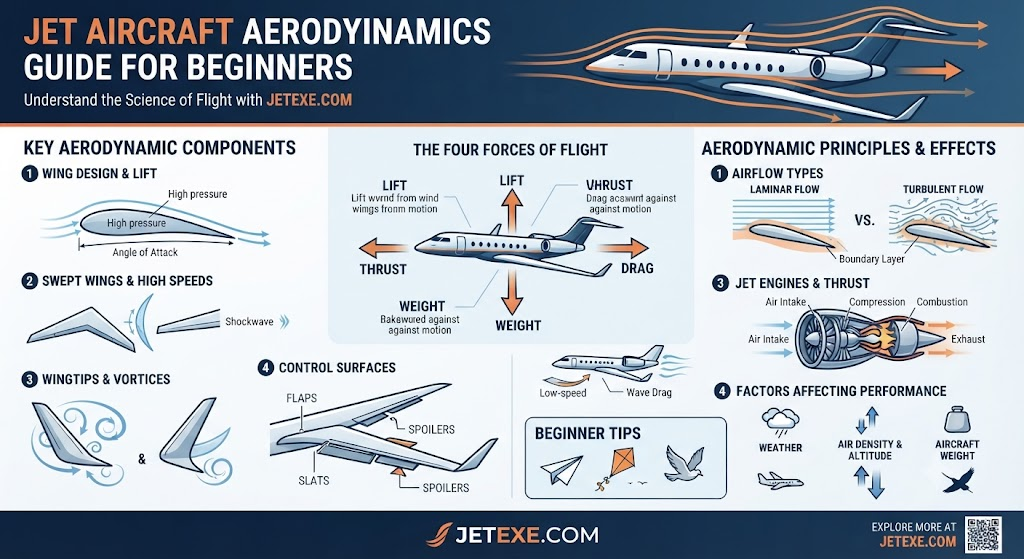
The Four Forces of Flight
Every aircraft in flight is affected by four major forces:
1- Lift
2- Weight
3- Thrust
4- Drag
These four forces must work together in balance for safe and controlled flight.
Lift
Lift is the upward force that allows an aircraft to rise into the sky and stay airborne. It is mainly produced by the wings.
Aircraft wings are designed with a special curved shape called an airfoil. As the aircraft moves forward, air flows over and under the wing. The shape of the wing and the angle at which it meets the air create pressure differences. This helps generate lift.
The angle between the wing and the incoming airflow is called the angle of attack. When the angle of attack increases, lift usually increases up to a certain point. However, if the angle becomes too high, airflow can separate from the wing, causing a stall. This is why pilots carefully control the aircraft’s speed and angle during takeoff, climb, and landing.
Lift is not created by wing shape alone. Aircraft speed, air density, wing area, and angle of attack all play an important role.
Weight
Weight is the downward force caused by gravity. It includes the aircraft’s structure, fuel, passengers, baggage, cargo, and onboard systems.
Before every flight, pilots and operators must consider aircraft weight carefully. If an aircraft is too heavy, it may need more runway for takeoff, more thrust to climb, and more fuel during flight.
Private jets and business jets are designed to balance comfort, range, and weight. A lighter aircraft usually performs better, uses less fuel, and can often fly farther.
Thrust
Thrust is the forward force that moves the aircraft through the air. In jet aircraft, thrust is produced by jet engines.
A jet engine takes in air from the front, compresses it, mixes it with fuel, burns the mixture, and pushes hot exhaust gases out the back at high speed. This creates forward motion.
The basic process includes:
1- Air intake
2- Compression
3- Combustion
4- Exhaust
Thrust helps the aircraft gain speed. Speed is important because the wings need airflow to generate lift. Jet engines do not directly lift the aircraft; they help move it forward so the wings can do their job.
Drag
Drag is the force that resists aircraft movement. It acts opposite to thrust and slows the aircraft down.
There are different types of drag:
Parasite Drag
Parasite drag is caused by the aircraft moving through the air. It comes from the fuselage, antennas, landing gear, engine nacelles, and other external surfaces.
The faster an aircraft flies, the more parasite drag increases.
Induced Drag
Induced drag is related to lift production. When wings create lift, they also create swirling air patterns near the wingtips. These are called wingtip vortices.
Induced drag is stronger at lower speeds, especially during takeoff and landing.
Wave Drag
Wave drag happens at very high speeds when air begins to compress around the aircraft. This becomes important when jets fly near the speed of sound.
This is one reason modern jets have swept wings and smooth aerodynamic shapes.
How Jet Aircraft Wings Work
Jet aircraft wings are not flat boards. They are carefully shaped airfoils designed to manage airflow efficiently.
The top surface of the wing is usually curved, while the bottom surface is flatter. This helps create pressure differences and lift. However, modern aerodynamics is not only about pressure difference. It also involves airflow direction, wing angle, speed, and aircraft design.
Why Jet Aircraft Have Swept Wings
Many jet aircraft have wings that sweep backward. Swept wings help reduce drag at high speeds and delay problems caused by air compression.
At jet cruising speeds, straight wings can create more drag. Swept wings allow aircraft to fly faster and more efficiently.
This is why business jets, commercial airliners, and many high-speed aircraft use swept-wing designs.
Winglets
Winglets are small vertical or angled surfaces at the tips of wings. They reduce wingtip vortices and improve fuel efficiency.
For private jets and business jets, winglets can help improve range, reduce fuel burn, and support smoother performance.
Flaps and Slats
Flaps are movable surfaces on the trailing edge of the wing. Slats are movable surfaces on the leading edge.
Pilots use flaps and slats during takeoff and landing to increase lift at lower speeds. This helps aircraft operate safely from runways.
Spoilers
Spoilers are panels on the wings that can rise into the airflow. They reduce lift and increase drag.
Pilots use spoilers during landing to help slow the aircraft and keep it firmly on the runway.
Understanding Airflow
Airflow is the movement of air around the aircraft. Smooth airflow helps an aircraft fly efficiently. Disturbed airflow can increase drag and reduce control.
Laminar Flow
Laminar flow is smooth and organized airflow. Aircraft designers try to maintain laminar flow where possible because it reduces drag and improves efficiency.
Turbulent Flow
Turbulent flow is rough and irregular airflow. It creates more drag and can affect aircraft performance.
Boundary Layer
The boundary layer is the thin layer of air close to the aircraft surface. This layer is important because it affects drag and airflow behavior.
Flow Separation
Flow separation happens when airflow no longer follows the wing surface smoothly. This can reduce lift and may lead to a stall.
Pilots are trained to avoid unsafe flight conditions where flow separation becomes dangerous.
Why Speed Changes Aerodynamics
Speed has a major effect on jet aircraft aerodynamics.
At low speeds, aircraft need more lift support from flaps, slats, and higher angles of attack. This is common during takeoff and landing.
At high speeds, drag increases and airflow compression becomes more important. Jet aircraft are designed to cruise efficiently at high altitude where the air is thinner and drag is lower.
When aircraft approach very high speeds, compressibility effects become important. This means air behaves differently because it gets compressed around the aircraft. Modern jet designs manage this with swept wings, smooth fuselage shapes, and carefully designed engine inlets.
Jet Engines and Aerodynamics
Jet engines provide thrust, but aerodynamics allows the aircraft to fly efficiently.
Engines and wings must work together. If an aircraft has powerful engines but poor aerodynamic design, it may waste fuel and perform poorly. If it has efficient wings but weak thrust, it may not reach the required speed or altitude.
Engine placement also matters. Many business jets have engines mounted near the rear of the fuselage. This can reduce cabin noise, improve wing design flexibility, and create a cleaner aerodynamic profile.
Engine nacelles, which are the outer coverings of jet engines, are also shaped carefully to reduce drag and manage airflow.
Factors Affecting Jet Aircraft Performance
Several factors can affect how a jet aircraft performs.
Weather
Wind, rain, storms, and turbulence can influence flight performance and comfort.
Temperature
Hot air is less dense than cold air. In hot weather, aircraft may need more runway distance for takeoff.
Air Density
Aircraft perform better in denser air because wings can generate more lift and engines can produce better thrust.
Altitude
At high altitude, air is thinner. This reduces drag and helps jets cruise more efficiently.
Wind
Headwinds can increase travel time, while tailwinds can reduce it. Crosswinds can make takeoff and landing more challenging.
Aircraft Weight
A heavier aircraft needs more lift, more thrust, and more runway distance.
Runway Length
Short runways require careful performance planning, especially for business jets operating from smaller airports.
Aerodynamic Design Features of Modern Jets
Modern jets are designed to be fast, efficient, safe, and comfortable.
Key aerodynamic features include:
1- Swept wings for high-speed efficiency
2- Winglets for reduced drag
3- Smooth fuselage shapes
4- Lightweight composite materials
5- Efficient engine nacelles
6- Advanced flap systems
7- Noise-reducing designs
8- Fuel-saving wing profiles
9- Streamlined tails
10- Improved airflow management
These features help modern jets travel farther, use less fuel, and provide a better passenger experience.
Common Aerodynamic Myths
Myth 1: Bigger Engines Always Make an Aircraft Better
Bigger engines can provide more thrust, but they also add weight and fuel consumption. Aircraft performance depends on balance, not engine size alone.
Myth 2: Wings Alone Create Lift
Wings are essential, but lift also depends on speed, angle of attack, air density, and aircraft control.
Myth 3: Heavier Aircraft Cannot Fly Efficiently
Heavy aircraft can fly efficiently if they are properly designed. Aerodynamic efficiency, engine performance, and weight distribution all matter.
Myth 4: Faster Always Means Better
Flying faster can increase fuel burn and drag. The best speed is usually the one that balances time, safety, comfort, and efficiency.
Beginner-Friendly Examples of Aerodynamics
A paper airplane shows how wing shape and balance affect flight.
A kite shows how airflow can create lift when held at the right angle.
A cyclist feels more resistance when riding against the wind, which is similar to drag.
A bird changes wing shape and angle to climb, glide, or turn.
A boat moving through water shows how shape affects resistance, similar to how aircraft shape affects drag in air.
These simple examples make it easier to understand how jet aircraft interact with airflow.
How Pilots Use Aerodynamics During Flight
Pilots use aerodynamic principles in every phase of flight.
During takeoff, they increase thrust and use the wings to generate lift.
During climb, they manage speed, angle, and engine power.
During cruise, they maintain efficient altitude and speed.
During turns, pilots use lift, bank angle, and control surfaces.
During descent, they manage drag and speed.
During landing, they use flaps, slats, spoilers, and careful control inputs to touch down safely.
Aerodynamics is not just an engineering subject. It is part of everyday flying.
Why Aerodynamics Matters in Business Aviation
In business aviation, aerodynamics is extremely important.
Private jets are designed for speed, range, comfort, and efficiency. A well-designed business jet can fly longer distances, use less fuel, reduce noise, and provide a smoother ride.
Aerodynamics also affects operating cost. Lower drag means better fuel efficiency. Better wing design means improved range. Smooth airflow means less vibration and more passenger comfort.
For executive travelers, this means faster travel, better cabin experience, and access to more destinations.
JETEXE.COM focuses on aviation knowledge and premium jet travel understanding, making aerodynamics an important topic for anyone interested in private jet technology.
Latest Trends in Jet Aircraft Aerodynamics
Jet aircraft design continues to improve.
Engineers are using advanced computer tools to test aircraft shapes before building them. Computational Fluid Dynamics, often called CFD, helps designers study airflow digitally.
Modern aircraft also use lightweight materials to reduce weight and improve efficiency.
Future aviation concepts include blended wing designs, hybrid propulsion, electric aircraft research, and improved sustainable aviation technologies.
Artificial intelligence is also helping engineers test new aerodynamic shapes faster and more accurately.
These developments may shape the future of business jets, private aviation, and long-range executive travel.
Practical Tips for Beginners Learning Aerodynamics
If you are new to aviation, start with basic flight physics.
Learn the four forces of flight first.
Watch aircraft during takeoff and landing to observe flaps, slats, and spoilers.
Try simple paper airplane experiments.
Learn common aircraft parts such as wing, fuselage, tail, engine, flap, rudder, and elevator.
Read beginner aviation guides before moving into advanced engineering topics.
Most importantly, stay curious. Aerodynamics becomes easier when you connect theory with real aircraft behavior.
Frequently Asked Questions
1- What is jet aircraft aerodynamics?
Jet aircraft aerodynamics is the study of how air moves around a jet aircraft during flight. It explains lift, drag, thrust, stability, and control. It helps engineers design aircraft that fly safely and efficiently. Beginners can understand it by learning the four forces of flight.
2- Why do jet aircraft have swept wings?
Jet aircraft have swept wings to reduce drag at high speeds. Swept wings help manage airflow when aircraft fly near high cruising speeds. They also improve stability and efficiency. This design is common in business jets and commercial aircraft.
3- What creates lift in a jet aircraft?
Lift is created mainly by the wings as air flows around them. Wing shape, speed, angle of attack, and air density all affect lift. The aircraft must move forward fast enough for the wings to generate lift. Jet engines provide the thrust needed to create this forward movement.
4- What is drag in aviation?
Drag is the force that resists aircraft movement through air. It works opposite to thrust. Too much drag reduces speed and increases fuel consumption. Aircraft designers try to reduce drag with smooth shapes, winglets, and efficient surfaces.
5- How do jet engines produce thrust?
Jet engines take in air, compress it, mix it with fuel, burn the mixture, and push hot gases out the back. This fast-moving exhaust creates forward force called thrust. Thrust moves the aircraft through the air. The wings then use airflow to generate lift.
6- Why do jets fly at high altitude?
Jets fly at high altitude because the air is thinner, which reduces drag. Less drag helps improve fuel efficiency and allows smoother cruising. High altitude also helps jets avoid some weather conditions. This is one reason long-distance flights are usually operated high above the ground.
7- What affects jet aircraft fuel efficiency?
Fuel efficiency depends on aircraft weight, drag, engine performance, altitude, speed, and weather. Aerodynamic design plays a major role in reducing fuel burn. Winglets, smooth fuselage shapes, and efficient engines all help. Pilots also choose efficient flight levels and speeds.
8- What is an airfoil?
An airfoil is the special shape of a wing that helps create lift. It is designed so air flows around it in a controlled way. Airfoil design affects lift, drag, speed, and stability. Jet aircraft use advanced airfoil shapes for high-speed performance.
9- Why are winglets important?
Winglets reduce drag caused by wingtip vortices. They help improve fuel efficiency and aircraft range. Many modern jets use winglets because they support better aerodynamic performance. They are especially useful for long-distance and business jet operations.
10- Can beginners learn aircraft aerodynamics easily?
Yes, beginners can learn aerodynamics step by step. Start with lift, weight, thrust, and drag. Use simple examples like paper airplanes, kites, birds, and moving cars. Once the basics are clear, advanced topics become easier to understand.
Conclusion
Jet aircraft aerodynamics is the foundation of modern flight. It explains how aircraft lift off, cruise efficiently, turn safely, and land smoothly. For beginners, the subject may seem technical at first, but the core ideas are simple when explained clearly.
Lift, weight, thrust, and drag work together during every flight. Wings, engines, airflow, speed, and aircraft shape all play important roles in performance. Modern jets are the result of careful aerodynamic design, advanced engineering, and continuous improvement.
For aviation learners, business travelers, and private jet enthusiasts, understanding aerodynamics creates a deeper appreciation of how jet aircraft work. Whether you are interested in private aviation, business jet technology, or the science of flight, aerodynamics is the perfect starting point for your aviation learning journey.
