
Introduction
Jet engines are the foundation of modern aviation, providing the thrust required for aircraft to fly efficiently across short and long distances. Among the most important jet engine types are the turbojet and the turbofan. While both operate on the same basic gas turbine principle, their design, performance, and usage are significantly different.
Understanding the difference between turbojet and turbofan engines helps aviation learners, pilots, and engineers recognize why some aircraft are designed for speed while others focus on efficiency, comfort, and long-range travel.
This guide explains both engine types in a simple and structured way for beginners.
What is a Turbojet Engine?
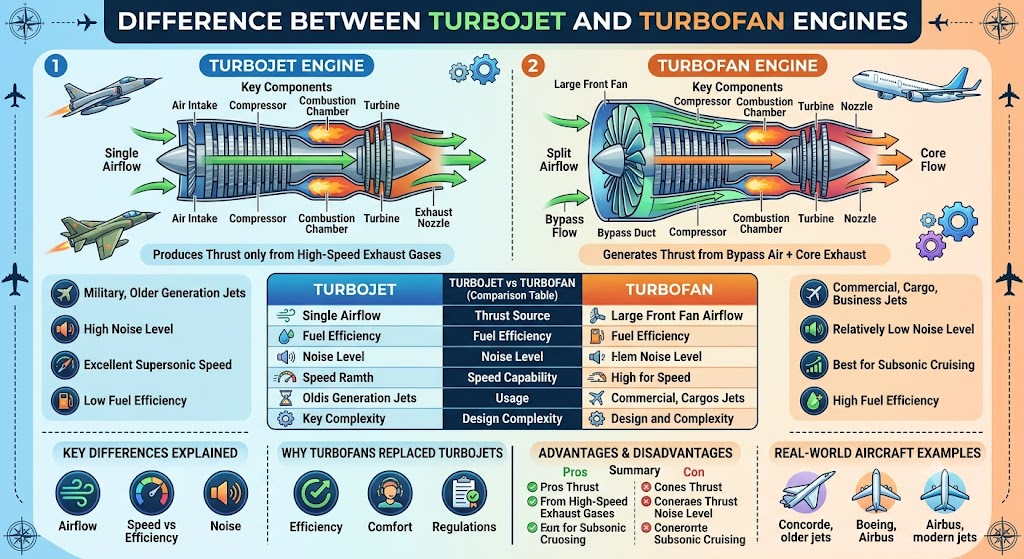
A turbojet engine is one of the earliest jet engine designs. It produces thrust by drawing air into the engine, compressing it, burning fuel, and expelling high-speed exhaust gases.
Working principle:
- Air enters the intake
- Compressor increases air pressure
- Fuel is injected and burned in the combustion chamber
- Hot gases expand through the turbine
- Exhaust gases exit at high velocity to produce thrust
Key characteristics:
- Produces thrust only from exhaust gases
- Designed for high-speed and supersonic flight
- Less efficient at low speeds
- Generates high noise levels
Applications:
- Military fighter aircraft
- Supersonic experimental aircraft
- Older generation jet aircraft
Turbojets are powerful but not fuel-efficient, which limits their use in modern commercial aviation.
What is a Turbofan Engine?
A turbofan engine is an advanced version of the jet engine widely used in modern aviation. It includes a large front fan that generates additional thrust by moving a significant amount of air around the engine core.
Working principle:
- Large fan draws air into the engine
- Air splits into bypass flow and core flow
- Core air is compressed, burned, and expanded
- Bypass air flows around the core and contributes to thrust
Key characteristics:
- Highly fuel-efficient
- Much quieter than turbojets
- Optimized for long-distance commercial flights
- Uses bypass airflow for improved performance
Applications:
- Commercial aircraft
- Cargo planes
- Business jets
- Modern military aircraft
Turbojet vs Turbofan Engines (Comparison Table)
| Feature | Turbojet Engine | Turbofan Engine |
|---|---|---|
| Thrust Source | Exhaust gases only | Exhaust + bypass air |
| Fuel Efficiency | Low | High |
| Noise Level | Very high | Relatively low |
| Speed Capability | Excellent for supersonic speeds | Best for subsonic cruising |
| Usage | Military and supersonic jets | Commercial aviation |
| Design Complexity | Simpler | More complex |
Key Differences Explained
1. Airflow System
Turbojets use a single airflow path through the engine core, while turbofans split airflow into bypass and core streams.
2. Fuel Efficiency
Turbofans are more fuel-efficient because bypass air reduces the load on the core engine.
3. Speed vs Efficiency
Turbojets are better for high-speed supersonic travel, while turbofans are designed for fuel-efficient cruising.
4. Noise Levels
Turbojets are very loud due to high-velocity exhaust gases, whereas turbofans are quieter due to slower bypass airflow.
5. Aircraft Usage
Turbojets are mostly used in military aviation, while turbofans dominate commercial aviation.
Why Turbofan Engines Replaced Turbojets in Commercial Aviation
Commercial aviation shifted toward turbofan engines due to several practical reasons:
- Fuel efficiency became a priority for airlines
- Passenger comfort required lower noise levels
- Environmental regulations demanded reduced emissions
- Long-distance travel required better fuel economy
These factors made turbofan engines the standard for modern passenger aircraft.
Advantages and Disadvantages
Turbojet Engine
Advantages:
- High-speed capability
- Simple design
- Suitable for supersonic flight
Disadvantages:
- Very high fuel consumption
- Extremely noisy
- Poor efficiency at low speeds
Turbofan Engine
Advantages:
- High fuel efficiency
- Low noise levels
- Ideal for long-haul flights
Disadvantages:
- More complex design
- Heavier engine structure
- Less efficient at extreme supersonic speeds
Real-World Aircraft Examples
Turbojet Aircraft:
- Concorde (supersonic passenger aircraft)
- Early military jet fighters
- Experimental high-speed jets
Turbofan Aircraft:
- Boeing 737
- Airbus A320
- Boeing 787 Dreamliner
- Modern fighter aircraft
FAQs
1. What is the main difference between turbojet and turbofan engines?
Turbojets generate thrust only from exhaust gases, while turbofans use both exhaust gases and bypass air.
2. Which engine is more fuel efficient?
Turbofan engines are significantly more fuel efficient than turbojet engines.
3. Why are turbojet engines not used in commercial aircraft?
Because they consume more fuel, produce more noise, and are less efficient for long-distance flights.
4. Which engine is faster?
Turbojets are better suited for very high-speed supersonic flight.
5. Do modern aircraft use turbojet engines?
Most modern aircraft use turbofan engines; turbojets are mostly limited to older or specialized military aircraft.
6. What is bypass air in turbofan engines?
It is the air that flows around the engine core instead of passing through it.
7. Why are turbofan engines quieter?
Because most thrust is generated from slower-moving bypass air rather than high-speed exhaust.
8. Are turbofan engines used in fighter jets?
Yes, modern fighter jets use advanced turbofan engines, often with afterburners.
9. Which engine is more reliable?
Turbofan engines are more reliable due to modern design improvements and redundancy systems.
10. What is the future of jet engine technology?
Turbofan engines will continue to evolve with better efficiency, lower emissions, and improved performance.
Conclusion
Turbojet and turbofan engines represent two important stages in jet propulsion technology. Turbojets are known for their simplicity and high-speed capability, making them suitable for military and supersonic aircraft. However, turbofan engines have become the dominant choice in modern aviation due to their superior fuel efficiency, lower noise levels, and better suitability for commercial air travel.
Today, turbofan engines power almost all passenger aircraft, enabling safe, efficient, and long-distance global connectivity. Understanding both engine types provides a strong foundation for anyone interested in aviation, aerospace engineering, or pilot training.
