
Introduction
Turbojet engines are one of the most important breakthroughs in aviation history. They introduced true jet propulsion and laid the foundation for modern high-speed aircraft. Even though modern commercial aviation now relies mostly on turbofan engines, turbojets remain extremely important for aviation students to understand the fundamentals of jet propulsion.
This guide explains turbojet engines in a simple, structured, and educational way to help students clearly understand how they work, where they are used, and why they are important in aerospace engineering.
Introduction
Aircraft propulsion has evolved from propeller-based systems to advanced jet engines capable of high-speed and long-distance travel. Among the earliest jet engine designs is the turbojet engine.
Turbojets were widely used in early jet aircraft and military aviation. Today, they are mostly used in specialized high-speed applications, but they remain essential for learning core aviation principles.
Aviation students study turbojet engines because they help explain:
- Basic jet propulsion principles
- High-speed aircraft performance
- Evolution of modern jet engine designs
What Is a Turbojet Engine?
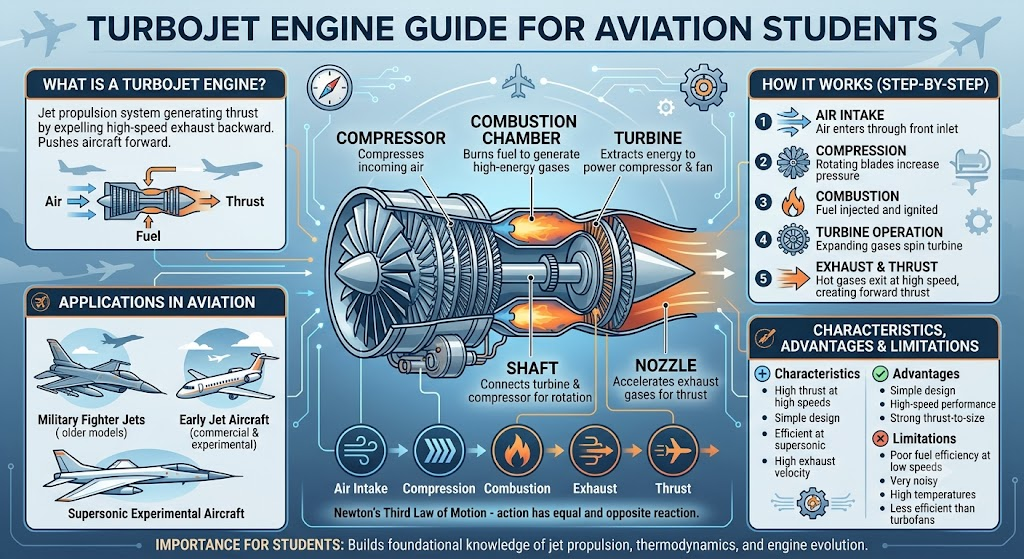
A turbojet engine is a type of jet engine that generates thrust by drawing in air, compressing it, mixing it with fuel, burning it, and expelling high-speed exhaust gases from the rear nozzle.
Simple Definition
A turbojet engine produces thrust entirely by accelerating exhaust gases backward, which pushes the aircraft forward.
Where Turbojets Are Used
- Early generation jet aircraft
- Military fighter jets (older models)
- Supersonic experimental aircraft
Turbojets are known for their simple design and ability to produce high-speed thrust.
How a Turbojet Engine Works (Step-by-Step)
Turbojet engines operate based on Newton’s Third Law: every action has an equal and opposite reaction.
1. Air Intake
Air enters the engine through the front inlet as the aircraft moves forward.
2. Compression
The compressor increases the pressure of incoming air using rotating blades.
3. Combustion
Fuel is injected into the compressed air and ignited, producing high-temperature and high-pressure gases.
4. Turbine Operation
The expanding gases spin the turbine, which powers the compressor.
5. Exhaust and Thrust
The hot gases exit through the nozzle at high speed, creating forward thrust.
Main Components of a Turbojet Engine
Compressor
Compresses incoming air before combustion.
Combustion Chamber
Burns fuel to generate high-energy gases.
Turbine
Extracts energy from gases to power the compressor.
Nozzle
Accelerates exhaust gases to create thrust.
Shaft
Connects turbine and compressor for continuous rotation.
Each component works together to ensure continuous engine operation and thrust generation.
Characteristics of Turbojet Engines
Turbojet engines have unique performance features:
- High thrust at high speeds
- Simple internal design compared to modern engines
- Efficient mainly at supersonic speeds
- High exhaust velocity
- Significant noise and heat output
These characteristics make turbojets ideal for speed-focused applications.
Advantages and Limitations
Advantages
- Simple design and construction
- High-speed performance capability
- Strong thrust-to-size ratio
- Suitable for supersonic flight
Limitations
- Poor fuel efficiency at low speeds
- Very noisy operation
- High exhaust temperatures
- Less efficient compared to turbofan engines
Applications in Aviation
Military Aircraft
Used in early fighter jets where speed was the main requirement.
Early Commercial Aviation
Some early jet airliners used turbojet engines before turbofans became standard.
Supersonic Aircraft
Turbojets were used in aircraft designed to exceed the speed of sound.
Turbojet vs Modern Turbofan Engines
Turbojet Engines
- Focus on speed and thrust
- Less fuel-efficient
- High noise levels
- Mostly used in older or specialized aircraft
Turbofan Engines
- Focus on fuel efficiency
- Quieter operation
- Better for commercial aviation
- Widely used in modern aircraft
Key Difference
Turbojets produce thrust using all exhaust gases, while turbofans use a large fan system to improve efficiency and reduce noise.
Importance for Aviation Students
Understanding turbojet engines is essential for aviation students because it helps build foundational knowledge of aircraft propulsion systems.
It helps students understand:
- How jet propulsion works
- Thermodynamics in aviation systems
- Evolution from turbojets to modern engines
- Basic principles behind advanced aircraft engines
Real-World Example
Early supersonic military aircraft used turbojet engines to achieve high speeds and altitude performance. These engines allowed aviation engineers to explore supersonic flight capabilities.
However, as aviation technology advanced, turbofan engines replaced turbojets in commercial aviation due to better fuel efficiency and lower noise levels.
Conclusion
Turbojet engines are a fundamental part of aviation history and engineering education. While they are not widely used in modern commercial aircraft, they remain extremely important for understanding how jet propulsion works.
For aviation students, learning about turbojet engines provides a strong foundation in aerospace engineering concepts. It also helps them understand how modern engines evolved to become more efficient, quieter, and environmentally friendly.
Frequently Asked Questions (FAQs)
1. What is a turbojet engine?
A turbojet engine is a jet propulsion system that generates thrust by expelling high-speed exhaust gases from the rear.
2. How does a turbojet engine work?
It works by compressing air, mixing it with fuel, burning it, and releasing high-speed exhaust gases to create thrust.
3. Where are turbojet engines used?
They are mainly used in older fighter jets, early aircraft, and some supersonic experimental aircraft.
4. Why are turbojet engines not common in commercial aviation?
Because they are less fuel-efficient and produce more noise compared to turbofan engines.
5. What is the main advantage of a turbojet engine?
It provides strong thrust at very high speeds.
6. What is the biggest disadvantage of turbojets?
They consume more fuel and are less efficient at lower speeds.
7. What replaced turbojet engines in modern aircraft?
Turbofan engines replaced them due to better efficiency and reduced noise.
8. Are turbojet engines still used today?
Yes, but mostly in military or specialized high-speed aircraft.
9. Why should aviation students learn turbojet engines?
They form the foundation of jet propulsion theory and help understand modern engine design.
10. What is the difference between turbojet and turbofan engines?
Turbojets use exhaust gases for thrust, while turbofans use a fan system for improved efficiency.
