
Introduction
Modern aviation relies on one of the most powerful engineering innovations ever created: the jet engine. From commercial aircraft carrying hundreds of passengers to executive jets used for business travel, jet engines make fast, efficient, and long-distance flight possible.
This blog explains jet engine basics in a simple way so beginners can clearly understand how they work, what they are made of, and why they are essential in modern aviation.
Introduction
Air travel has completely transformed global connectivity. Today, aircraft can travel thousands of kilometers in a matter of hours, and this is possible because of jet engines.
Jet engines generate thrust, which is the force that pushes an aircraft forward. They are used in:
- Commercial passenger aircraft
- Executive and private jets
- Military fighter aircraft
Understanding jet engine basics helps you understand how modern aircraft achieve speed, altitude, and efficiency.
What Is a Jet Engine?
A jet engine is a propulsion system that moves an aircraft forward by releasing high-speed exhaust gases backward.
Simple Definition
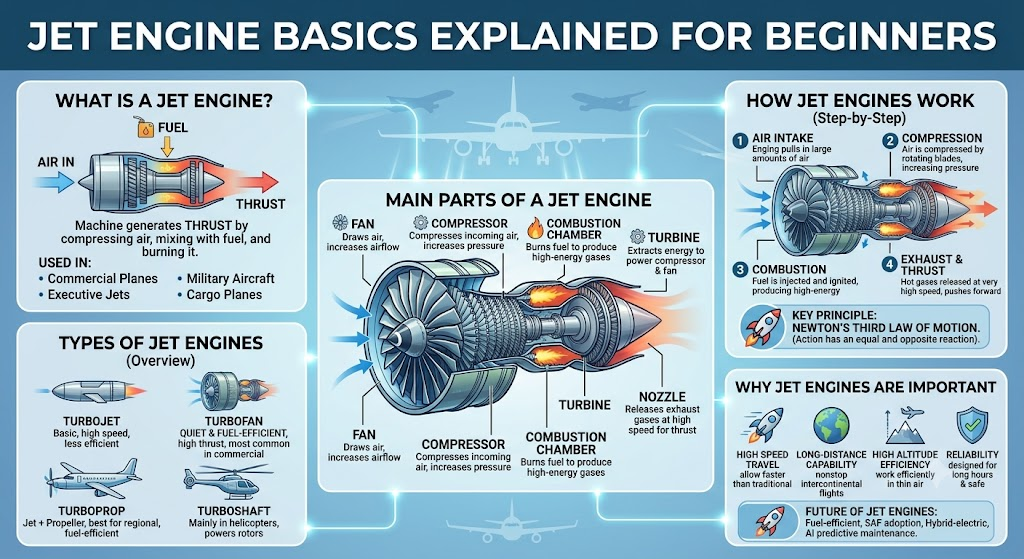
A jet engine is a machine that generates thrust by taking in air, compressing it, mixing it with fuel, and burning it to produce powerful exhaust gases.
Where Jet Engines Are Used
- Passenger airplanes
- Business and executive jets
- Military aircraft
- Cargo aircraft
Jet engines are widely used because they provide high power, efficiency at altitude, and long-range capability.
How Jet Engines Work (Step-by-Step)
Jet engines operate on a simple principle: pushing air backward creates forward motion.
1. Air Intake
The engine pulls in large amounts of air through the front while the aircraft moves forward.
2. Compression
The air is compressed using rotating blades, increasing its pressure and temperature.
3. Combustion
Fuel is injected into the compressed air and ignited, producing a high-energy combustion reaction.
4. Exhaust and Thrust
Hot gases are released at very high speed from the back of the engine, creating thrust that pushes the aircraft forward.
Key Principle
Jet engines work based on Newton’s Third Law of Motion: every action has an equal and opposite reaction.
Main Parts of a Jet Engine
A jet engine consists of several important components that work together:
Fan
Draws air into the engine and increases airflow.
Compressor
Compresses incoming air to increase pressure and temperature.
Combustion Chamber
Burns fuel to produce high-energy gases.
Turbine
Extracts energy from hot gases to power the compressor and fan.
Nozzle
Releases exhaust gases at high speed to generate thrust.
Each part plays a critical role in producing continuous and controlled engine power.
Types of Jet Engines (Beginner Overview)
Turbojet
- Basic jet engine design
- Produces high speed
- Less efficient at low speeds
Turbofan (Most Common)
- Used in most modern commercial aircraft
- Quiet and fuel-efficient
- High thrust performance
Turboprop
- Combination of jet engine and propeller
- Best for short regional flights
- Highly fuel-efficient at lower speeds
Turboshaft
- Used mainly in helicopters
- Powers rotor systems instead of direct thrust
Why Jet Engines Are Important in Aviation
Jet engines are essential for modern aviation because they provide:
High Speed Travel
They allow aircraft to travel much faster than traditional propeller-driven aircraft.
Long-Distance Capability
They enable nonstop intercontinental flights.
High Altitude Efficiency
They work efficiently in thin air at high altitudes.
Reliability
They are designed for long operating hours with strong safety standards.
Jet Engines in Real Life
Commercial Aircraft
Large passenger aircraft use turbofan engines designed for fuel efficiency and long-distance travel.
Executive Jets
Private jets use smaller, high-performance engines designed for speed, flexibility, and comfort.
Military Aircraft
Fighter jets use powerful engines designed for speed, agility, and performance in extreme conditions.
Advantages and Limitations of Jet Engines
Advantages
- Very high thrust output
- Efficient at cruising altitude
- Supports long-distance travel
- Reliable and widely tested technology
Limitations
- High fuel consumption
- Expensive maintenance
- Noise generation
- Environmental impact due to emissions
Future of Jet Engine Technology
Jet engine technology is continuously improving to make aviation more efficient and sustainable.
Key advancements include:
- Fuel-efficient next-generation engines
- Sustainable Aviation Fuel (SAF) adoption
- Hybrid-electric propulsion systems
- AI-based predictive maintenance
These improvements aim to reduce emissions and improve performance in modern aviation.
Frequently Asked Questions (FAQs)
1. What is a jet engine in simple terms?
A jet engine is a machine that pushes an aircraft forward by releasing fast-moving gases backward.
2. How does a jet engine create thrust?
It creates thrust by expelling exhaust gases at high speed, which pushes the aircraft forward.
3. What are the main types of jet engines?
The main types are turbojet, turbofan, turboprop, and turboshaft engines.
4. Why are turbofan engines most commonly used?
Because they are quieter, more fuel-efficient, and suitable for commercial air travel.
5. Do all airplanes use jet engines?
No, some smaller aircraft use propellers or turboprop engines instead.
6. Are jet engines safe?
Yes, jet engines are highly reliable and built under strict aviation safety standards.
7. What fuel do jet engines use?
They typically use aviation turbine fuel (ATF), a type of refined kerosene.
8. Can jet engines work in space?
No, jet engines require air, so they cannot operate in space.
9. What is the most important part of a jet engine?
All parts are important, but the combustion chamber is where energy is produced.
10. What is the future of jet engines?
Future engines will be more fuel-efficient, quieter, and more environmentally friendly.
Conclusion
Jet engines are the foundation of modern aviation. They make it possible for aircraft to travel fast, efficiently, and over long distances. By converting fuel into powerful thrust, jet engines enable everything from commercial air travel to executive aviation and military operations.
For beginners, understanding jet engine basics provides a clear picture of how aircraft fly and why this technology is so important in global transportation. As technology advances, jet engines will continue to evolve toward cleaner, more efficient, and smarter aviation systems.
