
Introduction
Private aviation has become an essential part of modern travel, offering speed, privacy, and flexibility that commercial airlines often cannot match. Among the most commonly used aircraft categories in private aviation are light jets and heavy jets. While both are designed for private flying, they differ greatly in size, range, comfort, cost, and overall travel experience.
Understanding these differences helps travelers, business executives, and charter clients choose the right aircraft based on their journey requirements.
✈️ Introduction to Private Jets
Private jets are aircraft designed for exclusive, non-commercial travel. They are widely used by individuals, corporations, and charter companies for efficient and comfortable travel.
Key benefits of private jets include:
- Faster boarding and departure processes
- Flexible scheduling
- Access to smaller and regional airports
- High level of privacy and comfort
Within this segment, light jets and heavy jets serve two very different travel needs.
🛩️ What Are Light Jets?
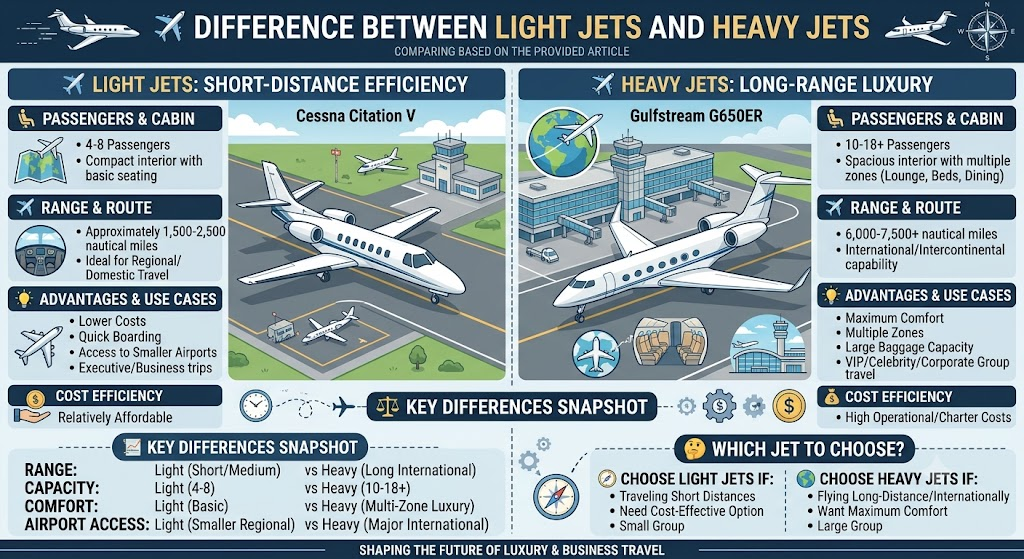
Light jets are small, efficient private aircraft designed for short to medium-distance travel. They are ideal for quick regional trips and small groups.
✈️ Key Features of Light Jets
- Seating capacity: 4 to 8 passengers
- Flight range: Approximately 1,500 to 2,500 nautical miles
- Cabin: Compact but comfortable
- Speed: High efficiency for short routes
- Cost: Relatively affordable in private aviation category
🧳 Common Use Cases
- Short business meetings between nearby cities
- Domestic and regional travel
- Emergency or urgent executive travel
- Small family or private group trips
💡 Advantages of Light Jets
- Lower operating and charter costs
- Quick boarding and turnaround time
- Access to smaller airports
- Efficient for short-distance travel
⚠️ Limitations of Light Jets
- Limited cabin space
- Not suitable for long-haul international flights
- Minimal onboard luxury features
- Smaller luggage capacity
🛫 What Are Heavy Jets?
Heavy jets are large, long-range private aircraft designed for luxury and international travel. They are commonly used by corporations, VIPs, and high-net-worth individuals.
✈️ Key Features of Heavy Jets
- Seating capacity: 10 to 18+ passengers
- Flight range: 6,000 to 7,500+ nautical miles
- Cabin: Spacious with multiple zones
- Amenities: Beds, lounges, dining areas, entertainment systems
- Performance: Built for long-haul and intercontinental flights
🧳 Common Use Cases
- International business travel
- VIP and celebrity transportation
- Long family vacations
- Government or diplomatic travel
- Corporate group travel
💡 Advantages of Heavy Jets
- Extremely long travel range
- High level of luxury and comfort
- Multiple cabin zones for work and rest
- Greater luggage capacity
- Advanced in-flight services
⚠️ Limitations of Heavy Jets
- High operating and charter costs
- Requires larger international airports
- Not cost-effective for short trips
- Longer ground handling time
⚖️ Key Differences Between Light Jets and Heavy Jets
✈️ Range
- Light Jets: Short to medium range
- Heavy Jets: Long-range international capability
👥 Passenger Capacity
- Light Jets: 4–8 passengers
- Heavy Jets: 10–18+ passengers
💺 Comfort Level
- Light Jets: Compact cabin with basic luxury
- Heavy Jets: Spacious, multi-zone luxury interiors
⛽ Cost Efficiency
- Light Jets: More affordable
- Heavy Jets: High operational cost
🧳 Luggage Capacity
- Light Jets: Limited
- Heavy Jets: Large baggage capacity
🛬 Airport Access
- Light Jets: Can use smaller airports
- Heavy Jets: Require major airports
🤔 Light Jets vs Heavy Jets: Which One Should You Choose?
🧭 Choose Light Jets if:
- You are traveling short or regional distances
- You want a cost-effective private travel option
- You are traveling with a small group
- You prioritize speed and efficiency
🌍 Choose Heavy Jets if:
- You are flying long-distance or internationally
- You want maximum comfort and luxury
- You are traveling with a larger group
- You need onboard meeting or resting facilities
In simple terms, light jets are designed for efficiency, while heavy jets are built for luxury and long-range travel.
🌍 Real-World Use Cases
💼 Corporate Travel
Executives often use light jets for quick domestic meetings, saving time and increasing productivity.
👨👩👧 Family Luxury Travel
Families traveling internationally prefer heavy jets for comfort, privacy, and long-flight convenience.
🚑 Special Missions
Heavy jets are also used for medical evacuation and VIP transport due to their range and onboard facilities.
🚀 Future of Private Aviation
The private aviation industry continues to grow rapidly, driven by increasing demand for flexible and on-demand travel.
Key trends include:
- Expansion of charter flight services
- Rising demand for membership-based jet programs
- Development of fuel-efficient aircraft
- Increased accessibility of private aviation in emerging markets
Both light and heavy jets will continue to play a major role in shaping the future of luxury and business travel.
❓ Frequently Asked Questions (FAQs)
1. What is the main difference between light jets and heavy jets?
Light jets are designed for short-distance, cost-efficient travel, while heavy jets are built for long-distance international travel with higher luxury and capacity.
2. Which jet is more affordable, light or heavy?
Light jets are significantly more affordable in terms of operating and charter costs compared to heavy jets.
3. How many passengers can a light jet carry?
Light jets typically carry between 4 to 8 passengers depending on the model.
4. Are heavy jets only used for international flights?
No, but they are most efficient and commonly used for long-distance and international travel due to their range.
5. Which jet is more comfortable?
Heavy jets offer more comfort, with spacious cabins, beds, lounges, and luxury amenities.
6. Can light jets land at small airports?
Yes, light jets can access smaller regional airports with shorter runways.
7. Why are heavy jets more expensive?
They are larger, have higher fuel consumption, longer range capabilities, and include premium onboard facilities.
8. Are light jets suitable for business travel?
Yes, they are ideal for short business trips between nearby cities.
9. How far can a heavy jet fly without refueling?
Most heavy jets can fly between 6,000 to 7,500+ nautical miles nonstop.
10. Which jet should I choose for a family vacation?
For long-distance international family travel, a heavy jet is usually the better choice due to comfort and space.
🧾 Conclusion
Light jets and heavy jets represent two distinct categories in private aviation, each serving different travel needs. Light jets are perfect for short, quick, and budget-friendly trips, making them ideal for regional business travel and small groups. On the other hand, heavy jets are designed for long-haul, international journeys with maximum luxury, space, and onboard comfort.
Choosing between them depends on your travel distance, group size, budget, and comfort expectations. If efficiency and speed matter most, light jets are the right choice. If luxury, range, and comfort are your priority, heavy jets are unmatched.
Understanding these differences allows travelers to make smarter aviation decisions and enjoy a seamless flying experience tailored to their needs.
