
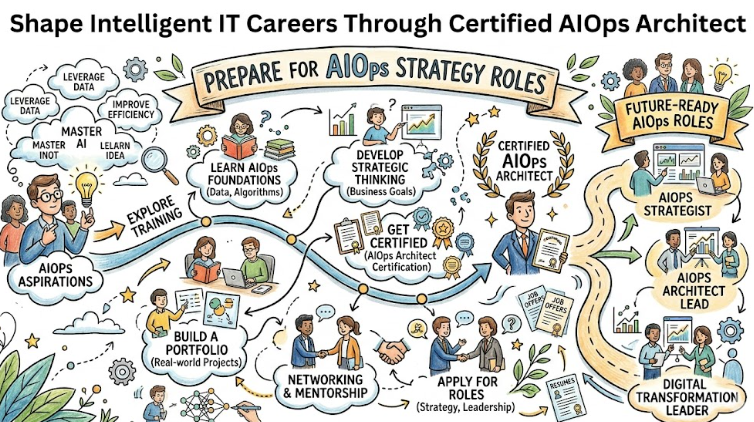
Introduction
The modern engineering landscape is shifting from manual intervention to automated, intelligent operations. As a Certified AIOps Architect, professionals can bridge the gap between traditional IT operations and artificial intelligence. This guide is designed for DevOps, SRE, and platform engineers who seek to implement self-healing systems and predictive analytics in production environments. By following the pathways outlined by aiopsschool, you will learn how to reduce noise, accelerate root cause analysis, and drive operational excellence. Making the right career decision today requires understanding how AI integrates with the existing cloud-native stack to provide a competitive edge in global markets.
What is the Certified AIOps Architect?
The Certified AIOps Architect is a professional designation that validates an individual’s ability to design, deploy, and manage AI-driven operational frameworks. It moves beyond theoretical machine learning by focusing strictly on the application of data science to solve infrastructure and software delivery challenges. This certification represents a commitment to modernizing the “Ops” in DevOps through the use of big data and automation. It ensures that an architect can handle the velocity and volume of telemetry data generated by enterprise-scale distributed systems.
Who Should Pursue Certified AIOps Architect?
This certification is ideally suited for Senior DevOps Engineers, Site Reliability Engineers (SREs), and Cloud Architects who are responsible for maintaining high availability. Infrastructure managers and technical leads who need to oversee the digital transformation of their operations teams will also find immense value in this curriculum. While it is highly beneficial for experienced professionals, ambitious beginners with a strong grasp of Python and Linux can use this to differentiate themselves. Globally, and specifically within the rapidly growing Indian tech sector, this role is becoming critical for companies managing complex microservices architectures.
Why Certified AIOps Architect is Valuable in 2026 and Beyond
As enterprise environments become too complex for human-only monitoring, the demand for AIOps expertise is skyrocketing. This certification provides longevity to a career because it focuses on the logic of intelligent automation rather than just a specific vendor tool. Organizations are moving toward “NoOps” or highly automated environments, making the AIOps Architect a key stakeholder in long-term strategy. The return on investment is seen through significantly reduced Mean Time to Repair (MTTR) and the ability to prevent outages before they occur, making the architect indispensable.
Certified AIOps Architect Certification Overview
The program is delivered via the Certified AIOps Architect and hosted on the aiopsschool for intelligent operations. The assessment approach is grounded in practical application, requiring candidates to demonstrate competency in data ingestion, pattern recognition, and automated response. Unlike generic certifications, this is structured to mirror the lifecycle of an AIOps implementation, from initial data collection to the maturity of self-healing workflows. It provides a vendor-neutral foundation while ensuring candidates understand the nuances of various algorithmic approaches to IT telemetry.
Certified AIOps Architect Certification Tracks & Levels
The certification is structured into three distinct tiers to cater to different stages of a professional’s career. The Foundation level introduces core concepts of data pipelines and basic anomaly detection for those transitioning from standard operations roles. The Professional level dives deeper into building predictive models and integrating them with CI/CD and incident management tools. Finally, the Advanced level focuses on architectural design, governance, and the strategic scaling of AIOps across multi-cloud enterprise environments, aligning perfectly with executive-level technical leadership.
Complete Certified AIOps Architect Certification Table
| Track | Level | Who it’s for | Prerequisites | Skills Covered | Recommended Order |
| Core AIOps | Foundation | Junior Engineers | Basic Linux/Python | Monitoring, Logging, AI basics | 1st |
| Architecture | Professional | SREs / DevOps | 3+ Years Experience | ML Pipelines, Data Correlation | 2nd |
| Strategic | Advanced | Leads / Architects | Professional Cert | Governance, Scaling, Strategy | 3rd |
| FinOps-AI | Specialty | Cloud FinOps | Cloud Economics | Cloud Cost Prediction, Anomaly | Optional |
Detailed Guide for Each Certified AIOps Architect Certification
Certified AIOps Architect – Foundation Level
What it is
This entry-level certification validates a candidate’s understanding of the fundamental building blocks of AI in IT operations. It ensures the professional speaks the language of both data science and infrastructure management.
Who should take it
It is designed for system administrators and junior DevOps engineers who want to understand how traditional monitoring evolves into intelligent observability. No deep prior AI knowledge is required.
Skills you’ll gain
- Understanding the AIOps landscape and key terminology.
- Basic data collection and normalization techniques.
- Identifying different types of IT telemetry data.
Real-world projects you should be able to do
- Setting up a basic centralized logging pipeline with anomaly alerts.
- Creating dashboards that differentiate between “noise” and “signals.”
Preparation plan
- 7–14 days: Focus on vocabulary, the five stages of AIOps, and reviewing basic cloud-native monitoring tools.
- 30 days: Engage with practical labs involving log ingestion and basic visualization using open-source tools.
- 60 days: Conduct a deep dive into statistical methods used for threshold-based alerting versus AI-based alerting.
Common mistakes
Candidates often underestimate the importance of data quality, focusing too much on the AI models and not enough on the cleaning of the input data.
Best next certification after this
- Same-track option: Professional Certified AIOps Architect.
- Cross-track option: SRE Foundation.
- Leadership option: Team Lead – Operations.
Certified AIOps Architect – Professional Level
What it is
This certification validates the ability to build and implement functional AIOps workflows that solve specific operational pain points. It focuses on the implementation of correlation and causation engines.
Who should take it
Mid-level SREs and DevOps engineers who are actively managing production workloads and need to reduce alert fatigue through intelligent automation.
Skills you’ll gain
- Implementing event correlation to reduce redundant alerts.
- Building automated incident response triggers.
- Managing life cycles of machine learning models for IT data.
Real-world projects you should be able to do
- Designing an automated incident remediation workflow that triggers based on predictive health checks.
- Implementing a root-cause analysis engine across a microservices mesh.
Preparation plan
- 7–14 days: Study correlation algorithms and the difference between supervised and unsupervised learning in Ops.
- 30 days: Build hands-on integrations between monitoring tools and automated remediation scripts.
- 60 days: Perform stress tests on models to ensure they do not produce false positives during high-load events.
Common mistakes
The most frequent error is over-automating too quickly without a manual verification phase, leading to unintended system changes.
Best next certification after this
- Same-track option: Advanced AIOps Strategist.
- Cross-track option: MLOps Professional.
- Leadership option: Principal Engineer Path.
Choose Your Learning Path
DevOps Path
Engineers on this path focus on integrating AIOps into the continuous delivery pipeline. The goal is to use predictive analytics to determine if a code deployment will cause performance degradation before it reaches all users. It emphasizes the “Shift Right” philosophy where production data informs the next development cycle.
DevSecOps Path
This path combines security observability with intelligent operations to detect threats in real-time. By using AI to baseline normal user behavior, security professionals can identify sophisticated attacks that traditional signature-based tools might miss. It bridges the gap between infrastructure health and security posture.
SRE Path
The Site Reliability Engineering path uses AIOps to manage Service Level Objectives (SLOs) and Error Budgets more effectively. Professionals focus on building self-healing systems that can resolve 1-tier and 2-tier incidents without human intervention. This path is heavily focused on reducing “toil” through smart automation.
AIOps Path
This is the core specialized path focused on the architecture of data platforms for IT operations. It involves mastering the flow of data from various sources into a centralized engine that provides actionable insights. It is for those who want to be the primary architects of an organization’s intelligence layer.
MLOps Path
While AIOps focuses on using AI to run IT, MLOps focuses on the operational excellence of running AI models themselves. This path is for engineers who manage the infrastructure where data science teams deploy their models, ensuring reliability and scalability of ML workloads.
DataOps Path
DataOps focuses on the quality and velocity of data delivery to the AIOps engine. Professionals on this path ensure that the telemetry data is clean, secure, and available in real-time. It is essential for large-scale organizations where data silos prevent AI from working effectively.
FinOps Path
This path uses AI to predict and optimize cloud spending patterns. By applying AIOps principles to financial data, architects can identify waste and automatically right-size resources. It is becoming a critical function for organizations looking to maximize their cloud return on investment.
Role → Recommended Certified AIOps Architect Certifications
| Role | Recommended Certifications |
| DevOps Engineer | AIOps Foundation + DevOps Professional |
| SRE | AIOps Professional + SRE Advanced |
| Platform Engineer | AIOps Architect + Cloud Native Expert |
| Cloud Engineer | AIOps Foundation + FinOps Associate |
| Security Engineer | AIOps Professional + SecOps Specialty |
| Data Engineer | DataOps + AIOps Foundation |
| FinOps Practitioner | FinOps Professional + AIOps Analytics |
| Engineering Manager | AIOps Strategic Leadership |
Next Certifications to Take After Certified AIOps Architect
Same Track Progression
After reaching the architect level, professionals should look toward mastering specific algorithmic domains. This involves deep diving into neural networks for IT operations or specialized NLP (Natural Language Processing) for automated log analysis. Deep specialization ensures you remain the top technical authority in the intelligent operations space.
Cross-Track Expansion
An AIOps architect can benefit significantly from expanding into MLOps or FinOps. Understanding how to manage the lifecycle of a machine learning model or how to automate cost savings provides a multi-dimensional skill set. This makes the professional more versatile and able to solve complex business problems beyond just system uptime.
Leadership & Management Track
For those looking to move into people or strategy management, the next step is focusing on Digital Transformation leadership. This involves learning how to build teams, manage budgets for AI initiatives, and communicate the technical ROI of AIOps to C-level executives. It marks the transition from “builder” to “visionary.”
Training & Certification Support Providers for Certified AIOps Architect
DevOpsSchool
This provider is a pioneer in the DevOps training space, offering comprehensive programs that cover the entire software delivery lifecycle. They provide extensive lab environments and real-world scenarios that help students transition from traditional methods to automated workflows. Their curriculum is updated frequently to reflect the latest industry trends.
Cotocus
Known for its specialized consulting and training approach, this organization focuses on deep technical dives into cloud-native technologies. They offer hands-on workshops that are highly regarded by enterprise teams looking to upskill their workforce. Their instructors are usually active practitioners in the field.
Scmgalaxy
This is a massive community-driven platform that offers a wealth of resources for configuration management and DevOps professionals. It serves as a knowledge hub where engineers can find tutorials, documentation, and certification paths for various modern technologies. It is a go-to resource for self-paced learners.
BestDevOps
Focusing on quality and career-oriented training, this provider offers curated paths for engineers looking to reach senior levels. Their programs emphasize the practical application of tools and methodologies in large-scale production environments. They are known for their structured approach to complex technical subjects.
devsecopsschool
This institution specializes in the intersection of security and operations, providing the skills necessary to build secure automated pipelines. Their training covers everything from vulnerability scanning to compliance-as-code. It is an essential stop for any professional looking to master the security aspect of modern engineering.
sreschool
Dedicated entirely to Site Reliability Engineering, this provider focuses on the principles of reliability, scalability, and error budget management. Their courses are designed to teach engineers how to maintain high availability in complex systems. The training is deeply rooted in the practices popularized by major tech giants.
aiopsschool
As the primary host for AIOps specific certifications, this platform offers the most focused curriculum for intelligent operations. They bridge the gap between data science and IT, providing the specific training needed for the Certified AIOps Architect role. Their focus is strictly on AI-driven infrastructure management.
dataopsschool
This provider focuses on the data engineering side of operations, teaching professionals how to manage the flow and quality of data. Their courses are critical for anyone involved in building the data pipelines that power AI engines. They emphasize the importance of data agility and reliability.
finopsschool
Specializing in cloud financial management, this organization helps professionals master the art of cloud cost optimization. Their training combines financial accountability with technical execution. It is the leading choice for those looking to manage and reduce cloud spend through intelligent analysis.
Frequently Asked Questions (General)
- How difficult is it to pass the Certified AIOps Architect exam?
The exam is moderately difficult as it requires both operational experience and a conceptual understanding of data science. - What are the prerequisites for the professional level?
Typically, 3 to 5 years of experience in DevOps or SRE roles is recommended to fully grasp the advanced topics. - How long does the certification remain valid?
The certification is generally valid for two to three years, after which renewal is required to stay current with technology. - Is there a coding requirement for this certification?
Yes, a basic to intermediate understanding of Python is essential for data manipulation and automation scripts. - Can I take the exam online?
Yes, most providers offer a proctored online exam format for global accessibility. - What is the average salary increase after getting certified?
While it varies by region, many professionals report a 20% to 35% increase in salary due to the specialized nature of the role. - How does this differ from a standard DevOps certification?
DevOps focuses on the pipeline and culture, while AIOps focuses specifically on using AI to manage and improve those operations. - Are there any lab-based assessments in the exam?
Most advanced certifications include performance-based questions or labs where you must solve a specific problem in a live environment. - Does this certification cover specific tools like Splunk or ELK?
It covers the architectural principles that apply to all these tools rather than focusing on just one vendor’s software. - How much time should I dedicate to studying daily?
An average of 1 to 2 hours of focused study per day for 8 weeks is usually sufficient for most candidates. - Is this certification recognized globally?
Yes, the skills taught are based on industry standards used by enterprise companies worldwide. - Are there community groups for aspirants?
Yes, platforms like Scmgalaxy and various LinkedIn groups provide support and networking for candidates.
FAQs on Certified AIOps Architect
- What is the core focus of the Certified AIOps Architect curriculum?
The curriculum focuses on the integration of big data and machine learning into IT operations to automate tasks and provide deep insights. - Does this certification help in reducing operational costs?
Absolutely, it teaches architects how to use AI to identify inefficiencies and prevent costly downtime through predictive maintenance. - Is machine learning experience mandatory before starting?
No, the foundation level introduces the necessary machine learning concepts specifically tailored for IT operations professionals. - How does AIOps impact the daily life of an SRE?
It reduces the “toil” and alert noise, allowing SREs to focus on long-term engineering improvements rather than constant fire-fighting. - What kind of data sources does an AIOps Architect work with?
Architects work with metrics, logs, events, traces, and even human-generated data like incident tickets and chat logs. - Can a manager benefit from this technical certification?
Yes, it provides managers with the technical literacy needed to lead AI-driven transformation projects and hire the right talent. - What are the common tools used during the training?
Training often involves working with data pipelines like Kafka, storage like Prometheus or Elasticsearch, and various ML libraries. - Is there a focus on multi-cloud environments?
Yes, the architecture level specifically addresses the challenges of correlating data across different cloud providers and on-premise systems.
Final Thoughts: Is Certified AIOps Architect Worth It?
From a mentor’s perspective, the transition to AIOps is not just a trend; it is a necessity driven by the sheer scale of modern infrastructure. Becoming a Certified AIOps Architect places you at the forefront of this evolution. It is a challenging path that requires a blend of traditional operations wisdom and new-age data science skills. However, the ability to build systems that “think” and “heal” is perhaps the most valuable asset an engineer can have in the current market. If you are looking to move beyond manual scripting and into the realm of intelligent, scalable architecture, this certification is a sound investment in your professional future. Focus on the fundamentals of data quality, be patient with the learning curve of algorithms, and you will find yourself leading the next generation of engineering teams.
