
Introduction
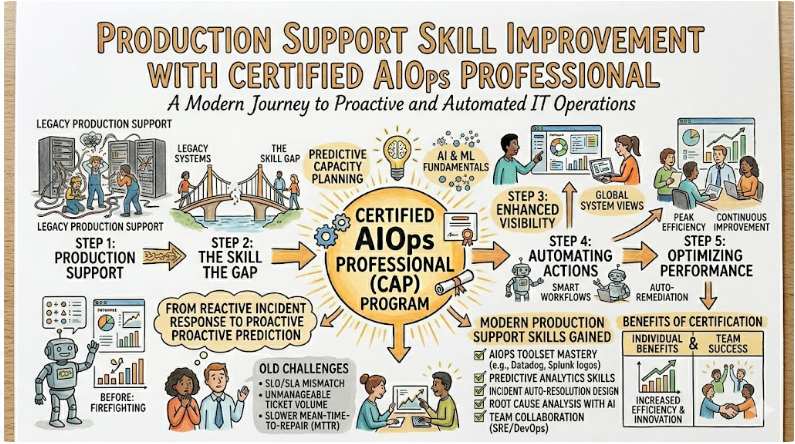
The Certified AIOps Professional is a comprehensive program designed to bridge the gap between traditional IT operations and the future of autonomous systems. As organizations move toward cloud-native architectures, the sheer volume of telemetry data makes manual monitoring impossible. This guide is crafted for engineers and managers who want to understand how artificial intelligence and machine learning can be applied to DevOps and platform engineering. By following this roadmap at aiopsschool, professionals can transition from reactive troubleshooting to proactive, data-driven system management.
What is the Certified AIOps Professional?
The Certified AIOps Professional represents a new standard in modern infrastructure management, focusing on the convergence of data science and system reliability. Unlike theoretical courses, this program emphasizes production-focused learning where participants interact with real-time streaming data and complex distributed systems. It exists to solve the “alert fatigue” problem that plagues modern SRE teams by introducing algorithmic noise reduction and automated incident response.
This certification aligns with enterprise practices by teaching how to integrate machine learning models directly into existing CI/CD pipelines and observability stacks. It validates an engineer’s ability to build systems that learn from historical outages to prevent future failures. For an enterprise, this means a significant reduction in Mean Time to Repair (MTTR) and a more stable environment for digital products.
Who Should Pursue Certified AIOps Professional?
This certification is built for professionals who sit at the intersection of development and operations, particularly those looking to specialize in high-scale environments. Site Reliability Engineers (SREs), Cloud Architects, and DevOps Engineers will find the curriculum directly applicable to their daily challenges of managing massive infrastructure. It is also highly relevant for Data Engineers who want to pivot toward infrastructure or Security professionals looking to use AI for threat detection.
In the global market, and specifically within the rapidly growing tech hubs in India, there is a massive demand for engineers who can handle “Day 2” operations using intelligence. While beginners can enter at the foundation level to build a strong conceptual base, experienced senior engineers and technical leads will benefit from the advanced architectural modules. It provides a structured path for managers to understand how to build and lead AIOps teams effectively.
Why Certified AIOps Professional is Valuable in and Beyond
As infrastructure becomes increasingly complex and ephemeral, the demand for AIOps skills is reaching a critical point. Organizations are moving away from simple threshold-based monitoring toward sophisticated anomaly detection that requires the skills taught in this program. This certification ensures that your career remains insulated from the commoditization of basic cloud tasks by focusing on high-value intelligence layers.
Investing in this certification provides a strong return on time because it teaches principles that are tool-agnostic, though it uses industry-standard frameworks for practice. The longevity of this skill set is high, as the industry shift toward “Autonomous Operations” is a decade-long transition that has only just begun. Professionals who master these skills now will be the architects of the next generation of self-healing platforms.
Certified AIOps Professional Certification Overview
The program is delivered via the Certified AIOps Professional official curriculum and is hosted on the aiopsschool platform. It is structured to provide a hands-on assessment approach where candidates must demonstrate competency through practical labs rather than just multiple-choice questions. This ownership of the learning process ensures that the badge represents actual technical capability in a production-like environment.
The certification is categorized into distinct tiers to accommodate different levels of professional maturity and technical depth. Each module is designed to reflect a specific phase of the AIOps adoption journey, from data collection and ingestion to model training and automated remediation. This practical structure allows participants to apply what they learn in their current roles almost immediately.
Certified AIOps Professional Certification Tracks & Levels
The certification is divided into three primary levels: Foundation, Professional, and Advanced. The Foundation level focuses on the “Observability to AIOps” transition, covering data types and basic statistical analysis. The Professional level dives deep into machine learning algorithms for anomaly detection and incident correlation, which is where most mid-level engineers find their sweet spot.
Advanced levels and specialized tracks allow for deep dives into specific domains like AIOps for FinOps or AIOps for Security. These levels align with a professional’s career progression, moving from individual contributor tasks to architectural design and organizational strategy. By moving through these tracks, an engineer can demonstrate a clear growth path within their organization or the broader job market.
Complete Certified AIOps Professional Certification Table
| Track | Level | Who it’s for | Prerequisites | Skills Covered | Recommended Order |
| Core AIOps | Foundation | Junior Engineers, Managers | Basic Linux & Monitoring | Log analysis, Metrics, Intro to AI | 1 |
| Engineering | Professional | SREs, DevOps Engineers | Python, Foundation Cert | ML Models, Anomaly Detection, RCA | 2 |
| Architecture | Advanced | Principal Engineers, Architects | Professional Cert, K8s Exp | System Design, Event Correlation | 3 |
| Specialized | FinOps Focus | Cloud Economists, FinOps | Cloud Billing Basics | Forecasting, Cost Anomaly Detection | 4 |
Detailed Guide for Each Certified AIOps Professional Certification
Certified AIOps Professional – Foundation
What it is
This level validates a fundamental understanding of the AIOps landscape and the shift from traditional monitoring to intelligent observability. It ensures the candidate understands how data flows from infrastructure to intelligence.
Who should take it
It is suitable for entry-level cloud engineers, project managers, and traditional operations staff who need to understand the modern terminology and basic workflows of AIOps.
Skills you’ll gain
- Understanding the four pillars of AIOps: Data, Analytics, Algorithms, and Automation.
- Differentiating between metrics, logs, and traces in an AI context.
- Identifying use cases for AIOps within a standard DevOps lifecycle.
- Basic understanding of data ingestion and cleaning for operations.
Real-world projects you should be able to do
- Set up a basic centralized logging system that feeds into a statistical analysis tool.
- Create a dashboard that highlights seasonal patterns in system traffic.
Preparation plan
- 7-14 Days: Focus on terminology, the history of AIOps, and understanding the core differences between monitoring and observability.
- 30 Days: Complete the official foundation labs and study the different types of operational data structures.
- 60 Days: Review case studies of AIOps implementations in Fortune 500 companies to understand organizational impact.
Common mistakes
- Underestimating the importance of data quality before applying AI.
- Confusing standard automation (scripts) with AIOps (intelligence).
Best next certification after this
- Same-track option: Certified AIOps Professional – Professional
- Cross-track option: Certified SRE Professional
- Leadership option: Digital Transformation Leader
Certified AIOps Professional – Professional
What it is
The Professional level is a technical deep dive into the algorithms and machine learning models used to solve operational problems. It validates the ability to build and deploy AIOps tools.
Who should take it
Experienced DevOps engineers, SREs, and Platform engineers who want to implement AI-driven solutions in their current production environments.
Skills you’ll gain
- Implementing supervised and unsupervised learning for system telemetry.
- Building automated Root Cause Analysis (RCA) engines.
- Developing noise reduction strategies for alert management systems.
- Integrating AIOps tools with Slack or Jira for intelligent incident routing.
Real-world projects you should be able to do
- Build a machine learning model that predicts disk failure or memory leaks before they happen.
- Implement an event correlation engine that groups 1000 alerts into 5 actionable incidents.
Preparation plan
- 7-14 Days: Brush up on Python for data science and common ML libraries like Scikit-learn or TensorFlow.
- 30 Days: Dive into the AIOps School professional labs focusing on time-series forecasting.
- 60 Days: Build a capstone project that applies an anomaly detection model to a live Kubernetes cluster.
Common mistakes
- Trying to use complex neural networks for simple problems that require basic regression.
- Neglecting the feedback loop where humans validate the AI’s findings.
Best next certification after this
- Same-track option: Certified AIOps Professional – Advanced
- Cross-track option: Certified MLOps Professional
- Leadership option: AIOps Strategy Lead
Certified AIOps Professional – Advanced
What it is
This level focuses on the architectural strategy and large-scale deployment of AIOps across an entire enterprise. It validates the ability to design self-healing systems.
Who should take it
Principal engineers, Architects, and Technical Leads responsible for the stability and efficiency of large-scale, global infrastructure.
Skills you’ll gain
- Designing multi-layer AIOps architectures for hybrid cloud environments.
- Establishing Governance and Ethics for AI in IT operations.
- Creating ROI frameworks for AIOps adoption at the executive level.
- Mastering automated remediation (Self-healing) workflows.
Real-world projects you should be able to do
- Design a system that automatically scales and reconfigures infrastructure based on predicted demand.
- Build an enterprise-wide “Incident Command Center” powered by generative AI and AIOps.
Preparation plan
- 7-14 Days: Study enterprise architecture patterns and distributed systems theory.
- 30 Days: Work through advanced labs on automated remediation and policy-driven operations.
- 60 Days: Write a whitepaper or design document for an end-to-end AIOps transformation.
Common mistakes
- Focusing too much on the tech and not enough on the cultural change required for AIOps.
- Failing to account for the “Black Box” problem where engineers don’t trust the AI’s decisions.
Best next certification after this
- Same-track option: AI Research for Infrastructure
- Cross-track option: Certified FinOps Architect
- Leadership option: Chief Technology Officer (CTO) Track
Choose Your Learning Path
DevOps Path
The DevOps path focuses on integrating intelligence into the CI/CD pipeline. Engineers on this path use AIOps to predict build failures and identify performance regressions during the testing phase. The goal is to move from “Continuous Integration” to “Intelligent Integration” where the system understands the impact of code changes. This path is ideal for those who want to ensure high-quality software delivery at speed.
DevSecOps Path
In the DevSecOps path, AIOps is applied to security telemetry to identify zero-day threats and unusual user behavior. Instead of relying on static signatures, professionals learn to build behavioral baselines. This allows for the detection of subtle exfiltration attempts that traditional tools might miss. It is a critical path for those working in regulated industries like banking or healthcare.
SRE Path
The Site Reliability Engineering path is the most natural fit for AIOps, focusing on uptime and SLOs. Here, the curriculum emphasizes error budget management and proactive incident prevention. Professionals learn to use AI to automate the “Toil” out of their daily jobs, allowing them to focus on high-level engineering tasks. This path transforms an SRE from a firefighter into a system architect.
AIOps Path
The pure AIOps path is for those who want to become specialists in the domain itself. This path covers the full spectrum from data engineering for operations to the deployment of complex ML models. It is designed for engineers who want to build the platforms that other teams use to keep their systems running. This path leads to roles such as AIOps Engineer or Infrastructure Data Scientist.
MLOps Path
The MLOps path focuses on the lifecycle of machine learning models themselves. While AIOps uses AI to help Ops, MLOps uses Ops to help AI. Professionals learn how to version models, monitor for feature drift, and ensure the reliability of AI services. This is essential for companies whose primary product is an AI-driven application.
DataOps Path
DataOps focuses on the reliability and quality of data pipelines, which are the lifeblood of AIOps. On this path, you learn how to apply DevOps principles to data movement and transformation. It ensures that the “Garbage In, Garbage Out” problem doesn’t ruin your AIOps initiatives. This is a foundational path for organizations building large-scale data lakes.
FinOps Path
The FinOps path uses AIOps to manage the complex and often unpredictable costs of cloud computing. By using AI for forecasting and anomaly detection in billing, professionals can prevent “cloud bill shock.” This path is becoming increasingly important as CFOs demand more accountability for cloud spending. It bridges the gap between engineering and finance.
Role → Recommended Certified AIOps Professional Certifications
| Role | Recommended Certifications |
| DevOps Engineer | Foundation, Professional |
| SRE | Professional, Advanced |
| Platform Engineer | Professional, Advanced |
| Cloud Engineer | Foundation, Professional |
| Security Engineer | Foundation, DevSecOps Specialization |
| Data Engineer | Foundation, DataOps Specialization |
| FinOps Practitioner | Foundation, FinOps Specialization |
| Engineering Manager | Foundation, AIOps Strategy |
Next Certifications to Take After Certified AIOps Professional
Same Track Progression
After completing the advanced level of AIOps certification, professionals should look toward deep specialization in specific AI subfields. This could involve studying Deep Learning for time-series data or Natural Language Processing for automated log parsing. The goal here is to move from a generalist to a specialist who can build custom proprietary AIOps tools that provide a competitive advantage to their company.
Cross-Track Expansion
Broadening your skills into adjacent domains like MLOps or FinOps is highly recommended to become a “T-Shaped” professional. Understanding how your AIOps initiatives impact the company’s bottom line or how to better manage the models you’ve built adds layers of value to your profile. This cross-pollination of skills makes you indispensable in multi-disciplinary teams and complex enterprise environments.
Leadership & Management Track
For those looking to move into management, the next step is focusing on digital transformation and strategy. This involves learning how to build teams, manage vendors, and align technical AIOps goals with business outcomes. Certifications in ITIL 4, COBIT, or specialized CTO programs can help bridge the gap between high-level engineering and executive leadership roles.
Training & Certification Support Providers for Certified AIOps Professional
DevOpsSchool
A premier training provider known for its exhaustive technical depth and community-driven approach to learning. They offer a wide array of programs that cover the entire spectrum of DevOps and AIOps, ensuring that students get a 360-degree view of the industry. Their instructors are typically industry veterans who bring real-world scenarios into the classroom, making the learning experience both practical and engaging. With a strong presence in the global market, they provide the necessary support for professionals to clear their certifications and advance their careers. The platform is highly regarded for its post-training support and extensive library of resources that help engineers stay updated with the latest trends.
Cotocus
Provides specialized consulting and training services that focus on the architectural side of cloud-native technologies. Their approach is highly tailored to meet the needs of modern enterprises looking to upskill their workforce in AIOps and SRE practices. They emphasize hands-on labs and project-based learning, which is essential for mastering the complexities of the Certified AIOps Professional program. By focusing on the integration of tools and culture, they help professionals understand the “why” behind the “how.” Their training modules are designed to be concise yet impactful, making them a favorite for busy working professionals who need to see immediate results.
Scmgalaxy
Built a reputation as a comprehensive knowledge hub for everything related to software configuration management and DevOps. They provide a unique blend of free resources and premium certification training that caters to a global audience of engineers. Their curriculum for AIOps is particularly strong in the area of data ingestion and pipeline automation, reflecting their roots in traditional DevOps. The platform’s community forums and technical blogs provide an excellent ecosystem for continuous learning long after the formal training has ended. For candidates looking for a balanced approach between self-paced study and guided instruction, this is a highly reliable choice.
BestDevOps
Focuses on delivering high-quality, boutique training experiences for small groups and corporate teams. They pride themselves on a “zero-fluff” curriculum that targets the specific skills needed to pass advanced certifications like the Certified AIOps Professional. Their teaching methodology involves deep-dive sessions into troubleshooting and system design, which are critical for senior engineering roles. Because they keep their classes small, they can offer personalized feedback and mentorship that is often missing in larger platforms. This makes them an ideal choice for engineers who are looking for a more high-touch, expert-led learning journey to accelerate their career growth.
devsecopsschool
The go-to provider for professionals who want to view AIOps through a security-first lens. They specialize in integrating security protocols into the automated workflows of DevOps and AIOps. Their training programs are designed to teach engineers how to use AI to detect vulnerabilities and mitigate threats in real-time. Given the increasing importance of cybersecurity, their specialized tracks offer a significant edge in the job market. They provide a rigorous curriculum that combines theory with intensive practical labs, ensuring that graduates are ready to protect complex, AI-driven cloud environments from sophisticated cyberattacks.
sreschool
Focuses exclusively on the principles of Site Reliability Engineering and its evolution into AIOps. They provide a structured environment for learning how to manage service levels, error budgets, and complex incident responses using intelligent tools. Their curriculum is heavily influenced by the practices of top-tier tech companies, providing students with insights into how the best in the business operate. By focusing on reliability as a core feature of the product, they help engineers shift their mindset from “keeping the lights on” to “engineering for growth.” Their programs are essential for anyone aspiring to become a world-class SRE.
aiopsschool
The primary hosting and delivery platform for the Certified AIOps Professional program. It serves as a specialized academy dedicated entirely to the convergence of AI and operations. The platform offers a seamless learning experience, from foundational modules to advanced architectural simulations. Because they are the primary stakeholders in the certification, their content is always aligned with the latest exam objectives and industry requirements. They provide a unique environment where data science and systems engineering meet, offering specialized tools and datasets for students to practice their skills in a safe yet realistic setting.
dataopsschool
Addresses the critical need for data reliability in the age of AIOps. They provide specialized training on how to manage the lifecycle of data with the same rigor that DevOps brings to software development. Their courses cover everything from data versioning to automated testing of data pipelines, which are essential prerequisites for a successful AIOps implementation. By focusing on the “plumbing” of the AI world, they ensure that the models built by engineers are fed with high-quality, reliable information. This is a vital resource for any organization that wants to move beyond pilot projects to production-grade AIOps.
finopsschool
Specializes in the economic side of cloud-native engineering, teaching professionals how to optimize cloud spend using AIOps. They provide a unique curriculum that combines financial management with technical automation. In an era where cloud costs can easily spiral out of control, their training offers immediate value to both engineers and business leaders. Students learn how to build automated cost-anomaly detection systems and predictive billing models. This specialized knowledge is highly sought after by large enterprises looking to maximize their return on cloud investment without sacrificing performance or agility.
Frequently Asked Questions (General)
- What is the typical difficulty level of the Certified AIOps Professional exam?
The exam is considered moderately difficult as it requires a mix of systems engineering knowledge and basic data science concepts. It is designed to test practical application rather than rote memorization. - How long does it typically take to complete the entire certification path?
For a working professional, completing the journey from Foundation to Professional level usually takes about 3 to 6 months, depending on prior experience with Python and Linux. - Are there any specific prerequisites for the Foundation level?
No formal prerequisites are required, but a basic understanding of IT operations, Linux commands, and monitoring concepts will significantly help you grasp the material faster. - Is this certification recognized globally by top-tier tech companies?
Yes, the skills taught in this program are aligned with the operational needs of major cloud providers and enterprise organizations worldwide, including those in India’s tech hubs. - What is the Return on Investment (ROI) for this certification?
Engineers with AIOps certifications often see a significant salary bump and are eligible for higher-level architectural roles that command premium compensation in the market. - Do I need to be a Data Scientist to pass the Professional level?
No, you do not need to be a data scientist. The course focuses on the application of ML models rather than the deep mathematical theory behind their creation. - How does this certification differ from a standard DevOps certification?
A standard DevOps certification focuses on CI/CD and automation, while this certification focuses on adding an intelligence layer to those processes using AI and ML. - Is there a requirement for recertification after a certain period?
To keep up with the fast-paced nature of the industry, recertification or continuous learning credits are typically required every two years to ensure your skills remain current. - Can I skip the Foundation level if I have 10 years of experience?
While experienced professionals may find the content familiar, it is recommended to complete the Foundation level to align with the specific terminology and framework used in the program. - Does the certification involve hands-on coding labs?
Yes, the Professional and Advanced levels are heavily lab-based, requiring you to write scripts, configure models, and solve real-world infrastructure problems in a live environment. - What tools will I learn to use during the program?
You will gain experience with a variety of tools including ELK stack, Prometheus, Grafana, Scikit-learn, and specialized AIOps platforms that are commonly used in the industry. - Are there corporate discounts available for team certifications?
Most training providers listed in this guide offer corporate packages for teams looking to upskill multiple engineers simultaneously as part of an organizational transformation.
FAQs on Certified AIOps Professional
- How does Certified AIOps Professional address alert fatigue specifically?
The certification teaches specific algorithms for event correlation and noise reduction, allowing you to group related alerts and focus only on the root cause. - Will I learn about Generative AI in this program?
Yes, the curriculum has been updated to include how LLMs can be used to assist in incident summarization and automated runbook generation for operations teams. - Does the program cover AIOps for multi-cloud environments?
Absolutely, the certification focuses on tool-agnostic principles that can be applied across AWS, Azure, Google Cloud, and on-premises data centers. - What is the focus on automated remediation in the advanced track?
It teaches how to safely design and implement self-healing workflows where the AI can automatically take corrective actions like restarting services or scaling resources. - Is Python the only language used for the labs?
While Python is the primary language due to its strong AI ecosystem, the concepts can be applied using other languages like Go or Java depending on your stack. - How is the practical exam structured?
The practical exam usually presents a broken or inefficient environment where you must apply AIOps techniques to restore service and optimize performance within a set timeframe. - Does the course cover the ethics of AI in IT operations?
Yes, the Advanced level includes modules on the ethical use of AI, focusing on transparency, bias in data, and ensuring human oversight in automated systems. - Can this certification help me move into a Management role?
Yes, the AIOps Strategy modules are specifically designed to help senior engineers transition into leadership by focusing on ROI, team building, and long-term technical vision.
Final Thoughts: Is Certified AIOps Professional Worth It?
As someone who has seen the evolution of operations from manual rack-and-stack to the era of cloud-native automation, I can tell you that we are at another major turning point. The volume of data we generate today is simply beyond human capacity to manage effectively. If you are an engineer who feels overwhelmed by the “noise” of modern systems, or a manager struggling to reduce MTTR, the Certified AIOps Professional program is an essential investment.
My honest advice is to look beyond the “AI” hype. AIOps isn’t about replacing engineers with robots; it’s about giving engineers the “superpowers” they need to manage complex systems with ease. This certification provides a structured, disciplined way to acquire those powers. It’s not just a badge; it’s a toolkit for the next decade of your career. If you are willing to put in the work to master the intersection of data and operations, the career impact will be profound and long-lasting.
