
Introduction
Private jet charter can seem complicated when you first start researching it. Unlike commercial airline tickets, private charter prices do not usually follow one simple fare structure.
The final cost depends on several factors, including the aircraft, route, flight duration, airport, passenger requirements, and availability. Understanding these factors can make it easier to read a charter quote and compare different options.
This guide explains how private jet charter costs are calculated, what may be included in a quote, which additional charges beginners should know about, and what to consider before booking.
What Is a Private Jet Charter?
A private jet charter allows an individual, family, business, or group to arrange the use of an aircraft for a specific journey without purchasing the aircraft.
Instead of buying individual seats like on a commercial airline, the customer generally books the aircraft for the required trip. The aircraft may accommodate a certain number of passengers depending on its category and configuration.
Charter travel can offer greater flexibility in terms of departure times and airport selection. However, that flexibility comes with costs that vary from one trip to another.
For example, a short domestic flight using a light jet can have a very different price from a long international journey using a heavy jet.
How Much Does a Private Jet Charter Cost?
There is no universal price for a private jet charter.
A charter quote is usually based on the specific requirements of the trip. Two flights covering similar distances can have different prices if they use different aircraft, depart from different airports, or take place during different periods.
Some charter providers may quote an hourly rate, while others may provide an all-inclusive trip price. The quoted amount may also include several operational expenses rather than simply representing the aircraft’s flying time.
For beginners, the important point is to look at the complete quotation rather than focusing only on an advertised hourly rate.
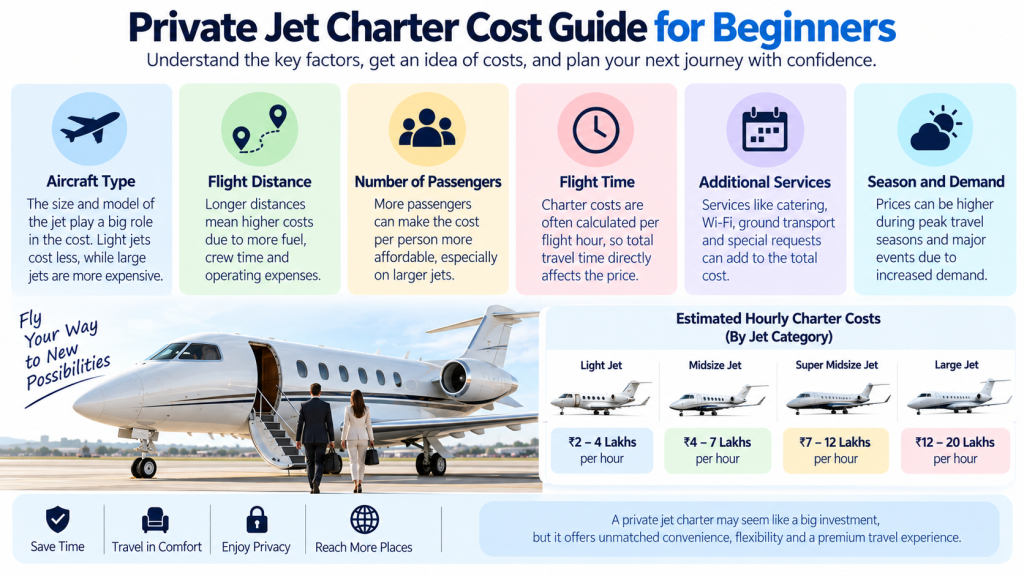
An illustrative pricing range can sometimes help explain the market, but it should not be treated as a guaranteed booking price. Actual costs change according to aircraft availability, route, airport charges, positioning requirements, fuel costs, and other operational factors.
Main Factors That Affect Private Jet Charter Cost
Several factors contribute to the final price of a charter flight.
Aircraft Type and Size
The aircraft is one of the most important cost factors.
Very light and light jets generally suit smaller groups and shorter journeys. Midsize and super-midsize aircraft can provide more cabin space and longer-range capability. Heavy jets are designed for larger groups and longer journeys and typically involve higher operating costs.
Choosing the largest aircraft available is not always necessary. The aircraft should match the number of passengers, luggage requirements, route, and expected flight duration.
Flight Distance and Route
Longer flights generally require more fuel and operating time. However, distance alone does not determine the final price.
The aircraft may also need to travel to the departure airport before picking up passengers. This positioning flight can influence the overall quotation.
International routes may also involve additional operational and handling requirements.
Number of Passengers
Passenger numbers influence aircraft selection.
A small group may be able to use a light jet, while a larger group may require a midsize, super-midsize, or heavy aircraft.
Passengers should also consider luggage. An aircraft that technically accommodates the required number of people may not provide enough luggage capacity for the group’s needs.
Flight Duration
Aircraft operating costs are closely connected with flight time. Longer journeys generally require more fuel and crew operating time.
Flight duration can also influence whether the aircraft needs additional operational arrangements during the trip.
Aircraft Availability
Charter pricing can change according to aircraft availability.
If a suitable aircraft is already positioned close to the departure airport, the trip may have different costs from a situation where an aircraft needs to travel from another location before beginning the passenger journey.
Availability can also vary during periods of high demand.
Departure and Arrival Airports
Private aircraft do not always use the same airports as commercial airlines.
A charter operator may consider airport suitability, runway requirements, operating restrictions, landing charges, parking availability, and other factors when planning a flight.
An airport that is convenient for a passenger may therefore have different operational costs from another airport nearby.
Travel Season and Demand
Demand can affect charter pricing.
Major holidays, popular events, peak vacation periods, and other high-demand travel periods can reduce aircraft availability in some markets.
Travel dates with greater flexibility may provide more aircraft choices, although there is no guarantee that changing dates will produce a lower price.
Understanding Different Aircraft Categories
Understanding basic aircraft categories helps beginners make sense of charter quotations.
Very Light Jets
Very light jets are generally designed for smaller passenger groups and shorter journeys.
They can be suitable when travelers do not need a large cabin or extensive luggage capacity.
Light Jets
Light jets offer more space than very light jets and can serve a wider range of short- and medium-distance trips.
They are often considered when a small group wants private transportation without requiring a larger aircraft.
Midsize Jets
Midsize jets generally provide additional cabin space and range.
They can be useful for longer journeys where passengers want more room during the flight and may need greater luggage capacity.
Super-Midsize Jets
Super-midsize aircraft typically provide larger cabins and longer-range capabilities than midsize jets.
They may be considered for longer domestic flights or certain international routes, depending on the aircraft’s capabilities and operating conditions.
Heavy Jets
Heavy jets generally offer larger cabins, greater passenger capacity, and long-range capabilities.
They are commonly considered for longer international journeys or larger groups, although the appropriate aircraft always depends on the specific route and passenger requirements.
What Is Usually Included in a Charter Quote?
A charter quote may contain several components rather than simply an aircraft rental charge.
Depending on the operator and quotation, the price may include:
- Aircraft usage
- Flight crew
- Fuel
- Standard operational expenses
- Certain airport charges
- Aircraft positioning
- Standard handling services
However, there is no universal rule that every quote includes the same items.
This is why beginners should ask the charter provider to explain exactly what the quoted price covers.
A lower-looking quote may not necessarily represent a lower total cost if important expenses appear separately.
Additional Costs Beginners Should Know About
The final charter price can include additional charges depending on the trip.
Landing and Airport Fees
Airports may charge fees for landing, handling, parking, or other services.
These costs can vary between airports and may become more significant when an aircraft remains at an airport for an extended period.
Parking or Overnight Charges
If an aircraft needs to remain at an airport while passengers are away, parking or overnight charges may apply.
The amount depends on the airport and length of stay.
Catering
Basic refreshments may sometimes be included, while customized catering can create an additional charge.
Passengers requesting specific meals, beverages, or special arrangements should ask whether those services are included in the quotation.
Ground Transportation
A private jet charter does not necessarily include transportation between the airport and final destination.
Car services, chauffeur arrangements, or other ground transportation may be booked separately unless they are included in the charter package.
De-Icing
Flights operating in cold-weather conditions may require aircraft de-icing before departure.
This is an operational requirement rather than an optional luxury service, and the related cost can vary depending on the circumstances.
International Handling
International flights can involve additional handling, customs, immigration, permits, and other operational requirements.
The exact requirements depend on the countries and airports involved.
Special Passenger Requests
Special arrangements can also affect the total cost.
Examples may include customized catering, additional ground services, unusual scheduling requirements, or other services requested by passengers.
One-Way, Round-Trip, and Empty-Leg Flights
Understanding the difference between these options can help beginners evaluate charter quotations.
One-Way Charter
A one-way charter takes passengers from one destination to another without automatically including a return flight.
The aircraft’s positioning requirements can influence the price because the aircraft may need to reposition after dropping off passengers.
Round-Trip Charter
A round-trip charter covers travel to the destination and a return journey.
The pricing depends on the itinerary, waiting period, aircraft availability, and operational requirements.
A round trip should not automatically be assumed to cost exactly twice the price of a one-way flight.
Empty-Leg Flights
An empty leg occurs when an aircraft needs to fly without passengers because it is repositioning for another scheduled journey.
If a suitable empty-leg flight matches a passenger’s route and timing, it may be offered at a different price from a standard charter.
However, empty legs are dependent on existing aircraft movements. They may have limited availability and less scheduling flexibility, so travelers should not assume that an empty leg will always be available for their preferred route.
How to Compare Private Jet Charter Quotes
Comparing charter quotations requires more than looking at the first price you see.
Start by checking the aircraft type. Make sure it has appropriate passenger seating, luggage capacity, range, and cabin space for your journey.
Next, review the complete itinerary. Confirm the departure airport, arrival airport, flight schedule, and any planned stops.
You should also check what the quote includes.
Ask whether fuel, crew, airport charges, handling, catering, positioning, and other relevant expenses are included or charged separately.
Cancellation and itinerary-change conditions also deserve attention. A quote with a different cancellation policy may have different practical implications from another quotation with a similar headline price.
When comparing options through a private aviation service such as JETEXE.COM, the goal should be to understand the complete trip arrangement rather than comparing one number in isolation.
Common Mistakes Beginners Should Avoid
Focusing Only on the Advertised Price
An advertised hourly rate may not represent the complete cost of a trip.
Always ask for the total quotation and request clarification about additional charges.
Choosing an Aircraft Without Checking Passenger Needs
Aircraft categories differ in seating, cabin dimensions, luggage capacity, and range.
Choose an aircraft based on the actual requirements of the journey rather than simply selecting a larger or more expensive category.
Assuming Every Charter Quote Includes the Same Services
Different providers may structure their quotations differently.
One quotation may include certain services that another lists separately.
Read the quotation carefully before comparing prices.
Ignoring Airport Details
The nearest airport may not always be the airport used by the aircraft.
Check the proposed departure and arrival airports and consider how they affect your overall travel plans.
Forgetting About Schedule Flexibility
Charter travel offers flexibility, but aircraft availability still matters.
If your schedule can move by a few hours or days, tell the charter provider. This may allow them to examine a wider range of available aircraft.
Not Asking About Cancellation Terms
Travel plans can change.
Before confirming a booking, understand the cancellation, rescheduling, and refund conditions that apply to the specific charter.
Important Considerations Before Booking
Cost is only one part of choosing a private charter.
Check the Operator
Travelers should understand who is operating the aircraft and whether the operator holds the appropriate regulatory approvals for the flight.
The aircraft operator and the company arranging the charter may not always be the same organization, so ask for clear information about the actual operator.
Confirm Aircraft Details
Ask about the aircraft type and configuration.
Passenger capacity, luggage space, cabin dimensions, range, and onboard facilities can all matter depending on the journey.
Review the Complete Quote
Request a clear breakdown of the total cost and identify any charges that could change before departure.
This is especially important for international travel and complex itineraries.
Consider Your Actual Travel Requirements
Think about the number of passengers, luggage, flight duration, airport preferences, schedule, and any special requirements before selecting an aircraft.
Check Travel Documentation
International private flights can involve passport, visa, customs, immigration, and other documentation requirements.
Travelers should confirm the applicable requirements well before departure.
Understand Changes and Cancellation Policies
Ask what happens if the flight time, passenger list, route, or aircraft needs to change.
Clear communication before booking can prevent misunderstandings later.
Frequently Asked Questions
1. What is the average cost of a private jet charter?
There is no single average price that applies to every charter. Costs vary according to aircraft type, route, flight duration, availability, airport charges, and other requirements.
2. Is private jet charter charged by the hour?
Some providers may use hourly pricing as part of their quotation, while others provide a complete trip price. The final amount can include expenses beyond basic flying time.
3. Does a private jet charter price include fuel?
Fuel may be incorporated into the quoted price, but travelers should confirm this with the charter provider because quotation structures can differ.
4. Are airport fees included in private jet charter costs?
Some airport and handling fees may be included, while others may appear separately. Always ask for an explanation of the quotation.
5. Is a round-trip charter cheaper than two separate one-way flights?
Not necessarily. The price depends on aircraft positioning, availability, itinerary, waiting time, and other operational factors.
6. What is an empty-leg private jet flight?
An empty leg is a repositioning flight in which the aircraft travels without passengers. If the route and timing match a passenger’s needs, the flight may be available as a charter option.
7. Can I choose any airport for a private jet?
Not always. Aircraft operations depend on airport facilities, runway requirements, operating restrictions, availability, and other factors.
8. Does the number of passengers affect the charter price?
Yes. Passenger numbers can influence the aircraft category required. Luggage requirements can also affect aircraft selection.
9. Can private jet charter prices change after receiving a quote?
They can, depending on factors such as itinerary changes, aircraft availability, airport charges, additional services, and other operational requirements. Ask how long the quotation remains valid.
10. What should beginners ask before booking a private jet?
Beginners should ask about the aircraft, operator, total price, inclusions, additional charges, airports, schedule, cancellation conditions, luggage capacity, and any special travel requirements.
Conclusion
Private jet charter pricing becomes easier to understand once you look beyond the headline number. Aircraft type, route, flight time, passenger requirements, airport selection, availability, and additional services can all influence the final cost.
For beginners, the most important step is to request a clear quotation and understand what it includes. Comparing the complete trip rather than a single hourly figure can provide a more accurate picture of the actual expense.
Private aviation can involve a wide range of aircraft and travel arrangements, so the right choice depends on the specific journey. Taking time to understand the quotation, aircraft, operator, and booking conditions can help travelers approach private jet charter with more realistic expectations.
