
Introduction
IT teams manage many things every day. They watch servers, apps, networks, databases, cloud systems, and other services. Each system creates logs, metrics, events, and alerts. As the number of systems grows, people can quickly receive more information than they can check by hand.
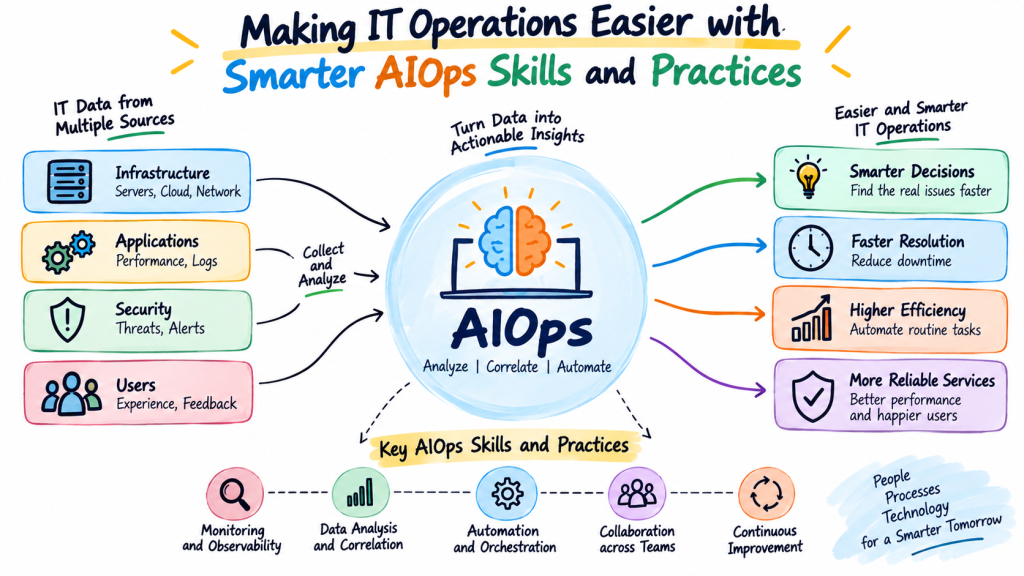
AIOps gives teams a smarter way to handle this large flow of information. It brings together artificial intelligence, machine learning, data analysis, observability, and automation. These technologies help teams spot unusual activity, connect related events, find possible causes, and respond to incidents.
TheAIOps.com focuses on making these ideas easier to understand. Its resources cover learning, tools, implementation, consulting, and career skills for people who want to understand modern IT operations.
Why Modern IT Teams Need Smarter Operations
A small IT environment may create only a few alerts. However, a large environment can create thousands of events from different systems. Engineers then need to decide which alerts matter and which ones they can safely ignore.
AIOps can help by looking at several signals together. For instance, an application may slow down while database usage rises and server memory reaches a high level. Instead of treating each alert as a separate issue, an AIOps system can connect the events.
This approach gives teams more context. It can also reduce repeated manual checks and help engineers spend more time solving important problems.
Artificial Intelligence for IT Operations Made Simple
Artificial Intelligence for IT Operations uses intelligent software to study information from IT environments. The system can examine large amounts of data and search for patterns that people may miss.
Think about a school teacher checking hundreds of test answers. The teacher could inspect every answer one at a time, but a smart system could quickly point out common mistakes. AIOps works in a similar way with IT data.
It can examine logs, metrics, events, traces, and alerts. Then, it can highlight unusual behavior or connect events that may share the same cause.
Still, people remain important. Engineers decide which actions make sense, check automated results, and handle situations that need human judgment.
Learning AIOps Through Practical Training
A strong learning path can make AIOps much easier for beginners. AIOps Training can introduce the basic ideas first and then move toward real operational tasks.
Students can start with monitoring and observability. After that, they can learn anomaly detection, event correlation, root-cause analysis, incident management, predictive analytics, and automation.
Hands-on practice makes these topics easier to remember. For example, learners can study a normal system pattern and then compare it with unusual behavior.
A useful training plan can include:
- IT operations fundamentals
- Monitoring and observability
- Logs, metrics, and traces
- Event correlation
- Anomaly detection
- Root-cause analysis
- Incident management
- Automation and remediation
This step-by-step learning path can help beginners build confidence without trying to understand everything at once.
Building Proof of Knowledge with AIOps Certification
An AIOps Certification can give professionals a formal way to show their knowledge. However, learners should look beyond the certificate itself.
A useful certification program should test more than simple definitions. It should help learners understand how AIOps systems work and how teams use them during real IT problems.
Before selecting a program, learners can check whether it covers monitoring, observability, data analysis, event correlation, anomaly detection, automation, and practical use cases.
Projects can add even more value. For example, a learner could build a small monitoring setup, study alerts, identify a pattern, and explain how an automated response could help.
That combination creates a stronger learning experience than memorizing terms alone.
Finding a Clear Path Through an AIOps Course
An AIOps Course can organize learning into connected lessons. Beginners can follow a clear path instead of searching for separate explanations across many places.
A good course can begin with AIOps basics. Then, it can explain architecture, data sources, observability, machine learning concepts, event correlation, anomaly detection, and automation.
Practical examples should appear throughout the learning process. For example, a course may show how several alerts can point toward one application problem.
Students can also learn about common implementation challenges. These challenges may include poor data quality, too many alerts, missing integrations, unclear ownership, and unsafe automation.
TheAIOps.com brings together learning resources that can help readers explore these subjects in a simple and practical way.
Choosing AIOps Tools for Real IT Problems
Every organization has different needs. Therefore, teams should not choose AIOps Tools simply because a tool has many features.
One company may need better observability. Another may want to reduce alert noise. A third may want to connect incident management with automation.
Teams can compare tools using simple questions:
- What data can the tool collect?
- Which systems can it connect?
- Can it detect unusual behavior?
- Can it group related events?
- Does it support automation?
- Can engineers understand its results?
- Does it fit the existing IT environment?
- Can the team manage it easily?
A simple tool that solves a clear problem may provide more value than a complex tool that the team rarely uses.
Seeing the Bigger Picture with an AIOps Platform
An AIOps Platform can bring data and operational capabilities into one working environment. It can collect information from applications, servers, networks, cloud services, databases, and monitoring systems.
The platform can then study this information. For example, it may notice that several alerts appear at the same time and connect them with one service problem.
Teams can use these capabilities to understand incidents more clearly. Some platforms can also support predictive analysis and automated actions.
| Capability | What it helps teams do |
|---|---|
| Data collection | Gather information from many systems |
| Event correlation | Connect related events |
| Anomaly detection | Spot unusual behavior |
| Root-cause analysis | Find possible causes |
| Predictive analytics | Identify possible future problems |
| Automation | Run selected actions |
| Incident management | Organize and respond to issues |
Teams should still review results and create clear controls before they allow automated actions to affect important systems.
Starting AIOps Implementation Without Making Things Complicated
Successful AIOps Implementation does not require a company to change its entire IT environment in one move. Teams can begin with one clear problem.
Suppose an application creates too many alerts. The team can first study those alerts and find repeated patterns. Next, it can connect related events and identify the alerts that usually belong together.
After testing the process, the team can automate a small and safe task. For example, it might restart a service after specific conditions occur and record the action for review.
A simple implementation path can include:
- Pick one important problem.
- Understand the current process.
- Collect useful operational data.
- Check data quality.
- Connect relevant systems.
- Test event correlation.
- Add limited automation.
- Measure the results.
- Expand only after successful testing.
This approach helps teams learn from small projects before they make larger changes.
Where AIOps Consulting Can Add Value
Some organizations know that they have operational problems but do not know where to start. AIOps Consulting can help them examine their current environment and identify practical opportunities.
Consultants can review monitoring systems, data sources, workflows, incident processes, integrations, and automation plans. They can then help create a roadmap based on the organization’s needs.
For example, a company may discover that several teams use different monitoring systems. A consulting team can help map those systems and identify useful ways to connect their data.
Good consulting should answer practical questions. What problem should the team solve first? What data does it need? Which tasks can it automate safely? How should the team measure progress?
Using AIOps Services for Different Operational Needs
Organizations may need different types of AIOps Services. Some teams need planning support. Others need help with technology integration, monitoring, automation, analytics, or operational workflows.
A service provider may help assess the existing environment and identify areas that need improvement. It may also help teams connect different systems and create operational workflows.
However, teams should define their goals before starting. A goal such as “reduce repeated alerts” gives a project a clearer direction than “use AIOps everywhere.”
Organizations can review these areas before selecting services:
- Current operational challenges
- Monitoring and observability setup
- Data sources
- Integration requirements
- Security controls
- Automation needs
- Internal team skills
- Measurement plans
Clear goals help teams use services in a focused way.
Preparing for an AIOps Engineer Career
People who want to become an AIOps Engineer need more than knowledge of one software product. The role connects several technical areas.
An engineer may work with cloud systems, Linux, monitoring, observability, automation, data pipelines, incident management, and troubleshooting.
A learner can build skills in stages. First, learn basic infrastructure and IT operations. Next, explore cloud platforms and monitoring. Then, study automation, data analysis, and AIOps concepts.
| Skill | Practical use |
|---|---|
| Linux | Understand servers and systems |
| Networking | Understand system communication |
| Cloud | Work with modern infrastructure |
| Monitoring | Track system health |
| Observability | Understand system behavior |
| Automation | Reduce repeated manual tasks |
| Data analysis | Find useful operational patterns |
| Troubleshooting | Solve technical problems |
Small projects can also help learners understand how these skills work together.
A Real-World Example of AIOps in Action
Imagine an online shopping company during a busy sales period. Its application receives heavy traffic, while the database handles many requests.
The monitoring system starts producing several alerts. One alert shows high server usage. Another shows database pressure. A third shows slow application responses.
An engineer could inspect each alert separately. Instead, an AIOps system can examine the events together and identify a possible connection.
The team can then investigate the main issue instead of spending time on every alert individually. If the team confirms a safe response, it can automate part of the process.
This example shows how context can make IT operations easier to manage.
Lessons from Practical Experience and Case Studies
Real projects often reveal problems that simple theory cannot explain. A team may start an AIOps project expecting automation to solve everything, but poor data can quickly create problems.
For example, duplicate alerts can confuse event correlation. Missing logs can make root-cause analysis harder. Weak integrations can leave important systems outside the AIOps view.
These lessons point to an important idea: AIOps success starts with good operational foundations.
Teams should improve monitoring, data quality, ownership, and incident processes before they add complex automation.
Case studies can also help learners understand how organizations approach these challenges and what measurements they use to track progress.
Measuring AIOps with Useful Data
Numbers can help teams understand whether an AIOps project actually helps. However, teams should measure their own environment instead of relying only on broad industry claims.
Useful measurements include:
- Alert volume
- Repeated incidents
- Time to detect problems
- Time to resolve incidents
- Manual work
- Automation success rate
- Service availability
- False alerts
For example, a team can record its alert volume before and after an event-correlation project. It can also track how long engineers spend investigating similar incidents.
Industry research and statistics can provide useful context, but teams should check the source, sample size, definitions, and measurement method before applying any number to their own environment.
Comparing Traditional Monitoring and AIOps
Traditional monitoring still plays an important role in IT operations. It often uses rules and thresholds to tell teams when something crosses a limit.
AIOps adds another layer of analysis. It can study several signals, recognize patterns, connect related events, and support automated responses.
| Area | Traditional monitoring | AIOps approach |
|---|---|---|
| Main focus | Known conditions | Patterns and wider context |
| Alerts | Rules and thresholds | Rules plus intelligent analysis |
| Data | Selected monitoring data | Multiple operational sources |
| Correlation | Often limited | Connects related events |
| Analysis | Often needs manual work | Can support automated analysis |
| Automation | May require separate tools | Can connect with automation |
The choice depends on the team’s needs. AIOps can complement existing monitoring instead of forcing teams to replace everything.
A Simple Method for Better AIOps Decisions
Teams can use a simple Learn, Connect, Check, Automate, Measure method.
First, Learn how the current environment works. Next, Connect the data that can help explain problems. Then, Check the results carefully.
After that, teams can Automate safe and repeatable actions. Finally, they should Measure the outcome.
This method keeps the process practical. It also gives people a chance to review each stage before moving forward.
Experts can add useful insight through interviews, workshops, and real project discussions. Their experience can help teams spot common mistakes, but teams should still match recommendations to their own environment.
AIOps Content for Modern Search and Learning
Clear technical content should help both people and modern search systems understand a subject.
AEO, or Answer Engine Optimization, helps content answer questions directly. GEO, or Generative Engine Optimization, focuses on making information clear and useful for generative search experiences.
LLMO, or Large Language Model Optimization, encourages strong structure, useful context, and clear explanations. AISEO, or AI Search Optimization, supports content discovery across newer search experiences.
At the same time, E-E-A-T focuses on experience, expertise, authoritativeness, and trust. AIOps content can support these principles through real examples, practical explanations, clear comparisons, case studies, and trustworthy research.
Frequently Asked Questions About AIOps
What does AIOps mean?
AIOps means using artificial intelligence, data, machine learning, and automation to help teams manage IT operations.
Can beginners learn AIOps?
Yes. Beginners can start with IT operations, monitoring, cloud basics, and automation before moving into advanced AIOps topics.
What can AIOps Tools do?
AIOps Tools can collect operational data, identify unusual activity, connect related events, support incident analysis, and automate selected tasks.
What does an AIOps Platform provide?
An AIOps Platform can bring together operational data and capabilities such as analytics, event correlation, anomaly detection, and automation.
Does AIOps remove the need for engineers?
No. Engineers still make decisions, investigate complex incidents, manage risks, and check automated actions.
What should an AIOps Engineer learn?
An AIOps Engineer can benefit from skills in Linux, cloud, networking, monitoring, observability, automation, data analysis, and troubleshooting.
Why should teams start AIOps Implementation with one use case?
A small project lets teams test their data, processes, integrations, and automation before they expand the work.
Can AIOps Consulting help with planning?
Yes. Consulting can help organizations assess their environment, identify useful opportunities, and create an implementation roadmap.
What should an AIOps Course include?
A useful course can cover fundamentals, architecture, monitoring, observability, data, anomaly detection, event correlation, automation, and practical use cases.
How can AIOps Certification support a career?
A certification can demonstrate knowledge of AIOps concepts, while projects and hands-on practice can help demonstrate practical ability.
Final Thought
Better IT operations do not come from technology alone. Teams need good data, clear processes, skilled people, careful testing, and measurable goals.
AIOps can help organizations handle complex IT environments by connecting operational information and supporting smarter decisions. At the same time, professionals can build their skills through AIOps Training, AIOps Certification, and a practical AIOps Course.
Organizations can explore AIOps Tools, an AIOps Platform, AIOps Consulting, AIOps Services, and careful AIOps Implementation according to their needs.
For anyone preparing for an AIOps Engineer role, the best starting point remains simple: learn the basics, practice with real examples, solve small problems, and grow your skills one step at a time.
