
Introduction
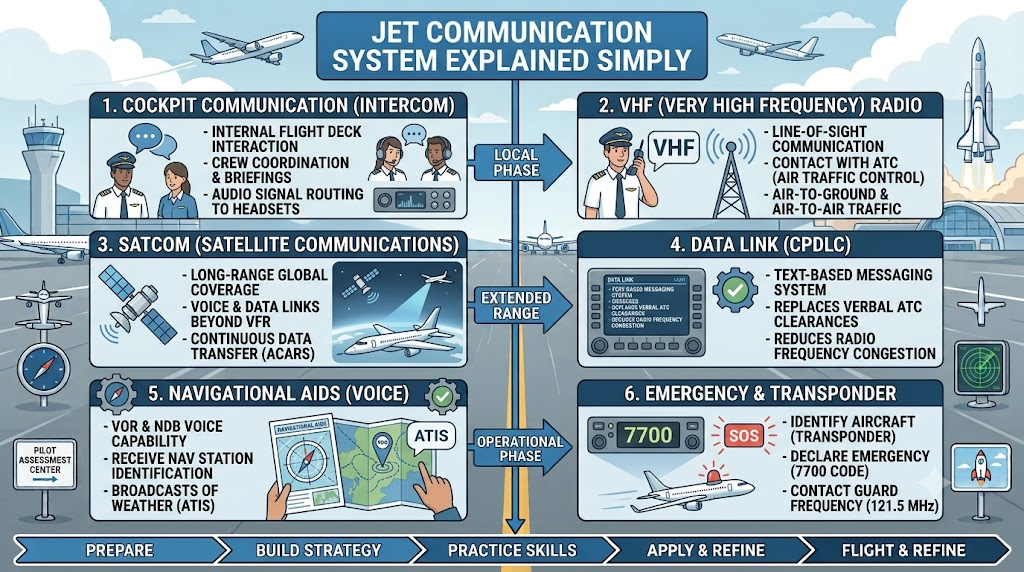
Communication is one of the most important parts of modern aviation because pilots need to exchange clear information with air traffic controllers, other crew members, and ground personnel. Jet aircraft use a combination of radio, audio, intercom, and other communication technologies to support these interactions. Although the equipment can be technically complex, its basic purpose is straightforward: to help the right people communicate at the right time. This article explains how jet communication systems work and why they matter in aviation.
Main Content
What Is a Jet Communication System?
A jet communication system is a collection of equipment that allows people on board an aircraft to communicate with people inside and outside the aircraft.
In a typical flight environment, communication may take place between pilots and air traffic controllers, between flight crew members, and between the cockpit and ground personnel.
The system can include several interconnected components, including radios, antennas, microphones, headsets, speakers, audio control equipment, and intercom systems.
The exact equipment depends on the aircraft model and its configuration. A modern commercial jet may have several communication capabilities rather than relying on one single system.
The basic purpose remains the same: to transmit and receive clear information reliably.
Why Communication Is Important in Aviation
Aviation involves coordination between many people and organizations. Pilots must communicate with appropriate air traffic services and ground personnel while also maintaining communication within the flight crew.
Communication can be important during almost every phase of a flight.
During pre-flight preparation, pilots may need to coordinate with ground personnel and obtain relevant operational information. During taxiing, communication helps coordinate aircraft movement. During departure and cruise, pilots communicate with the appropriate air traffic control services. During arrival, communication continues as the aircraft approaches, lands, and moves toward its parking position.
Clear communication helps support:
- Situational awareness.
- Coordination.
- Understanding of instructions.
- Exchange of important information.
- Efficient aircraft movement.
- Safe flight operations.
For this reason, aviation communication is designed around clarity, consistency, and standardized procedures.
Basic Parts of an Aircraft Communication System
Radio Transceiver
A radio transceiver is equipment capable of both transmitting and receiving radio signals.
The word “transceiver” combines the functions of a transmitter and receiver.
In aviation, radio equipment allows pilots to communicate with appropriate stations using the communication systems installed on the aircraft.
Antenna
An antenna allows the aircraft’s communication system to transmit and receive radio signals.
Different communication systems may use different antenna arrangements depending on the aircraft design and equipment.
The antenna is therefore an essential part of the communication chain.
Microphone
A microphone captures the pilot’s voice.
When a pilot speaks, the microphone converts the sound into an electrical signal that can be processed and transmitted by the communication equipment.
Microphone quality and proper operation are important because aviation communication needs to remain understandable, particularly when several people are communicating in a busy environment.
Headset and Speakers
Headsets allow pilots to hear incoming radio communication and other audio information.
Aircraft may also use speakers as part of their audio systems.
Headsets can be especially useful in the cockpit because they allow crew members to hear communication clearly while managing other cockpit sounds.
Audio Control Panel
An audio control system allows pilots to manage different audio sources and communication channels.
The exact design differs between aircraft, but the basic purpose is to help the crew select and control the communication sources they need to monitor or use.
Intercom System
An intercom system is primarily used for communication within the aircraft.
For example, flight crew members may use the intercom to communicate with each other.
This is different from external radio communication, which is used to communicate with people or stations outside the aircraft.
How Radio Communication Works
The basic process of aircraft radio communication is easier to understand than it may initially appear.
When a pilot wants to transmit a message, the pilot speaks into a microphone. The microphone converts the sound into an electrical signal.
The communication equipment processes the signal and uses a transmitter to send it through the aircraft’s antenna.
The receiving station detects the transmitted signal and converts it back into audio that can be heard by the recipient.
The process works in the opposite direction when the aircraft receives a message.
In simple terms:
Voice → Microphone → Communication Equipment → Antenna → Radio Signal → Receiving Station
The receiving side reverses this basic process so that the radio signal becomes understandable audio.
This basic principle is used across many aviation radio communication systems, although the technology involved can be much more sophisticated in modern aircraft.
VHF Communication
Very High Frequency, commonly called VHF, is widely associated with aviation voice communication.
VHF communication is particularly useful where line-of-sight conditions are available.
The term “line of sight” means that communication is influenced by the physical path between the transmitting and receiving antennas. The Earth’s curvature and terrain can therefore affect how far a VHF signal can effectively travel.
VHF communication is commonly used for communication between aircraft and air traffic services during many phases of flight.
Students learning aviation should understand the basic concept rather than focusing only on technical terminology.
HF Communication
High Frequency, or HF, communication can provide longer-distance communication capabilities than conventional VHF in suitable conditions.
HF radio propagation can interact with the Earth’s ionosphere, allowing signals to travel over much greater distances.
This makes HF useful in certain areas where conventional terrestrial communication coverage may be limited.
However, HF communication can be affected by atmospheric and propagation conditions.
This illustrates an important principle in aviation communication: different technologies have different strengths and limitations.
Satellite Communication
Modern aviation can also use satellite-based communication systems.
Satellite communication can provide connectivity over areas where traditional terrestrial radio systems may have limitations.
Depending on the aircraft and its equipment, satellite-based systems can support various communication functions.
Not every aircraft has exactly the same satellite communication capabilities. Equipment depends on aircraft design, operator requirements, route, and installed systems.
Satellite communication is therefore best understood as another communication option within the broader aviation communication environment.
Aircraft Intercom System
External radio communication and internal intercom communication serve different purposes.
An intercom allows people inside the aircraft to communicate with one another.
In the cockpit, this can help flight crew members exchange information without using an external radio channel.
Intercom communication can also be relevant during ground operations and other situations where internal coordination is necessary.
The intercom therefore complements radio communication rather than replacing it.
Audio Control System
An aircraft’s audio control system helps pilots manage different communication and audio sources.
A pilot may need to listen to more than one type of communication or select a particular source for transmission.
The audio control system provides a way to organize these sources.
The exact controls and layout vary significantly between aircraft, so pilots must become familiar with the specific equipment installed in the aircraft they operate.
Communication During Different Flight Phases
Before Departure
Before an aircraft begins moving, the flight crew may need to communicate with relevant ground personnel and aviation services.
This communication can involve operational coordination and other information required before departure.
Taxi
During taxiing, pilots may communicate with the appropriate ground or airport control service.
Clear communication is important because airports can have complex movement areas with aircraft, vehicles, and personnel operating simultaneously.
Takeoff
During departure, communication may involve the appropriate air traffic control service.
Pilots receive and acknowledge relevant instructions while managing the aircraft’s departure.
Cruise
During cruise, pilots generally communicate with the appropriate en-route air traffic services for the airspace through which they are flying.
Communication requirements can vary depending on the route and airspace.
Descent and Approach
As the aircraft approaches its destination, communication continues with the relevant controlling services.
Pilots may receive information and instructions related to the arrival and approach.
Landing and Taxi-In
Communication continues after landing while the aircraft moves through the airport environment.
The flight crew may communicate with ground services or other relevant airport personnel as required.
The exact communication procedures depend on the airport, airspace, aircraft operation, and applicable aviation regulations.
Practical Explanation: How a Pilot Uses the Communication System
Imagine a jet preparing to depart from an airport.
The pilots first ensure that their communication equipment is configured appropriately for the operation. They communicate with the relevant ground service and receive information or instructions.
As the aircraft moves through the airport, the crew may communicate with different controlling services.
After departure, the aircraft may transition to another air traffic control frequency or service as required.
During the flight, the pilots continue monitoring and communicating through the appropriate systems.
As the aircraft approaches its destination, the communication process changes again as responsibility transitions between relevant services.
Throughout the flight, pilots are expected to communicate clearly and efficiently.
Aviation Phraseology
Aviation communication is different from ordinary conversation.
Pilots and controllers generally use standardized phraseology and established communication procedures to reduce ambiguity.
Important concepts include:
- Callsigns.
- Clearances.
- Instructions.
- Readbacks.
- Standard terminology.
A callsign helps identify the aircraft or station involved in a communication.
A readback allows a pilot to repeat relevant instructions or information to confirm understanding.
Standardized communication is particularly valuable in busy aviation environments because it reduces the chance of confusion.
Communication Components and Their Functions
| Component | Basic Function | Why It Matters |
|---|---|---|
| Microphone | Captures the pilot’s voice | Allows spoken messages to be transmitted |
| Headset | Allows the pilot to hear audio | Helps maintain clear communication |
| Radio transceiver | Transmits and receives radio signals | Provides external radio communication |
| Antenna | Sends and receives radio signals | Connects the aircraft equipment with the radio environment |
| Audio control panel | Manages communication and audio sources | Helps pilots control different audio channels |
| Intercom system | Supports internal communication | Allows crew members to communicate inside the aircraft |
Common Problems in Jet Communication Systems
Even well-designed communication systems can experience technical or operational difficulties.
Poor Audio Quality
Static, noise, or unclear audio can make messages difficult to understand.
Clear audio is particularly important when communication is taking place in a busy environment.
Radio Interference
Unwanted signals can sometimes interfere with communication.
Interference can make a transmission difficult to hear or understand.
Incorrect Frequency Selection
A communication system is only useful when it is configured for the appropriate communication channel.
Selecting an incorrect frequency can prevent the crew from communicating with the intended station.
Microphone Problems
A faulty or poorly functioning microphone can affect the quality of transmitted speech.
Because the microphone is the first stage in converting a person’s voice into a communication signal, problems at this stage can affect the entire transmission.
Headset or Speaker Issues
If a headset or speaker is not working correctly, pilots may have difficulty hearing incoming communication.
This can make otherwise normal radio transmissions difficult to understand.
Antenna or Equipment Problems
Problems involving antennas or communication equipment can affect transmission and reception.
Technical issues should be addressed according to approved aircraft maintenance and operating procedures by appropriately qualified personnel.
Comparing Common Aircraft Communication Methods
| Communication Method | General Purpose | Typical Advantage |
|---|---|---|
| VHF | Aircraft and ground or air traffic communication | Widely useful for line-of-sight aviation communication |
| HF | Longer-distance radio communication | Can support communication where conventional VHF coverage is limited |
| Satellite communication | Communication through satellite networks | Can provide connectivity over remote areas |
| Aircraft intercom | Communication within the aircraft | Supports coordination between crew members |
Important Considerations
Jet communication systems can appear complicated because they combine several technologies into one aircraft environment. However, the basic concept is straightforward: communication equipment allows pilots to send and receive information using appropriate systems.
One important point is that not every jet has identical communication equipment.
Aircraft models, operators, routes, and configurations can differ. A communication system installed on one aircraft may not have exactly the same capabilities or controls as the system installed on another.
Communication procedures can also vary depending on the airport, airspace, flight operation, and applicable regulations.
Another important consideration is the use of standardized aviation phraseology. Pilots should communicate clearly and avoid unnecessary or ambiguous language. This becomes particularly important when workload is high or when several aircraft are communicating within the same environment.
Communication systems also require appropriate inspection, maintenance, and operational procedures. If a technical problem occurs, pilots and maintenance personnel must follow the procedures applicable to that aircraft and operation.
It is also important to remember that communication is only one part of aviation safety and coordination. Pilots use communication together with navigation, surveillance, weather information, aircraft instruments, procedures, and professional judgment.
Frequently Asked Questions
1. What is a jet communication system?
A jet communication system is a collection of equipment that allows aircraft crew members to communicate with air traffic services, ground personnel, and other people while also communicating internally within the aircraft.
2. Why is communication important in aviation?
Communication allows pilots and other aviation personnel to exchange important information, instructions, clearances, and operational updates. Clear communication supports coordination and situational awareness.
3. What is VHF communication?
VHF stands for Very High Frequency. VHF radio is widely used for aviation voice communication, particularly where line-of-sight conditions are available.
4. What is HF communication?
HF stands for High Frequency. HF radio can support longer-distance communication and may be useful in areas where conventional VHF coverage is limited.
5. Do all jets use the same communication systems?
No. Communication equipment can vary depending on the aircraft model, configuration, operator, route, and operational requirements.
6. What is an aircraft intercom system?
An intercom system allows people within the aircraft, particularly flight crew members, to communicate with each other without using an external radio communication channel.
7. What does an aircraft antenna do?
An antenna allows communication equipment to transmit and receive radio signals. Different communication systems may use different antenna arrangements.
8. How do pilots communicate with air traffic control?
Pilots use the communication equipment installed in the aircraft to transmit and receive radio messages with the appropriate air traffic services. The specific procedures depend on the operating environment.
9. What happens if aircraft communication equipment has a problem?
The response depends on the nature of the problem and the applicable aircraft and operational procedures. Pilots follow approved procedures for communication equipment issues, while maintenance matters are handled according to appropriate technical requirements.
10. Why is standardized aviation phraseology important?
Standardized phraseology helps pilots and controllers communicate clearly and consistently. It reduces ambiguity and makes important messages easier to understand, especially in busy aviation environments.
Conclusion
Jet communication systems are an essential part of modern aircraft operations. Although the equipment can involve sophisticated technology, its fundamental purpose is simple: to allow pilots and other aviation personnel to exchange information clearly and reliably.
VHF and HF radios, satellite communication, antennas, microphones, headsets, audio control systems, and intercoms can all play different roles within an aircraft’s communication environment. The exact combination depends on the aircraft and its operation.
For aviation students and beginners, understanding the basic function of each component is a useful starting point. More importantly, communication should be viewed as part of a larger aviation system that includes navigation, surveillance, weather information, procedures, and professional coordination.
Clear communication is not simply about speaking and listening. It is about using the appropriate system, understanding standardized terminology, confirming important information, and following the procedures applicable to the flight.
