
Introduction
Modern jet aircraft rely on sophisticated cockpit systems to help pilots monitor flight information, navigation, engines, and aircraft systems. One of the most significant developments in aviation technology is the introduction of the glass cockpit.
Traditional aircraft cockpits used numerous individual mechanical instruments and gauges. Modern glass cockpits, in contrast, use electronic displays to organize important information in a more integrated format. This allows pilots to monitor several aspects of the aircraft from a smaller number of displays.
For pilots, however, operating a glass cockpit is not simply about learning to read digital screens. They also need to understand how different displays work together, how flight-management systems interact with cockpit information, and how to respond when a display or system does not operate normally.
This Glass Cockpit Guide for Jet Aircraft explains the major components of modern glass cockpits, how they present information, their advantages and limitations, and why proper training is essential for pilots transitioning to advanced jet aircraft.
What Is a Glass Cockpit?
A glass cockpit is an aircraft flight deck that uses electronic displays to present information that was traditionally shown through separate analog instruments.
The term “glass” refers to the electronic display screens used in the cockpit. These displays can present different types of information depending on the aircraft, avionics configuration, and selected display mode.
A modern glass cockpit may provide information related to:
- Aircraft attitude
- Airspeed
- Altitude
- Heading
- Vertical speed
- Navigation
- Flight management
- Engine performance
- Aircraft systems
- Warnings and cautions
The exact arrangement and functionality can vary significantly between aircraft manufacturers and models.
Why Are Glass Cockpits Used in Jet Aircraft?
Modern jet aircraft operate in complex environments where pilots need to monitor a large amount of information. Glass cockpit systems help organize this information and make it available through integrated electronic displays.
One of the main benefits is information integration. Instead of requiring pilots to scan numerous individual instruments, several important parameters can be presented together.
Glass cockpits can also support situational awareness by combining flight, navigation, and aircraft system information.
Other reasons for using glass cockpit technology include:
- Clear presentation of flight information
- Integration of navigation data
- Improved aircraft system monitoring
- Support for flight automation
- Flexible information presentation
- Reduced dependence on individual mechanical instruments
These systems are designed to support pilots rather than replace their judgment and decision-making.
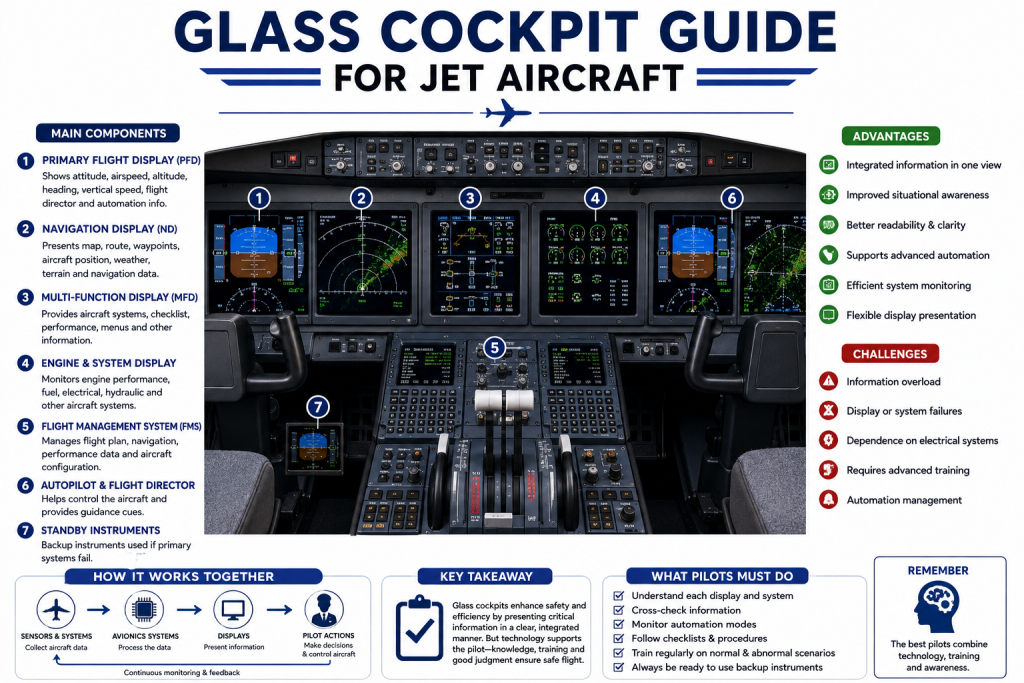
Main Components of a Jet Aircraft Glass Cockpit
The exact cockpit configuration depends on the aircraft type, but several components are commonly associated with modern glass cockpits.
Primary Flight Display
The Primary Flight Display (PFD) is one of the most important electronic displays in a modern aircraft cockpit.
It normally presents essential flight information such as:
- Airspeed
- Altitude
- Aircraft attitude
- Heading
- Vertical speed
- Flight director guidance
- Selected flight parameters
- Automation mode information
The PFD allows pilots to monitor the aircraft’s fundamental flight condition without having to look at multiple separate mechanical instruments.
Navigation Display
The Navigation Display (ND) provides navigation-related information to the flight crew.
Depending on the aircraft and its installed avionics, it may show:
- Planned route
- Waypoints
- Aircraft position
- Heading
- Track
- Navigation information
- Weather information
- Terrain information
The precise information available on the display depends on the aircraft’s equipment and configuration.
Multi-Function Display
A Multi-Function Display (MFD) can provide different types of information through selectable pages or modes.
Depending on the aircraft, an MFD may be used to access navigation information, aircraft systems, performance data, checklists, or other functions.
MFD functions are not standardized across every aircraft, so pilots must learn the specific system installed in the aircraft they operate.
Engine Indication and Crew Alerting System
Some jet aircraft use an Engine Indication and Crew Alerting System (EICAS).
EICAS can present engine parameters and information about various aircraft systems. It can also provide messages that alert pilots to abnormal conditions.
The system helps organize engine and aircraft information so that the crew can monitor important conditions during flight.
Electronic Centralized Aircraft Monitor
Some aircraft use an Electronic Centralized Aircraft Monitor (ECAM) for system monitoring and crew information.
ECAM can display engine information, aircraft system status, warnings, cautions, and other relevant information.
Although ECAM and EICAS perform similar broad functions, they are not identical. Their design and operation depend on the aircraft manufacturer and model.
Flight Management System
The Flight Management System (FMS) is another important part of many modern jet aircraft.
An FMS can assist with:
- Flight route management
- Navigation
- Performance information
- Waypoint management
- Flight planning
- Navigation database functions
The FMS can work with other aircraft systems to provide navigation and flight-management information to the crew.
Because FMS interfaces and capabilities vary between aircraft, pilots require aircraft-specific training to use them correctly.
Autopilot and Flight Director
Modern jet aircraft often use automation systems such as the autopilot and flight director.
A flight director provides guidance cues to help the pilot follow selected flight targets. An autopilot can control certain aspects of the aircraft when it is appropriately engaged.
Pilots must understand which automation modes are active, which modes are armed, and what the aircraft is expected to do. Effective automation management is an important part of modern jet operations.
Standby Flight Instruments
Modern aircraft also have backup or standby instrumentation designed to provide essential flight information if the primary display system becomes unavailable.
The specific standby instruments and backup arrangements depend on the aircraft design.
Understanding these backup systems is an important part of aircraft-specific training.
How the Primary Flight Display Works
The PFD provides pilots with a consolidated view of the aircraft’s basic flight condition.
The display normally provides an indication of aircraft attitude, allowing pilots to understand the aircraft’s relationship with the horizon.
Other sections provide airspeed and altitude information. Depending on the aircraft, heading, vertical speed, flight director guidance, and automation information may also be displayed.
Pilots must learn more than the location of individual symbols and numbers. They need to understand what the information means and develop an effective instrument-scanning technique.
Understanding the Navigation Display
The Navigation Display gives pilots a broader picture of the aircraft’s navigation situation.
It can show the planned route, aircraft position, waypoints, heading, and track. Depending on the aircraft’s equipment, it may also provide weather or terrain-related information.
The navigation display can help pilots compare the aircraft’s current position with the intended route.
However, pilots must understand the source and limitations of displayed information. They should not assume that every aircraft provides identical navigation functions.
Glass Cockpit and Flight Management Systems
The glass cockpit and Flight Management System work together to present navigation and flight-management information.
A route can be managed through the FMS, while relevant navigation information may then appear on the aircraft’s navigation display. Selected flight information can also be presented through other cockpit displays.
An FMS can contain extensive navigation and performance information, but pilots remain responsible for understanding the information entered into the system and verifying that it is appropriate.
This is why FMS training is an important part of advanced pilot training.
Engine and Aircraft System Monitoring
Modern jet aircraft contain numerous systems that require continuous monitoring.
Glass cockpit displays can help pilots monitor areas such as:
- Engine speed
- Engine temperature
- Fuel quantity
- Hydraulic systems
- Electrical systems
- Pressurization
- Flight control systems
- Other aircraft parameters
When an abnormal condition occurs, the aircraft’s monitoring system may provide a warning, caution, or other message.
These alerts are designed to support the flight crew. Pilots must still interpret the information correctly and follow the appropriate aircraft procedures and checklists.
How Glass Cockpits Improve Situational Awareness
A major advantage of glass cockpits is their ability to organize different types of information in one integrated environment.
For example, pilots can use the PFD to monitor attitude, airspeed, altitude, and other flight parameters while using the navigation display to monitor position and route information.
Separate system displays can provide information about engines and aircraft equipment.
This integration can help pilots develop a clearer understanding of the aircraft’s overall condition.
However, pilots should avoid becoming overloaded with information. Good cockpit management requires knowing which information is most relevant at each stage of flight.
Advantages of Glass Cockpits
1. Integrated Information
Multiple types of flight and aircraft information can be presented through a smaller number of electronic displays.
2. Improved Readability
Electronic displays can organize information in a clear and structured format.
3. Better Situational Awareness
Flight, navigation, and system information can be available within an integrated cockpit environment.
4. Support for Automation
Glass cockpit systems work closely with modern flight-management and automation systems.
5. Flexible Information Presentation
Electronic displays can provide different information pages and display modes depending on the aircraft’s design.
6. Advanced System Monitoring
Modern aircraft can monitor numerous systems and provide relevant information to the flight crew.
Limitations and Challenges of Glass Cockpits
Despite their advantages, glass cockpit systems also introduce certain challenges.
Information Overload
Modern displays can provide a large amount of information. Pilots must learn to identify the information that matters most instead of trying to monitor everything at once.
Display Failures
Electronic displays and associated avionics can experience failures. Pilots therefore need to understand backup systems and applicable abnormal procedures.
Dependence on Electrical Systems
Electronic cockpit displays depend on aircraft electrical and avionics systems. Aircraft are designed with backup arrangements, but pilots must still understand how their specific systems respond to failures.
Automation Management
Modern aircraft can perform many tasks automatically. Pilots need to understand automation modes and verify that the aircraft is responding as expected.
Training Requirements
A cockpit with fewer visible instruments does not necessarily mean a simpler aircraft. Modern avionics can be highly sophisticated and require dedicated training.
Human Factors
Pilots need to maintain effective instrument-scanning habits and avoid excessive dependence on automation or a single source of information.
Glass Cockpit Training for Student Pilots
Pilots who intend to progress toward modern jet aircraft should become familiar with electronic flight displays and integrated avionics.
Training should focus on understanding how the systems work rather than simply memorizing display layouts.
Important training areas include:
- Reading primary flight information
- Understanding navigation displays
- Learning automation modes
- Understanding flight-management systems
- Developing effective instrument-scanning habits
- Recognizing abnormal indications
- Understanding backup instruments
- Following aircraft-specific procedures
- Practicing system failures in an appropriate simulator
Simulator training can be particularly useful because it allows pilots to practice normal and abnormal situations in a controlled environment.
It is also important to remember that cockpit layouts and avionics systems differ between aircraft. Experience with one glass cockpit does not automatically qualify a pilot to operate another aircraft type.
Glass Cockpit vs Traditional Cockpit
| Feature | Traditional Cockpit | Glass Cockpit |
|---|---|---|
| Main display method | Individual analog instruments | Electronic displays |
| Information integration | More limited | Highly integrated |
| Navigation presentation | Separate instruments and displays | Integrated navigation displays |
| System monitoring | Multiple gauges and indicators | Electronic system pages and alerts |
| Automation integration | More limited in older aircraft | Extensive in modern aircraft |
| Training requirements | Instrument interpretation | Instruments, avionics, and automation |
| Display flexibility | Limited | Multiple selectable formats |
The comparison does not mean that traditional cockpits are inherently unsafe or that glass cockpits eliminate every cockpit challenge. Each design reflects the technology and requirements of its aircraft generation.
Important Safety Considerations
Glass cockpit technology is designed to support pilots, but it does not replace pilot judgment, training, checklists, or standard operating procedures.
Pilots must understand the information presented on their displays and recognize when information may be incomplete, unreliable, or unavailable.
Cross-checking information remains important. Pilots should not assume that an automated system is always correct simply because information appears on an advanced electronic display.
Aircraft-specific training is essential because cockpit layouts, alerting systems, automation behavior, display functions, and operating procedures can differ considerably between aircraft.
Frequently Asked Questions
1. What is a glass cockpit in a jet aircraft?
A glass cockpit is a flight deck that uses electronic displays to present flight, navigation, engine, and aircraft system information instead of relying mainly on traditional individual analog gauges.
2. What information is shown on a Primary Flight Display?
A PFD commonly displays airspeed, altitude, aircraft attitude, heading, vertical speed, and flight guidance information. The exact presentation varies depending on the aircraft.
3. What is the difference between a PFD and an ND?
The PFD primarily provides essential flight information such as attitude, airspeed, altitude, and heading. The ND focuses mainly on navigation information, including route, position, waypoints, and related data.
4. Do all jet aircraft use the same glass cockpit layout?
No. Glass cockpit layouts and avionics systems vary according to the aircraft manufacturer, aircraft model, generation, and installed equipment.
5. How does a glass cockpit help pilots?
A glass cockpit integrates important flight, navigation, and aircraft system information into electronic displays. This can improve information organization and support situational awareness when the systems are used correctly.
6. Can glass cockpit displays fail?
Yes. Electronic displays and related avionics can experience failures. Aircraft therefore have backup systems and procedures to help pilots manage display or system problems.
7. Do student pilots need to learn glass cockpit systems?
Student pilots planning to fly modern aircraft should become familiar with electronic flight displays, navigation systems, automation, and aircraft-specific procedures through appropriate training.
Conclusion
Glass cockpits have changed the way pilots interact with modern jet aircraft. By replacing or integrating many traditional instruments with electronic displays, they allow flight crews to access important flight, navigation, engine, and aircraft system information in a more organized way.
The Primary Flight Display, Navigation Display, Flight Management System, engine monitoring systems, and other avionics all contribute to the modern flight deck. These technologies can improve information management and support pilot situational awareness, but they also require pilots to understand automation, display indications, system limitations, and backup procedures.
For aspiring pilots, learning the fundamentals of glass cockpit technology is an important part of preparing for modern aviation. Proper aircraft-specific training, simulator practice, effective instrument scanning, and sound cockpit discipline remain essential for using these advanced systems safely and effectively.
