
Introduction
Private aviation has transformed the way executives, corporations, and high-value travelers move across the world. Among the most commonly used options in this segment are business jets and charter jets. While both provide premium air travel experiences compared to commercial airlines, they differ significantly in ownership, cost structure, flexibility, and usage patterns.
Understanding the difference between business jets and charter jets helps travelers and organizations choose the right aviation solution based on their travel frequency, budget, and operational needs. Whether it is long-term corporate mobility or on-demand travel, both options play an important role in modern aviation.
What is a Business Jet?
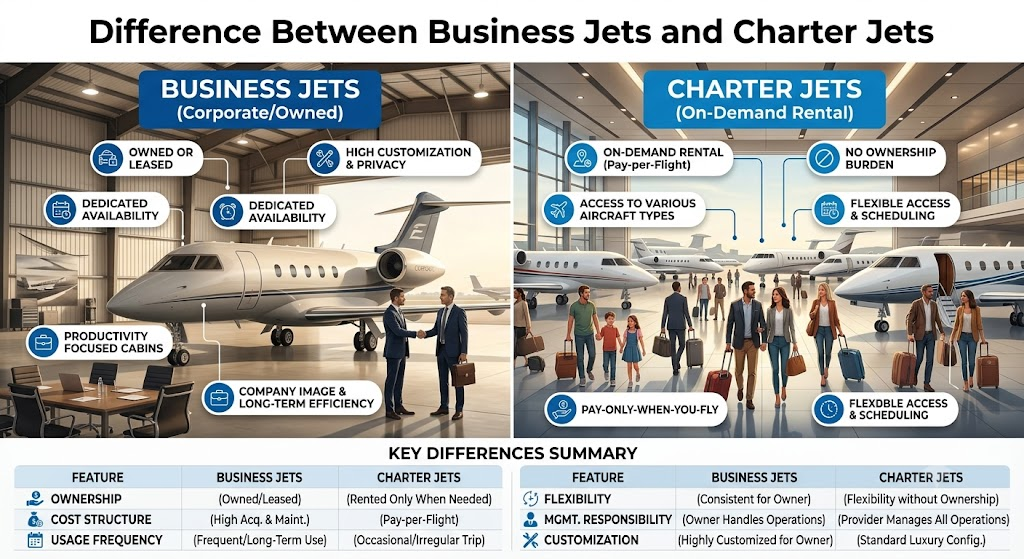
A business jet is an aircraft primarily used by companies, executives, or high-net-worth individuals for corporate and personal travel. These jets are usually owned, leased, or managed under long-term agreements.
Key Characteristics of Business Jets:
- Typically owned or leased by corporations or individuals
- Used for frequent executive and corporate travel
- Offers high levels of privacy and customization
- Designed for productivity during travel (meetings, workspaces)
- Maintained and operated for long-term use
Business jets are a strategic asset for companies that require regular, efficient, and private air transportation.
What is a Charter Jet?
A charter jet is an aircraft that can be rented on-demand for a specific trip. Instead of ownership, users pay for individual flights as needed through charter service providers.
Key Characteristics of Charter Jets:
- Available for short-term, on-demand rental
- No ownership or long-term commitment required
- Wide variety of aircraft options depending on trip needs
- Flexible booking based on destination and schedule
- Pay-per-use pricing model
Charter jets are ideal for travelers who need private aviation occasionally without the responsibility of owning an aircraft.
Key Differences Between Business Jets and Charter Jets
Although both offer private aviation experiences, their operational models are quite different.
1. Ownership Model
- Business jets are owned or leased by companies or individuals
- Charter jets are rented only when needed
2. Cost Structure
- Business jets involve high acquisition and maintenance costs
- Charter jets operate on a pay-per-flight basis
3. Usage Frequency
- Business jets are used frequently by corporate teams and executives
- Charter jets are used occasionally for specific trips
4. Flexibility
- Business jets offer consistent availability for the owner
- Charter jets offer flexibility without ownership burden
5. Management Responsibility
- Business jet owners handle maintenance, crew, and operations
- Charter service providers manage all operational aspects
6. Customization
- Business jets are often highly customized for the owner
- Charter jets offer standard luxury configurations depending on aircraft type
Advantages of Business Jets
Business jets provide strong long-term value for organizations and frequent flyers.
Dedicated Availability
Aircraft is always available for company use, reducing travel delays.
Productivity in Air
Cabins are designed for meetings, communication, and uninterrupted work.
Brand Image
Corporate jets enhance company reputation and executive presence.
Long-Term Efficiency
For frequent travel, owning or leasing can be more efficient than repeated charters.
Advantages of Charter Jets
Charter jets are popular among occasional private aviation users.
No Ownership Burden
No need to manage maintenance, crew, or operational logistics.
Flexible Access
Choose aircraft type and schedule based on each trip requirement.
Cost Control
Pay only when you fly, making it suitable for irregular travel needs.
Wide Availability
Access to different aircraft categories depending on journey length and passenger count.
Business Jet vs Charter Jet: Which One Should You Choose?
The right choice depends on travel frequency and financial priorities.
Choose Business Jets If:
- You travel frequently for business
- Your company requires dedicated aviation access
- You need consistent aircraft availability
- You prioritize branding and executive efficiency
Choose Charter Jets If:
- You travel occasionally or seasonally
- You want flexibility without ownership responsibility
- You prefer pay-per-use travel
- You need different aircraft types for different trips
FAQs: Difference Between Business Jets and Charter Jets
1. What is the main difference between a business jet and a charter jet?
A business jet is usually owned or leased by a company or individual for frequent use, while a charter jet is rented only when needed. The key difference lies in ownership and usage model. Business jets focus on long-term dedicated travel, whereas charter jets offer on-demand flexibility.
2. Are charter jets cheaper than business jets?
Yes, charter jets are generally more cost-effective for occasional travel because you only pay for the flights you use. Business jets require high purchase, maintenance, and operational costs. However, for frequent travelers, business jets can be more efficient in the long run.
3. Who typically uses business jets?
Business jets are commonly used by corporate executives, large organizations, government officials, and high-net-worth individuals. They are designed for frequent travel, privacy, and productivity during flights.
4. Can anyone book a charter jet?
Yes, charter jets are accessible to anyone who can afford the service. Travelers can book them through aviation charter companies without needing ownership or membership in most cases.
5. Which is more flexible: business jet or charter jet?
Charter jets are more flexible because they can be booked on-demand for different routes, times, and aircraft types. Business jets are flexible for the owner but are tied to long-term ownership and availability.
6. Do business jets require more management than charter jets?
Yes, business jets require management for maintenance, crew hiring, scheduling, and operational costs. Charter jets are fully managed by the service provider, reducing responsibility for the user.
7. Are business jets more luxurious than charter jets?
Business jets are often more customized and luxurious because they are tailored to the owner’s preferences. Charter jets also offer luxury, but the level depends on the aircraft selected for each trip.
8. Which is better for corporate travel: business jet or charter jet?
Business jets are better for companies with frequent travel needs and dedicated executive transport requirements. Charter jets are better for occasional corporate trips where flexibility and cost control are priorities.
9. Do charter jets offer different aircraft options?
Yes, charter services provide a wide range of aircraft options, from light jets to long-range jets. This allows travelers to choose based on distance, passenger count, and comfort needs.
10. Is owning a business jet worth it?
Owning a business jet is worth it for organizations or individuals who travel frequently and need constant availability, privacy, and efficiency. For less frequent travel, chartering is usually a more practical choice.
Conclusion
The difference between business jets and charter jets lies mainly in ownership, usage, and operational flexibility. Business jets are designed for long-term corporate use, offering consistency, privacy, and efficiency for frequent travelers. In contrast, charter jets provide a flexible, on-demand solution ideal for occasional private travel without ownership commitments.
Both options represent important segments of private aviation, and the best choice depends on whether the priority is long-term control or short-term flexibility.
