
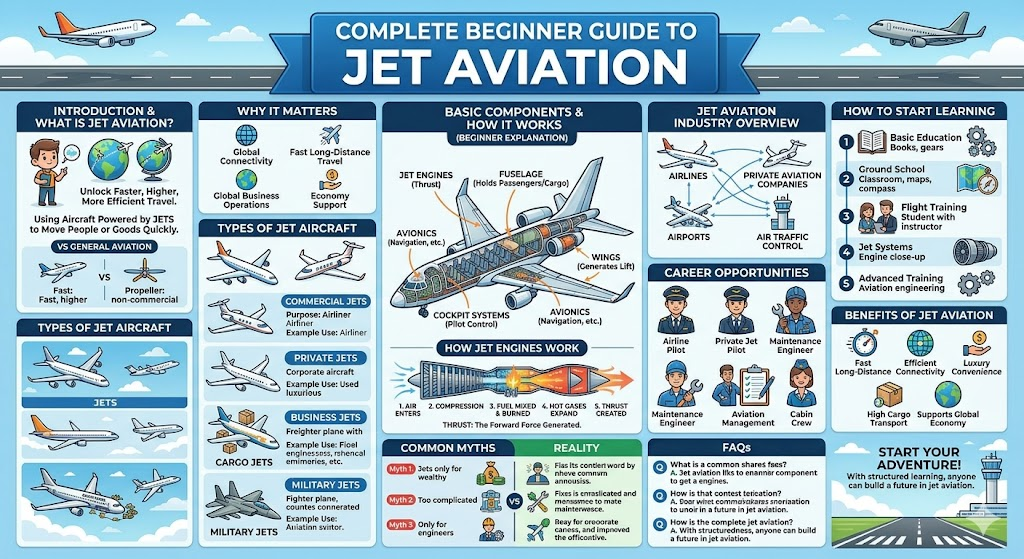
Introduction
Jet aviation represents one of the most advanced and influential areas of modern flight. From commercial airliners crossing continents in hours to private jets offering flexible business travel, jet aircraft have transformed how the world connects, travels, and does business.
For beginners, jet aviation may seem highly technical, but the core idea is simple: jets are aircraft powered by powerful engines that allow faster, higher, and more efficient flight compared to propeller-based aircraft.
This guide is designed to help beginners understand jet aviation from the ground up. You will learn what jet aviation is, how jet engines work, types of jet aircraft, industry structure, career paths, and how to begin learning aviation in a structured way.
What is Jet Aviation?
Jet aviation refers to the segment of aviation that uses jet-powered aircraft for transportation, business, cargo, and military operations.
Simple Definition:
Jet aviation is the use of aircraft powered by jet engines to move people or goods quickly across short, medium, or long distances.
Jet Aviation vs General Aviation
| Category | Meaning | Example |
|---|---|---|
| Jet Aviation | Aircraft powered by jet engines | Boeing 737, private jets |
| General Aviation | All non-commercial or small aircraft operations | Small training aircraft, propeller planes |
Why Jet Aviation Matters
- Faster travel times
- Long-distance connectivity
- Global business operations
- High efficiency in modern air transport
Types of Jet Aircraft
Jet aviation includes different categories of aircraft designed for specific purposes.
| Type of Jet Aircraft | Purpose | Example Use |
|---|---|---|
| Commercial Jets | Passenger transport | Airlines for domestic and international travel |
| Private Jets | Luxury and executive travel | Business owners and VIP travel |
| Business Jets | Corporate aviation | Company executives and charter services |
| Cargo Jets | Transport goods and logistics | Express delivery and freight companies |
| Military Jets | Defense and security operations | Fighter jets and surveillance aircraft |
Key Insight:
Each jet type is designed based on speed, range, passenger capacity, and mission requirements.
Basic Components of a Jet Aircraft
Understanding jet aircraft starts with knowing its core parts:
1. Jet Engines
Provide thrust by compressing air, burning fuel, and releasing high-speed exhaust gases.
2. Fuselage
The main structure that holds passengers, cargo, and systems.
3. Wings
Generate lift and help stabilize the aircraft during flight.
4. Cockpit Systems
The control center where pilots operate the aircraft.
5. Avionics
Electronic systems used for navigation, communication, and flight control.
How Jet Engines Work (Beginner Explanation)
Jet engines operate on a simple principle: air goes in, energy is added, and fast-moving air comes out to push the aircraft forward.
Basic Working Steps:
- Air enters the engine
- It is compressed by internal blades
- Fuel is mixed and burned
- Hot gases expand rapidly
- High-speed exhaust creates thrust
Thrust is the forward force generated by a jet engine that pushes the aircraft through the air.
Simple Understanding:
The faster the exhaust gases exit the engine, the more thrust is produced, allowing the aircraft to fly faster and higher.
Jet Aviation Industry Overview
Jet aviation is part of a large global ecosystem that supports transportation, commerce, and defense.
Key Industry Segments:
Airlines
Operate commercial jet aircraft for passenger travel across cities and countries.
Private Aviation Companies
Provide charter and luxury jet services for individuals and businesses.
Airports
Manage jet operations, ground handling, and passenger services.
Air Traffic Control
Ensures safe and organized movement of jet aircraft in controlled airspace.
Why It Matters:
Jet aviation supports global trade, tourism, and international business connectivity.
How to Start Learning Jet Aviation
Beginners can enter jet aviation through structured learning paths.
Step 1: Basic Education
A strong foundation in science and communication helps in aviation understanding.
Step 2: Ground School
Covers theory subjects such as:
- Aerodynamics
- Navigation
- Meteorology
- Air regulations
Step 3: Flight Training
Practical flying experience under certified instructors.
Step 4: Understanding Jet Systems
Learn how jet engines, avionics, and aircraft systems function.
Step 5: Advanced Training
Move toward commercial pilot or aviation engineering pathways.
Career Opportunities in Jet Aviation
Jet aviation offers multiple career paths depending on interest and qualifications.
1. Airline Pilot
Flies commercial jet aircraft for passenger airlines.
2. Private Jet Pilot
Operates business jets for private clients.
3. Aircraft Maintenance Engineer
Maintains and repairs jet aircraft systems.
4. Aviation Management
Manages airline and airport operations.
5. Cabin Crew
Ensures passenger safety and comfort onboard jets.
Benefits of Jet Aviation
Jet aviation plays a major role in modern transportation.
- Fast long-distance travel
- Efficient international connectivity
- Luxury and business travel convenience
- High cargo transport capability
- Supports global economy and trade
Common Myths About Jet Aviation
Myth 1: Jets are only for wealthy people
Reality: Commercial jets are widely used for public travel.
Myth 2: Jet aviation is too complicated
Reality: It becomes simple when learned step by step.
Myth 3: Only engineers can understand aviation
Reality: Anyone with interest and training can learn aviation basics.
Frequently Asked Questions (FAQs)
1. What is jet aviation?
Jet aviation refers to aircraft operations using jet engines for transport, business, cargo, and military use.
2. How do jet engines work?
Jet engines create thrust by compressing air, burning fuel, and releasing high-speed exhaust gases.
3. What are the main types of jet aircraft?
Commercial jets, private jets, business jets, cargo jets, and military jets.
4. Is jet aviation different from general aviation?
Yes, jet aviation specifically uses jet-powered aircraft, while general aviation includes all types of smaller aircraft operations.
5. Can beginners learn jet aviation?
Yes, beginners can start with basic aviation theory and gradually move into advanced training.
6. What careers are available in jet aviation?
Pilot, engineer, cabin crew, aviation management, and air traffic control roles.
7. Are jet aircraft faster than propeller planes?
Yes, jet aircraft are significantly faster and more efficient for long distances.
8. Do all airlines use jet aircraft?
Most modern commercial airlines primarily use jet aircraft.
9. What is the role of avionics in jets?
Avionics handle navigation, communication, and flight control systems.
10. Is jet aviation safe?
Yes, it is one of the most regulated and safest forms of transportation.
11. What is the main advantage of jets?
Speed, efficiency, and long-range travel capability.
12. How can I start a career in jet aviation?
Start with education, then ground school, flight training, and advanced aviation certifications.
Conclusion
Jet aviation is a powerful and essential part of the modern world, connecting countries, supporting global trade, and enabling fast travel. While it may seem complex at first, understanding its basics—aircraft types, engine function, industry structure, and career paths—makes it much easier to grasp.
For beginners, the journey into jet aviation starts with curiosity and structured learning. Whether your goal is to become a pilot, engineer, or aviation professional, jet aviation offers exciting and rewarding opportunities.
With the right guidance and consistent learning, anyone can begin exploring this fascinating field and build a strong foundation in aviation.
