
Introduction
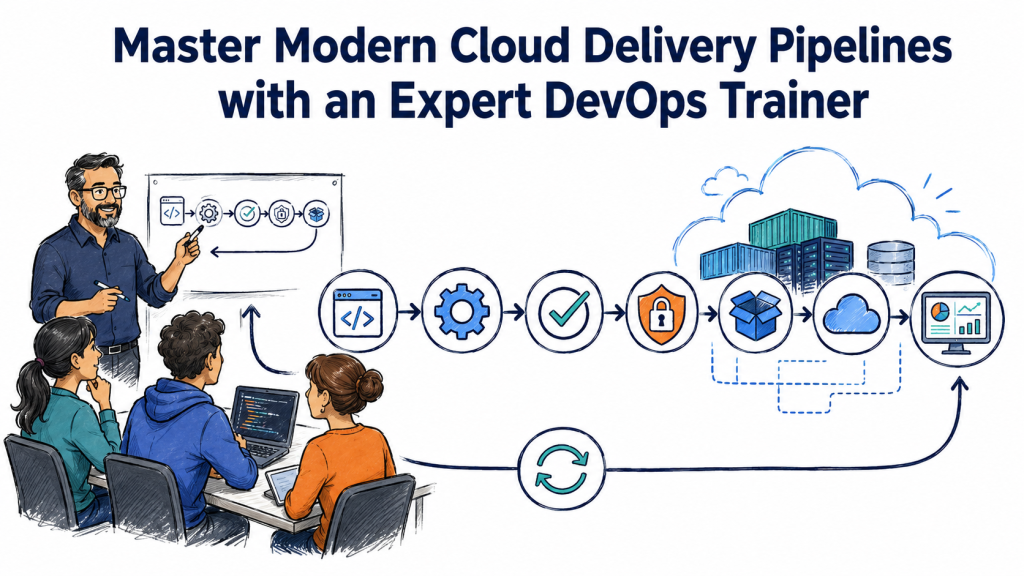
Rapid delivery cycles drive contemporary software engineering, compelling organizations to release secure software without disrupting daily operations. Modern tooling alone never guarantees engineering efficiency. Real transformation happens when engineers master cloud architectures and automated pipelines through direct practice.
A professional DevOps Trainer guides technical teams through every stage of this operational evolution. Instead of enduring static lectures, your engineers experiment with live environments, debug realistic deployment failures, and design scalable architectures that directly improve organizational release speed and system stability.
What Does a DevOps Trainer Do?
A dedicated DevOps Trainer acts as an educator, engineering practitioner, and technical mentor. They lead developers, quality analysts, and operations personnel through modern CI/CD patterns, container orchestration, automated testing, and Infrastructure as Code.
Rather than focusing on surface-level syntax, these mentors show technical teams how to unite automation frameworks with sound engineering principles. Consequently, your staff gains the self-reliance needed to maintain production systems with minimal friction.
Why Practical DevOps Learning Matters
Purely theoretical training collapses as soon as engineers face broken builds or cluster misconfigurations in staging environments. Technical benchmark studies indicate that engineers who train with scenario-based exercises resolve production blockers significantly faster than peers who study passive guides.
Hands-on labs teach engineers how to resolve failing unit test gates, fix faulty container manifests, and execute zero-downtime rollbacks under live conditions. As a result, your team develops the essential instincts to safeguard production availability.
What Should You Look for in a DevOps Trainer?
Securing an effective mentor directly influences the return on your training investment. You must partner with an instructor who balances enterprise background with engaging teaching capabilities.
- Active Engineering History: Look for mentors who maintain production clusters and mission-critical deployment automation.
- Tailored Lab Design: Choose educators who construct custom exercises matching your specific programming runtimes and cloud frameworks.
- Deep Architectural Insight: Prioritize mentors who explain architectural trade-offs rather than basic command-line options.
- Measurable Evaluations: Select trainers who validate progress through functional pipeline assessments and automated test suites.
Corporate DevOps Training: What Makes It Different?
Targeted Corporate DevOps Training differs sharply from generic public workshops. Generic courses focus on broad overviews, whereas enterprise-grade programs resolve company-specific operational bottlenecks, compliance rules, and legacy dependencies.
These enterprise programs establish standard delivery conventions across multiple squads. Standardized workflows remove friction between development and operations teams, shorten onboarding timelines for new hires, and protect organizational security baselines across every department.
How to Plan Effective Corporate DevOps Training
Engineering leaders can establish an effective upskilling track by following this step-by-step framework:
- Assess Skills: Audit existing technical proficiencies against target release goals.
- Provision Sandboxes: Build cloud test environments that reflect your operational infrastructure.
- Deliver Modules: Schedule weekly sessions centered around live pipeline creation.
- Execute Capstones: Challenge participants to deploy a complete microservice architecture to production.
- Review Outcomes: Measure changes in pipeline success rates and deployment cadence.
DevOps Trainer in India: What Should Organizations Consider?
Companies seeking an experienced DevOps Trainer in India discover an extensive network of senior practitioners well-versed in global software delivery and distributed team dynamics.
Always verify whether candidate instructors understand hybrid cloud models, microservice architectures, and cost-control strategies. Instructors with extensive enterprise backgrounds ensure your team learns battle-tested deployment patterns rather than basic textbook setups.
Online DevOps Trainer: When Remote Learning Works Well
Engaging an Online DevOps Trainer provides flexible scheduling for geographically dispersed technical groups. Virtual, instructor-led bootcamps combine interactive terminal sharing, real-time screen demonstrations, and cloud-hosted sandboxes.
This model allows your distributed organization to upskill teams simultaneously across different office locations while maintaining hands-on interactive engagement.
Kubernetes Trainer: Building Cloud-Native Skills
Mastering container infrastructure demands deep operational knowledge. A skilled Kubernetes Trainer trains engineering teams to manage container scheduling, declarative manifests, Helm charts, ingress controllers, and service meshes.
Your engineers learn to configure robust self-healing clusters, execute canary releases without downtime, implement horizontal autoscaling, and secure internal pod communication within enterprise Kubernetes networks.
AWS DevOps Trainer: Connecting Cloud and Delivery Automation
A dedicated AWS DevOps Trainer helps cloud engineers harness Amazon Web Services tools to build robust deployment pipelines.
Engineers learn how to connect AWS CodePipeline, Elastic Container Service, Elastic Kubernetes Service, CloudWatch, and Terraform. Through targeted lab sessions, your engineers optimize cloud operational costs and establish resilient deployment workflows across complex AWS multi-account landing zones.
Azure DevOps Trainer: Improving Microsoft Cloud Delivery
Organizations building on Microsoft enterprise products achieve massive productivity gains by hiring an Azure DevOps Trainer. These programs emphasize Azure Repos, multi-stage Azure Pipelines, Azure Artifacts, and Azure Kubernetes Service.
Engineers build robust YAML-driven release automation, operate self-hosted build runners inside private virtual networks, configure automated infrastructure with Bicep, and govern enterprise cloud releases securely.
DevSecOps Trainer: Bringing Security Into Delivery
Modern teams must embed security validations directly into their release automation. An experienced DevSecOps Trainer teaches developers and operations staff to protect applications early without creating delivery roadblocks.
- Static Code Analysis (SAST): Trigger automated vulnerability scans on every pull request.
- Dynamic Application Testing (DAST): Scan staging environments for runtime security flaws automatically.
- Container Security: Scan container images for vulnerabilities and enforce minimal base layers.
- Centralized Secrets Management: Secure API tokens and cryptographic keys with centralized secret vaults.
SRE Trainer: Improving Reliability
Sustaining high platform availability during peak traffic demands rigorous Site Reliability Engineering workflows. A certified SRE Trainer guides your team through Service Level Indicators, Service Level Objectives, and error budget governance.
Engineers build comprehensive observability dashboards using metrics, logs, and distributed traces. This practical knowledge transforms reactive engineering organizations into proactive, incident-resilient teams.
MLOps Trainer: Applying DevOps Principles to Machine Learning
Deploying artificial intelligence systems to live environments requires specialized operational workflows. An MLOps Trainer unites data science experimentation with dependable software engineering practices.
Your engineers master automated training pipelines, data version control, experiment tracking, containerized model inference, and real-time model drift monitoring. These techniques ensure all production AI models remain reproducible, auditable, and easily scalable under variable user demand.
How DevOps Tools Fit Together
A mature engineering delivery pipeline integrates discrete automation tools into a unified platform. The comparison table below shows how essential technology categories function across the delivery lifecycle:
Connecting these tools into a single continuous delivery workflow prevents process silos and accelerates feature deployment from developer laptops to production clusters.
Common Mistakes When Choosing DevOps Training
Organizations often fail to realize value from technical upskilling investments because of standard planning oversights:
- Overemphasizing Tool Syntax: Teaching basic command-line flags while ignoring foundational architectural design.
- Relying on Generic Materials: Using outdated course tracks that do not match the company’s real technology stack.
- Neglecting Sandbox Labs: Forcing engineers into slide-heavy lectures without hands-on terminal practice.
- Omitting Post-Course Mentoring: Abandoning engineers immediately after training without guidance on applying new concepts to production code.
How to Measure Training Results
Quantify your technical upskilling return on investment by tracking key delivery metrics before and after the training engagement:
Monitoring these indicators gives leadership verifiable proof of improved software velocity and production stability.
Questions to Ask Before Hiring a DevOps Trainer
Interview potential instructors thoroughly to ensure they possess the right technical background for your team:
- Which enterprise production architectures have you designed and maintained recently?
- Will you tailor the lab environments to use our preferred cloud platforms and programming stacks?
- What percentage of the workshop involves active, hands-on terminal exercises?
- How do you test and evaluate an engineer’s practical pipeline skills during the course?
- Do you provide follow-up architectural review sessions after our engineers complete the labs?
Who Can Benefit From a DevOps Trainer?
Targeted technical instruction benefits multiple roles across your technology department:
- Software Engineers: Master containerized workflows, microservice testing, and deployment scripts.
- System Administrators: Transition from manual server configuration to version-controlled Infrastructure as Code.
- QA Engineers: Embed automated testing stages directly inside CI/CD execution tracks.
- Engineering Directors: Gain clear visibility into automated delivery metrics and modern operational practices.
Building a Long-Term DevOps Learning Strategy
Treat technical training as an ongoing operational initiative rather than an isolated annual event. Build internal architectural wikis, provide persistent cloud sandbox environments, and encourage active knowledge-sharing between development teams.
Combine quarterly upskilling workshops with collaborative internal hackathons and code-review clinics. This continuous approach sustains learning momentum and keeps your engineering organization aligned with modern cloud innovations.
Choosing the Right Expert for the Job
Selecting the ideal technical mentor accelerates your project roadmap and protects your architecture from costly mistakes. Ensure your chosen instructor understands your strategic business priorities, existing pipeline blockers, and desired cloud platform.
A seasoned mentor instills operational discipline, empowers developers to own their releases, and builds the confidence required to run high-availability production environments.
DevOpsTrainer as a Trainer Discovery Resource
Finding certified, battle-tested engineering mentors tailored to your specific infrastructure stack takes significant effort. A dedicated discovery hub streamlines this process by connecting decision-makers directly with top-tier technical instructors.
Whether your team needs an immersive on-site workshop, targeted Kubernetes orchestration coaching, or virtual multi-cloud pipeline bootcamps, locating the right educator gives your engineers the exact skills needed to deliver software faster.
Frequently Asked Questions About DevOpsTrainer
Which technical areas do your instructors cover during corporate training?
Instructors cover Git branching workflows, continuous integration pipelines, Infrastructure as Code using Terraform, container orchestration with Kubernetes, multi-cloud hosting, and end-to-end telemetry systems.
Why should our organization choose live corporate training over self-guided courses?
Live corporate training provides custom cloud lab environments that reflect your exact tech stack, real-time code reviews from working professionals, and targeted solutions for your company’s operational bottlenecks.
Can our team request a custom training curriculum matching our internal stack?
Yes, instructors build tailored training tracks around your preferred cloud vendors, operating systems, CI/CD tools, container engines, and application frameworks.
What percentage of training time focuses on hands-on practical labs?
Most instructors dedicate roughly 60% to 70% of total class hours to live hands-on terminal exercises, infrastructure provisioning, and pipeline troubleshooting scenarios.
Which prerequisites should our developers meet before joining these sessions?
Engineers require basic command-line familiarity in Linux, fundamental Git version control knowledge, and a general understanding of standard software development life cycles.
What is the typical duration for an enterprise training program?
Enterprise engagements span anywhere from intensive three-day deep dives to multi-week part-time modular tracks designed to keep active development sprints moving forward.
How effective is remote training compared to on-site classroom delivery?
Remote training matches on-site instruction through interactive terminal sharing, pair debugging, cloud sandbox labs, and instant instructor feedback.
Do instructors include real-world pipeline troubleshooting in their curriculum?
Yes, instructors create broken pipeline builds, bad configuration manifests, and crashed containers so your engineers learn how to resolve production outages safely.
How does an enterprise prepare its network and cloud accounts prior to the sessions?
Instructors collaborate with your system administrators to set up sandbox cloud accounts, configure container registry permissions, and seed sample code repositories before the first day.
What reinforcement resources do trainers provide after the program concludes?
Instructors supply recorded video sessions, reusable IaC templates, capstone project evaluation feedback, and follow-up architectural review checkpoints.
Final Thoughts
High-velocity engineering organizations win by delivering secure, scalable code with speed and confidence. Equipping your engineers with modern DevOps, cloud infrastructure, and reliability practices eliminates deployment delays while protecting production stability.
Investing in top-tier technical mentors transforms software delivery from a fragile manual process into an automated, predictable business advantage that fuels long-term organizational growth.
