
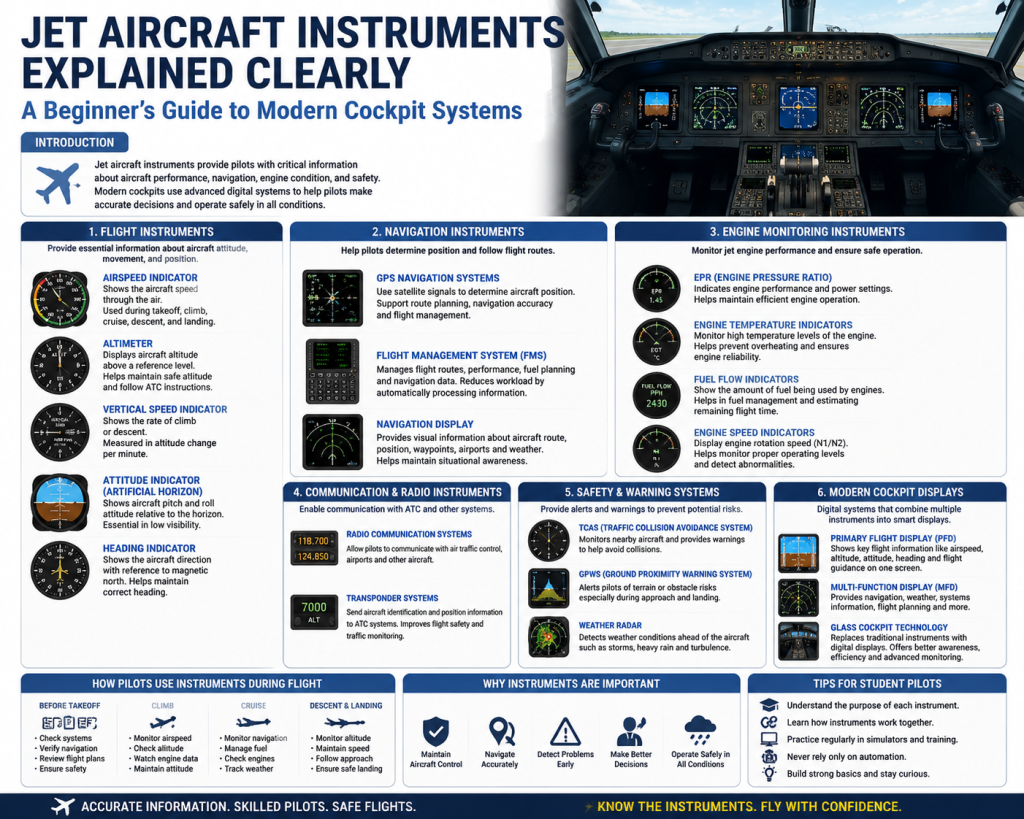
Introduction
A jet aircraft cockpit may look complex to beginners because it contains numerous displays, controls, and instruments. However, every instrument has a specific purpose: helping pilots understand the aircraft’s condition, maintain safe flight, navigate accurately, and make informed decisions.
Unlike early aircraft that relied heavily on basic mechanical instruments, modern jet aircraft use advanced digital systems that combine multiple sources of information into easy-to-read displays. These systems provide pilots with real-time data about speed, altitude, direction, engine performance, weather conditions, and aircraft safety.
Jet aircraft operate at high speeds and altitudes where small changes can have significant effects. Because of this, pilots depend on accurate instruments to manage every stage of flight, from takeoff to landing.
Understanding jet aircraft instruments is important for aviation students, aircraft enthusiasts, and anyone interested in how modern aircraft operate. This guide explains the major cockpit instruments, their functions, and how pilots use them during flight.
What Are Jet Aircraft Instruments?
Jet aircraft instruments are systems and displays inside the cockpit that provide pilots with important information about aircraft performance, position, and operating conditions.
These instruments help pilots monitor:
- Aircraft speed
- Altitude
- Direction
- Flight attitude
- Engine performance
- Fuel status
- Weather conditions
- Navigation information
- Safety warnings
Aircraft instruments allow pilots to fly safely even when visibility is limited or external references are unavailable.
For example, during night flights or flights through clouds, pilots cannot always rely on what they see outside the aircraft. Instead, they use cockpit instruments to understand the aircraft’s exact condition.
Main Categories of Jet Aircraft Instruments
Jet aircraft instruments can generally be divided into several major categories:
- Flight instruments
- Navigation instruments
- Engine monitoring instruments
- Communication systems
- Safety and warning systems
- Electronic cockpit displays
Each category plays an important role in aircraft operation.
1. Flight Instruments
Flight instruments provide pilots with essential information about aircraft movement and position in the air.
These are some of the most important instruments used during every flight.
Airspeed Indicator
The airspeed indicator shows how fast the aircraft is moving through the air.
Airspeed information is important because pilots must maintain specific speed ranges during different phases of flight.
Pilots use airspeed information during:
- Takeoff
- Climb
- Cruise
- Descent
- Landing
Flying too slowly can affect aircraft performance, while excessive speed can create safety concerns.
Modern jet aircraft usually display airspeed digitally on cockpit screens.
Altimeter
The altimeter shows the aircraft’s altitude above a reference level.
Altitude information helps pilots:
- Maintain assigned flight levels
- Avoid terrain obstacles
- Follow air traffic instructions
- Perform safe approaches
During commercial flights, maintaining correct altitude is essential because aircraft often operate in controlled airspace with many other aircraft.
Vertical Speed Indicator
The vertical speed indicator shows whether the aircraft is climbing, descending, or maintaining altitude.
It displays the rate of altitude change, usually measured as altitude gained or lost per minute.
Pilots use this information during:
- Takeoff climb
- Descent planning
- Landing approaches
It helps pilots maintain smooth altitude changes.
Attitude Indicator
The attitude indicator, also known as an artificial horizon, shows the aircraft’s position relative to the horizon.
It provides information about:
- Aircraft pitch
- Aircraft roll
- Nose-up or nose-down position
This instrument is especially important during poor visibility conditions when pilots cannot clearly see the natural horizon.
Heading Indicator
The heading indicator shows the aircraft’s direction.
It helps pilots understand:
- Current flight direction
- Required heading changes
- Navigation accuracy
The heading indicator works with other navigation systems to help aircraft follow planned routes.
2. Navigation Instruments
Navigation instruments help pilots determine aircraft position and follow flight routes accurately.
Modern jet aircraft use advanced navigation technology to improve accuracy and efficiency.
GPS Navigation Systems
GPS systems use satellite signals to determine aircraft location.
Pilots use GPS information for:
- Route planning
- Position monitoring
- Navigation accuracy
- Flight management
Modern aviation relies heavily on satellite-based navigation systems.
Flight Management System (FMS)
The Flight Management System is one of the most important systems in modern jet aircraft.
It helps pilots manage:
- Flight routes
- Performance calculations
- Fuel planning
- Navigation data
The FMS reduces workload by automatically processing large amounts of flight information.
However, pilots still monitor and verify the information provided by automated systems.
Navigation Display
Navigation displays provide pilots with visual information about the aircraft’s route and surroundings.
They may show:
- Planned flight path
- Aircraft position
- Nearby airports
- Weather information
- Navigation points
These displays help pilots maintain situational awareness.
3. Engine Monitoring Instruments
Jet engines require continuous monitoring because they operate under extreme conditions.
Engine instruments help pilots ensure that engines are functioning correctly.
Engine Pressure Ratio (EPR)
Engine Pressure Ratio provides information about jet engine performance.
Pilots use EPR information to monitor engine operation and ensure proper power settings.
It helps maintain efficient engine performance during different flight phases.
Engine Temperature Indicators
Temperature monitoring is critical because jet engines operate at very high temperatures.
These indicators help pilots monitor:
- Engine temperature levels
- Abnormal conditions
- Performance limits
Maintaining proper temperature helps protect engine reliability.
Fuel Flow Indicators
Fuel flow indicators show how much fuel the engines are using.
Pilots monitor fuel information to:
- Manage fuel consumption
- Estimate remaining flight time
- Make fuel-related decisions
Fuel management is an important part of flight planning and safety.
Engine Speed Indicators
Engine speed indicators display engine rotation information.
They help pilots monitor:
- Engine performance
- Abnormal engine behavior
- Proper operating levels
Continuous engine monitoring allows pilots to identify potential issues early.
4. Communication and Radio Instruments
Communication systems allow pilots to exchange information with air traffic controllers and other aviation teams.
Radio Communication Systems
Aircraft radios allow pilots to communicate with:
- Air traffic control
- Airport operations
- Other aircraft when required
Clear communication is essential for safe aircraft movement and flight coordination.
Transponder Systems
A transponder sends aircraft identification information to air traffic control systems.
It helps:
- Identify aircraft location
- Support air traffic monitoring
- Improve flight safety
Transponders are an important part of modern aviation communication.
5. Safety and Warning Systems
Modern jet aircraft include advanced safety systems designed to help pilots identify risks.
Traffic Collision Avoidance System (TCAS)
TCAS helps prevent aircraft collisions by monitoring nearby aircraft.
It provides pilots with information about nearby traffic and can provide warnings when necessary.
This system improves safety in busy airspace.
Ground Proximity Warning System (GPWS)
GPWS helps pilots avoid terrain-related risks.
It provides warnings when the aircraft may be approaching unsafe terrain conditions.
This system is especially valuable during approach and landing.
Weather Radar
Weather radar helps pilots detect weather conditions ahead of the aircraft.
It can help identify:
- Storm activity
- Heavy precipitation
- Dangerous weather patterns
Pilots use weather radar information to make safer routing decisions.
Modern Jet Cockpit Displays
Modern aircraft have moved from traditional instrument panels to advanced digital cockpit systems.
These are often called glass cockpits.
Primary Flight Display (PFD)
The Primary Flight Display combines important flight information into one screen.
It usually displays:
- Airspeed
- Altitude
- Aircraft attitude
- Flight direction
- Flight guidance information
The PFD helps pilots quickly understand aircraft status.
Multi-Function Display (MFD)
The Multi-Function Display provides additional aircraft information.
It may display:
- Navigation information
- Weather data
- Aircraft systems information
- Flight planning details
MFD systems reduce workload by organizing important information efficiently.
Glass Cockpit Technology
Glass cockpit technology replaces many traditional mechanical instruments with digital displays.
Benefits include:
- Better information organization
- Improved pilot awareness
- Reduced workload
- Advanced system monitoring
Modern aviation depends heavily on digital cockpit technology.
How Pilots Use Aircraft Instruments During Different Flight Phases
Before Takeoff
Before departure, pilots check:
- Aircraft systems
- Engine information
- Navigation settings
- Flight plans
Instrument checks help confirm that the aircraft is ready for operation.
During Climb
During climb, pilots monitor:
- Airspeed
- Altitude
- Engine performance
- Aircraft attitude
Maintaining proper climb performance is essential for safe flight operations.
During Cruise
During cruise flight, pilots focus on:
- Navigation
- Fuel management
- Engine monitoring
- Weather conditions
Automation assists pilots, but continuous monitoring remains important.
During Descent and Landing
During landing operations, pilots closely monitor:
- Altitude
- Speed
- Approach guidance
- Aircraft position
Landing requires accurate instrument information because aircraft operate close to the ground.
Importance of Aircraft Instruments in Aviation Safety
Aircraft instruments play a major role in aviation safety.
They help pilots:
- Maintain aircraft control
- Navigate accurately
- Identify problems early
- Make better decisions
- Operate safely in different environments
Without reliable instruments, modern aviation operations would not be possible.
Common Mistakes Beginners Make While Learning Aircraft Instruments
Memorizing Without Understanding
Beginners sometimes focus only on remembering instrument names instead of understanding their purpose.
Understanding how instruments work together creates stronger aviation knowledge.
Ignoring Instrument Relationships
Aircraft instruments are interconnected.
For example:
- Airspeed affects aircraft performance
- Altitude affects flight planning
- Engine information affects power management
Pilots must understand the relationship between different systems.
Depending Only on Automation
Modern aircraft use advanced automation, but pilots must understand manual instrument operation.
Automation supports pilots but does not replace aviation knowledge.
Not Practicing Instrument Reading
Regular practice helps pilots interpret information quickly and accurately.
Simulator training is especially useful for developing instrument skills.
How Student Pilots Learn Aircraft Instruments
Student pilots learn aircraft instruments through multiple training methods.
Ground School
Students study:
- Aircraft systems
- Instrument functions
- Aviation principles
- Flight operations
Simulator Training
Simulators allow students to practice cockpit procedures safely.
They help develop:
- Instrument reading skills
- Decision-making ability
- Emergency response
Flight Training
Actual flight experience helps students apply their knowledge in real situations.
Instructor Guidance
Experienced instructors teach students how to interpret instrument information correctly.
Future Trends in Jet Aircraft Instruments
Aircraft instrumentation continues evolving with new technology.
Future developments may include:
- More advanced digital displays
- Artificial intelligence assistance
- Predictive maintenance systems
- Improved automation
- Enhanced safety monitoring
Technology will continue supporting pilots by providing better information and improving flight efficiency.
Frequently Asked Questions
1. What are jet aircraft instruments?
Jet aircraft instruments are cockpit systems that provide pilots with information about flight conditions, aircraft performance, navigation, and safety.
2. Why are aircraft instruments important for pilots?
They help pilots control aircraft, monitor systems, navigate accurately, and make safe decisions during flight.
3. What are the main flight instruments in a jet aircraft?
The main flight instruments include the airspeed indicator, altimeter, attitude indicator, vertical speed indicator, and heading indicator.
4. How does an altimeter work in an aircraft?
An altimeter measures aircraft altitude using atmospheric pressure information and displays the aircraft’s height above a reference level.
5. What is the purpose of a Primary Flight Display?
A Primary Flight Display combines important flight information such as speed, altitude, and aircraft attitude into one digital screen.
6. What instruments monitor jet engine performance?
Engine pressure ratio indicators, temperature indicators, fuel flow indicators, and engine speed indicators help monitor jet engine performance.
7. How do pilots use navigation instruments?
Pilots use navigation instruments to track aircraft position, follow routes, and maintain accurate flight paths.
8. What is a glass cockpit system?
A glass cockpit uses digital displays instead of traditional mechanical instruments to provide aircraft information.
9. Why do student pilots learn aircraft instruments?
Instrument knowledge helps student pilots understand aircraft behavior and safely operate during different flight conditions.
10. How have aircraft instruments changed with modern technology?
Aircraft instruments have evolved from basic mechanical systems into advanced digital displays with automation and improved monitoring capabilities.
Conclusion
Jet aircraft instruments are essential tools that allow pilots to safely control, navigate, and monitor modern aircraft. From basic flight instruments like airspeed indicators and altimeters to advanced systems like flight management computers and digital cockpit displays, every instrument has an important role.
Understanding aircraft instruments helps aviation students build strong foundations and allows enthusiasts to better appreciate the technology behind modern flight.
As aviation continues to advance, cockpit instruments will become even more intelligent and efficient. However, the fundamental importance of accurate information, pilot understanding, and safe decision-making will always remain at the center of aviation operations.
