
Introduction
Jet aircraft are complex flying machines that depend on precise engineering, powerful engines, and advanced flight control systems to operate safely. While engines provide the thrust needed to move through the sky, control surfaces are responsible for changing direction, maintaining stability, and helping pilots manage the aircraft during every phase of flight.
Control surfaces are movable parts located on the wings and tail section of an aircraft. By changing the airflow around the aircraft, these surfaces allow pilots to control movements such as turning, climbing, descending, and slowing down.
Understanding jet aircraft control surfaces is essential for aviation students, beginner pilots, aircraft enthusiasts, and anyone interested in learning how modern airplanes are controlled.
Real-world examples:
- Commercial jet pilots use control surfaces during takeoff, cruise, and landing to maintain safe aircraft movement.
- Fighter aircraft depend on advanced control surfaces for high-speed maneuverability.
- Aircraft engineers design control systems to improve stability, efficiency, and flight safety.
- Flight training programs teach students how control surfaces influence aircraft behavior.
What Are Jet Aircraft Control Surfaces?
Jet aircraft control surfaces are movable aerodynamic components that allow pilots to control the aircraft’s attitude and direction.
When these surfaces move, they change the airflow around the aircraft, creating aerodynamic forces that affect movement.
The main purposes of control surfaces are:
- Controlling aircraft direction.
- Maintaining stability.
- Managing altitude changes.
- Improving maneuverability.
- Supporting safe takeoff and landing operations.
Modern jet aircraft use a combination of mechanical, hydraulic, and electronic systems to operate these surfaces accurately.
How Aircraft Movement Is Controlled
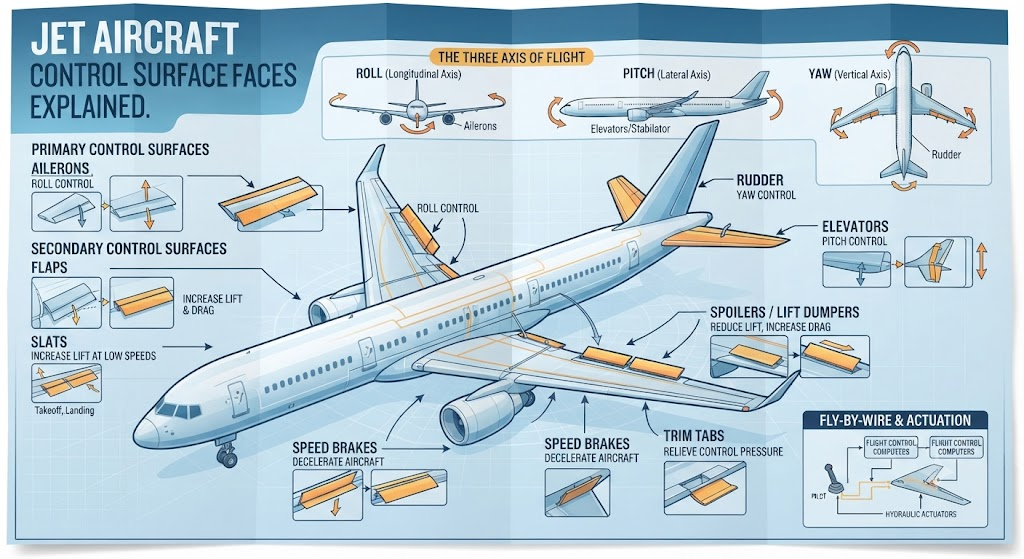
Aircraft movement is based on three primary rotational movements:
Roll
Roll is the movement of the aircraft around its longitudinal axis.
It controls:
- Left and right wing movement.
- Aircraft banking during turns.
Pitch
Pitch is the movement around the lateral axis.
It controls:
- Nose-up movement.
- Nose-down movement.
- Climbing and descending.
Yaw
Yaw is the movement around the vertical axis.
It controls:
- Left and right directional movement.
Control surfaces work together to manage these three movements.
Primary Control Surfaces of Jet Aircraft
Primary control surfaces are the main components responsible for controlling aircraft movement.
The three major primary control surfaces are:
- Ailerons
- Elevators
- Rudders
Ailerons
Ailerons are movable surfaces located on the outer sections of aircraft wings.
Their main function is to control roll movement.
How Ailerons Work
When a pilot moves the control stick or flight control system:
- One aileron moves upward.
- The opposite aileron moves downward.
This creates different lift forces on each wing, causing the aircraft to bank left or right.
Role of Ailerons in Jet Aircraft
Ailerons help pilots:
- Turn the aircraft.
- Maintain wing balance.
- Control direction during flight.
They are especially important during:
- Takeoff adjustments.
- Banking turns.
- Landing approaches.
Elevators
Elevators are located on the horizontal stabilizer at the rear of the aircraft.
Their main function is controlling pitch movement.
How Elevators Work
When elevators move upward:
- The tail produces a downward force.
- The aircraft nose moves upward.
When elevators move downward:
- The aircraft nose moves downward.
Importance of Elevators
Elevators help pilots:
- Climb.
- Descend.
- Maintain altitude.
- Control aircraft attitude.
During takeoff, elevators help create the correct nose-up position required for liftoff.
Rudder
The rudder is located on the vertical stabilizer at the tail section.
Its primary function is controlling yaw movement.
How Rudders Work
When the rudder moves:
- It changes airflow around the tail.
- It pushes the aircraft nose left or right.
Importance of Rudders
Rudders help with:
- Directional control.
- Coordinated turns.
- Crosswind operations.
- Aircraft stability.
During takeoff and landing, rudder control is especially important for maintaining runway alignment.
Secondary Control Surfaces of Jet Aircraft
Secondary control surfaces improve aircraft performance, efficiency, and control.
Major secondary surfaces include:
- Flaps
- Slats
- Spoilers
- Speed brakes
- Trim systems
Flaps
Flaps are movable surfaces located on the trailing edge of aircraft wings.
They are mainly used during low-speed flight conditions.
Functions of Flaps
Flaps help:
- Increase lift during takeoff.
- Reduce landing speed.
- Improve aircraft control.
During takeoff, partial flap deployment allows aircraft to generate sufficient lift at lower speeds.
During landing, larger flap settings increase lift and drag, helping aircraft descend safely.
Slats
Slats are movable surfaces located on the front edge of wings.
They improve airflow over the wing during slow-speed operations.
Benefits of Slats
Slats help:
- Increase maximum lift capability.
- Delay stall conditions.
- Improve low-speed handling.
They are commonly used during:
- Takeoff.
- Landing approaches.
Spoilers
Spoilers are panels located on the upper surface of aircraft wings.
They reduce lift and increase drag.
Functions of Spoilers
Spoilers are used for:
- Reducing altitude quickly.
- Slowing the aircraft.
- Assisting landing operations.
- Improving braking after touchdown.
After landing, spoilers help transfer aircraft weight onto the landing gear, improving braking effectiveness.
Speed Brakes
Speed brakes are aerodynamic devices used to increase drag without significantly changing aircraft direction.
They allow pilots to:
- Reduce speed.
- Control descent rates.
- Manage aircraft energy.
Speed brakes are useful during situations where pilots need additional slowing without reducing engine power significantly.
Trim Systems
Trim systems reduce the continuous effort required from pilots when maintaining a specific flight condition.
They help balance aircraft controls during:
- Cruise flight.
- Long-distance operations.
- Stable climbs or descents.
Modern aircraft use automatic trim systems controlled through advanced flight computers.
Fly-By-Wire Control Systems in Modern Jets
Modern jet aircraft often use fly-by-wire technology instead of traditional mechanical controls.
In a fly-by-wire system:
- Pilot inputs are converted into electronic signals.
- Computers process flight commands.
- Actuators move control surfaces.
Advantages of Fly-By-Wire Systems
Benefits include:
- Improved aircraft stability.
- Faster response.
- Reduced pilot workload.
- Enhanced safety features.
Many modern commercial and military aircraft use advanced digital flight control systems.
How Pilots Use Control Surfaces During Different Flight Phases
Takeoff
During takeoff:
- Flaps increase lift.
- Ailerons maintain wing control.
- Rudder keeps the aircraft aligned with the runway.
- Elevators help achieve rotation.
Climb
During climb:
- Elevators control pitch.
- Engines provide thrust.
- Trim systems help maintain a stable climb angle.
Cruise
During cruise:
- Control surfaces make small adjustments.
- Flight computers maintain stability.
- Trim reduces pilot workload.
Descent
During descent:
- Elevators control aircraft attitude.
- Speed brakes may increase drag.
- Flaps help prepare for landing.
Landing
During landing:
- Flaps increase lift at lower speeds.
- Slats improve airflow.
- Rudder maintains alignment.
- Spoilers assist braking after touchdown.
Importance of Control Surfaces in Jet Aircraft Safety
Control surfaces are essential because they allow pilots to respond to changing flight conditions.
They help aircraft handle:
- Weather changes.
- Wind conditions.
- Speed variations.
- Aircraft weight changes.
- Emergency situations.
Regular maintenance and inspection of control surfaces are critical because even small issues can affect aircraft performance.
Advanced Control Surface Technologies
Modern aviation continues to improve aircraft control through advanced technologies.
Composite Materials
Lightweight materials help reduce aircraft weight while maintaining strength.
Smart Flight Controls
Modern computers continuously monitor aircraft conditions and adjust control inputs.
Adaptive Wings
Future aircraft designs may use wings that automatically change shape for better efficiency.
Autonomous Flight Systems
Advanced aircraft use automation to assist pilots with precise control and navigation.
Common Mistakes Beginners Make About Aircraft Control Surfaces
“Engines Control the Direction of Aircraft”
Engines provide thrust, but control surfaces change aircraft movement and direction.
“Only Wings Control Aircraft”
The wings generate lift, but tail surfaces and other controls are essential for stability.
“Control Surfaces Move Only During Turns”
Control surfaces operate throughout flight, including takeoff, cruise, and landing.
“Larger Control Surfaces Are Always Better”
Control surface size depends on aircraft design, speed, and operational requirements.
How Students Can Learn More About Jet Aircraft Controls
Beginners interested in aviation can improve their knowledge through:
- Aircraft maintenance courses.
- Pilot training programs.
- Flight simulation practice.
- Aviation textbooks.
- Aerospace engineering studies.
- Aircraft observation and analysis.
Understanding control surfaces creates a strong foundation for learning aircraft operations and flight mechanics.
Frequently Asked Questions
1. What are jet aircraft control surfaces?
Jet aircraft control surfaces are movable aerodynamic components that help pilots control direction, stability, and aircraft movement during flight.
2. What are the primary control surfaces of an aircraft?
The primary control surfaces are ailerons, elevators, and rudders, which control roll, pitch, and yaw movements.
3. What do ailerons do on a jet aircraft?
Ailerons control aircraft roll by changing lift distribution between the wings during turns.
4. How do elevators control an aircraft?
Elevators control pitch movement by changing the aircraft’s nose-up or nose-down position.
5. What is the purpose of a rudder?
A rudder controls yaw movement and helps maintain directional stability during flight.
6. Why are flaps used during landing?
Flaps increase lift and drag, allowing aircraft to fly safely at lower speeds during landing.
7. What is the difference between flaps and spoilers?
Flaps increase lift, while spoilers reduce lift and increase drag to help slow the aircraft.
8. What is a fly-by-wire system?
Fly-by-wire is an electronic flight control system that uses computers to manage aircraft control inputs.
9. Are control surfaces important for aircraft safety?
Yes, control surfaces are essential for maintaining stability, maneuverability, and safe flight operations.
10. Do fighter jets use different control surfaces than commercial jets?
Fighter jets may use more advanced control systems designed for high-speed maneuverability and specialized operations.
Conclusion
Jet aircraft control surfaces are among the most important components that make controlled flight possible. From ailerons and elevators to advanced fly-by-wire systems, every control element plays a specific role in maintaining aircraft stability, direction, and safety.
Understanding how these surfaces work provides valuable knowledge for aviation students, pilots, engineers, and aircraft enthusiasts. As aircraft technology continues to evolve, control systems will become even more advanced, improving efficiency, safety, and flight performance.
The science behind aircraft control demonstrates how engineering and aerodynamics work together to make modern aviation possible.
