
Introduction
Jet aircraft are among the most advanced flying machines ever built. They can travel at high speeds, operate at extreme altitudes, and carry hundreds of passengers across continents. But despite their complexity, every jet aircraft is governed by the same four basic forces of flight: lift, drag, thrust, and weight.
These four forces determine how a jet takes off, climbs, cruises, turns, descends, and lands. Understanding them is essential for pilots, engineers, and aviation enthusiasts who want to understand how modern jet aviation works.
In this blog, we will explore how these forces behave specifically in jet aircraft and how they interact in real-world flight operations.
What Are the Four Forces in Jet Aviation?
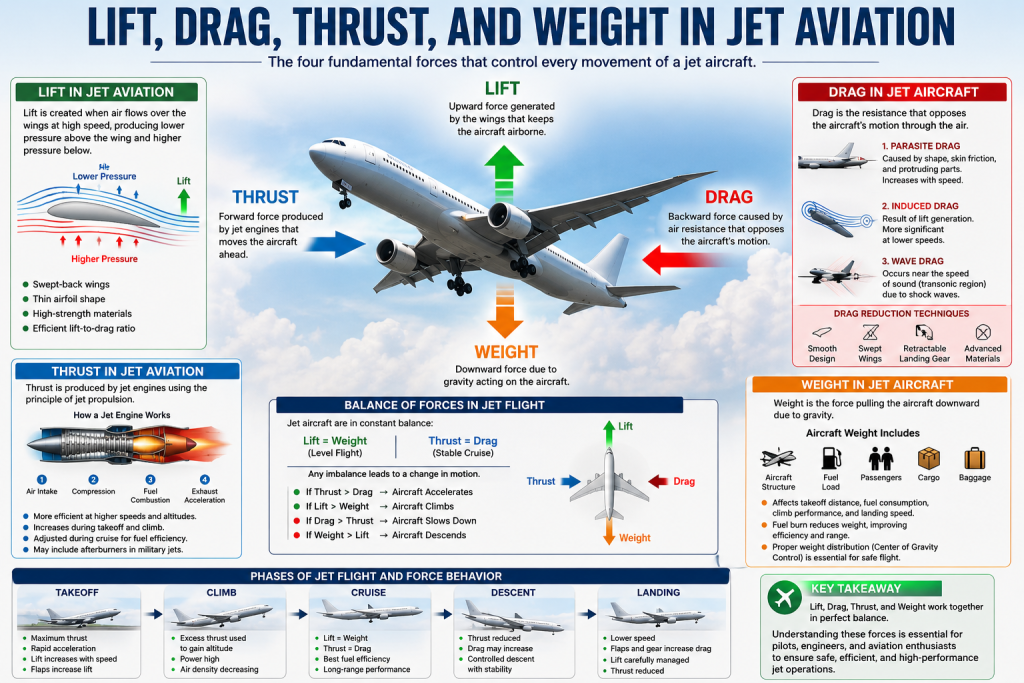
The four fundamental forces acting on any aircraft are:
- Lift – upward force generated by wings
- Drag – resistance force opposing motion
- Thrust – forward force produced by engines
- Weight – downward force due to gravity
In jet aviation, these forces become even more important because of high speeds, high altitudes, and complex aerodynamics.
| Force | Direction | Role in Jet Flight |
|---|---|---|
| Lift | Upward | Keeps aircraft airborne |
| Drag | Backward | Opposes motion |
| Thrust | Forward | Produced by jet engines |
| Weight | Downward | Due to gravity |
Lift in Jet Aviation
Lift in jet aircraft is generated by the wings as air flows over them at high speed. Jet aircraft typically fly faster and higher than propeller aircraft, which means their wings are designed to perform efficiently in high-speed aerodynamic conditions.
Jet wings often feature:
- Swept-back design
- Thin airfoil shape
- High-strength materials
- Efficient lift-to-drag ratio
As air flows over the wing, it creates a pressure difference between the upper and lower surfaces. Lower pressure above the wing and higher pressure below it results in upward lift.
At high altitudes, air is thinner, so jets must maintain higher speeds or optimized wing designs to generate sufficient lift.
Physics of Lift in Jets
Lift in jet aviation is influenced by both classical principles:
Bernoulli’s Principle
Faster airflow over the wing leads to lower pressure above the wing, contributing to lift generation.
Newton’s Third Law
The wing pushes air downward, and in return, the air pushes the wing upward.
Angle of attack plays a major role in controlling lift. However, in jet aircraft, it must be carefully managed to avoid high-speed stalls or aerodynamic instability.
Drag in Jet Aircraft
Drag is one of the most critical forces in jet aviation because jets operate at high speeds where aerodynamic resistance increases significantly.
There are three main types of drag in jet aircraft:
1. Parasite Drag
Caused by the aircraft’s shape, skin friction, and protruding components. It increases with speed.
2. Induced Drag
Generated as a byproduct of lift creation. It is more significant at lower speeds.
3. Wave Drag
A unique type of drag in jet aviation that occurs near the speed of sound (transonic region). It is caused by shock waves forming on the aircraft.
Wave drag is one of the biggest challenges in high-speed jet design.
To reduce drag, jet aircraft use:
- Smooth fuselage design
- Swept wings
- Retractable landing gear
- Advanced composite materials
Thrust in Jet Aviation
Thrust in jet aircraft is produced by jet engines, which operate on the principle of jet propulsion.
A jet engine works in four main stages:
- Air intake
- Compression
- Fuel combustion
- Exhaust acceleration
High-speed exhaust gases are expelled backward, producing forward thrust.
Unlike propeller aircraft, jet engines become more efficient at higher speeds and altitudes.
Key characteristics of jet thrust:
- Increases during takeoff and climb
- Reduced during cruise for fuel efficiency
- Adjusted constantly for flight control
- May include afterburners in military jets
Thrust is what allows jets to overcome drag and maintain high-speed flight.
Weight in Jet Aircraft
Weight is the force pulling the aircraft downward due to gravity.
In jet aviation, weight management is extremely important because it affects:
- Takeoff distance
- Fuel consumption
- Climb performance
- Landing speed
- Structural limits
Aircraft weight includes:
- Aircraft structure
- Fuel load
- Passengers
- Cargo
- Baggage
As fuel burns during flight, weight decreases, improving efficiency and range.
Proper weight distribution, known as center of gravity control, is essential for safe jet operation.
Balance of Forces in Jet Flight
Jet aircraft are in a constant balance of forces:
- Lift equals weight during level flight
- Thrust equals drag during stable cruise
Any imbalance leads to acceleration, climb, descent, or deceleration.
For example:
- If thrust > drag → aircraft accelerates
- If lift > weight → aircraft climbs
- If drag > thrust → aircraft slows down
- If weight > lift → aircraft descends
This balance is continuously managed by pilots and automated flight systems.
Takeoff in Jet Aviation
Takeoff is one of the most demanding phases of jet flight.
During takeoff:
- Maximum thrust is applied
- Aircraft accelerates rapidly
- Lift increases with speed
- Pilot rotates aircraft at correct speed
Jets require long runways because they need sufficient speed to generate enough lift.
Flaps are used to increase lift at lower speeds, reducing required runway length.
Climb Phase
During climb, jets use excess thrust to gain altitude.
Key characteristics:
- High engine power
- Increasing altitude
- Decreasing air density
- Adjusted angle of attack
As altitude increases, air becomes thinner, requiring careful thrust and lift management.
Cruise Flight
Cruise is the most stable phase of jet aviation.
In cruise:
- Lift equals weight
- Thrust equals drag
- Aircraft maintains steady speed and altitude
Jet aircraft are designed to be most fuel-efficient at high-altitude cruise conditions.
This is where aerodynamic efficiency is critical.
Descent and Landing
During descent:
- Thrust is reduced
- Drag is managed carefully
- Lift is controlled using flaps and speed adjustments
During landing:
- Flaps increase lift at lower speeds
- Drag helps slow the aircraft
- Weight is gradually transferred to landing gear upon touchdown
Precise control of all four forces ensures a safe landing.
High-Speed Jet Aerodynamics
Jet aircraft operate in subsonic and transonic speed ranges, where aerodynamic effects become complex.
Key challenges include:
- Shock wave formation
- Wave drag increase near Mach 1
- Loss of efficiency at high speed
- Stability changes at high altitude
To manage these effects, jet aircraft use:
- Swept wings
- Slim fuselage design
- Advanced materials
- Engine optimization
Wing Design in Jet Aircraft
Jet wings are designed differently from small aircraft wings.
Common designs include:
- Swept wings for high-speed efficiency
- High aspect ratio wings for fuel efficiency
- Advanced winglets for drag reduction
Commercial jets like the Boeing 737 and Airbus A320 use optimized wing designs for balanced performance, fuel efficiency, and stability.
Real-World Jet Examples
- Boeing 737 – Short to medium-haul commercial jet
- Airbus A320 – Widely used passenger jet
- Boeing 787 Dreamliner – Long-range fuel-efficient aircraft
- Fighter Jets – Designed for high thrust and extreme maneuverability
Each aircraft uses the same four forces but optimizes them differently.
Common Myths About Jet Forces
| Myth | Fact |
|---|---|
| Jets fly only because of engine thrust | Wings generate lift; engines provide thrust |
| Drag is always harmful | Drag is necessary for control and landing |
| Faster speed always improves lift | Only up to structural and aerodynamic limits |
| Weight does not change in flight | Fuel burn reduces weight continuously |
Why Pilots Must Understand These Forces
Understanding these forces helps pilots:
- Control aircraft safely
- Optimize fuel efficiency
- Prevent aerodynamic stalls
- Manage takeoff and landing performance
- Handle emergencies effectively
Jet aviation requires constant awareness of aerodynamic balance.
Frequently Asked Questions
1. What are the four forces in jet aviation?
They are lift, drag, thrust, and weight. These forces control all phases of jet flight.
2. How does a jet engine produce thrust?
It burns fuel to produce high-speed exhaust gases that push the aircraft forward.
3. Why do jet aircraft use swept wings?
Swept wings reduce drag and improve performance at high speeds.
4. What is wave drag?
Wave drag is resistance caused by shock waves forming near the speed of sound.
5. How does altitude affect lift?
Higher altitude has thinner air, which reduces lift generation efficiency.
6. What is Mach number?
Mach number is the speed of an aircraft relative to the speed of sound.
7. Why is weight important in jet operations?
Weight affects fuel consumption, takeoff distance, climb rate, and landing performance.
8. How do flaps affect jet performance?
Flaps increase lift and drag, helping aircraft take off and land at lower speeds.
9. What happens when thrust is reduced?
The aircraft slows down and may descend depending on lift and drag balance.
10. How do pilots balance all four forces?
They use engine power, aerodynamic controls, and flight systems to maintain stability.
Conclusion
Lift, drag, thrust, and weight are the foundation of jet aviation. Every jet aircraft in the sky operates through a continuous balance of these four forces. Jet engines generate powerful thrust, wings create lift, drag manages resistance, and weight constantly pulls the aircraft downward.
Understanding these forces helps explain how modern jets achieve speed, efficiency, and safety at high altitudes. For students and aviation enthusiasts, mastering these fundamentals is the first step toward understanding advanced aerodynamics and flight operations.
