
Introduction
Corporate jet travel has become an essential part of modern business operations. In today’s fast-moving corporate world, time is one of the most valuable assets, and business leaders are constantly looking for ways to travel faster, more efficiently, and more comfortably. Corporate jets provide a powerful solution by offering flexibility, privacy, and direct access to destinations that commercial airlines may not serve efficiently.
Unlike traditional airline travel, corporate jets are designed to maximize productivity and minimize delays. This guide explains everything business travelers need to know about corporate jets, including their types, benefits, usage models, costs, and future trends.
What Is a Corporate Jet?
A corporate jet is a private aircraft used by businesses, executives, and organizations for official travel purposes. These jets are designed to provide fast, flexible, and private transportation for work-related journeys.
Corporate jets are commonly used for:
- Executive business travel
- Corporate meetings across cities
- International business trips
- Client visits and deal closures
- Time-sensitive travel requirements
Unlike commercial airlines, corporate jets operate on flexible schedules and can fly directly to smaller airports closer to business destinations.
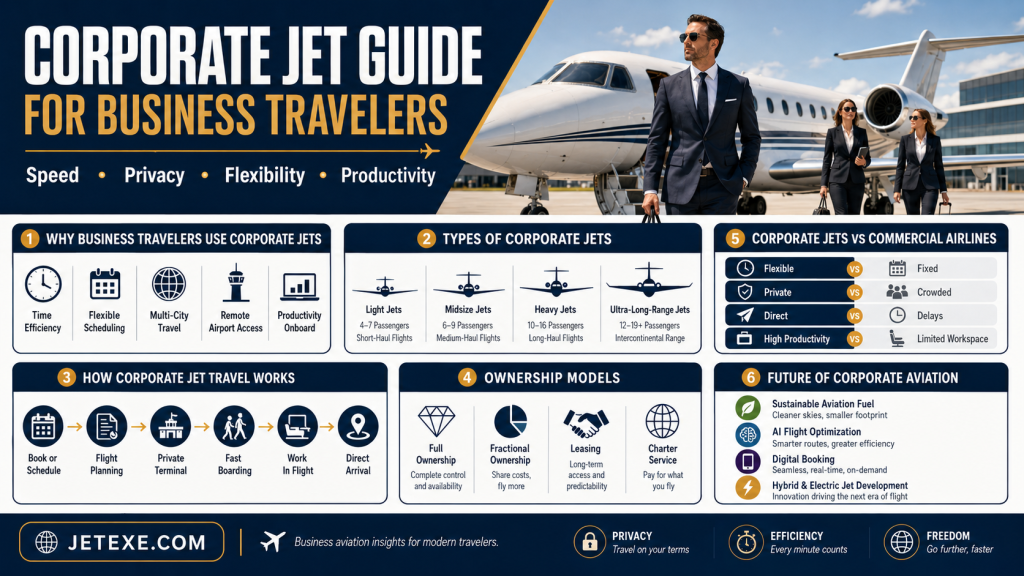
Why Corporate Jets Are Important for Business Travel
Corporate jets play a major role in improving business efficiency.
Time Efficiency
Business leaders can save hours by avoiding long airport queues, delays, and layovers.
Flexible Scheduling
Flights can be scheduled based on business needs rather than airline availability.
Multi-City Travel in One Day
Executives can attend meetings in multiple cities within a single day.
Remote Location Access
Corporate jets can land at smaller airports closer to business hubs.
Productivity During Travel
Cabins are designed for meetings, discussions, and work while flying.
Types of Corporate Jets
Corporate jets come in different categories based on size, range, and usage.
Light Jets
Light jets are ideal for short business trips and small teams.
Common uses:
- Regional meetings
- Short-distance executive travel
- Quick client visits
They are cost-efficient and fast for short routes.
Midsize Jets
Midsize jets offer a balance of comfort, range, and performance.
Common uses:
- Domestic business travel
- Medium-range international routes
- Small corporate teams
They provide more cabin space and better in-flight comfort.
Heavy Jets
Heavy jets are designed for long-distance international travel.
Common uses:
- Intercontinental business trips
- Large executive teams
- High-comfort travel requirements
They include advanced amenities and extended range capability.
Ultra-Long-Range Jets
These are the most advanced corporate jets.
Common uses:
- Non-stop global travel
- High-level executive missions
- Time-critical international business operations
They offer maximum range, luxury, and efficiency.
Key Features of Corporate Jets
Corporate jets are designed for productivity and comfort.
- Luxury seating arrangements
- High-speed Wi-Fi connectivity
- Conference-style cabin layouts
- Private and secure environment
- Customized food and beverage services
- Advanced navigation and safety systems
These features make corporate jets suitable for high-level business operations.
How Corporate Jet Travel Works
Corporate jet travel is structured for speed and efficiency.
Step 1: Booking or Scheduling
The company selects a jet based on travel requirements.
Step 2: Flight Planning
Routes, fuel, and airport selection are optimized.
Step 3: FBO Terminal Access
Passengers use private terminals instead of commercial airports.
Step 4: Fast Boarding Process
No long queues or security delays.
Step 5: In-Flight Operations
Business work, meetings, or rest can continue during flight.
Step 6: Direct Arrival
Aircraft lands closer to the destination city, saving ground travel time.
Corporate Jet Ownership Models
There are multiple ways businesses access corporate jets.
Full Ownership
A company owns the aircraft completely and controls usage.
Fractional Ownership
Multiple users share ownership of one aircraft.
Jet Leasing
Aircraft is leased for a specific period or usage requirement.
Charter Services
Jets are booked on demand without ownership responsibilities.
Each model has different cost and flexibility advantages.
Corporate Jet vs Commercial Airlines
| Feature | Corporate Jets | Commercial Airlines |
|---|---|---|
| Scheduling | Fully flexible | Fixed schedules |
| Airport Access | Small airports | Major airports only |
| Privacy | High | Low |
| Travel Time | Minimal delays | Longer due to processes |
| Productivity | High onboard work efficiency | Limited workspace |
| Cost | High | Lower per seat |
Corporate jets focus on efficiency and time savings rather than mass transportation.
Benefits of Corporate Jet Travel
Corporate aviation provides significant advantages for businesses.
- Maximum time savings
- Increased productivity during travel
- Reduced travel fatigue
- Flexible route planning
- Access to remote locations
- Enhanced privacy and confidentiality
These benefits make corporate jets valuable for high-level executives.
Limitations of Corporate Jets
Despite advantages, corporate jets also have limitations.
- High operational costs
- Maintenance and management requirements
- Weather-related restrictions
- Availability during peak demand
- Regulatory compliance requirements
These factors must be considered before choosing corporate aviation.
Cost Factors of Corporate Jet Travel
Corporate jet costs are based on multiple components:
- Aircraft fuel expenses
- Pilot and crew salaries
- Maintenance and servicing
- Airport landing and handling charges
- Charter or leasing fees
- Insurance and operational costs
Costs vary depending on jet size, distance, and usage frequency.
Who Should Use Corporate Jets?
Corporate jets are ideal for:
- Business executives
- Entrepreneurs and founders
- Corporate teams
- Consultants and advisors
- High-frequency travelers
- Time-sensitive professionals
They are especially useful when time is more valuable than travel cost.
Future of Corporate Aviation
Corporate aviation is evolving rapidly with technology and sustainability trends.
- Sustainable aviation fuels
- Electric and hybrid jet development
- AI-powered flight optimization
- Digital booking and management systems
- On-demand jet services expansion
These innovations will make business aviation more efficient and environmentally responsible.
How JETEXE.COM Helps Business Travelers
JETEXE.COM provides insights into corporate aviation, helping business travelers understand:
- Business jet types and usage
- Corporate travel efficiency strategies
- Aviation concepts simplified for professionals
- Jet comparison and selection guidance
- Executive travel optimization knowledge
It serves as a knowledge platform for modern business aviation.
Frequently Asked Questions
1- What is a corporate jet?
A corporate jet is a private aircraft used by businesses for executive and official travel.
2- How do business jets work?
They operate on flexible schedules and provide direct, efficient travel for business users.
3- What are the types of corporate jets?
Light, midsize, heavy, and ultra-long-range jets.
4- Are corporate jets faster than airlines?
Yes, they save time by avoiding delays, layovers, and airport congestion.
5- Who uses corporate jets?
Executives, entrepreneurs, and corporate teams.
6- How much does corporate jet travel cost?
It depends on aircraft type, distance, and usage model.
7- What is jet charter service?
It is renting a private jet for specific trips without ownership.
8- Is corporate aviation safe?
Yes, it follows strict aviation safety standards and regulations.
9- What are ownership options for jets?
Full ownership, fractional ownership, leasing, and charter services.
10- Why do companies use business jets?
To save time, increase productivity, and improve travel flexibility.
Conclusion
Corporate jets have become an essential part of modern business travel by offering speed, flexibility, privacy, and efficiency. They allow executives and organizations to optimize their schedules, reduce travel time, and improve productivity during transit. While they involve higher costs compared to commercial airlines, the value they provide in terms of time savings and business efficiency is significant. As technology and sustainability evolve, corporate aviation is expected to become even more advanced and accessible for global businesses.
