
Introduction
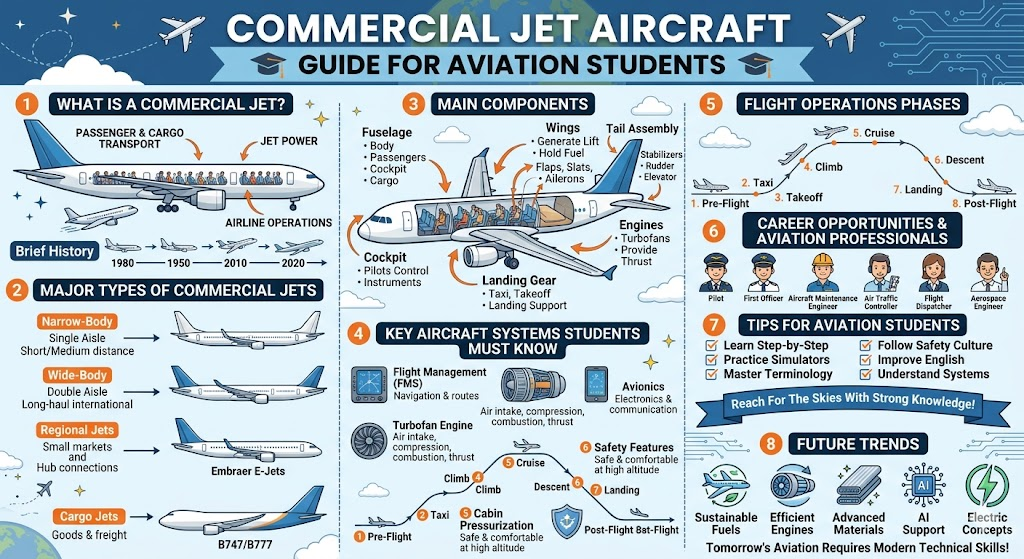
Commercial jet aircraft are the backbone of modern air travel. They carry millions of passengers and large amounts of cargo across cities, countries, and continents every day. For aviation students, understanding commercial jets is very important because these aircraft are used in airline operations, pilot training, aircraft maintenance, airport management, flight dispatch, and aerospace engineering. A commercial jet is not just a flying machine; it is a combination of advanced engineering, safety systems, crew coordination, navigation technology, and strict operational procedures. This guide explains commercial jet aircraft in simple language so students can build a strong foundation for aviation careers.
What Is a Commercial Jet Aircraft?
A commercial jet aircraft is an aircraft powered by jet engines and mainly used for passenger or cargo transportation. Airlines use these aircraft to operate scheduled flights between domestic and international destinations.
Commercial jets are designed for speed, efficiency, safety, and comfort. They can fly at high altitudes, cover long distances, and operate in different weather and airport conditions. These aircraft are operated by trained pilots and supported by engineers, ground staff, dispatchers, air traffic controllers, and cabin crew.
Commercial jet aircraft are commonly used for:
- Passenger transportation
- Cargo transportation
- International airline operations
- Domestic airline routes
- Business travel
- Charter operations
- Long-distance air travel
Brief History of Commercial Jet Aircraft
The development of commercial jet aircraft changed global travel. Before jet aircraft became popular, most passenger aircraft used propeller engines. These aircraft were slower and took longer to cover long distances.
Jet aircraft introduced faster travel, higher cruising altitudes, better passenger capacity, and improved airline efficiency. Over time, aircraft manufacturers improved engine performance, fuel efficiency, passenger comfort, navigation systems, and safety technologies.
Modern commercial jets are far more advanced than early airliners. They use digital cockpits, automated systems, efficient engines, advanced materials, and strong safety designs. This evolution has made air travel faster, safer, and more accessible for people around the world.
Major Types of Commercial Jet Aircraft
Narrow-Body Aircraft
Narrow-body aircraft have a single aisle inside the cabin. They are commonly used for short and medium-distance routes. Many domestic and regional airline flights use narrow-body aircraft because they are efficient, flexible, and suitable for busy airports.
Examples include aircraft similar to the Boeing 737 and Airbus A320 families. These aircraft are popular because they can operate many flights per day and serve both small and large airports.
Wide-Body Aircraft
Wide-body aircraft have two aisles and a larger cabin. They are mostly used for long-haul international routes and high-capacity flights. These aircraft can carry more passengers and more cargo than narrow-body aircraft.
Wide-body jets are often used on routes between major global cities. They usually offer more cabin space, longer range, and advanced passenger comfort features.
Regional Jets
Regional jets are smaller commercial aircraft used for shorter routes. They connect smaller cities with larger airline hubs. These aircraft are useful where passenger demand is lower but air connectivity is still important.
Regional jets help airlines expand their network and provide air service to less crowded airports.
Long-Haul Aircraft
Long-haul aircraft are designed to fly for many hours without stopping. They have large fuel capacity, efficient engines, advanced navigation systems, and comfortable cabin layouts.
These aircraft are used for international flights across oceans and continents. They are important for global business, tourism, and cargo movement.
Cargo Jet Aircraft
Cargo jets are designed to carry goods instead of passengers. They may transport packages, machinery, medical supplies, electronics, food products, and emergency materials.
Some cargo jets are built specifically for freight, while others are converted from passenger aircraft. Cargo aviation plays a major role in global trade.
Business Jets versus Commercial Jets
Business jets are smaller aircraft used by companies, executives, private owners, or charter services. Commercial jets are usually larger and operated by airlines for public passenger or cargo service.
The main difference is purpose. Business jets focus on private travel and flexibility, while commercial jets focus on scheduled airline operations and large-scale transport.
Main Components of a Commercial Jet Aircraft
Fuselage
The fuselage is the main body of the aircraft. It holds passengers, cargo, cockpit, cabin systems, and many internal structures. The fuselage is designed to handle air pressure, flight loads, and operational stress.
Wings
Wings generate lift, which allows the aircraft to fly. They also hold fuel tanks and support important systems such as flaps, slats, spoilers, and ailerons. Wing design affects aircraft performance, fuel efficiency, and stability.
Engines
Jet engines produce thrust, which moves the aircraft forward. Most commercial jets use turbofan engines because they are powerful and efficient for airline operations.
Cockpit
The cockpit is where pilots control the aircraft. It includes flight instruments, control systems, navigation displays, communication equipment, autopilot controls, and warning systems.
Landing Gear
Landing gear supports the aircraft during taxi, takeoff, and landing. It includes wheels, brakes, shock absorbers, and steering systems. Landing gear must handle heavy loads during landing.
Flight Control Surfaces
Flight control surfaces help pilots control the aircraft’s movement. These include ailerons, elevators, rudder, flaps, slats, and spoilers. They help manage turning, climbing, descending, landing, and speed control.
Fuel System
The fuel system stores and delivers fuel to the engines. Fuel is usually stored in the wings and managed carefully during flight to maintain balance and efficiency.
Electrical Systems
Electrical systems power cockpit instruments, lights, communication equipment, cabin systems, and many aircraft functions. Commercial jets have backup systems to maintain safety if one system fails.
Hydraulic Systems
Hydraulic systems use pressurized fluid to move heavy aircraft components such as landing gear, brakes, flaps, and flight controls. These systems are powerful and essential for aircraft operation.
Avionics Systems
Avionics include electronic systems used for navigation, communication, monitoring, and flight management. Modern commercial jets rely heavily on avionics for safe and efficient flight.
How Commercial Jet Engines Work
Most commercial jet aircraft use turbofan engines. A turbofan engine works by taking in air, compressing it, mixing it with fuel, burning the mixture, and pushing hot gases backward to create thrust.
The main stages of jet engine operation include:
- Air intake: The engine pulls in large amounts of air.
- Compression: Air is compressed to increase pressure.
- Combustion: Fuel is added and burned with compressed air.
- Turbine operation: Hot gases spin turbine blades.
- Thrust generation: Exhaust gases move backward and push the aircraft forward.
Turbofan engines are designed to provide strong thrust while improving fuel efficiency and reducing noise. They are one of the most important technologies in commercial aviation.
Important Aircraft Systems Students Should Understand
Flight Management System
The Flight Management System helps pilots plan and manage routes, fuel, navigation, and performance. It supports efficient flight operations and reduces pilot workload.
Navigation System
Navigation systems help pilots know the aircraft’s position, direction, altitude, and route. These systems use multiple sources of information to improve accuracy.
Communication System
Communication systems allow pilots to speak with air traffic control, airline operations, cabin crew, and other aircraft when required.
Autopilot
Autopilot helps control the aircraft during different phases of flight. It does not replace pilots, but it reduces workload and supports stable flight management.
Weather Radar
Weather radar helps pilots detect storms, heavy rain, and dangerous weather conditions ahead. This allows pilots to avoid unsafe areas during flight.
Cabin Pressurization
At high altitudes, outside air pressure is very low. Cabin pressurization keeps the cabin safe and comfortable for passengers and crew.
Safety Systems
Commercial jets include many safety systems such as warning alerts, fire detection, emergency oxygen, backup power, redundant controls, and evacuation equipment.
Flight Operations of Commercial Jets
Pre-Flight Planning
Before flight, pilots and dispatchers review weather, route, fuel, aircraft performance, passenger load, cargo weight, and airport conditions.
Taxi Procedures
Taxiing means moving the aircraft on the ground between the gate and runway. Pilots follow airport signs, air traffic control instructions, and safe speed limits.
Takeoff
During takeoff, engines produce high thrust, and the aircraft accelerates along the runway. Pilots monitor speed, engine performance, and aircraft control until the aircraft becomes airborne.
Climb
After takeoff, the aircraft climbs to its cruising altitude. Pilots manage engine power, navigation, air traffic control communication, and aircraft systems.
Cruise
Cruise is the main part of the flight where the aircraft flies at a stable altitude and speed. This phase focuses on fuel efficiency, navigation, monitoring, and passenger comfort.
Descent
During descent, pilots reduce altitude and prepare for landing. They review weather, runway information, approach procedures, and landing performance.
Landing
Landing requires accurate speed control, alignment, communication, and aircraft handling. Pilots use flaps, landing gear, brakes, and reverse thrust to safely land and slow the aircraft.
Post-Flight Procedures
After landing, pilots taxi to the gate, shut down systems, complete reports, and coordinate with ground teams for the next operation.
Roles of Aviation Professionals Around Commercial Jets
Airline Pilots
Airline pilots operate commercial aircraft and are responsible for safe flight. They manage navigation, communication, aircraft systems, and decision-making.
First Officers
First officers support the captain and share cockpit responsibilities. They assist with flying, monitoring systems, communication, and safety checks.
Aircraft Maintenance Engineers
Aircraft maintenance engineers inspect, repair, and maintain aircraft systems. Their work ensures that aircraft remain safe and airworthy.
Flight Dispatchers
Flight dispatchers help plan flights, review weather, calculate fuel, and support pilots before and during operations.
Air Traffic Controllers
Air traffic controllers guide aircraft safely through controlled airspace and airport areas. They help prevent conflicts and maintain smooth traffic flow.
Cabin Crew
Cabin crew manage passenger safety, comfort, emergency procedures, and onboard service. They play an important safety role during flights.
Ground Operations Teams
Ground teams handle baggage, fueling, aircraft cleaning, boarding, towing, and other airport services that support airline operations.
Popular Commercial Jet Aircraft Students Should Know
Boeing 737
The Boeing 737 is one of the most widely used narrow-body aircraft families. It is commonly used for short and medium-distance routes and is popular among airlines for its operational flexibility.
Boeing 777
The Boeing 777 is a wide-body aircraft used for long-haul international flights. It is known for its range, capacity, and powerful twin-engine design.
Boeing 787 Dreamliner
The Boeing 787 Dreamliner is a modern long-haul aircraft designed with advanced materials, efficient engines, and passenger comfort features.
Airbus A320
The Airbus A320 family is widely used for domestic and regional airline routes. It is known for modern cockpit technology and efficient airline operations.
Airbus A350
The Airbus A350 is a modern wide-body aircraft designed for long-haul flights. It focuses on fuel efficiency, range, and passenger comfort.
Airbus A380
The Airbus A380 is a very large wide-body aircraft with two full passenger decks. It is used on high-demand routes between major international airports.
Embraer E-Jets
Embraer E-Jets are regional aircraft used for short and medium routes. They are popular for connecting smaller markets with larger airline networks.
Commercial Jet Safety Features
Commercial jets are designed with safety as the highest priority. They include multiple backup systems so that if one system fails, another can support the aircraft.
Important safety features include:
- Redundant flight control systems
- Backup electrical systems
- Fire detection and suppression
- Emergency oxygen systems
- Weather radar
- Ground proximity warning systems
- Traffic collision avoidance systems
- Regular inspections
- Strict pilot training
- Emergency evacuation equipment
Safety in commercial aviation is also supported by regulations, maintenance programs, crew training, and continuous monitoring.
How Aviation Students Can Learn More About Commercial Jets
Aviation students can learn about commercial jets through both classroom study and practical exposure.
Useful learning methods include:
- Reading aircraft system basics
- Practicing with flight simulators
- Watching cockpit procedure training videos
- Visiting airports where allowed
- Joining aviation clubs
- Studying aircraft manuals
- Learning aviation terminology
- Understanding airline operations
- Following aircraft maintenance concepts
- Speaking with aviation professionals
Students should focus on building a strong foundation instead of trying to memorize everything at once.
Future of Commercial Jet Aircraft
Commercial aviation is changing quickly. Future aircraft may focus more on sustainability, fuel efficiency, automation, and passenger comfort.
Important future trends include:
- Sustainable aviation fuel
- More efficient engines
- Lightweight aircraft materials
- Artificial intelligence support systems
- Improved cockpit automation
- Electric aircraft research
- Hydrogen-powered aircraft concepts
- Lower-emission airline operations
- Advanced maintenance monitoring
- Smarter air traffic management
Aviation students should stay updated because future aircraft will require new skills and modern technical understanding.
Career Opportunities Related to Commercial Jet Aircraft
Pilot Careers
Students who want to fly commercial jets can pursue pilot training and airline career pathways. This requires strong discipline, medical fitness, technical knowledge, and flight experience.
Aircraft Engineering
Aircraft engineers work on design, testing, maintenance, and improvement of aircraft systems. This career is suitable for students interested in technical and mechanical areas.
Airline Management
Airline management involves planning routes, managing operations, improving customer experience, handling crew schedules, and supporting business decisions.
Flight Operations
Flight operations professionals coordinate schedules, aircraft movement, dispatch, weather planning, and operational control.
Aviation Safety
Aviation safety professionals study risks, incidents, procedures, and compliance to improve flight safety.
Aerospace Research
Aerospace researchers work on future aircraft technologies, materials, propulsion systems, and aviation innovation.
Tips for Aviation Students
Aviation students should develop both technical and professional skills. Understanding aircraft systems is important, but communication, teamwork, and discipline are equally valuable.
Practical tips include:
- Learn aviation basics step by step
- Understand aircraft systems clearly
- Practice with flight simulation tools
- Improve English communication
- Study weather and navigation basics
- Learn cockpit terminology
- Follow aviation safety culture
- Stay updated with airline industry trends
- Build problem-solving skills
- Respect procedures and checklists
Aviation is a serious field, and strong habits built during student life can help throughout a professional career.
Frequently Asked Questions
1- What is a commercial jet aircraft?
A commercial jet aircraft is a jet-powered aircraft used mainly by airlines to carry passengers or cargo. It is designed for regular flight operations, high safety standards, long-distance travel, and efficient transportation.
2- How does a jet engine work?
A jet engine pulls in air, compresses it, mixes it with fuel, burns the mixture, and pushes hot gases backward. This backward movement creates thrust, which moves the aircraft forward.
3- What is the difference between Airbus and Boeing aircraft?
Airbus and Boeing are two major aircraft manufacturers. Both produce safe and advanced commercial aircraft, but their cockpit design, control philosophy, aircraft systems, and operational features can differ.
4- What aircraft do most airlines use?
Many airlines use narrow-body aircraft for short and medium routes and wide-body aircraft for long international routes. Aircraft similar to the Boeing 737 and Airbus A320 families are common in many airline fleets.
5- Why do commercial aircraft fly at high altitudes?
Commercial aircraft fly at high altitudes because the air is thinner, which helps reduce drag and improve fuel efficiency. High altitude also allows aircraft to avoid some weather and traffic congestion.
6- How safe are commercial jets?
Commercial jets are designed with strong safety systems, backup equipment, strict maintenance, trained crews, and regulated procedures. Safety is one of the most important priorities in commercial aviation.
7- What skills should aviation students learn?
Aviation students should learn aircraft systems, navigation, communication, safety procedures, weather basics, decision-making, teamwork, and technical problem-solving.
8- What are the main aircraft systems?
Main aircraft systems include engines, electrical systems, hydraulic systems, fuel systems, avionics, navigation, communication, pressurization, landing gear, and flight controls.
9- How can students learn aircraft operations?
Students can learn aircraft operations through aviation courses, simulators, aircraft manuals, airport exposure, aviation clubs, and guidance from pilots, engineers, and instructors.
10- What careers involve commercial jet aircraft?
Careers include airline pilot, aircraft maintenance engineer, flight dispatcher, air traffic controller, cabin crew, aviation safety specialist, airline operations manager, and aerospace engineer.
Conclusion
Commercial jet aircraft are a major part of the aviation world, and every aviation student should understand how they work, why they matter, and what career opportunities they create. From engines and wings to cockpit systems and airline operations, commercial jets combine engineering, safety, teamwork, and technology. Learning about these aircraft helps students prepare for careers as pilots, engineers, dispatchers, safety experts, and aviation managers. The future of commercial aviation will bring more advanced, efficient, and sustainable aircraft, so students who build strong knowledge today will be better prepared for tomorrow’s aviation industry.
