
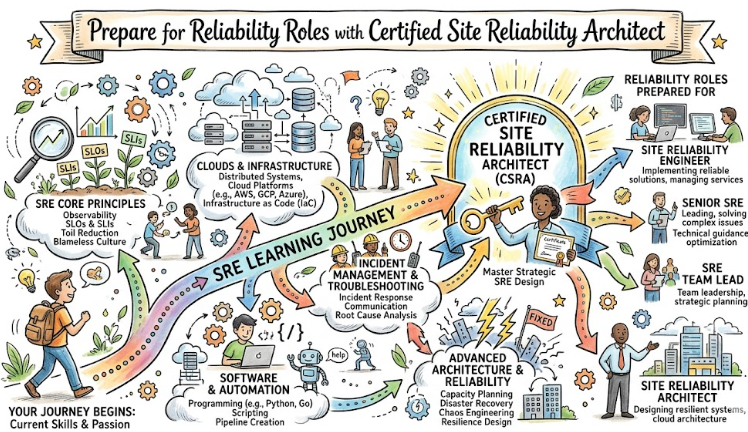
Introduction
The Certified Site Reliability Architect program is an elite professional track developed for experts who intend to master the structural integrity of complex digital ecosystems. This manual is designed for senior engineers, infrastructure leads, and technical directors who recognize that high-level system design is the primary driver of uptime. By engaging with this curriculum at sreschool, practitioners can acquire the sophisticated skills necessary to construct platforms that remain steadfast under extreme operational pressure.
In an industry where the cost of failure grows exponentially with scale, this guide serves as a career compass for those moving beyond tactical automation into strategic system governance. It outlines the transition from managing individual components to overseeing entire service architectures through the lens of reliability and resilience. By the conclusion of this text, you will have a clear understanding of how this certification facilitates advanced career progression and helps you build a more robust technical organization.
What is the Certified Site Reliability Architect?
The Certified Site Reliability Architect is a professional standard that validates a person’s capability to oversee the complete lifecycle of highly available distributed systems. It exists because modern digital businesses require more than just quick fixes; they need architectures that are fundamentally built to handle failure without service interruption. This credential represents the pinnacle of reliability engineering, shifting the focus from day-to-day operations to the overarching design of resilient frameworks.
This program prioritizes production-grade proficiency over theoretical exploration, ensuring that every participant can translate complex requirements into stable, scalable realities. It aligns with current enterprise demands by emphasizing the creation of automated guardrails, self-healing mechanisms, and sophisticated observability patterns. The architect’s role is to ensure that reliability is treated as a core architectural pillar, influencing every decision from the initial code structure to the final deployment strategy.
Who Should Pursue Certified Site Reliability Architect?
This certification is specifically targeted at senior software professionals, cloud architects, and veteran DevOps engineers who are responsible for the continuity of mission-critical services. It is crafted for individuals who have already mastered the fundamentals of automation and are now looking to direct the structural strategy of their organizations. Security architects and data platform leads also find this path essential, as it provides a unified framework for maintaining high availability across diverse technical domains.
While highly motivated juniors can use the foundation tier to establish a long-term career objective, the advanced levels are primarily intended for seasoned leads and engineering managers. In major technology markets, including the rapidly evolving sector in India, there is a distinct lack of professionals who can architect systems with 99.999% reliability targets. Whether you are scaling a fast-growing startup or governing the infrastructure of a global bank, this certification offers the high-level perspective required to lead complex technical transformations successfully.
Why Certified Site Reliability Architect is Valuable in and Beyond
The current professional landscape demands architects who can simplify the massive complexity of multi-cloud and microservices environments. This certification remains valuable because it centers on the immutable laws of distributed computing, which do not change even as specific cloud vendors release new tools. It provides a durable skill set that allows you to remain technically relevant by focusing on architectural constancy rather than chasing fleeting tool trends.
The investment in this architect-level credential yields significant career dividends, as it qualifies you for the most influential roles in platform engineering and technical leadership. Enterprise organizations are increasingly desperate for leaders who can prove their ability to safeguard digital trust through superior system design. By attaining this status, you demonstrate a level of expertise that justifies higher compensation, broader professional influence, and the capacity to direct the most critical technical initiatives within your company.
Certified Site Reliability Architect Certification Overview
This program is officially provided through the portal at Certified Site Reliability Architect and is administered by sreschool. It utilizes a rigorous assessment model that evaluates a candidate’s ability to solve intricate design challenges and manage large-scale production incidents effectively. This practical focus ensures that the certification serves as a reliable indicator of an engineer’s true capability in a real-world production environment.
The curriculum is structured into logical tiers, allowing for a steady progression from foundational reliability principles to advanced strategic governance. Ownership of the program is held by industry veterans who ensure that the learning objectives are always aligned with current production standards and enterprise needs. This modular approach allows for flexible learning while maintaining a high standard of technical integrity, making it a globally respected benchmark for senior engineering talent.
Certified Site Reliability Architect Certification Tracks & Levels
The certification is categorized into three primary levels: Foundation, Professional, and Advanced. The Foundation level establishes the necessary vocabulary and cultural understanding, while the Professional level deepens technical skills in observability, automation, and incident response. The Advanced level is reserved for those who architect resilient systems and lead organizational strategy at a global scale.
In addition to these vertical levels, the program offers specialized tracks such as DevSecOps, FinOps, and SRE specializations. These allow an architect to build horizontal expertise in critical areas like security, cloud economics, and data integrity. This structured tiering ensures that as your responsibilities grow, your credentials can evolve to match your role, providing a continuous roadmap for professional development and technical mastery.
Complete Certified Site Reliability Architect Certification Table
| Track | Level | Who it’s for | Prerequisites | Skills Covered | Recommended Order |
| SRE Core | Foundation | New Engineers, Leads | Basic IT Knowledge | SLOs, SLIs, Toil, Culture | 1 |
| SRE Core | Professional | DevOps, SRE Engineers | 2+ Years Experience | Observability, Incidents | 2 |
| SRE Core | Advanced | Architects, Senior Leads | Professional Cert | Resilience, Chaos, Scaling | 3 |
| DevSecOps | Professional | Security Professionals | Foundation Level | Security Automation, Compliance | 4 |
| FinOps | Professional | Cloud Analysts | Foundation Level | Cost Optimization, Efficiency | 5 |
| DataOps | Professional | Data Architects | Foundation Level | Pipeline Uptime, Data Integrity | 6 |
Detailed Guide for Each Certified Site Reliability Architect Certification
Certified Site Reliability Architect – Foundation
What it is
The Foundation certification validates a basic understanding of SRE principles and the cultural shift required for operational excellence. It ensures that the candidate is proficient in the fundamental metrics and terminology used to manage service health.
Who should take it
This is intended for software developers, junior systems administrators, and technical managers who are transitioning into reliability-focused environments. It serves as the ideal baseline for anyone joining a high-performing SRE team.
Skills you’ll gain
- Understanding the core philosophy of SRE vs. traditional Ops.
- Establishing and measuring Service Level Objectives (SLOs).
- Managing Error Budgets to balance feature velocity and stability.
- Identifying and automating repetitive operational toil.
- Principles of blameless culture and post-mortem analysis.
Real-world projects you should be able to do
- Construct a basic reliability dashboard for a standard web application.
- Draft an Error Budget policy for an internal service.
- Map manual workflows to identify candidates for automation.
Preparation plan
- 7 Days: Focus on the core definitions of SLI, SLO, and Toil within the SRE handbook.
- 30 Days: Complete foundational monitoring labs and participate in SRE culture workshops.
- 60 Days: Implement basic metrics tracking on a personal project using industry-standard tools.
Common mistakes
- Confusing SLOs with SLAs (Service Level Agreements), which are legal rather than technical targets.
- Neglecting the cultural elements of SRE in favor of only learning about tools.
Best next certification after this
- Same-track option: Professional SRE
- Cross-track option: DevOps Foundation
- Leadership option: Technical Team Lead Certification
Certified Site Reliability Architect – Professional
What it is
The Professional certification validates the technical ability to implement and manage SRE practices in production environments. It proves that the candidate can handle incident response, observability, and automation at a sophisticated level.
Who should take it
This is for engineers with 2+ years of experience who are responsible for the daily uptime of critical services. It is designed for practitioners who want to prove their technical depth in managing live systems.
Skills you’ll gain
- Building advanced observability pipelines (Logs, Metrics, Traces).
- Designing automated incident response and self-healing systems.
- Mastering capacity planning and demand forecasting.
- Facilitating blameless post-mortems and root-cause analysis.
- Managing on-call rotations and reliability metrics reporting.
Real-world projects you should be able to do
- Set up a full-stack observability suite for a microservices cluster.
- Automate a multi-region failover process for a high-availability database.
- Lead a post-mortem for a simulated production outage.
Preparation plan
- 7 Days: Review advanced networking and distributed systems theory.
- 30 Days: Practice hands-on labs involving Kubernetes and observability tools.
- 60 Days: Deep-dive into automation scripting and participate in incident response drills.
Common mistakes
- Creating alert fatigue by setting up too many non-actionable notifications.
- Focusing on specific tools rather than the underlying reliability patterns.
Best next certification after this
- Same-track option: Advanced Architect
- Cross-track option: FinOps Specialist
- Leadership option: SRE Manager Certification
Certified Site Reliability Architect – Advanced
What it is
The Advanced certification is the highest technical level, validating the ability to architect for resilience and lead global SRE strategy. It focuses on the science of failure and the engineering of robust systems that withstand catastrophic outages.
Who should take it
Principal engineers, site reliability architects, and senior technical leads. This is for the individual who defines the reliability standards and architectural patterns for an entire organization.
Skills you’ll gain
- Designing for resilience using circuit breakers and bulkheads.
- Executing chaos engineering experiments in production safely.
- Managing global traffic and implementing multi-region disaster recovery.
- Leading organizational change to adopt SRE practices at scale.
- Architecting cloud-native systems that are robust against regional failures.
Real-world projects you should be able to do
- Design a 99.99% available architecture for a global consumer application.
- Execute a chaos engineering experiment to test system recovery.
- Create a company-wide reliability roadmap and budget strategy.
Preparation plan
- 7 Days: Study high-level system design patterns from major tech companies.
- 30 Days: Practice chaos engineering methodologies in a safe, isolated environment.
- 60 Days: Perform a comprehensive reliability audit of a major production architecture.
Common mistakes
- Attempting chaos engineering before having a mature observability foundation.
- Failing to align technical reliability targets with actual business requirements.
Best next certification after this
- Same-track option: SRE Research Fellow
- Cross-track option: Cloud Solutions Architect
- Leadership option: Chief Technology Officer
Choose Your Learning Path
DevOps Path
The DevOps path focuses on the speed and quality of software delivery, ensuring that code moves from development to production without friction. Integrating the Certified Site Reliability Architect curriculum here ensures that this speed does not compromise the stability of the environment. This path is perfect for engineers who want to manage the entire lifecycle of an application, from build to long-term production maintenance. It emphasizes the “you build it, you run it” mentality while providing the metrics to prove success.
DevSecOps Path
The DevSecOps path is for professionals who believe that security is an essential part of reliability. By following this path, you learn how to automate security checks and compliance guardrails within the SRE framework. This ensures that your systems are not only available but also secure and compliant with industry standards. It is a critical path for engineers working in data-sensitive industries like finance or healthcare, where a security breach is considered a catastrophic reliability failure.
SRE Path
The SRE path is the specialized route for those who want to be the ultimate authority on system uptime and performance. This path focuses purely on the science of reliability, moving from foundational concepts to advanced chaos engineering and resilient architecture. It is designed for those who enjoy solving complex distributed systems puzzles and building the automation that keeps global services running. This path leads to roles such as Principal SRE or Reliability Architect in major technology organizations.
AIOps Path
The AIOps path is a forward-looking specialization that uses machine learning and artificial intelligence to enhance operational efficiency. In this path, you learn how to apply algorithmic analysis to massive amounts of telemetry data to predict and prevent failures. This path moves beyond traditional threshold-based alerting to more intelligent, proactive monitoring. It is ideal for SREs who are interested in data science and want to build self-healing systems that learn from past incidents and patterns in system behavior.
MLOps Path
The MLOps path focuses on the reliability and scalability of machine learning models in production environments. Unlike traditional software, ML models require specific monitoring for data drift and model decay, which can be managed using SRE principles. This path teaches you how to build pipelines that ensure models are deployed reliably and remain accurate over time. It is a critical specialization as more companies integrate AI into their core products and require those services to be always available and performant.
DataOps Path
The DataOps path focuses on the reliability and quality of data pipelines, which are the lifeblood of modern analytics-driven companies. You apply the Certified Site Reliability Architect framework to ensure that data flows smoothly, accurately, and without latency from sources to consumers. This path is ideal for data engineers who want to implement better observability and incident response for their data platforms. It ensures that the “data warehouse” or “data lake” is as resilient as any other mission-critical application.
FinOps Path
The FinOps path combines the technical discipline of SRE with financial accountability and cloud cost optimization. You learn how to build reliable systems that are also economically efficient, treating “cost” as another metric to be balanced against performance and availability. This path is highly valued by management, as it ensures the organization is getting the best possible return on its cloud investment. It involves managing trade-offs between high availability and infrastructure spend, a key skill for any senior engineer.
Role → Recommended Certified Site Reliability Architect Certifications
| Role | Recommended Certifications |
| DevOps Engineer | SRE Foundation, SRE Professional |
| SRE | Foundation, Professional, Advanced |
| Platform Engineer | SRE Professional, Advanced |
| Cloud Engineer | SRE Foundation, Cloud Solutions Architect |
| Security Engineer | SRE Foundation, DevSecOps Specialist |
| Data Engineer | SRE Foundation, DataOps Specialist |
| FinOps Practitioner | SRE Foundation, FinOps Specialist |
| Engineering Manager | SRE Foundation, SRE Leadership |
Next Certifications to Take After Certified Site Reliability Architect
Same Track Progression
For those who have completed the initial levels, the best next step is to pursue deep specializations in niche areas like Resilience Engineering or Advanced Chaos Engineering. These certifications focus on the edge cases of reliability, teaching you how to prepare for “black swan” events and catastrophic failures. Staying in the same track allows you to develop the deep, specialized knowledge required for principal-level roles where you are the final authority on system stability.
Cross-Track Expansion
If you have mastered the core SRE principles, expanding into DevSecOps or FinOps provides a broader “T-shaped” skill set. Understanding how security and cost impact reliability makes you a much more versatile architect and a more valuable asset to the business. Cross-track expansion is particularly useful for those looking to move into Platform Engineering roles, where you are responsible for building the tools and frameworks that other developers use to maintain their own reliability.
Leadership & Management Track
For those looking to move away from individual contributor roles, transitioning into a leadership track is the logical next step. This involves certifications in Engineering Management, Agile Leadership, or Technical Product Management. Your background as a Certified Site Reliability Architect gives you the technical credibility to lead engineers, while leadership training provides the soft skills needed to manage stakeholders and steer organizational strategy toward long-term technical health.
Training & Certification Support Providers for Certified Site Reliability Architect
DevOpsSchool
DevOpsSchool is a prominent leader in the technical training landscape, providing a wide array of programs focused on SRE and DevOps methodologies. They offer a mix of live instructor-led sessions and self-paced learning that is highly regarded for its practical depth. Their curriculum for the Certified Site Reliability Architect is designed by industry veterans who focus on real-world application rather than just exam theory. Students benefit from access to extensive lab environments where they can practice complex scenarios. With a strong presence in India and a global reach, they have helped thousands of professionals transition into high-paying reliability roles through their structured and supportive learning ecosystem that emphasizes hands-on mastery.
Cotocus
Cotocus has built a reputation for delivering high-end, intensive technical bootcamps that focus on the most demanding areas of cloud-native engineering and reliability. Their support for the Certified Site Reliability Architect program is characterized by a “learn by doing” philosophy, where students spend the majority of their time in hands-on laboratories. They specialize in teaching the technical intricacies of Kubernetes, Prometheus, and automated infrastructure management. For engineers who want a deep, technical immersion that prepares them for the realities of production operations, Cotocus provides the expert guidance and realistic environments needed to master the science of resilience. Their training is highly targeted at senior professionals looking to achieve an elite level of architectural proficiency.
Scmgalaxy
Scmgalaxy is a community-driven training platform that has been a cornerstone of the DevOps and SRE community for over a decade. They offer a wealth of resources, including specialized training tracks for the Certified Site Reliability Architect designation. Their unique strength lies in their vast library of tutorials, webinars, and open-source contributions that help students stay ahead of the curve. Scmgalaxy focuses on providing a holistic view of the software delivery lifecycle, ensuring that architects understand how their role interacts with development and configuration management. Their training programs are designed to be accessible to all skill levels while providing the depth required for advanced professional certification and continued career success in production environments.
BestDevOps
BestDevOps provides a highly focused and efficient training experience for professionals who need to master SRE principles quickly without compromising on technical quality. Their support for the Certified Site Reliability Architect certification is built around clear, concise instruction and outcome-oriented learning. They pride themselves on removing the “fluff” from technical training and focusing on the skills that have the most significant impact on production reliability. Their mock exams and study guides are meticulously crafted to reflect the current requirements of the certification. This makes BestDevOps an ideal choice for busy engineers who need a streamlined path to professional validation and a deeper understanding of how to build and maintain stable, scalable systems.
devsecopsschool
devsecopsschool is the premier training provider for engineers who want to master the intersection of security and reliability. Their curriculum for the Certified Site Reliability Architect includes specialized modules on security automation, compliance-as-code, and secure infrastructure design. They teach students how to treat security as a first-class citizen of reliability, ensuring that systems are robust against both failures and attacks. For professionals working in high-security environments, devsecopsschool offers the specialized knowledge and laboratory environments needed to build and manage resilient, secure platforms. Their training is highly regarded for its technical rigor and its focus on the most critical security challenges facing modern cloud-native engineering teams, ensuring complete production protection.
sreschool
sreschool is the primary institution dedicated exclusively to the advancement of site reliability engineering as a professional discipline. They provide the most direct and comprehensive support for the Certified Site Reliability Architect program, offering a curriculum that is perfectly aligned with the official certification standards. Because they focus solely on SRE, their training programs offer a level of depth and specialization that is hard to find elsewhere. Students benefit from working with expert practitioners who are at the forefront of the reliability field. sreschool provides the ideal environment for mastering the SRE mindset, from basic foundations to advanced chaos engineering, making it the top choice for serious SRE professionals who want high-authority technical validation.
aiopsschool
aiopsschool is a forward-thinking training provider that focuses on the integration of artificial intelligence and machine learning into the SRE workflow. Their support for the Certified Site Reliability Architect certification includes cutting-edge modules on predictive monitoring, automated root cause analysis, and AI-driven incident remediation. They prepare engineers for the future of operations, where intelligent systems help manage the complexity of hyperscale environments. By following the aiopsschool path, professionals gain a unique competitive advantage, mastering the tools and techniques that are defining the next generation of operations. Their training is technical, innovative, and focused on the practical application of AI in real-world production systems, ensuring architects stay ahead of technological shifts.
dataopsschool
dataopsschool addresses the specific reliability challenges found in the world of big data and analytics. Their training support for the Certified Site Reliability Architect program includes specialized tracks for data engineers and database administrators. They teach how to apply SRE principles like SLOs and observability to data pipelines and storage systems, ensuring that data is as reliable and performant as any other part of the application stack. For professionals managing large-scale data platforms, dataopsschool provides the specialized knowledge and hands-on labs needed to ensure data integrity and availability. Their training is essential for organizations that rely on data-driven decision-making and require high availability for their data infrastructure, making it a vital specialized career track.
finopsschool
finopsschool provides the essential link between engineering reliability and financial accountability in the cloud. Their support for the Certified Site Reliability Architect certification includes a deep focus on cost optimization and cloud financial management. They teach students how to build reliable systems that are also economically efficient, managing the trade-offs between performance and spend. This training is vital for senior engineers and managers who need to justify their infrastructure costs to the business. By following the finopsschool curriculum, professionals learn how to maximize the ROI of their cloud investment while maintaining the high standards of reliability required for modern digital services, ensuring architectural choices are both technically sound and financially sustainable.
Frequently Asked Questions (General)
1. How difficult is the Certified Site Reliability Architect exam?
The exam is considered to be of high difficulty. It is designed to test professional experience and the ability to apply SRE principles to complex, real-world architectural design challenges.
2. What are the prerequisites for the advanced level?
Candidates typically need to hold the Professional level certification and have at least five years of experience in a senior technical or architectural role in production environments.
3. How much time should I dedicate to study?
For the full journey, most professionals spend 6 to 12 months, with 30-60 days focused specifically on each level of certification through consistent study and hands-on laboratory practice.
4. Is the certification recognized globally?
Yes, the Certified Site Reliability Architect is a globally recognized credential that is highly valued by top technology companies, financial institutions, and global enterprise service providers.
5. What is the typical salary impact of this certification?
While results vary by region, certified architects often move into the highest tier of engineering compensation, reflecting their ability to lead mission-critical technical strategies and organizations.
6. Can I take the exam online?
Yes, the exams are proctored online, allowing professionals from anywhere in the world to earn their credentials without the need for travel to a physical testing center.
7. Does the certification focus on specific cloud tools?
The certification is tool-agnostic. It focuses on the fundamental architectural patterns and principles that apply equally to AWS, Azure, Google Cloud, and on-premise infrastructure.
8. How does this differ from a standard Cloud Architect cert?
A Cloud Architect focuses on the features of a specific cloud provider, whereas a Site Reliability Architect focuses on the cross-platform principles of uptime, resilience, and operational excellence.
9. Is there a practical component to the exam?
Yes, the higher levels of certification include scenario-based assessments where you must demonstrate your ability to solve architectural problems and lead incident response in simulated environments.
10. Can engineering managers benefit from this program?
Absolutely. Managers gain the technical vocabulary and structural understanding needed to lead high-performing SRE teams and set realistic engineering targets that align with business value.
11. How often is the certification content updated?
The curriculum is reviewed annually by a committee of industry experts to ensure it reflects the latest developments in cloud-native technology and reliability engineering best practices.
12. Is there a community for certified architects?
Yes, sreschool and its partners maintain exclusive communities where certified professionals can network, share best practices, and stay informed about the latest shifts in the industry.
FAQs on Certified Site Reliability Architect
1. How does the CSRA differ from the Professional SRE level?
The Professional level focuses on the tactical implementation of SRE, while the Architect level focuses on the long-term strategic design and structural governance of the system.
2. Is coding a major requirement for this certification?
While you don’t need to be a full-stack developer, you must be able to read and write code for automation and understand how code architecture affects system reliability.
3. Does it cover chaos engineering in depth?
Yes, chaos engineering is a core pillar of the Advanced tier, teaching architects how to build systems that can be safely tested through intentional failure injection in production.
4. How are SLOs and Error Budgets tested at the architect level?
You will be tested on your ability to design appropriate SLOs for complex business scenarios and demonstrate how to use Error Budgets to make strategic engineering decisions.
5. What is the role of Toil Reduction in the curriculum?
At the architect level, the focus is on designing platforms that prevent toil from occurring in the first place through self-service features and automated guardrails.
6. Does the program address multi-cloud reliability?
Yes, it covers architectural patterns for designing systems that can fail over between different cloud providers or regions to ensure maximum global service availability.
7. How is incident response addressed?
The curriculum covers the leadership and coordination aspects of incident response, focusing on how architects can lead a team through a crisis and facilitate blameless learning.
8. What is the value of the “Cost-Aware Architecture” section?
It teaches architects to treat cloud costs as a technical metric, ensuring that the systems they design are not only reliable but also financially efficient for the business.
Final Thoughts: Is Certified Site Reliability Architect Worth It?
From the perspective of a mentor who has seen the technical industry evolve over two decades, the shift toward site reliability architecture is one of the most important developments in recent years. The Certified Site Reliability Architect is more than just a credential; it is a rigorous validation of your ability to lead in a high-stakes, production-focused environment. It requires a significant commitment of time and effort, but the payoff in terms of professional influence and career growth is immense.
In an era where every business is a digital business, the person who can guarantee the reliability of the architecture is the most valuable person in the engineering organization. If you are a senior professional who is passionate about building stable, scalable systems and leading technical teams toward excellence, this path is for you. There is no marketing hype here—just the honest advice that mastering these principles is the key to a long and successful career at the top of the engineering stack.
