
Introduction
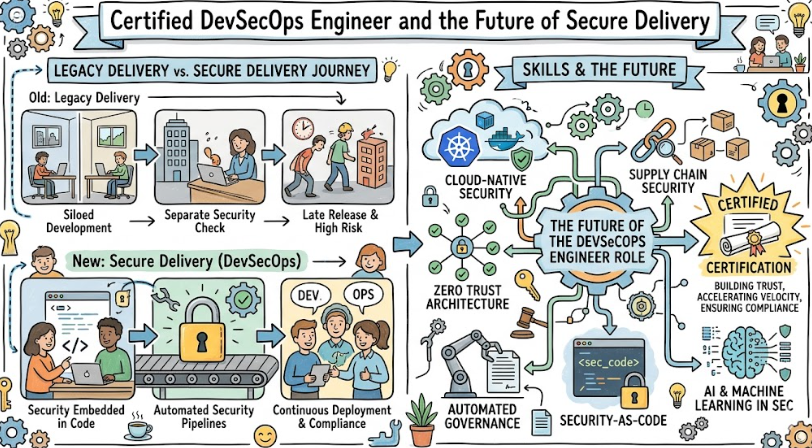
The Certified DevSecOps Engineer certification is designed for professionals who want to build secure software delivery pipelines without slowing engineering speed. It matters because modern teams can no longer treat security as a final checkpoint. Instead, security must be integrated into development, testing, deployment, and operations from the start. This guide is for working engineers, managers, and technical leaders who want a practical view of what this certification means in real work.
In today’s cloud-native and platform-driven environments, DevSecOps has become a core capability rather than a niche specialization. Teams are expected to automate compliance checks, reduce misconfigurations, secure containers, and improve release confidence. That is why learning through a structured program from DevSecOpsSchool can help professionals build useful, job-relevant skills that map directly to enterprise delivery needs. This guide helps you understand whether this certification fits your role, experience level, and long-term learning path.
What is the Certified DevSecOps Engineer?
Certified DevSecOps Engineer represents a practical certification path focused on embedding security into DevOps workflows. It is not just about knowing security concepts in theory. It is about learning how to apply those concepts in CI/CD pipelines, infrastructure automation, container platforms, cloud systems, and daily engineering operations. The value of the certification comes from its production-focused direction.
This certification exists because organizations need engineers who can balance speed, stability, and security together. Traditional separation between development, operations, and security creates friction and delays. DevSecOps closes that gap by making security part of design, build, release, and monitoring activities. That is why this certification is closely aligned with real enterprise practices rather than classroom-only knowledge.
It also fits well within modern engineering workflows where teams use Git, automated testing, container registries, Kubernetes, vulnerability scanning, secrets management, and policy controls. A strong DevSecOps engineer understands both the tooling and the operating model behind secure software delivery. That makes the certification useful for professionals who want relevant skills that continue to matter even as tools evolve.
Who Should Pursue Certified DevSecOps Engineer?
This certification is useful for DevOps engineers, cloud engineers, SREs, platform engineers, security engineers, and release professionals who want stronger security capability in delivery pipelines. It is especially relevant for people already working with CI/CD, containers, infrastructure as code, or cloud deployment. If your work touches build systems, deployment automation, compliance, or runtime security, this certification has practical value.
Beginners can also benefit if they already understand basic Linux, scripting, cloud fundamentals, and software delivery concepts. For early-career professionals, this certification creates structure and helps connect many topics that are often learned separately. It can act as a bridge between DevOps automation and applied security practice. That makes it a strong option for people moving from pure operations or development into security-aware platform roles.
Experienced engineers can use it to formalize knowledge they may already apply informally. Many professionals know parts of DevSecOps, such as scanning images or managing secrets, but lack a complete framework. Managers and technical leaders can also benefit because they need to understand how secure delivery programs are designed, governed, and scaled. For India and global markets alike, this certification aligns well with the growing need for secure cloud transformation.
Why Certified DevSecOps Engineer is Valuable in the Years Ahead
DevSecOps remains valuable because software delivery is becoming faster, more distributed, and more regulated. Organizations are moving to cloud-native platforms, microservices, containers, and automated deployment models. As these systems grow in complexity, security cannot remain manual or isolated. Engineers who can design secure pipelines and reduce operational risk will continue to be in demand across industries.
Another reason this certification has lasting value is that it teaches principles that survive tool changes. Specific scanners, policy engines, or cloud platforms may change over time, but the underlying practices remain stable. Secure coding feedback loops, secrets management, supply-chain awareness, policy automation, runtime visibility, and compliance integration are durable skills. That means the return on learning effort is stronger than learning a single tool in isolation.
From a career perspective, the certification signals that you understand modern engineering responsibilities beyond shipping code. It shows awareness of risk, resilience, governance, and platform maturity. Employers increasingly want professionals who can improve security without becoming blockers. That balance is one of the most practical reasons this certification continues to matter for engineers and managers.
Certified DevSecOps Engineer Certification Overview
The program is delivered through the official course page and hosted on DevSecOpsSchool. In practical terms, this means learners are entering a structured certification environment built around applied DevSecOps knowledge instead of generic awareness content. The certification is intended to validate how well a professional understands secure development pipelines, security automation, infrastructure hardening, and operational security integration across the software lifecycle.
The structure is best understood as a career-oriented learning framework. It is not only about passing an assessment. It is about building capability in areas such as CI/CD security, container security, cloud controls, secrets handling, compliance automation, and incident-aware engineering. A serious certification path should test practical understanding, decision-making, and implementation readiness rather than only memorization.
Ownership and delivery model also matter. When a certification is closely tied to a specialized provider, the value often depends on how well the curriculum reflects real-world implementation work. In this case, professionals should view the program as a hands-on path for applying security in delivery systems, not just a badge for resumes. That is what gives the certification real workplace relevance.
Certified DevSecOps Engineer Certification Tracks & Levels
The most logical way to understand certification levels is through three stages: foundation, professional, and advanced. Foundation-level learning usually focuses on basic DevOps security concepts, security awareness in pipelines, and the role of automation in reducing common risks. Professional-level learning moves deeper into real delivery environments, where engineers must integrate tools, policies, and controls into daily release workflows.
Advanced-level progression is about architecture, governance, scale, and leadership. At that stage, professionals are expected to design secure platform patterns, influence multi-team standards, and make trade-offs between speed, risk, and compliance. Advanced learning is often less about individual tools and more about system design, operating model maturity, and secure engineering culture.
Specialization tracks may also align with DevOps, SRE, FinOps, cloud, data, and AI-related domains. For example, a DevOps track may focus on pipeline security, while an SRE track may emphasize reliability and security together. A FinOps-oriented extension may focus on governance and cost-risk trade-offs. These levels map naturally to career progression from implementer to owner to leader.
Complete Certified DevSecOps Engineer Certification Table
| Track | Level | Who it’s for | Prerequisites | Skills Covered | Recommended Order |
|---|---|---|---|---|---|
| DevSecOps | Foundation | Beginners, junior engineers, support engineers | Basic Linux, Git, SDLC awareness | DevSecOps basics, CI/CD security concepts, secure delivery lifecycle | Start here |
| DevSecOps | Professional | DevOps engineers, cloud engineers, platform engineers | Scripting, CI/CD exposure, containers, cloud basics | Pipeline security, secrets management, container security, policy checks | After Foundation |
| DevSecOps | Advanced | Senior engineers, architects, security leads | Strong DevOps and cloud experience | Secure platform design, enterprise controls, governance, scale patterns | After Professional |
| SRE Security | Professional | SREs, operations engineers, incident leads | Monitoring, automation, production operations | Runtime security, response integration, reliability with security controls | After Foundation |
| Cloud Security Automation | Professional | Cloud engineers, platform teams | Cloud exposure, IAM basics, IaC familiarity | Cloud posture, IAM controls, IaC scanning, workload security | After Foundation |
| Leadership / Governance | Advanced | Engineering managers, architects, program owners | Team leadership, delivery governance experience | Policy adoption, compliance workflows, cross-team security operating models | After Professional |
Detailed Guide for Each Certified DevSecOps Engineer Certification
Certified DevSecOps Engineer – Foundation
What it is
This level validates a working understanding of DevSecOps basics. It confirms that the learner understands how security fits into software delivery and why secure automation matters in modern engineering.
Who should take it
This level suits beginners, junior DevOps engineers, QA professionals, support engineers, and developers moving toward platform or cloud roles. It is best for people who know the delivery lifecycle but have not yet built security into pipelines in a structured way.
Skills you’ll gain
- Understanding of DevSecOps principles and workflow
- Basic knowledge of CI/CD security checkpoints
- Awareness of secrets, vulnerabilities, and misconfigurations
- Foundational understanding of container and cloud security
- Better communication between development, operations, and security teams
Real-world projects you should be able to do
- Add basic security checks into a CI pipeline
- Identify weak points in a simple application delivery flow
- Document a secure release checklist for a team
- Configure baseline secrets handling practices
- Support secure build and deployment reviews
Preparation Plan
7–14 Days
This plan is for professionals who already know DevOps, CI/CD, cloud, or security basics. Focus on DevSecOps fundamentals, secure pipeline flow, secrets management, container security, IaC security, and basic compliance checks. Keep the study practical and revision-focused.
Spend the first few days understanding where security fits in the software delivery lifecycle. Then revise scanning, access control, secure builds, and deployment checks. In the last few days, review weak areas and practice explaining real-world secure delivery scenarios.
30 Days
This is the best plan for most working professionals. In the first week, cover DevSecOps basics, SDLC, CI/CD, and security integration in delivery pipelines. In the second week, focus on secrets, dependency risks, code scanning, artifact security, and container hardening.
In the third week, study IaC security, cloud security basics, IAM, and policy checks. In the final week, combine everything into an end-to-end secure pipeline understanding, revise mistakes, and practice scenario-based questions.
60 Days
This plan is best for beginners or career switchers. In the first two weeks, build basics in Linux, Git, networking, SDLC, cloud, and CI/CD. Then spend the next two weeks on DevSecOps principles, secure pipelines, secrets handling, vulnerability management, and container security.
In the remaining weeks, go deeper into IaC security, policy enforcement, runtime security, compliance automation, and practical workflows. Use the final days for revision, mock scenarios, and connecting concepts to real production environments.
Common Mistakes
- Ignoring cloud security and identity-related risks
- Focusing only on tools and not on the full DevSecOps lifecycle
- Learning scanners and platforms separately without knowing where they fit
- Skipping fundamentals like Linux, networking, Git, CI/CD, and cloud basics
- Treating DevSecOps as only security scanning
- Ignoring secrets management, IAM, policy checks, and runtime security
- Relying too much on theory and avoiding hands-on practice
- Not practicing real-world pipeline and deployment scenarios
Best next certification after this
Same-track option: Certified DevSecOps Engineer – Professional
Cross-track option: SRE Security or Cloud Security Automation
Leadership option: Leadership / Governance track
Certified DevSecOps Engineer – Professional
What it is
This level validates practical implementation capability. It focuses on applying DevSecOps in real delivery systems where engineering teams must balance release speed, policy enforcement, and operational risk.
Who should take it
This certification is ideal for DevOps engineers, platform engineers, security engineers, cloud professionals, and experienced developers involved in build and deployment workflows. It is best for professionals who already work with pipelines, infrastructure as code, containers, or cloud platforms.
Skills you’ll gain
- Pipeline security design and control placement
- Secrets management and secure credential handling
- Container image scanning and registry governance
- Infrastructure as code review and policy enforcement
- Practical integration of compliance and audit readiness
Real-world projects you should be able to do
- Build a secure CI/CD pipeline with automated validation gates
- Integrate secrets handling into deployment workflows
- Scan and harden container images before release
- Add policy checks for infrastructure changes
- Improve release confidence through security automation
Preparation plan
In 7–14 days, revise practical concepts you already use at work and identify weak areas such as secrets, policy, or image security.
In 30 days, practice hands-on labs and map each control to a production workflow.
In 60 days, create end-to-end scenarios covering code, build, deploy, runtime, and remediation loops.
Common mistakes
Many candidates over-focus on one tool stack and fail to understand the broader design logic. Others ignore incident response and runtime visibility, assuming DevSecOps ends at deployment. Some also treat compliance as documentation only instead of automation.
Best next certification after this
Same-track option: Certified DevSecOps Engineer – Advanced
Cross-track option: SRE Security or DataOps security-focused learning
Leadership option: Leadership / Governance track
Certified DevSecOps Engineer – Advanced
What it is
This level validates the ability to design and lead secure delivery at scale. It moves beyond implementation into architecture, standards, governance, and multi-team platform enablement.
Who should take it
This is for senior engineers, principal engineers, architects, security leads, and engineering managers. It suits professionals responsible for platform patterns, security guardrails, enterprise controls, and organization-wide delivery quality.
Skills you’ll gain
- Secure platform architecture design
- Policy standardization across teams
- Governance models for delivery security
- Risk-based decision-making at scale
- Security enablement for engineering organizations
Real-world projects you should be able to do
- Design a secure internal developer platform pattern
- Define organization-wide pipeline guardrails
- Standardize policy and compliance automation across teams
- Lead secure modernization initiatives
- Improve collaboration between engineering, security, and leadership
Preparation plan
In 7–14 days, review your current architecture experience and identify where enterprise security design decisions occur.
In 30 days, study large-scale patterns, operating models, and governance controls.
In 60 days, prepare by mapping real organizational problems to secure platform solutions and leadership decisions.
Common mistakes
Candidates often stay too tool-focused and fail to think in systems. Some confuse advanced certification with deeper configuration knowledge only, when it really requires architecture judgment. Others miss the leadership angle and do not prepare for governance-related decisions.
Best next certification after this
Same-track option: deeper architecture specialization within DevSecOps
Cross-track option: FinOps governance or AIOps security operations alignment
Leadership option: Engineering leadership and security program governance
Choose Your Learning Path
DevOps Path
The DevOps path is best for professionals focused on build, release, deployment, automation, and platform delivery. Here, Certified DevSecOps Engineer fits naturally after basic DevOps maturity because it adds secure controls without changing the delivery mindset. This path is useful for engineers who already manage pipelines and want to improve trust in releases. It strengthens hands-on delivery capability while reducing security gaps that often appear in fast-moving teams.
DevSecOps Path
The DevSecOps path is for professionals who want security embedded into engineering work from the start. It is the most direct path for people who want to move from general DevOps knowledge into secure delivery ownership. This path is valuable for engineers who work with secrets, policy, compliance, secure builds, and cloud risk reduction. It creates a strong bridge between platform execution and security accountability.
SRE Path
The SRE path is relevant for professionals responsible for reliability, observability, incident response, and production health. Certified DevSecOps Engineer supports this path by helping SREs connect resilience with secure system behavior. Secure configuration, controlled deployments, and runtime awareness all reduce operational risk. This path is strong for teams where uptime, safety, and governance must work together.
AIOps Path
The AIOps path focuses on intelligence-driven operations, anomaly handling, and automated operational decision support. In this path, DevSecOps knowledge matters because secure telemetry pipelines, access controls, and automated response design all depend on disciplined engineering practices. Professionals in AIOps benefit from secure automation foundations before moving into advanced operations intelligence. This path is useful for engineers building smart operational systems at scale.
MLOps Path
The MLOps path is meant for professionals handling model deployment, data pipelines, reproducibility, and governed machine learning operations. Certified DevSecOps Engineer supports this by teaching how to secure pipelines, artifacts, access, and deployment systems. MLOps teams need many of the same controls as application teams, but with extra emphasis on artifact integrity and environment consistency. This path works well for engineers moving from DevOps into ML delivery platforms.
DataOps Path
The DataOps path is useful for data engineers and platform teams who manage data pipelines, transformation systems, and governed data movement. Security is critical here because data workflows often involve access control, compliance, lineage, and environment security. Certified DevSecOps Engineer helps data teams think more like secure platform teams. This path becomes especially valuable where regulated data and automation intersect.
FinOps Path
The FinOps path is for professionals who balance cloud efficiency, governance, and operational accountability. While FinOps is cost-centered, it overlaps with secure engineering because misconfigurations, poor access control, and weak governance often increase both risk and cost. Certified DevSecOps Engineer is useful here as a supporting capability. It helps teams build disciplined systems that are safer, more compliant, and operationally more predictable.
Role → Recommended Certified DevSecOps Engineer Certifications
| Role | Recommended Certifications |
|---|---|
| DevOps Engineer | Foundation, Professional |
| SRE | Foundation, Professional, SRE Security |
| Platform Engineer | Professional, Advanced |
| Cloud Engineer | Foundation, Professional, Cloud Security Automation |
| Security Engineer | Professional, Advanced |
| Data Engineer | Foundation, Professional, DataOps-aligned extension |
| FinOps Practitioner | Foundation, Leadership / Governance |
| Engineering Manager | Professional, Advanced, Leadership / Governance |
Next Certifications to Take After Certified DevSecOps Engineer
Same Track Progression
Same-track progression is the best option for professionals who want deep specialization in secure delivery engineering. After the core certification path, learners should move toward advanced design, platform security, policy engineering, and secure cloud architecture. This route helps build authority in enterprise delivery systems. It is ideal for engineers who want to become senior platform owners or DevSecOps architects.
Cross-Track Expansion
Cross-track expansion is useful when you want to broaden your engineering value beyond a single specialty. Moving into SRE, cloud security automation, DataOps, MLOps, or FinOps gives you a wider operational perspective. This approach is strong for professionals working in mixed environments where teams handle platform, data, security, and cost together. It also improves adaptability in changing technology landscapes.
Leadership & Management Track
The leadership track is best for professionals moving into governance, delivery management, platform strategy, or engineering leadership. At this stage, certifications should help you influence standards, adoption models, team capability, and measurable risk reduction. The goal is no longer just individual implementation skill. It is the ability to build systems, teams, and practices that scale across the organization.
Training & Certification Support Providers for Certified DevSecOps Engineer
DevOpsSchool
DevOpsSchool is widely associated with practical, instructor-led learning in DevOps and related engineering domains. Its value usually comes from applied teaching, structured delivery, and career-focused content that aims to help professionals use what they learn in workplace scenarios. For learners who prefer guided progression rather than self-study alone, this kind of provider can offer clarity, sequence, and practice-oriented support. It is especially useful for engineers who want to connect certification study with real implementation thinking.
Cotocus
Cotocus is often viewed in relation to enterprise technology services, consulting exposure, and industry-oriented learning support. For certification candidates, this matters because exposure to implementation thinking can strengthen the practical relevance of training. A provider with consulting alignment can help learners think in terms of real business constraints, delivery models, and platform decisions. That perspective is useful for professionals who want more than theory and need workplace-ready interpretation.
Scmgalaxy
Scmgalaxy has historically been associated with DevOps, automation, and software delivery learning communities. For certification support, a provider like this can be useful when it offers topic depth, trainer-led explanation, and practical context around tools and workflows. Learners preparing for DevSecOps-related certifications often need help connecting isolated concepts into one delivery model. A focused training ecosystem can make that transition easier and more structured.
BestDevOps
BestDevOps is generally recognized in conversations around skills-based DevOps training and certification awareness. From a learner’s point of view, the most useful providers are the ones that help translate broad topic names into practical learning steps. For certification candidates, support matters in areas such as sequencing, revision strategy, and implementation examples. That makes such providers relevant for professionals who want structured preparation and career-focused direction.
devsecopsschool.com
devsecopsschool.com is particularly relevant for learners focused on security-integrated engineering practices. A specialized provider can offer stronger alignment for candidates who want secure CI/CD, container security, policy controls, and cloud security automation within one coherent path. This specialization matters because general DevOps learning often does not go deep enough into security operating models. For professionals targeting DevSecOps roles, a focused site can provide better context and stronger topic coherence.
sreschool.com
sreschool.com can be a useful support option for learners who want to connect DevSecOps with reliability engineering. In many organizations, security and reliability issues overlap during deployment, incident handling, and production governance. A provider with SRE orientation can help learners understand how resilient systems are also shaped by secure operational practices. This makes it valuable for professionals working in production-heavy, service-oriented environments.
aiopsschool.com
aiopsschool.com becomes relevant when professionals want to understand how automation, analytics, and operational intelligence intersect with secure systems. While AIOps is a separate track, it benefits from stable, secure telemetry pipelines and trustworthy automation. Learners exploring both DevSecOps and operations intelligence can gain broader perspective from such a provider. It is most useful for professionals planning multi-domain growth beyond core pipeline security.
dataopsschool.com
dataopsschool.com is useful for professionals working where delivery systems and data workflows meet. Data platforms increasingly need secure automation, governed access, and operational discipline similar to application platforms. A provider focused on DataOps can help learners understand how DevSecOps thinking extends into data engineering environments. This matters for engineers who want secure, repeatable, and governed data operations at scale.
finopsschool.com
finopsschool.com can support professionals who want to connect engineering decisions with financial accountability and governance. Although FinOps is not the same as DevSecOps, both domains value disciplined automation, policy clarity, and operational visibility. For learners in cloud-heavy organizations, this overlap becomes increasingly useful. Understanding both can help professionals make better decisions around secure, efficient, and sustainable platform operations.
Frequently Asked Questions (General – 12 questions)
1. Is Certified DevSecOps Engineer difficult?
It depends on your background. If you already work with CI/CD, cloud, Linux, or containers, the certification will feel manageable but still serious. If you are new to these topics, you will need a structured preparation plan and more hands-on practice. The difficulty usually comes from connecting many moving parts into one secure delivery model.
2. Do I need a security background before starting?
No, but basic security awareness helps. Many learners come from DevOps, cloud, or platform roles rather than pure security teams. What matters most is understanding how software is built and deployed. The certification then helps you add security thinking into that workflow.
3. How long should I prepare for this certification?
A focused learner with prior experience may prepare in a few weeks. Someone changing domains may need one to two months of steady study and practice. The best timeline depends on whether you are learning concepts for the first time or organizing experience you already have. Practical lab time matters more than reading alone.
4. Is this certification good for DevOps engineers?
Yes, very much. DevOps engineers are often expected to own automation, pipelines, secrets handling, deployment controls, and platform quality. This certification strengthens those areas by adding a security-first mindset. It is one of the more practical extensions of a DevOps career path.
5. Can managers benefit from this certification?
Yes, especially engineering managers, delivery leads, and platform leaders. Even if they do not configure tools directly, they need to understand secure delivery models, control placement, and the trade-offs between speed and governance. It helps managers ask better questions and shape better engineering programs.
6. Does this certification help with cloud careers?
Yes. Cloud systems introduce identity, access, misconfiguration, network exposure, and workload security concerns that DevSecOps directly addresses. Professionals working on AWS, Azure, Kubernetes, or hybrid platforms can use this certification to improve security integration within modern cloud delivery models.
7. Is it useful if tools keep changing?
Yes, because the most important value is in the principles and workflow thinking. Tool names may change, but secure pipeline design, policy automation, secrets handling, and runtime awareness remain important. A strong certification helps you transfer these ideas across platforms and vendors.
8. Will this certification help in job interviews?
It can, especially when you can explain real scenarios clearly. Interviews often test how you think about secure builds, deployment gates, secrets, vulnerabilities, and cloud controls. The certification helps, but what matters more is whether you can describe applied decision-making with confidence.
9. Is it better than learning from free resources only?
Free resources are useful, but they are often fragmented. A structured certification path can save time by giving you sequence, coverage, and direction. It is particularly useful for professionals who want a defined roadmap instead of piecing together scattered content.
10. Should I take this before SRE or after SRE?
That depends on your role. If you work mostly in delivery pipelines and platform automation, take this earlier. If your role is deeply production-focused, SRE may come first. In many cases, the two complement each other rather than compete.
11. Does the certification have real ROI?
It can, if you apply the knowledge at work. The best return comes when the certification improves release quality, reduces misconfiguration, strengthens compliance readiness, or helps you move into a stronger role. Like any certification, value increases when backed by hands-on implementation.
12. What is the right sequence for a beginner?
Start with delivery basics, Linux, Git, cloud concepts, and CI/CD awareness. Then move into foundation-level DevSecOps knowledge before attempting more advanced certification work. This creates stability and makes later learning much easier. Skipping fundamentals is one of the biggest reasons candidates struggle.
FAQs on Certified DevSecOps Engineer
1. What does Certified DevSecOps Engineer validate in practical terms?
It validates your ability to think about software delivery as a secure lifecycle rather than a sequence of disconnected tasks. In practical terms, that means understanding where to place security checks, how to reduce pipeline risk, how to manage secrets, and how to improve trust in releases. It also shows that you can work across development, operations, and security responsibilities in a more integrated way.
2. Is Certified DevSecOps Engineer more focused on tools or methods?
It should be viewed as a methods-first certification supported by tools. Tools matter because modern DevSecOps is heavily automated, but the deeper value is understanding why each control exists and where it belongs in the workflow. A candidate who only memorizes tools will struggle. A candidate who understands method, design, and implementation logic will gain more lasting value.
3. Can a developer move into DevSecOps through this certification?
Yes, this certification can be a strong bridge for developers who already understand application delivery and want to expand into secure platform practices. Developers often adapt well because they already think in terms of code, automation, and workflow logic. The main new areas are cloud controls, secrets, policy, and operational security. With practice, this becomes a natural transition.
4. How important is hands-on practice for this certification?
Hands-on practice is essential. Without practical exposure, many ideas remain abstract and hard to apply in interviews or real projects. Even simple labs involving CI/CD, container images, access control, and policy checks can make a major difference. The certification becomes far more valuable when backed by implementation confidence.
5. Does this certification help with compliance-related roles?
Yes, especially in teams where compliance must be automated into engineering workflows. DevSecOps supports auditability, policy consistency, and repeatable controls. While it is not purely a compliance certification, it helps professionals understand how to make compliance more operational and less manual. That is useful in regulated enterprise environments.
6. How is Certified DevSecOps Engineer different from a generic DevOps certification?
A generic DevOps certification often focuses on automation, CI/CD, collaboration, and platform efficiency. Certified DevSecOps Engineer adds a stronger layer of security ownership, risk awareness, governance integration, and secure control design. In other words, it moves from fast delivery alone to safe and trustworthy delivery. That difference is very important in enterprise environments.
7. What kind of professionals gain the most from this certification?
The strongest gains usually come for DevOps engineers, platform engineers, SREs, cloud professionals, and security-aware developers who already work close to release systems. These roles can immediately apply what they learn. Managers also benefit when they are responsible for platform maturity, compliance readiness, or secure engineering programs. Practical relevance is highest where delivery speed and security must coexist.
8. Is Certified DevSecOps Engineer worth it for long-term growth?
Yes, if your career is moving toward cloud platforms, secure automation, engineering governance, or platform leadership. The certification supports long-term growth because it teaches skills that remain relevant even as tooling changes. It also helps professionals develop broader engineering judgment instead of narrow tool familiarity. That makes it a strong investment for sustained technical growth.
Final Thoughts: Is Certified DevSecOps Engineer Worth It?
Certified DevSecOps Engineer is worth serious consideration for professionals who want to stay relevant in modern software delivery. The real value is not in the certificate alone. It is in the mindset and capability that come from learning how to build secure systems without damaging delivery speed. For engineers, it creates stronger practical depth. For managers, it improves decision quality around platform maturity and governance.
For career growth, it opens paths into platform engineering, cloud security automation, SRE-aligned security work, and leadership. The certification is most useful when treated as a working skill, not a badge. If your daily world includes CI/CD, cloud, containers, policy, secrets, or release quality, this is a practical and worthwhile path.
