
Introduction
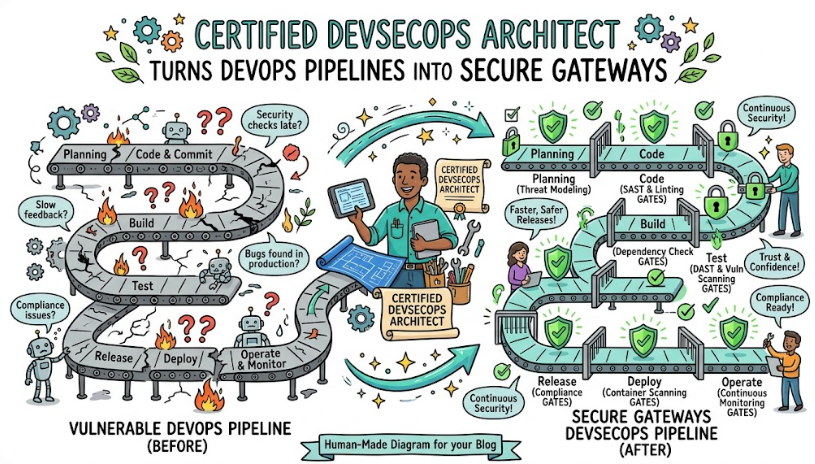
Most teams have adopted DevOps, but many still treat security as a late gate or a separate team problem. That leads to rushed fixes, failed audits, and fragile pipelines. The Certified DevSecOps Architect program is designed to solve this by teaching you how to design software delivery that is secure by design, not secure by accident.
This guide is for working engineers, tech leads, and managers in India and globally who already understand DevOps or cloud and now want to add strong security architecture skills. You will see what the Certified DevSecOps Architect certification covers, who it suits, how to prepare, what real‑world projects you should handle after it, and how it fits into DevOps, DevSecOps, SRE, AIOps/MLOps, DataOps, and FinOps career paths.
What Is Certified DevSecOps Architect?
The Certified DevSecOps Architect certification from DevSecOpsSchool validates that you can design secure architectures for DevOps pipelines, applications, and cloud platforms. It focuses on patterns, reference architectures, and decision‑making rather than only tool commands.
Core ideas include:
- Shifting security left into planning, coding, building, and testing stages.
- Building security checks into CI/CD pipelines as part of normal work.
- Securing containers, Kubernetes, Infrastructure as Code, and cloud services.
- Using policy‑as‑code and compliance‑as‑code for automated governance.
- Balancing speed, safety, cost, and compliance in real organisations.
Who Should Take Certified DevSecOps Architect?
This certification is aimed at professionals who already touch DevOps, cloud, or security and now want to move into architecture‑level responsibility.
It is a strong fit for:
- Senior DevOps / DevSecOps Engineers.
- SREs and Platform Engineers responsible for production platforms.
- Cloud Engineers and Cloud Architects.
- Security Engineers and AppSec specialists working with DevOps teams.
- Engineering Managers, Tech Leads, and Heads of DevOps/SRE/Security.
Recommended prerequisites:
- Hands‑on experience with CI/CD pipelines.
- Practical knowledge of at least one cloud platform.
- Basic familiarity with AppSec concepts (OWASP‑style risks, secure coding).
- Exposure to containers, Kubernetes, and Infrastructure as Code is very helpful.
Certification Overview Table
| Track | Level | Who it’s for | Prerequisites (recommended) | Skills covered (summary) | Recommended order |
|---|---|---|---|---|---|
| Certified DevSecOps Architect | Architect / Advanced | Senior DevOps, DevSecOps, SRE, platform, cloud, security engineers, managers | DevOps + cloud experience, basic AppSec, CI/CD, containers/Kubernetes exposure | Secure SDLC, secure CI/CD, SAST/DAST/SCA, secrets management, container/Kubernetes security, cloud & IaC security, threat modelling, security/compliance as code | After core DevOps/cloud and a mid‑level DevSecOps role |
Certified DevSecOps Architect
What it is
The Certified DevSecOps Architect program proves that you can design secure DevOps ecosystems end to end—from code and pipelines to containers, Kubernetes, and cloud. It is less about operating individual tools and more about creating a coherent, secure architecture that teams can follow.
Who should take it
- Experienced DevOps or DevSecOps engineers stepping into architect or principal roles.
- SREs and platform engineers who want stronger security design skills.
- Security engineers who must work closely with DevOps and platform teams.
- Managers and architects who own DevSecOps strategy and standards.
Skills you’ll gain
You will be able to:
- Map the SDLC and identify where security controls should live.
- Design CI/CD pipelines with SAST, DAST, SCA, and secret scanning built in.
- Architect secure container images, registries, and Kubernetes clusters.
- Introduce secrets management (vault‑style) and secure configuration patterns.
- Secure Infrastructure as Code (Terraform, Helm, etc.) with policy‑as‑code.
- Apply threat modelling and risk analysis to systems and pipelines.
- Use security as code and compliance as code to enforce policies automatically.
- Define security metrics, dashboards, and alerts for engineering and leadership.
Real‑world projects you should be able to do after it
After this certification, you should confidently handle projects such as:
- Designing a secure CI/CD architecture for a microservices platform, including all necessary gates and approvals.
- Creating a reference architecture for secure container and Kubernetes deployment with admission controllers and runtime protection.
- Rolling out an organisation‑wide secrets management strategy and cleaning hard‑coded secrets from code and pipelines.
- Defining and implementing IaC security and policy‑as‑code checks that block unsafe infrastructure changes.
- Setting up a security reporting framework (dashboards + alerts) aligned with risk levels and compliance needs.
Preparation Plan
7–14 Days – Fast Track
Best if you already have combined DevOps + security experience and mainly need structured revision.
- Days 1–2: Review DevSecOps basics and the Architect syllabus; mark gaps in pipeline security, cloud, or Kubernetes security.
- Days 3–5: Run focused labs on weak areas: for example, adding SAST/DAST/SCA to a pipeline, securing container images, or enabling policy‑as‑code on IaC.
- Days 6–9: Draft one end‑to‑end DevSecOps architecture for a real or sample product and get feedback from peers.
- Remaining days: Revise key concepts (threat modelling, compliance as code, risk‑based prioritisation) and practice answering scenario‑style questions.
30 Days – Standard Working Professional Plan
For engineers comfortable with DevOps/cloud but newer to structured DevSecOps architecture.
- Week 1:
- Refresh DevOps, CI/CD, and cloud basics.
- Learn DevSecOps principles, shift‑left strategies, and secure SDLC models.
- Week 2:
- Deep dive into application security in pipelines: SAST, DAST, SCA, secrets scanning, dependency checks.
- Study secret management and secure configuration patterns.
- Week 3:
- Focus on container, Kubernetes, and cloud security patterns, including image hardening, network policies, and identity controls.
- Learn IaC security, policy‑as‑code, and common misconfiguration classes.
- Week 4:
- Practise threat modelling and risk analysis on one application and one pipeline.
- Build a small “DevSecOps reference architecture” with diagrams and a written rationale.
60 Days – Deep‑Dive / Career Transition Plan
Ideal if you are coming from pure Dev, ops, or security and want to move into DevSecOps architecture.
- Weeks 1–2: Strengthen Linux, Git, CI/CD basics, and simple deployments.
- Weeks 3–4: Learn security fundamentals (OWASP‑style vulnerabilities, auth, encryption, least privilege).
- Weeks 5–6: Get comfortable with containers, Kubernetes basics, and one major cloud.
- Weeks 7–8: Study DevSecOps concepts and tool types; build a first secure pipeline with basic checks.
- Weeks 9–10: Add IaC, policy‑as‑code, and cloud security controls.
- Weeks 11–12: Complete at least two full architecture case studies plus practice tests before taking the final assessment.
Common Mistakes
- Treating DevSecOps as a tool list instead of an architecture and culture change.
- Adding many security steps without thinking about developer experience or lead time.
- Ignoring Kubernetes and IaC security, even though most modern stacks depend on them.
- Underestimating the importance of threat modelling and risk‑based prioritisation.
- Failing to document decisions clearly for auditors, management, and new team members.
Best Next Certification After DevSecOps Architect
Based on recent guidance on top certifications and DevSecOps career paths:
- Same track (DevSecOps depth)
- Move into DevSecOps Expert / DevSecOps Professional‑type programs for hands‑on tool mastery and advanced use cases.
- Cross‑track (visibility and reliability)
- Add Master in Observability Engineering (MOE) or similar observability/SRE certifications to connect security architecture with reliability, SLOs, and incident analysis.
- Leadership path
- Pursue DevOps/Cloud Architect or engineering‑leadership programs so you can influence organisation‑level strategy, governance, and budgets using your DevSecOps architecture background.
You can map these groups to specific named certifications from Gurukul Galaxy when you publish the blog.
Choose Your Path: 6 Learning Paths
DevOps path
DevSecOps Architect builds on your DevOps foundation. You design pipelines and platforms where every change goes through automated tests, security checks, and approvals, but teams still release frequently.
DevSecOps path
Here this certification is central. You combine it with DevSecOps engineer‑level skills and become the person who defines patterns, creates reference architectures, and coaches teams to adopt security‑by‑default workflows.
SRE path
As an SRE, you already focus on reliability. DevSecOps Architect lets you integrate security into SLOs, incident playbooks, and post‑incident reviews so that security and reliability are treated as two sides of the same coin.
AIOps/MLOps path
In AIOps and MLOps, you run complex data and model pipelines. With this certification, you design secure ML pipelines, protect training data and model registries, and embed security signals into automated operations.
DataOps path
DataOps teams manage sensitive data pipelines and analytics. DevSecOps Architect helps you design secure data workflows, implement fine‑grained access controls, and treat compliance checks as part of your data delivery process.
FinOps path
Security has direct financial impact. Combining DevSecOps Architect with FinOps training allows you to design security controls that reduce breach risk while still keeping cloud and tool costs under control, with clear reporting to finance and leadership.
Role → Recommended Certifications
| Role | Suggested certification flow with DevSecOps Architect |
|---|---|
| DevOps Engineer | DevOps/cloud fundamentals → DevSecOps Engineer/Professional → DevSecOps Architect → cloud/DevOps architect |
| SRE | SRE foundations → DevSecOps awareness → DevSecOps Architect → SRE/observability leadership |
| Platform Engineer | Cloud + Kubernetes → DevSecOps Architect → platform/security architect certifications |
| Cloud Engineer | Cloud associate → DevSecOps Engineer → DevSecOps Architect → multi‑cloud architect |
| Security Engineer | AppSec/cloud security basics → DevSecOps Engineer → DevSecOps Architect → advanced security certs |
| Data Engineer | Data platform basics → Data security fundamentals → DevSecOps Architect / DataOps‑security programs |
| FinOps Practitioner | Cloud + FinOps basics → DevSecOps awareness → DevSecOps Architect + advanced FinOps/cost governance |
| Engineering Manager | DevOps/cloud overview → DevSecOps Architect → engineering leadership / DevOps architect programs |
Top Training Partners for Certified DevSecOps Architect
DevSecOpsSchool
DevSecOpsSchool is the core provider of the Certified DevSecOps Architect program, with structured curriculum, case studies, and labs based on real DevOps and security transformations. Trainers typically bring many years of experience in DevOps, cloud, and AppSec, which helps bridge theory and real‑world constraints.
DevOpsSchool
DevOpsSchool offers strong foundations in DevOps, cloud, Kubernetes, and security engineering. Many learners build their base skills here (CI/CD, cloud, containers, IaC) and then move to DevSecOpsSchool for architecture‑focused work.
Cotocus
Cotocus provides long‑term learning paths that combine DevOps, SRE, cloud, and DevSecOps certifications. It is well‑suited if you want Certified DevSecOps Architect to be one step in a larger journey towards platform or security architecture roles.
Scmgalaxy
Scmgalaxy focuses on hands‑on DevOps and automation with real project examples. Its content helps you see how DevSecOps architecture decisions translate into concrete pipelines, scripts, and infrastructure configurations.
BestDevOps
BestDevOps curates DevOps and cloud‑native courses, including security and DevSecOps topics. For many engineers, it serves as a bridge between day‑to‑day tool skills and higher‑level architecture thinking.
sreschool.com
sreschool.com specialises in SRE and reliability engineering. When combined with Certified DevSecOps Architect, it helps you design systems that are secure, observable, and reliable, with clear SLOs and incident practices.
aiopsschool.com
aiopsschool.com delivers AIOps and automation‑focused training. DevSecOps architects can use this to extend their designs with AI‑driven detection and automated remediation based on security and operational signals.
dataopsschool.com
dataopsschool.com focuses on DataOps and modern data platforms. It complements DevSecOps Architect by showing how to secure data pipelines, analytics platforms, and ML workflows with DevSecOps patterns.
finopsschool.com
finopsschool.com focuses on FinOps and cost optimisation. Combining these programs with DevSecOps Architect helps you design secure architectures that also meet cost and governance targets.
FAQs – Certified DevSecOps Architect
- How hard is the Certified DevSecOps Architect program?
It is an advanced‑level program intended for people with real DevOps and cloud experience; it is challenging but manageable if you commit to steady study and at least one architecture project. - How much time should I plan for preparation?
Most professionals plan 6–12 weeks, depending on how strong their starting DevOps and security background is and how many hours they can invest each week. - Do I need a previous DevSecOps certification first?
It is strongly recommended that you have some DevSecOps or security‑engineering experience (for example a DevSecOps Professional/Engineer level) before going for Architect. - Is this more for security engineers or DevOps engineers?
It is for both. Security people learn architecture across pipelines and platforms, and DevOps/SRE/platform engineers learn how to embed strong security into their designs. - Can a developer or tech lead benefit from this certification?
Yes, especially senior developers or leads who are responsible for system design or leading teams; it helps them make informed choices about security trade‑offs. - What is the main value of this certification for my career?
It shows that you can design secure systems end to end, which is a key requirement for roles like DevSecOps Architect, Platform Architect, Head of DevSecOps, and similar positions. - Does the program focus on a single toolset?
No. It uses common tools as examples but focuses on patterns and architectures that you can apply with different vendors and stacks. - How does this compare with generic cloud security certifications?
Cloud security exams typically focus on one provider’s services; DevSecOps Architect focuses on how to integrate security into DevOps pipelines and lifecycle across clouds. - Is hands‑on coding required?
You should be comfortable reading YAML, scripts, and configuration, but the emphasis is on design and patterns rather than heavy application coding. - Can this help me move into management or leadership roles?
Yes. It gives you a structured way to talk about risk, controls, and architecture with both engineers and business stakeholders, which is key for leadership progression. - What is a good sequence with other certifications?
A common route is: DevOps/Cloud fundamentals → DevSecOps Engineer/Professional → Certified DevSecOps Architect → cloud/security/architecture leadership programs. - Is formal training necessary, or can I rely on self‑study?
Self‑study is possible for experienced people with access to complex environments, but structured training with labs, case studies, and expert feedback is much more efficient for most candidates.
Conclusion
The Certified DevSecOps Architect certification is for professionals who want to move beyond “adding a scanner” and instead design secure, scalable, and practical DevOps ecosystems. It brings together secure SDLC, pipeline security, container and Kubernetes hardening, cloud and IaC security, and policy‑as‑code into one architecture‑level view that reflects how real organisations build and run software today.
For engineers and managers in India and worldwide, this program fits naturally alongside DevOps, DevSecOps, SRE, AIOps/MLOps, DataOps, and FinOps paths and works well with cloud, observability, and leadership‑oriented certifications. If your goal is to be the person who can design delivery systems that are fast, secure, and audit‑ready, Certified DevSecOps Architect is a strong and future‑proof step.
