
Introduction
Kubernetes has become the standard way to run containers in production for many companies. Teams need people who can set up clusters, keep them running, and fix problems quickly when something breaks. The Certified Kubernetes Administrator (CKA) Certification Training Course helps you build these skills and prove them with a hands‑on exam.
This guide is for working engineers, software developers, SREs, platform and cloud engineers, and managers in India and worldwide. It explains what the CKA program is, who should take it, what you will learn, how to prepare in different time frames, and how it connects to DevOps, DevSecOps, SRE, AIOps/MLOps, DataOps, and FinOps careers.
What Is the Certified Kubernetes Administrator (CKA)?
The Certified Kubernetes Administrator (CKA) is a practical certification created by the Cloud Native Computing Foundation (CNCF) and The Linux Foundation. It checks if you can really manage Kubernetes clusters using the command line, not just answer theory questions.
The exam is:
- Online and monitored by a remote proctor.
- Fully hands‑on: you solve tasks in a real Kubernetes environment.
- Time‑bound: about two hours to complete a set of tasks.
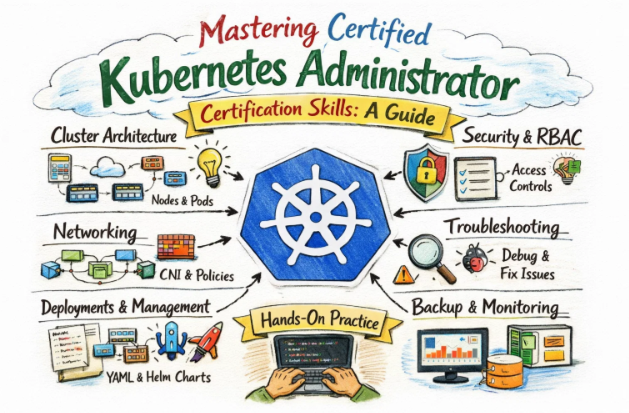
The topics are grouped into a few main areas:
- Cluster architecture, installation, and configuration.
- Workloads and scheduling.
- Services and networking.
- Storage.
- Troubleshooting.
Who Should Take the CKA Certification Training?
CKA is a good fit if you work with Kubernetes or want to move into roles that own Kubernetes platforms. It is especially useful for:
- DevOps Engineers and SREs who run container apps in production.
- Platform Engineers and Cloud Engineers who build and maintain shared clusters.
- System Administrators who are moving from traditional servers to Kubernetes.
- Engineering Managers who want a clear view of how clusters are installed and maintained.
You should have:
- Basic Linux and shell skills.
- Knowledge of containers (for example Docker).
- At least a basic idea of Kubernetes objects like pods, deployments, and services.
What You Will Learn in a CKA Training Course
A strong CKA training course covers all exam topics with step‑by‑step labs and real cluster work. You will learn:
- Cluster architecture and installation
- How the control plane and worker nodes work.
- How to install a cluster with kubeadm and manage certificates.
- Workloads and scheduling
- How to work with Pods, Deployments, ReplicaSets, DaemonSets, Jobs, and CronJobs.
- How to influence scheduling with node selectors, taints, tolerations, and affinity.
- Services and networking
- How to expose apps with ClusterIP, NodePort, LoadBalancer, and Ingress.
- Basics of CoreDNS and NetworkPolicies.
- Storage
- How to use Volumes, PersistentVolumes, PersistentVolumeClaims, StorageClasses, and dynamic provisioning.
- Troubleshooting
- How to debug issues with pods, nodes, and control plane components.
- How to use logs, events, and status commands to find and fix problems.
Real‑World Projects After CKA
Once you finish CKA training and pass the exam, you should be able to:
- Set up a Kubernetes cluster on virtual machines or cloud instances using kubeadm and add new worker nodes when needed.
- Deploy and scale a small microservices application using Deployments, Services, and Ingress.
- Configure storage so that stateful apps like databases can safely keep data using PVs and PVCs.
- Troubleshoot common production issues such as pods that keep crashing, DNS problems, or services that cannot talk to each other.
- Use namespaces, RBAC, and NetworkPolicies to create basic isolation between teams or environments.
CKA in the CNCF Certification Landscape
CKA is part of a larger CNCF certification family. Roughly, the stack looks like this:
- Entry level: KCNA / KCSA – basic cloud‑native and Kubernetes concepts.
- CKA: cluster administration, installation, and troubleshooting.
- CKAD: application design and development on Kubernetes.
- CKS: advanced security on Kubernetes.
Many people first complete CKA, then move to CKAD or CKS, because cluster admin skills create a strong base for both application and security work.
Certification Table – CKA and Related Tracks
| Track | Level | Who it’s for | Prerequisites (recommended) | Skills covered (summary) | Recommended order |
|---|---|---|---|---|---|
| Certified Kubernetes Administrator (CKA) Certification Training Course | Professional | Kubernetes admins, DevOps, SRE, platform engineers | Linux basics, containers, some Kubernetes knowledge | Cluster install and configuration, workloads, services & networking, storage, troubleshooting | First main Kubernetes certification |
| Certified Kubernetes Application Developer (CKAD) (reference) | Professional | Developers building microservices on Kubernetes | Kubernetes basics and some cluster usage | App design and deployment, config, observability, multi‑container patterns | Often after or with CKA |
| Certified Kubernetes Security Specialist (CKS) (reference) | Professional | Security engineers, DevSecOps specialists | Strong Kubernetes admin skills (CKA‑level) | Cluster and workload security, network security, runtime protection, supply chain security | After CKA for security‑focused roles |
Mini‑Guide: Certified Kubernetes Administrator (CKA)
What it is
The Certified Kubernetes Administrator (CKA) exam shows that you can manage Kubernetes in a real environment. You complete hands‑on tasks related to cluster setup, workloads, networking, storage, and troubleshooting inside a live cluster.
Who should take it
- DevOps Engineers, SREs, and Platform Engineers who own Kubernetes clusters.
- Cloud Engineers and System Administrators moving to container orchestration.
- Technical leads and managers who want confidence in Kubernetes decisions and designs.
Skills you’ll gain
- Plan and install Kubernetes clusters with kubeadm.
- Configure workloads, scheduling rules, and resource limits.
- Set up services, Ingress, and basic network policies.
- Configure and use persistent storage for stateful apps.
- Troubleshoot cluster, node, and pod issues with kubectl and logs.
Real‑world projects you should be able to do after it
- Build a multi‑node Kubernetes cluster on bare metal or cloud VMs and add/remove nodes as needed.
- Deploy a sample microservices application that uses services, ingress, and resource limits.
- Upgrade a cluster to a newer version with minimal impact and check that everything is healthy.
- Fix common issues such as broken deployments, misconfigured services, or failed nodes.
Preparation Plan for CKA
7–14 Day Plan – Fast Track
For people who already use Kubernetes every day:
- Days 1–2: Review the exam topics and mark which areas you feel less confident about.
- Days 3–6: Do short, focused labs only for weak areas (for example storage, NetworkPolicies, or cluster upgrades).
- Days 7–10: Take two or more timed mock exams; practise fast navigation, kubectl shortcuts, and YAML editing.
- Remaining days: Light review plus more troubleshooting practice under time pressure.
30 Day Plan – Working Professional
For people with basic Kubernetes experience:
- Week 1:
- Revise core objects: pods, deployments, services, namespaces.
- Learn or repeat cluster architecture and kubeadm installation steps.
- Week 2:
- Work on workloads and scheduling, including jobs, cronjobs, taints, tolerations, and affinity.
- Practise resource management (requests and limits).
- Week 3:
- Focus on services, DNS, ingress, and network policies.
- Study and practise storage concepts: PV, PVC, StorageClass.
- Week 4:
- Spend most time on troubleshooting labs: broken pods, failed nodes, and control plane issues.
- Take at least two timed practice exams and analyse all errors.
60 Day Plan – Deep‑Dive
For people new to Kubernetes or infrastructure:
- Weeks 1–2: Learn container basics and Kubernetes fundamentals using a local or managed cluster.
- Weeks 3–4: Study cluster architecture, kubeadm install, networking basics, and simple storage examples.
- Weeks 5–6: Deep‑dive each domain with repeated labs and full mock exams, focusing on speed and confidence.
Common Mistakes in CKA Preparation
- Watching videos only and doing very little practice in a terminal.
- Ignoring “small” topics like services or storage because they seem easy.
- Not practising in a time‑limited, exam‑like setup.
- Forgetting kubectl tricks, aliases, and autocomplete that save valuable time.
Best Next Certification After CKA
Based on common certification paths for software engineers and platform roles:
- Same track:
Certified Kubernetes Application Developer (CKAD) to focus more on application design and deployment. - Cross‑track:
Certified Kubernetes Security Specialist (CKS) to specialise in securing clusters and workloads. - Leadership:
cloud architect or platform architect certifications that help you design larger systems and talk to stakeholders confidently.
Choose Your Path: 6 Learning Paths Around CKA
DevOps path
In the DevOps path, CKA is your base Kubernetes skill. You combine it with cloud provider and CI/CD knowledge so you can design and run pipelines that deploy to Kubernetes safely and repeatably.
DevSecOps path
Here you pair CKA with security learning or CKS. You focus on building secure clusters, applying policies, scanning images, and making security checks part of the deployment flow.
SRE path
In the SRE path, CKA gives you a deep understanding of the platform where reliability work happens. You then apply SRE concepts like SLOs, error budgets, incident response, and capacity planning on top of Kubernetes.
AIOps/MLOps path
With this path, CKA supports running Kubernetes‑based data and ML systems. You combine it with data or ML certifications to run MLOps platforms where models, pipelines, and services all run on Kubernetes.
DataOps path
Many modern data tools run on Kubernetes. CKA helps you manage the cluster side, while DataOps skills focus on data pipelines and quality. Together, you can build data platforms that are both reliable and observable.
FinOps path
In the FinOps path, CKA helps you understand how cluster size, resource requests, and autoscaling impact cloud bills. When combined with FinOps training, you can help teams make better cost and capacity decisions.
Role → Recommended Certifications
| Role | Recommended certification flow (with CKA) |
|---|---|
| DevOps Engineer | Kubernetes basics → CKA → cloud DevOps/architect certification |
| SRE | Kubernetes basics → CKA → SRE/observability training and practical projects |
| Platform Engineer | Kubernetes basics → CKA → CKAD or cloud architect for broader platform design |
| Cloud Engineer | Cloud fundamentals → CKA → specialist cloud cert (AWS/Azure/GCP) |
| Security Engineer | Kubernetes basics → CKA → CKS and cloud security certifications |
| Data Engineer | Data platform basics → CKA (for platform) → data/analytics certification |
| FinOps Practitioner | Cloud fundamentals → CKA (for platform understanding) → FinOps/cost management programs |
| Engineering Manager | Cloud basics → CKA (high‑level view) → architecture/leadership oriented training |
Training Institutions for CKA Certification Training
- DevOpsSchool:
Offers a dedicated Certified Kubernetes Administrator (CKA) Certification Training Course with hands‑on labs, real exam‑style tasks, and support tailored to busy professionals and managers. - Cotocus:
Runs structured Kubernetes and DevOps programs where CKA is placed as a key admin milestone along with cloud and automation skills. - Scmgalaxy:
Focuses on real‑world DevOps and container practices, helping learners connect CKA topics with daily deployment and operations work. - BestDevOps:
Provides a mix of DevOps and cloud courses that can support CKA preparation as part of a wider career plan. - devsecopsschool.com:
Specialises in DevSecOps; good for learners who want to build on CKA with Kubernetes and container security. - sreschool.com:
Emphasises SRE topics like SLOs, incidents, and reliability, which align well with CKA‑level cluster skills. - aiopsschool.com: Focuses on AIOps and automation, where Kubernetes metrics and logs are key inputs.
- dataopsschool.com:
Aims at DataOps; helps people use Kubernetes safely as a base for data pipelines and analytics platforms. - finopsschool.com:
Teaches cloud cost and governance; CKA knowledge helps learners understand how cluster decisions affect spending.
FAQs – Certified Kubernetes Administrator (CKA) Certification Training Course
- Is the CKA exam very hard?
It is tough because it is fully hands‑on and timed, but with good practice and a clear plan, most motivated engineers can pass. - How much time should I plan for CKA preparation?
Many working professionals need between four and eight weeks, depending on their starting skills and how many hours they can study each week. - Do I need Kubernetes experience before taking a CKA course?
It helps to know the basics, but a good course usually includes a short intro to get you ready for deeper topics. - Should I do CKA before CKAD and CKS?
Most people find it easier to start with CKA, then move to CKAD or CKS, because admin skills make development and security topics easier to understand. - How does CKA help my career?
It proves that you can manage real Kubernetes clusters, which is a key skill for many DevOps, SRE, platform, and cloud roles. - Is CKA still useful if my company uses managed services like GKE, EKS, or AKS?
Yes, because the core Kubernetes concepts are the same, and you still need to understand how clusters and workloads behave. - Is CKA only for administrators, or also for developers?
It is mainly for admins and platform roles, but developers who handle deployments or want to move into DevOps/SRE also benefit a lot. - How is CKA different from multiple‑choice exams?
In CKA, you work in a real cluster and run commands to solve tasks, instead of just selecting answers from a list. - Why do some people fail CKA on the first try?
Common reasons include not enough practice in a terminal, slow typing or navigation, weak troubleshooting skills, and poor time management. - Does the CKA certification expire?
Yes, it is valid for a limited time and then you must renew it so that your certification stays current with the latest Kubernetes version. - Do employers recognise and value CKA?
CKA is widely known in the Kubernetes and cloud‑native world and is often mentioned in job descriptions for Kubernetes and platform roles. - Can I clear CKA by self‑study, or do I need a course?
Self‑study is possible, but many working professionals choose a structured course to save time, stay focused, and get ready more efficiently.
Conclusion
The Certified Kubernetes Administrator (CKA) Certification Training Course is a powerful way to show that you can handle real Kubernetes clusters, not just talk about them. It gives you the skills to install clusters, run workloads, keep them healthy, and fix problems under pressure. For engineers and managers in India and across the world, CKA is a strong base for DevOps, DevSecOps, SRE, AIOps/MLOps, DataOps, and FinOps careers and fits well into longer learning paths that combine Kubernetes, cloud, and security skills.
