
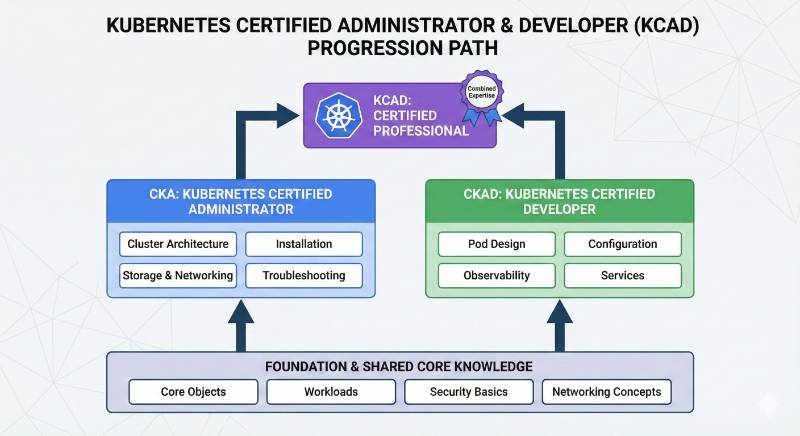
Kubernetes has become the operating system of the modern cloud. In my two decades in this industry, I have seen technologies come and go, but few have shifted the landscape as fundamentally as container orchestration. If you are a software engineer or an engineering manager today, “knowing” Kubernetes is no longer an optional skill—it is the baseline.
The Kubernetes Certified Administrator & Developer (KCAD) program is designed to bridge the gap between infrastructure management and application deployment. This guide serves as your master roadmap to understanding, preparing for, and mastering this certification to propel your career in the global market.
The Global Certification Landscape
To help you navigate the various options, here is a breakdown of the core certifications that define the current engineering standards.
Certification Comparison Table
| Track | Level | Who it’s for | Prerequisites | Skills Covered | Recommended Order |
| KCAD | Professional | Engineers & Managers | Linux Basics, Docker | Admin + Development | 1st (Core) |
| DSOCP | Advanced | Security Engineers | KCAD / CKA | DevSecOps, Security | 2nd (Cross-track) |
| SRECP | Professional | SREs | KCAD / CKA | Reliability, Scaling | 2nd (Cross-track) |
| DOCP | Professional | Data Engineers | Docker, Linux | Data Pipelines | 2nd (Cross-track) |
| MLOCP | Advanced | AI/ML Engineers | DataOps Basics | Model Deployment | 3rd (Specialized) |
Deep Dive: Kubernetes Certified Administrator & Developer (KCAD)
What it is
The KCAD is a comprehensive certification that combines the dual powers of cluster administration and cloud-native application development. It validates your ability to not only build and manage a Kubernetes cluster but also to deploy, scale, and troubleshoot the applications running inside it.
Who should take it
This is the “gold standard” for DevOps engineers, platform engineers, and senior software developers. It is also highly recommended for engineering managers who need to understand the technical constraints of the platforms their teams use daily.
Skills you’ll gain
- Cluster Orchestration: Installing and configuring production-ready clusters.
- Workload Management: Master Pods, Deployments, StatefulSets, and DaemonSets.
- Networking & Services: Configuring Ingress, Load Balancers, and Network Policies.
- Storage Excellence: Managing Persistent Volumes (PV) and Claims (PVC).
- Security & RBAC: Implementing Role-Based Access Control and Secret Management.
- Observability: Setting up logging, monitoring, and health checks.
Real-world projects you should be able to do after it
- Build a highly available Kubernetes cluster from scratch on any cloud provider.
- Migrate a legacy monolithic application into a microservices-based containerized environment.
- Implement a full-scale CI/CD pipeline that deploys code directly to Kubernetes namespaces.
- Debug and resolve production-level node failures and networking bottlenecks.
Preparation Plan
7–14 Days (The Expert Sprint)
- Day 1-3: Focus on
kubectlimperative commands for speed. - Day 4-7: Practice manual cluster bootstrapping and networking scenarios.
- Day 8-14: High-intensity mock exams focusing on troubleshooting and recovery.
30 Days (The Standard Professional Path)
- Week 1: Kubernetes Fundamentals and Architecture.
- Week 2: Workloads, Scheduling, and Storage.
- Week 3: Networking, Security, and RBAC.
- Week 4: Full-length labs and practice exams.
60 Days (The Comprehensive Learning Path)
- Month 1: Focus on Linux internals, Docker containers, and YAML basics.
- Month 2: Deep dive into each Kubernetes component with hands-on labs every weekend.
Common Mistakes
- Over-reliance on UI: The exam and real-world work happen in the terminal. Master the CLI.
- Ignoring Networking: Most production issues are networking issues. Don’t skip CNI and Ingress.
- Poor Time Management: Practice doing tasks under a timer to build muscle memory.
Best next certification after this
After earning your KCAD, I strongly recommend pursuing the DevSecOps Certified Professional (DSOCP) to add a much-needed layer of security expertise to your technical profile.
Choose Your Path: 6 Learning Roadmaps
Depending on your career goals, Kubernetes serves as the foundation for these specialized paths:
- DevOps Path: Focuses on the “continuous” everything—integration, delivery, and deployment.
- DevSecOps Path: Integrates security tools (SAST/DAST) and compliance directly into the Kubernetes lifecycle.
- SRE Path: Focuses on SLIs/SLOs, error budgets, and maintaining 99.99% uptime using automation.
- AIOps/MLOps Path: Uses Kubernetes (and tools like Kubeflow) to manage the heavy compute needs of AI models.
- DataOps Path: Orchestrates complex data pipelines and databases using Kubernetes Operators.
- FinOps Path: Focuses on resource optimization, requests/limits, and cost-visibility within clusters.
Role → Recommended Certifications Mapping
| Your Current/Target Role | Recommended Certification Journey |
| DevOps Engineer | KCAD → Certified DevOps Professional (CDP) |
| SRE | KCAD → SRE Certified Professional (SRECP) |
| Platform Engineer | KCAD → Master in DevOps Engineering (MDE) |
| Security Engineer | KCAD → DevSecOps Certified Professional (DSOCP) |
| Data Engineer | KCAD → DataOps Certified Professional (DOCP) |
| FinOps Practitioner | KCAD → Certified FinOps Professional |
| Engineering Manager | KCAD → DevOps Foundation for Managers |
Top Institutions for KCAD Training & Certifications
Choosing where to invest your time for training is a critical decision. Based on industry reputation and curriculum depth, here are the top institutions that provide specialized support for the Kubernetes Certified Administrator & Developer (KCAD) program:
- DevOpsSchool
This is a premier institution known for its “80% Practical, 20% Theory” methodology. They provide comprehensive, instructor-led training with lifetime access to an extensive library of recorded sessions and lab environments specifically designed for Kubernetes mastery. - Cotocus
Cotocus offers a boutique, consultancy-led training experience where the instructors are active industry practitioners. Their curriculum is deeply rooted in real-world scenarios, helping students understand not just the “how” of Kubernetes, but the “why” behind complex architectural decisions. - Scmgalaxy
A community-centric platform that has been a staple in the software configuration management world for years. They offer a wealth of free and premium resources, focusing heavily on the integration of Kubernetes within the broader DevOps and SCM lifecycle. - BestDevOps
This institution focuses on high-velocity automation and the practical application of Kubernetes in modern CI/CD pipelines. Their training is geared toward engineers who want to move into senior platform roles by mastering the intersection of orchestration and automation. - devsecopsschool.com
The go-to destination for those wanting to specialize in the security layer of Kubernetes. They focus on hardening clusters, implementing automated security scanning, and ensuring that your KCAD skills are backed by robust DevSecOps principles. - sreschool.com
Dedicated to Site Reliability Engineering, this school teaches how to use Kubernetes to achieve high availability and reliability. They focus on monitoring, logging, and chaos engineering within the Kubernetes ecosystem. - aiopsschool.com
This institution bridges the gap between Artificial Intelligence and Operations. Their training focuses on running complex ML workloads and data science pipelines on Kubernetes clusters using tools like Kubeflow. - dataopsschool.com
Focused on the data professional, this school teaches how to manage stateful applications and large-scale data processing engines (like Spark and Kafka) using Kubernetes Operators and Persistent Storage. - finopsschool.com
As cloud costs continue to rise, this school provides essential training on managing the financial aspects of Kubernetes. They focus on resource optimization, pod-level cost visibility, and building a culture of financial accountability in engineering teams.
Next Certifications to Take
After completing your KCAD, I recommend exploring these three distinct directions to further your career:
- Same Track (Advanced Mastery): Master in DevOps Engineering (MDE). This is the ultimate “black belt” for those who want to be architects.
- Cross-Track (Broadening Skills): DevSecOps Certified Professional (DSOCP). In today’s threat landscape, an engineer who doesn’t understand security is a liability.
- Leadership (Career Growth): Certified DevOps Manager (CDM). Perfect for those looking to move into people management or strategic technical leadership.
FAQs: Kubernetes Certified Administrator & Developer (KCAD)
1. How difficult is the KCAD exam?
It is considered a medium-to-hard level exam because it is performance-based. You aren’t just answering multiple-choice questions; you are solving real problems in a live terminal.
2. How much time do I need to prepare?
For someone with basic Linux experience, 30 to 60 days of consistent study (1-2 hours a day) is usually sufficient.
3. Are there any prerequisites?
While there are no official prerequisites, you should be comfortable with Linux command-line basics and understand how Docker containers work.
4. What is the validity of the certification?
The certification is typically valid for 2 to 3 years. Given how fast Kubernetes evolves, staying updated is essential.
5. Can I take the exam from home?
Yes, it is a proctored online exam. You will need a stable internet connection, a webcam, and a quiet room.
6. Does KCAD help in getting a salary hike?
Absolutely. Kubernetes expertise is one of the highest-paying skills in the current IT market in India and globally.
7. Is it better to do CKA or KCAD?
KCAD is designed to be a “Super-Set” that covers both administration (CKA) and development (CKAD) aspects, making it more versatile for modern engineers.
8. What happens if I fail the first attempt?
Most official programs, including those through DevOpsSchool, offer a free retake or additional support to ensure you pass on your next try.
9. Is this certification recognized globally?
Yes, Kubernetes certifications are the industry standard worldwide, from startups in Bangalore to tech giants in Silicon Valley.
10. Do I need to know a programming language?
While you don’t need to be a coding expert, being comfortable with YAML and basic shell scripting is mandatory.
11. How does KCAD impact my role as a Manager?
It gives you the technical depth to estimate timelines accurately, understand infrastructure costs, and lead your team through complex migrations.
12. Can I use documentation during the exam?
Yes, you are typically allowed to access the official Kubernetes documentation during the performance-based test.
FAQs: Kubernetes Certified Administrator & Developer (KCAD)
1. Is Kubernetes certification still worth it in 2026?
Absolutely. While many tools come and go, Kubernetes has become the “Linux of the Cloud.” It is the standard platform for almost all modern software. Having a certification like KCAD proves to employers that you don’t just know the theory—you have the hands-on skills to keep production systems running.
2. Which is better for my career: CKA, CKAD, or KCAD?
It depends on your goal. CKA is for those managing the hardware and cluster health (Ops). CKAD is for those writing and deploying the code (Dev). KCAD is the “super-set” designed for the modern DevOps/SRE professional who needs to do both. For a well-rounded career, KCAD offers the best ROI.
3. How does this certification impact my salary?
In the global market, and specifically in tech hubs like India, Kubernetes-certified professionals often command 20% to 35% higher salaries than their non-certified peers. It acts as a fast-pass through HR filters for high-paying SRE and Platform Engineering roles.
4. Can I jump straight into KCAD without prior experience?
Technically, yes, there are no “hard” prerequisites. However, I highly recommend having a basic grasp of Linux command line and Docker containers first. Trying to learn Kubernetes without knowing how a container works is like trying to learn to fly a plane before you can drive a car.
5. How long does the exam result take?
Typically, you will receive your results via email within 24 hours of completing the exam. The proctors and the automated grading system need that time to verify your performance-based solutions.
6. Is the exam multiple-choice?
No, and that is why it is so respected. It is 100% performance-based. You are given a live terminal and a set of real-world problems (e.g., “A pod is failing in Namespace X; find out why and fix it”). There is no guessing; you either know the command or you don’t.
7. Can I use the internet during the exam?
You cannot browse the general web, but you are allowed one extra tab to access the official Kubernetes documentation. Mastering how to search the official docs is a key part of your preparation.
8. What happens if I fail the first attempt?
Don’t panic—many top engineers don’t pass on the first try due to the strict time limits. Most registration fees (including those through DevOpsSchool) include one free retake. Use the first attempt as a “reconnaissance mission” to see where your weak points are.
Conclusion
In my journey through the IT landscape, I have seen many tools come and go. However, Kubernetes has proven itself to be the bedrock of modern engineering. The Kubernetes Certified Administrator & Developer (KCAD) is more than just a credential; it is a signal to the global market that you can handle the complexities of production-grade systems.
Whether you are an engineer looking to level up or a manager aiming to lead a high-performing team, mastering Kubernetes is the most impactful step you can take today. The path is challenging, but with the right preparation and a hands-on mindset, it is entirely achievable.
