
Introduction
Private jet charter allows travelers to arrange an aircraft for a specific journey without owning a private jet.
The process involves selecting a route, identifying a suitable aircraft, reviewing a quotation, and confirming the travel arrangements.
Unlike commercial airline travel, charter flights can offer greater scheduling flexibility and access to a wider range of airports.
Understanding each stage of the process helps first-time travelers know what to expect before booking a private flight.
What Is Private Jet Charter?
Private jet charter is the arrangement of an aircraft for a particular trip or itinerary. Instead of buying an individual seat on a scheduled airline, the traveler or group arranges the use of an aircraft for their journey.
A charter flight is operated by a flight crew and must comply with applicable aviation regulations and operational requirements.
Private jet charter is different from private jet ownership. An aircraft owner is responsible for the aircraft’s purchase, maintenance, crew, storage, insurance, and other operating requirements. A charter customer generally pays for access to an aircraft for a particular journey without taking ownership of it.
It is also different from fractional ownership, where multiple parties have an ownership interest in an aircraft or aircraft program.
Who Can Use a Private Jet Charter?
Private charter can be used by different types of travelers depending on their travel requirements and budget.
Business Travelers
Business travelers may consider charter when they need to visit multiple locations, have limited scheduling flexibility, or need to travel with a group.
Families
Families may value the privacy and scheduling flexibility associated with charter travel. Requirements involving children, pets, or special baggage should be communicated before the aircraft is selected.
Groups
A private aircraft can allow a group to travel together instead of purchasing separate seats on a commercial flight.
Leisure Travelers
Private charter can also be considered for vacations, special occasions, or destinations where commercial flight schedules are inconvenient.
Travelers Visiting Less-Connected Destinations
Some private aircraft can operate from airports that do not have regular commercial airline service. However, airport suitability depends on the aircraft, runway, weather, airport facilities, and applicable restrictions.
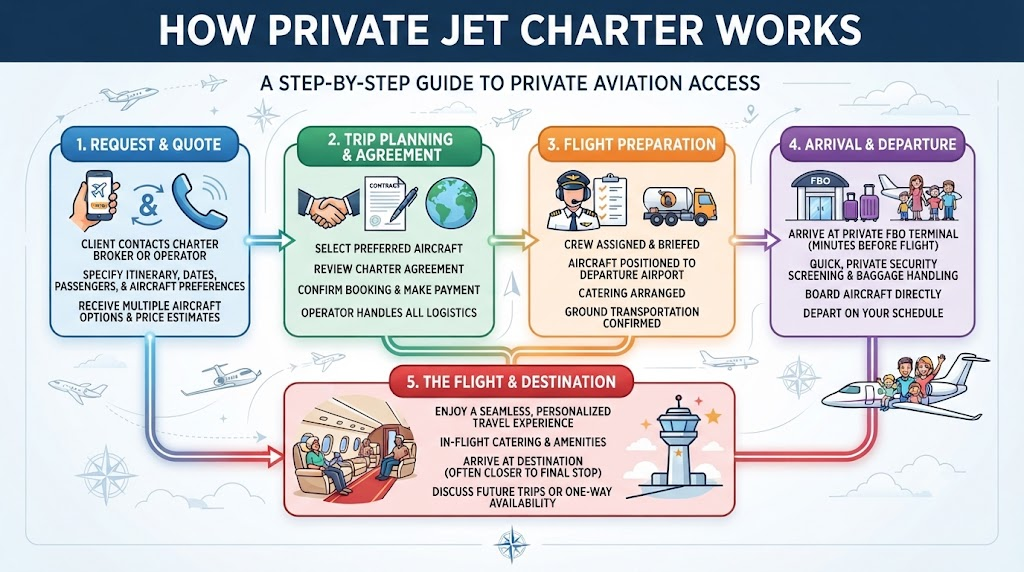
How Private Jet Charter Works Step by Step
The charter process can vary depending on the operator, route, country, and type of journey. However, most charter arrangements follow several basic stages.
Step 1: Determine the Travel Requirements
The first step is to establish exactly what the journey requires.
A traveler will normally need to provide information such as:
- Departure location
- Destination
- Travel date
- Preferred departure time
- Number of passengers
- Baggage requirements
- One-way or round-trip preference
- Special passenger requirements
The more accurate the information, the easier it is to identify suitable aircraft and travel options.
For example, a charter for two passengers traveling a short domestic route will have very different aircraft requirements from a long-distance international trip involving eight passengers and substantial baggage.
Step 2: Find a Suitable Charter Option
Once the travel requirements are known, suitable aircraft and itineraries can be considered.
Aircraft availability is an important part of this process. The preferred aircraft may not be available at the requested location or time.
Airport selection also matters. A private aircraft may have access to airports that are not commonly used by commercial airlines, but this does not mean every private jet can operate from every airport.
Runway characteristics, aircraft performance, airport operating hours, weather, navigation facilities, and other factors must be considered.
Step 3: Select the Aircraft
Private jets come in different sizes and configurations.
The aircraft should be selected according to the actual requirements of the trip rather than simply choosing the largest aircraft available.
Important factors include:
Passenger Capacity
The aircraft needs to accommodate all passengers comfortably while remaining within its certified operating limitations.
Range
The aircraft must have suitable range capability for the intended journey, considering operational requirements and possible weather or routing factors.
Cabin Size
A larger cabin may be more comfortable for longer flights, particularly when passengers need additional space.
Baggage Capacity
Baggage requirements should be discussed before selecting the aircraft. Large or unusual items may require additional planning.
Airport Compatibility
The aircraft must be suitable for the intended airports and operating conditions.
Budget
The aircraft should provide the required capability without paying for unnecessary capacity.
Types of Private Jets Used for Charter
Different aircraft categories are used for different travel requirements.
Very Light Jets
Very light jets are designed for smaller passenger groups and shorter journeys. Their compact size can make them appropriate for certain regional routes.
Light Jets
Light jets generally provide more cabin space and range than very light jets. They are often considered for short- and medium-distance journeys.
Midsize Jets
Midsize jets generally offer larger cabins and greater range. They can be useful for longer domestic trips and certain international routes.
Super Midsize Jets
Super midsize aircraft combine a relatively spacious cabin with longer-range capability. They may be suitable for larger groups or longer journeys.
Heavy Jets
Heavy jets generally provide larger cabins, greater passenger capacity, and longer range. They can be appropriate for extended journeys and larger groups.
Long-Range Jets
Long-range aircraft are designed for extended flights and can provide larger cabins and additional features intended for long-distance travel.
Aircraft specifications vary by model, so these categories should be treated as general guidelines rather than fixed specifications.
Step 4: Receive a Charter Quotation
After the route and aircraft requirements are established, a charter quotation can be prepared.
Private jet pricing is influenced by several factors rather than simply the number of passengers.
A quotation may take into account:
- Aircraft type
- Flight distance
- Flight duration
- Aircraft positioning
- Fuel requirements
- Crew expenses
- Airport charges
- Handling fees
- Parking
- Overnight requirements
- Seasonal demand
- Aircraft availability
The quoted price should therefore be evaluated as part of the complete itinerary.
Travelers should understand what is included and whether certain expenses may be charged separately.
Step 5: Review the Charter Terms
Before confirming the booking, travelers should carefully review the applicable terms.
Important areas include:
- Total estimated cost
- Payment conditions
- Cancellation policy
- Rescheduling rules
- Aircraft details
- Baggage limitations
- Passenger requirements
- Possible additional charges
This step is especially important for first-time charter travelers because private flight arrangements can involve different terms from conventional airline tickets.
Step 6: Confirm Passenger Information
Accurate passenger information is required for flight planning and applicable security or regulatory procedures.
Travelers may need to provide identification information and other documentation depending on the journey.
International travel can involve additional requirements relating to passports, visas, customs, immigration, and entry regulations.
Passenger information should be checked carefully before the flight.
Step 7: Confirm the Flight
Once the quotation and terms have been accepted and the required booking procedures have been completed, the flight can be confirmed.
The traveler should have clear information about:
- Aircraft
- Departure airport
- Arrival airport
- Departure time
- Passenger details
- Baggage arrangements
- Ground transportation
- Required documentation
The final itinerary should be reviewed before departure.
Step 8: Prepare for Departure
Private aviation departure procedures can differ from those at a large commercial airline terminal.
Many private flights use dedicated passenger facilities, including fixed-base operator facilities. The exact procedure depends on the airport and operation.
Before traveling, passengers should confirm:
- Exact departure location
- Recommended arrival time
- Parking or transportation arrangements
- Identification requirements
- Baggage procedures
- Security requirements
Although private aviation can provide a more streamlined airport experience, passengers still need to comply with applicable security and aviation procedures.
Step 9: Boarding and Flight
Once passengers arrive at the appropriate facility and complete the required procedures, they can proceed toward the aircraft.
Baggage is loaded according to the aircraft’s limitations. Passengers then board and receive the required safety information.
During the flight, the aircraft operates according to the approved flight plan and applicable operational requirements.
Private charter does not eliminate normal aviation considerations. Weather, air traffic, airport restrictions, aircraft performance, and other factors can influence the operation.
Step 10: Arrival and Disembarkation
After landing, passengers leave the aircraft and collect their baggage.
For domestic travel, the process may be relatively straightforward, depending on the airport.
International travel can involve customs, immigration, and other border-control procedures.
Ground transportation can then take passengers to their final destination if it has been arranged.
Private Jet Charter Process: A Practical Example
Consider a fictional example involving four passengers traveling from one Indian city to another for a business meeting.
First, the group provides the departure location, destination, preferred travel date, number of passengers, and baggage requirements.
The charter provider reviews the requirements and identifies suitable aircraft options.
The group compares the aircraft based on range, cabin size, passenger capacity, schedule, airport suitability, and overall cost.
After receiving a quotation, the travelers review what is included and clarify any potential additional charges.
Once the terms are accepted, the passenger information and required documents are submitted.
The departure facility and reporting instructions are then confirmed.
On the travel day, the passengers arrive at the specified private aviation facility, complete the required procedures, board the aircraft, and begin the journey.
After landing, they collect their baggage and continue to their final destination.
This example demonstrates that private jet charter is not simply a matter of arriving at an airport and boarding an aircraft. Planning, aircraft selection, documentation, operational requirements, and itinerary confirmation are all important parts of the process.
What Determines the Cost of a Private Jet Charter?
Private charter pricing can vary considerably between different journeys.
Aircraft Type
Larger aircraft generally have higher operating costs. However, choosing a smaller aircraft that cannot adequately serve the route or passenger requirements is not necessarily economical.
Flight Distance
Longer flights generally require more flight time and fuel.
Flight Duration
Aircraft and crew costs can be affected by the amount of time required to operate the journey.
Positioning
An aircraft may need to travel to the passenger’s departure airport before the charter. It may also need to reposition after the passengers arrive at their destination.
These movements can influence the overall price.
Airport Charges
Landing, handling, parking, and other airport-related expenses may contribute to the total cost.
Crew Requirements
Longer or more complex trips can require additional crew arrangements or overnight expenses.
Seasonal Demand
Demand for private aircraft can change during holidays, major events, and periods of increased business or leisure travel.
For this reason, travelers should consider the complete quotation rather than comparing only a basic hourly rate.
One-Way and Round-Trip Charter
A one-way charter takes passengers from one location to another without including a scheduled return journey.
A round-trip charter includes both outbound and return travel.
One-way charter pricing is not necessarily half the price of a round trip. The aircraft may need to reposition after completing the passenger journey.
A round trip may sometimes be operationally convenient when the aircraft remains available for the return journey, but this depends on the specific itinerary and aircraft schedule.
Empty-Leg Charter Explained
An empty-leg flight occurs when an aircraft needs to travel without passengers as part of its positioning requirements.
For example, an aircraft may carry passengers from City A to City B and then need to return to City A for another scheduled journey. The return flight may potentially be available as an empty-leg charter.
Empty-leg flights can sometimes be offered at lower prices, but they generally provide less flexibility.
The traveler may have to accept:
- A predetermined route
- A specific departure time
- Limited availability
- Short-notice scheduling
- Possible changes based on the aircraft’s operational requirements
Empty legs can therefore be useful when the traveler’s plans happen to match the aircraft’s positioning schedule.
Private Jet Charter vs. Commercial Air Travel
Private charter and commercial aviation serve different purposes.
| Factor | Private Jet Charter | Commercial Airline |
|---|---|---|
| Scheduling | Greater flexibility based on aircraft availability | Based on published schedules |
| Airport Access | May use additional airports | Generally limited to airline network |
| Privacy | Private cabin for the charter group | Shared cabin |
| Boarding | Often through private aviation facilities | Commercial airline terminal procedures |
| Baggage | Depends on aircraft capacity | Airline baggage policies apply |
| Cost | Generally higher | Generally lower per passenger |
| Group Travel | Aircraft can be arranged for the group | Individual seats are purchased |
| Experience | More customizable | More standardized |
The right option depends on the passenger’s priorities, budget, schedule, destination, and group size.
Common Mistakes When Booking a Private Jet Charter
1. Providing Incomplete Travel Information
Incomplete information about passengers, baggage, or travel timing can make it difficult to identify an appropriate aircraft.
2. Choosing an Aircraft Based Only on Price
The lowest-priced aircraft may not have the required range, baggage capacity, or cabin space.
3. Ignoring Additional Charges
Travelers should understand whether airport, handling, positioning, or other operational charges are included.
4. Not Checking Baggage Restrictions
Private aircraft still have weight and space limitations. Special equipment and oversized baggage should be declared in advance.
5. Assuming Every Airport Is Suitable
Aircraft performance and airport conditions determine whether a particular airport can be used.
6. Failing to Review Cancellation Terms
Travel plans can change. Understanding the applicable cancellation and rescheduling conditions before confirming the charter is important.
7. Not Confirming the Departure Facility
Private flights may use a facility different from the main commercial terminal. Passengers should verify the exact location in advance.
8. Providing Incorrect Passenger Information
Incorrect documentation or passenger details can cause avoidable problems, particularly on international journeys.
9. Ignoring Operational Considerations
Private aviation remains affected by weather, air traffic, airport restrictions, and other operational factors.
10. Focusing Only on Luxury
A private jet should be evaluated based on practical requirements such as aircraft suitability, safety standards, route, scheduling, baggage, and cost.
Important Safety and Operational Considerations
Understanding the booking process is important, but travelers should also pay attention to safety and operational matters.
Operator Credentials
Travelers should understand who is responsible for operating the aircraft and whether the operation meets applicable aviation requirements.
Aircraft Maintenance
Aircraft are subject to maintenance requirements. Travelers can ask appropriate questions about the aircraft and operator when evaluating a charter.
Pilot Qualifications
Flight crews should hold the qualifications and ratings required for the aircraft and operation.
Insurance
Appropriate aviation insurance is an important part of charter operations. Travelers may ask what coverage applies to their journey.
Aviation Regulations
Private charter operations remain subject to aviation regulations. Requirements vary according to the country, route, aircraft, and type of operation.
Weather
Weather can affect departure times, routing, airport selection, and flight operations. Private charter does not remove these limitations.
Air Traffic and Airport Restrictions
Air traffic congestion, runway conditions, airport operating hours, temporary restrictions, and other factors can influence a flight.
Key Stages of the Private Jet Charter Process
| Charter Stage | What Happens | What the Traveler Needs to Provide or Check |
|---|---|---|
| Travel Planning | Route and schedule are established | Dates, locations, passengers, baggage |
| Aircraft Selection | Suitable aircraft options are identified | Capacity, range, cabin, baggage |
| Quotation | Estimated charter cost is prepared | Included services and possible extra charges |
| Terms Review | Booking conditions are examined | Payment, cancellation, and rescheduling terms |
| Passenger Confirmation | Passenger information is submitted | Identification and required travel documents |
| Flight Confirmation | Aircraft and itinerary are finalized | Departure location, schedule, aircraft |
| Departure Preparation | Passenger instructions are provided | Arrival time, facility, documents |
| Boarding | Passengers complete departure procedures | Security and baggage requirements |
| Flight | Aircraft operates the planned journey | Follow crew instructions |
| Arrival | Passengers disembark and collect baggage | Customs or immigration where applicable |
Important Questions to Ask Before Booking
Before confirming a charter, first-time passengers should ask clear questions about the complete journey.
What Aircraft Will Operate the Flight?
Knowing the aircraft category and configuration helps travelers understand the expected cabin space, capacity, and baggage capability.
Is the Aircraft Suitable for the Route?
The aircraft should have appropriate range and performance characteristics for the planned journey.
What Is Included in the Quoted Price?
Travelers should understand the services and operational expenses included in the quotation.
Can Additional Charges Apply?
Ask about airport fees, handling, positioning, overnight expenses, and other potential charges.
What Baggage Restrictions Apply?
Confirm weight, size, and special-item limitations before traveling.
Which Airport and Facility Will Be Used?
Confirm the exact departure and arrival airports and the passenger facility.
What Documents Are Required?
Documentation requirements vary by route. International travel may require passports, visas, and other documents.
What Happens If the Flight Is Delayed?
Ask how operational delays, weather disruptions, or schedule changes are handled.
What Are the Cancellation Conditions?
Review the applicable cancellation and rescheduling terms before making a commitment.
What Safety and Operational Information Is Available?
Travelers should be able to understand the relevant operator and aircraft information before confirming a charter.
What Happens on the Day of the Flight?
The experience on departure day generally begins with reaching the correct airport facility.
Passengers should first confirm the exact location and recommended arrival time. Private aviation facilities may be separate from the main commercial terminal.
After arriving, passengers complete the applicable identification, security, and documentation procedures. Baggage is checked or handled according to the aircraft’s requirements.
Passengers then proceed to the aircraft, complete the boarding process, and receive the required safety briefing.
Once the aircraft departs, the flight proceeds according to its operational plan. Weather, air traffic, and airport conditions can affect the actual flight.
At the destination, passengers disembark and collect their baggage. International passengers may need to complete customs and immigration procedures before continuing their journey.
Frequently Asked Questions
1. How does private jet charter work?
Private jet charter involves arranging an aircraft for a specific journey. The process generally includes defining the itinerary, selecting a suitable aircraft, reviewing a quotation, confirming passenger information, completing booking requirements, and taking the flight.
2. What information is needed to book a private jet?
Travelers normally need to provide the departure location, destination, travel date, preferred time, passenger count, baggage requirements, and any special travel requirements.
3. How is a private jet selected for a charter?
The aircraft is generally selected according to passenger capacity, route distance, range, cabin space, baggage requirements, airport suitability, availability, and budget.
4. How is private jet charter pricing calculated?
Pricing can depend on aircraft type, flight distance, duration, positioning, fuel, crew, airport charges, handling, demand, and other operational expenses.
5. Can I choose my departure time?
Private charter generally provides more scheduling flexibility than commercial airline travel, but the actual departure time depends on aircraft availability, airport restrictions, crew requirements, weather, and air traffic conditions.
6. Can private jets use smaller airports?
Many private aircraft can use airports that do not have regular commercial airline service. However, airport suitability depends on aircraft performance, runway characteristics, weather, airport facilities, and operational restrictions.
7. What is an empty-leg private jet flight?
An empty-leg flight is typically a repositioning flight in which an aircraft travels without passengers. It may sometimes be offered at a lower price but usually provides less flexibility regarding route and schedule.
8. What documents are needed for private jet travel?
Requirements depend on the journey. Domestic travel may require suitable identification, while international travel can require passports, visas, customs documentation, and immigration-related documents.
9. What happens on the day of a private charter flight?
Passengers typically arrive at the specified private aviation facility, complete required procedures, provide or verify documentation, handle baggage, board the aircraft, and receive the necessary safety information before departure.
10. What should a first-time charter passenger check before booking?
A first-time traveler should check the aircraft, route, total cost, baggage restrictions, airport arrangements, operator information, cancellation terms, passenger documentation, and relevant safety and operational considerations.
Conclusion
Private jet charter is a structured process that begins with defining travel requirements and ends with passengers arriving at their destination. Aircraft selection, pricing, passenger information, airport arrangements, documentation, and operational planning all play important roles.
For first-time travelers, the key is to look beyond the idea of simply hiring a private aircraft. A successful charter requires choosing an appropriate aircraft, understanding the complete cost, reviewing the booking terms, confirming airport arrangements, and preparing the necessary documents.
With a clear understanding of how each stage works, travelers can approach private jet charter with realistic expectations and make more informed decisions about their journey.
